Before it was a park, this was where the Inquisition burned heretics. The Alameda Central — Mexico City’s oldest public park and one of the oldest in the Americas, dating to 1592 — sits on ground that was once the Quemadero, the site where the Holy Office of the Inquisition carried out its auto-da-fe executions. Today it’s full of poplar trees, fountains, families, and people eating corn on the cob from street vendors. Mexico City has a talent for turning dark history into pleasant afternoon strolls.
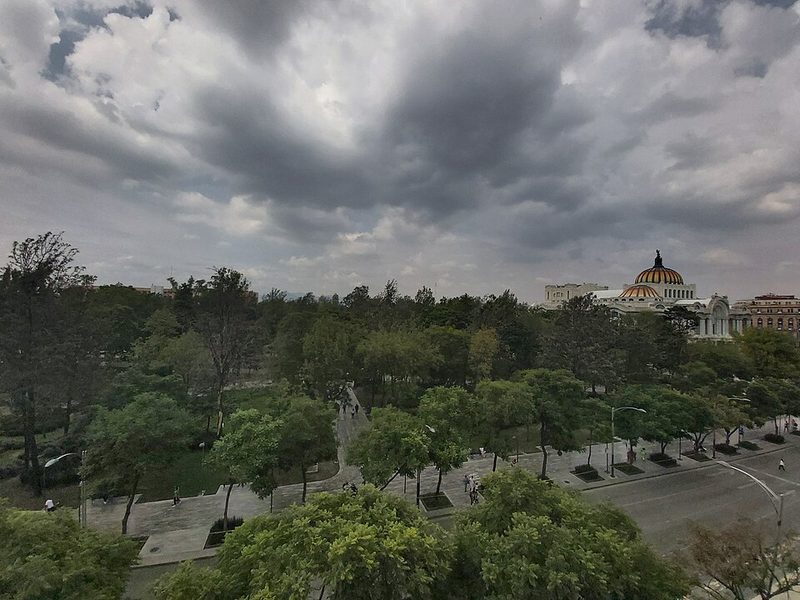
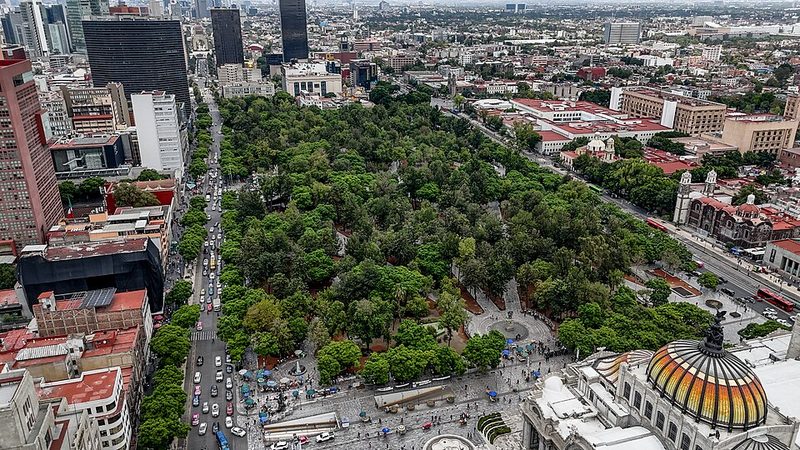
The park stretches between the Historic Center and Paseo de la Reforma, bordered on its east side by the Palace of Fine Arts — arguably the most beautiful building in the country. It’s a natural pause point between the colonial core and the Reforma corridor, and it’s been serving that role for over four centuries.
Four Hundred Years of Public Space
Viceroy Luis de Velasco II ordered the park’s creation in 1592, making it a contemporary of some of the oldest public gardens in Europe. The name comes from the alamos (poplar trees) that were originally planted throughout. It was initially much smaller than the current footprint and was, for its first two centuries, reserved for the upper classes.
The park expanded over time, absorbing the former Quemadero grounds after the Inquisition wound down. In the 18th century, Viceroy Carlos Francisco de Croix had it redesigned with fountains, walkways, and European-style gardens. The park became a fashionable promenade — the place where Mexico City’s colonial elite went to see and be seen.
The 19th century brought more changes. After independence, the park was opened to all social classes, though segregation by race and wealth persisted informally. Emperor Maximilian and President Porfirio Diaz both invested in renovations, adding the gas lamps, iron benches, and sculpture that gave the park much of its current character.
The most significant addition came in 1910, when the Hemiciclo a Juarez was inaugurated on the park’s southern edge — a white marble semicircular monument honoring Benito Juarez, Mexico’s most celebrated liberal president. It’s still the park’s visual anchor and a popular meeting point.
What’s in the Park
Hemiciclo a Juarez
The large white marble monument on the southern side of the park is dedicated to Benito Juarez, the Zapotec-born president who led the liberal reform movement, resisted the French invasion, and established the separation of church and state in Mexico. The hemicycle (half-circle) was designed by Guillermo de Heredia and inaugurated in 1910 by Porfirio Diaz — who had been Juarez’s military ally before becoming his political opposite.
The monument is a gathering spot, especially on Sunday mornings. Street performers, photographers, and food vendors cluster around it. It’s also the traditional starting point for political marches heading east toward the Zocalo.
Fountains and Sculptures
The Alameda has several fountains scattered among its pathways, the most notable being a central fountain with a Venus figure and smaller fountains at various intersections. Bronze and stone sculptures dot the walkways — allegorical figures, angels, mythological subjects. None are individually famous, but collectively they give the park a 19th-century European feel that contrasts pleasantly with the surrounding city chaos.
The Trees
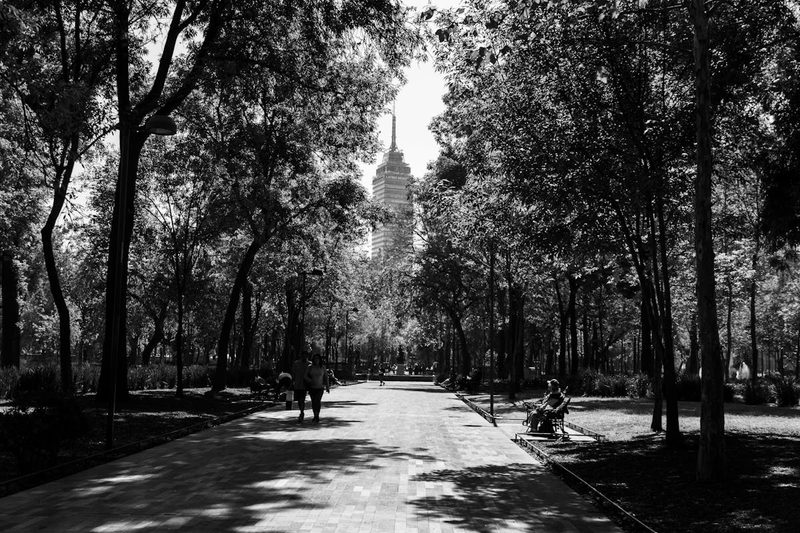
The park’s canopy is its best feature. Mature trees — poplars, ash, evergreens — create a green ceiling that filters the sunlight and makes the air noticeably cleaner than the surrounding streets. In a city where green space is aggressively competed for, the Alameda’s tree cover is genuine luxury. During the rainy season (June through October), the park is lush to the point of being almost tropical.
What’s Around the Alameda
The park’s surroundings are as important as the park itself.
Palace of Fine Arts (East Side)
The Palacio de Bellas Artes stands immediately east of the Alameda, its white marble facade and Art Nouveau/Art Deco design making it the most photographed building in Mexico City. It houses murals by Diego Rivera, David Alfaro Siqueiros, and Jose Clemente Orozco, among others. The building alone is worth crossing the city for. It was designed by the same architect (Adamo Boari) who built the Postal Palace a block to the northeast.
Postal Palace (Northeast)
The Palacio de Correos is a block northeast of the Alameda — an Italianate postal palace that’s still a functioning post office. Walk from the Alameda to Fine Arts to the Postal Palace and you’ve covered three of the most architecturally impressive buildings in the city in about ten minutes.
Diego Rivera Mural Museum (South Side)
The Museo Mural Diego Rivera, on the south side of the Alameda, houses one specific work: Rivera’s famous mural “Dream of a Sunday Afternoon in Alameda Central.” The mural was originally painted in the Hotel del Prado across the street, which was destroyed in the 1985 earthquake. The mural was carefully extracted and given its own museum. It depicts four centuries of Mexican history as a Sunday stroll through the Alameda, with Rivera himself appearing as a child holding the hand of La Catrina (the skeleton lady in the fancy hat who has become Mexico’s Day of the Dead icon). It’s one of Rivera’s most accessible works and directly connects to where you’re standing.
Torre Latinoamericana (Southeast)
A block southeast of the Alameda, the Torre Latinoamericana was Latin America’s tallest building when it opened in 1956 and still offers observation deck views from the 44th floor. It’s a good complement to a park visit — ground-level gardens followed by a bird’s-eye view of the city.
The Alameda Today
On weekday mornings, the Alameda is quiet — dog walkers, joggers, office workers taking shortcuts. By afternoon, the benches fill with people eating lunch, reading, or napping in the shade. The informal economy sets up around the perimeter: corn vendors, fruit sellers, balloon men.
Weekends transform the park. Families spread out on the grass, street musicians perform near the Hemiciclo, temporary markets sometimes appear along the edges, and the paths become crowded enough that you’ll need to adjust your walking speed downward.
During December, the park gets Christmas decorations and sometimes a temporary ice rink. Day of the Dead in late October/early November brings decorated altars. And throughout the year, the Alameda serves as the de facto front yard of the Palace of Fine Arts, meaning any major cultural event at the Palacio spills over into the park.
How to Get There
Metro: Bellas Artes station (Lines 2 and 8) exits directly next to the Palace of Fine Arts on the east side of the Alameda. Hidalgo station (Lines 2 and 3) is at the west end of the park. Either works.
Walking from the Zocalo: About 15 minutes west along Calle Madero and Avenida Juarez. The route passes through the heart of the Historic Center and is one of the most walked paths in the city.
Walking from Reforma: The park’s north side faces Avenida Hidalgo, which connects to Reforma within a few blocks. From the Angel of Independence, it’s about a 20-minute walk east.
Walking from Colonia Juarez: About 15 minutes east, following Avenida Juarez directly to the park.
Practical Tips
Safety: The Alameda is well-patrolled and generally safe during daylight. After dark, the park empties and the surrounding streets (particularly to the west and south) become less pleasant. Visit during the day.
Best time: Sunday morning is the most atmospheric — families, musicians, sunlight through the trees. Weekday mornings are quiet and good for a peaceful stroll. Avoid peak afternoon heat in the dry season (March-May) when the exposed walkways get hot.
Combine with: The Alameda works best as part of a Historic Center walking route. Start at the Zocalo and Metropolitan Cathedral, walk west along Madero, hit the Postal Palace and Palace of Fine Arts, then rest in the Alameda. The Rivera mural museum on the south side is a 20-minute stop that ties the whole area together.
Food: Don’t expect to find restaurants inside the park. The street vendors (corn, fruit, ice cream) are fine for snacking. For a proper meal, the streets south of the Alameda toward Juarez Avenue and Colonia Juarez have plenty of options. Cafe de Tacuba, one of the city’s oldest restaurants, is a few blocks east toward the Zocalo.
The Alameda Central isn’t the kind of park that makes you gasp. It won’t blow your mind the way a first glimpse of the Palace of Fine Arts does. But it’s one of those places that gets better the more context you have — knowing that people burned here, and paraded here, and painted murals about strolling here, and still come here on Sundays with their kids and their dogs and their corn on the cob. Four hundred years of use tends to give a place a particular warmth. The Alameda has it.