
Most people who visit Coyoacan head straight to the Blue House. We don’t blame them — Frida Kahlo’s former home is a genuine draw. But about two kilometers south, sitting on a volcanic rock hillside in the Pedregal de San Angel, there’s a building that looks like it was pulled directly from the pre-Columbian era. It wasn’t. It was designed in the 1940s by Diego Rivera, and it’s one of the most unusual museums in Mexico City.
The Anahuacalli Museum is Rivera’s other legacy — his personal monument to the civilizations that came before the Spanish conquest. If you’re interested in pre-Hispanic art, Mexican architecture, or just want to visit a building that genuinely looks like nothing else in the city, this place delivers. We think it’s one of the most undervisited attractions in all of Coyoacan, and that’s a shame.
What Is the Anahuacalli?
The name comes from Nahuatl: “anahuac” means “near the water” (the old name for the Valley of Mexico) and “calli” means “house.” So it’s the “House of Anahuac,” which Rivera intended as a temple to Mexican identity. He wanted a place where his enormous collection of pre-Columbian artifacts could be displayed in a setting that honored their origin rather than stuffing them into European-style glass cases.
Rivera began collecting pre-Hispanic art obsessively in the 1920s. By the time of his death in 1957, he’d amassed roughly 60,000 pieces — figurines, masks, pottery, tools, jewelry, and ceremonial objects from cultures spanning thousands of years: Olmec, Maya, Aztec, Zapotec, Totonac, and dozens of others. It’s one of the largest private collections of pre-Columbian art ever assembled by a single person.
The museum now displays about 2,000 of those pieces across its multiple floors, with rotating exhibitions pulling from the larger collection. If you’ve been to the National Anthropology Museum and want more depth on specific cultures, this is the natural next step.
The Building: Rivera’s Aztec Pyramid

Let’s talk about the structure itself, because it’s honestly the main event.
Rivera designed the Anahuacalli in collaboration with architect Juan O’Gorman (the same man who painted the famous mosaic murals covering the UNAM central library). Construction started in 1944 using dark volcanic stone — tezontle and basalt — quarried from the very lava fields the building sits on. The Pedregal de San Angel is a landscape formed by the eruption of the Xitle volcano roughly 1,600 years ago, and Rivera wanted his museum to grow directly out of that geological history.
The result is a massive, dark, brooding structure that looks like a cross between an Aztec pyramid and a Mayan temple, with elements borrowed from Teotihuacan as well. The walls are thick. The doorways are trapezoidal, narrower at the top than the bottom, in the style of pre-Hispanic architecture. Light enters through narrow slits and colored glass windows that cast strange, atmospheric shadows across the interior. On a cloudy day, the effect is genuinely dramatic.
Rivera didn’t live to see the museum finished. He died in 1957, and his daughter Ruth Rivera Marin and later the Dolores Olmedo Foundation oversaw the completion. The museum opened to the public in 1964. A major expansion and renovation completed in 2012 added modern exhibition spaces, a temporary gallery, and improved accessibility without compromising the original design.
The building covers about 16,000 square meters across multiple levels. The ground floor and basement hold the permanent collection. The upper floors feature Rivera’s own sketches and studies for his murals, plus rotating contemporary art exhibitions. The rooftop terrace offers views across the Pedregal and, on clear days, toward the volcanoes.
The Collection
The permanent collection is organized by culture and region rather than chronologically, which makes it easier to appreciate the stylistic differences between, say, Olmec and Totonac sculpture. Here’s what stands out.
Ground Floor: The Major Cultures
The ground floor rooms display pieces from the most prominent Mesoamerican civilizations. You’ll find West Mexican shaft tomb figures (Nayarit, Jalisco, Colima) that are remarkably expressive — dogs, warriors, musicians, couples, all rendered with a lively informality that feels modern. The Olmec pieces include stone masks with the characteristic downturned mouths and wide noses. There are Teotihuacan-era masks and incense burners, Maya ceramics, and Gulf Coast pieces from the Huastec and Totonac traditions.
Rivera’s taste was broad. He collected everything from massive stone sculptures to tiny clay figurines no bigger than your thumb. The scale range within a single room can be startling.
Basement: The Underworld
The basement level is designed to evoke Mictlan, the Aztec underworld. The lighting drops. The stone walls close in. The pieces here tend toward the darker side of the collection — death masks, skull representations, and figures associated with underworld deities. It’s effective. Rivera understood theatrical staging, and the architecture works overtime to create an atmosphere that a standard museum gallery simply can’t match.
Upper Floors: Rivera’s Studio and Temporary Exhibitions
The top floor was intended as Rivera’s personal studio, though he didn’t use it much before his death. It now houses sketches, drawings, and maquettes related to his murals, giving you a behind-the-scenes look at how he planned those massive works. If you’ve seen his murals at the Diego Rivera Studio in San Angel or at the National Palace, seeing the preparatory drawings adds a layer of understanding.
The newer gallery spaces host temporary exhibitions that typically connect pre-Hispanic art to contemporary Mexican and international artists. The quality of these shows varies, but when they’re good, they’re excellent.
The Grounds
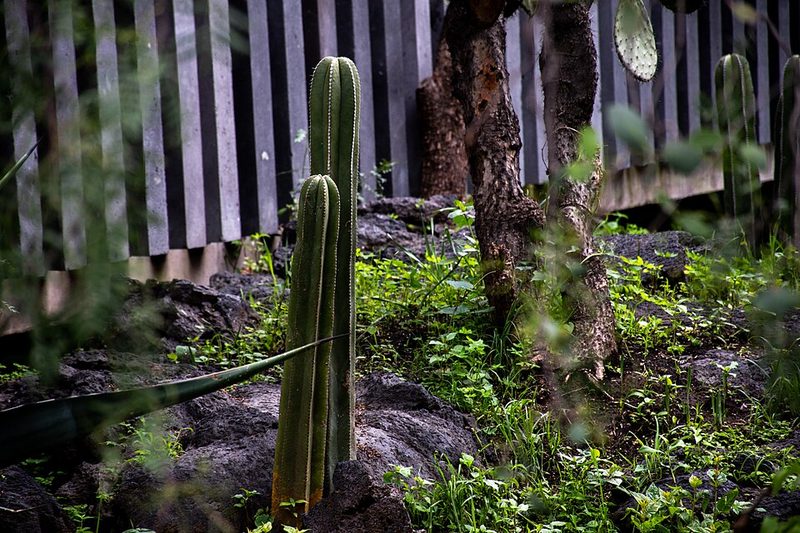
Don’t skip the exterior. The museum sits in a landscape of volcanic rock gardens, native plants, and pathways that wind through the Pedregal. The ecological garden features species native to the lava fields, many of which were nearly wiped out when residential development consumed most of the Pedregal in the mid-20th century. It’s a quiet, slightly wild space that feels completely separate from the city surrounding it.
There’s also an outdoor amphitheater used for cultural events, concerts, and Day of the Dead celebrations. The museum’s annual Dia de Muertos offering (ofrenda) is one of the most elaborate in the city and draws significant crowds in late October and early November.
Practical Information
Getting There
The Anahuacalli is at Museo 150, in the San Pablo Tepetlapa neighborhood. It’s about two kilometers south of central Coyoacan and not within easy walking distance of the Metro. Your best options:
- From Coyoacan: Take an Uber or taxi from the Coyoacan Metro station or the main plazas. It’s a 10-minute ride.
- By Metro: The nearest station is Tasquena (Line 2), but it’s still about 3 km from the museum. You’d need a taxi or bus from there.
- By car: There’s parking available at the museum. Enter via Division del Norte heading south.
The museum runs a free shuttle bus between the Anahuacalli and the Frida Kahlo Museum (Casa Azul) at scheduled times. Check their website for current schedules — this is the most convenient option if you’re combining both in one day, which we strongly recommend.
Hours and Admission
The museum is open Tuesday through Sunday, 11:00 AM to 5:30 PM. Closed Mondays. Admission is around 100 MXN for adults, with discounts for students, teachers, and seniors with valid ID. Children under 12 enter free.
How Long to Spend
Plan for 90 minutes to two hours. The collection isn’t enormous, but the building itself demands slow exploration. If you rush through in 45 minutes, you’re missing the point.
Combining with Other Visits
The natural pairing is with Coyoacan — hit the Anahuacalli in the morning, then spend the afternoon in the plazas, the Frida Kahlo Museum, and the Trotsky Museum. If you have a car, the UNAM campus is also nearby to the south, and the National Anthropology Museum makes an excellent counterpoint if you’re genuinely interested in pre-Columbian art.
Why We Think It’s Worth the Trip
The Anahuacalli isn’t on most tourists’ shortlists, and that’s part of what makes it special. You won’t fight crowds. You won’t wait in line. You’ll walk through a building that a world-famous artist designed as a love letter to the cultures that inspired his life’s work, built from the same volcanic rock those cultures once walked on.
Rivera wanted visitors to feel something when they entered this building — a connection to the deep past of the Valley of Mexico that goes beyond reading plaques and looking at objects behind glass. He succeeded. The Anahuacalli doesn’t just display pre-Columbian art. It surrounds you with it.