Mexico City has no shortage of monuments, but only one gets called “El Angel” by practically everyone who lives here. The Monumento a la Independencia — a gilded victory column rising from a busy roundabout on Paseo de la Reforma — is the closest thing this city of 22 million has to a universal symbol. Sports victories, political protests, New Year celebrations: they all end up here eventually.
Built to mark the centennial of Mexico’s independence war in 1910, El Angel manages to be both grandiose and oddly personal. It’s where families take photos on Sunday afternoons and where the entire city erupts after a World Cup qualifier. Understanding it means understanding something essential about how Mexico City thinks of itself.
What You’re Actually Looking At
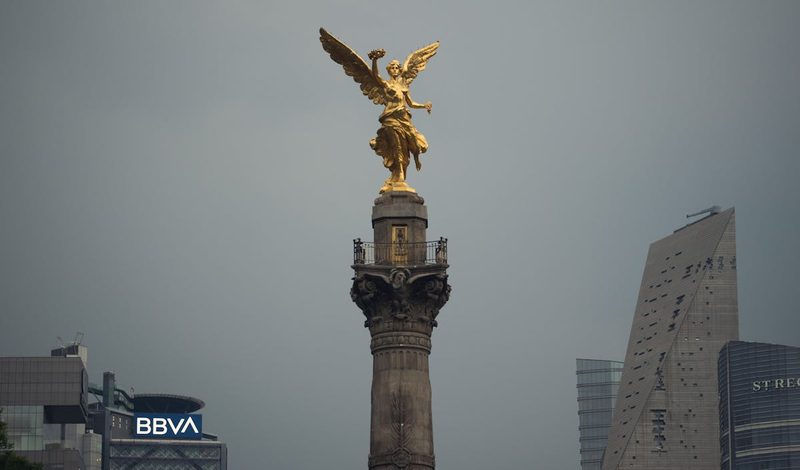
The structure works its way up in layers, each one carrying weight — literally and symbolically.
At the base, a quadrangular platform sits on what were originally nine stone steps. Mexico City’s infamous subsidence (the city is sinking, constantly) forced engineers to add fourteen more steps over the decades, so today you climb twenty-three just to reach the pedestal. It’s a fitting metaphor for a city that keeps rebuilding on shifting ground.
Bronze sculptures guard each corner of the base, representing Law, War, Justice, and Peace. On the main face, an inscription reads “La Nacion a los Heroes de la Independencia” — The Nation to the Heroes of Independence. A large bronze sculpture of a lion guiding a child stands at the front, symbolizing the Mexican people: fierce in conflict, gentle in peace.
The column itself rises 36 meters (118 feet), clad in quarried stone and decorated with garlands and the names of independence figures. A Corinthian capital at the top features four eagles with outstretched wings.
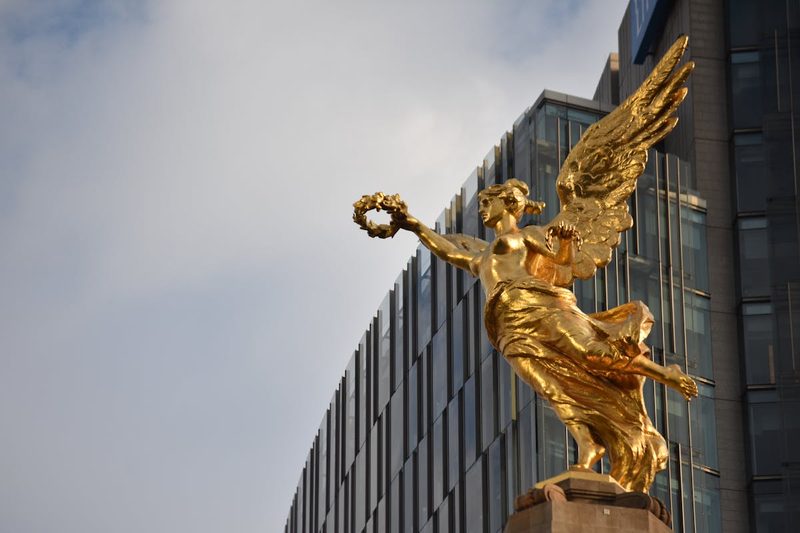
And then there’s the angel. Or more accurately, Nike — the Greek goddess of Victory — standing 6.7 meters tall, cast in bronze and covered in 24-karat gold leaf (last restored in 2006). She weighs seven tons. In her right hand, a laurel crown extends over the head of Miguel Hidalgo below. In her left, a broken chain with three links — one for each century of Spanish colonial rule.
The History Behind the Monument
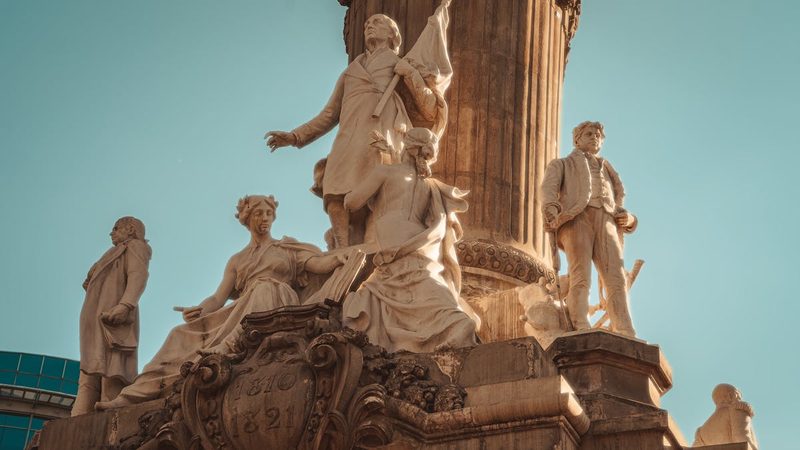
President Porfirio Diaz ordered construction in 1900, with architect Antonio Rivas Mercado leading the design and Italian sculptor Enrique Alciati handling the statuary. The foundation stone went in on January 2, 1902, along with a gold chest containing independence documents and commemorative coins.
Things didn’t go smoothly. In May 1906, when the column had reached about 25 meters with 2,400 stones in place, the sides collapsed. The foundations had been poorly planned. The entire structure was demolished and rebuilt from scratch.
The inauguration finally came on September 16, 1910 — Independence Day — with Diaz presiding over 10,000 soldiers and a crowd of foreign dignitaries. The poet Salvador Diaz Miron delivered the keynote. It was the centerpiece of weeks of centennial celebrations that Diaz had been planning for years: parades, processions, building dedications, street renamings, all designed to cement national identity.
The irony wasn’t lost on history. Within months, the Mexican Revolution had begun — a direct challenge to the same Diaz regime that had just thrown itself this elaborate party. The monument he built to celebrate the old independence now witnesses protests against the very kind of power he represented. Mexico City appreciates that kind of contradiction.
The Earthquake That Knocked Her Down
On July 28, 1957, an earthquake sent the Winged Victory crashing to the ground, where she shattered. Sculptor Jose Fernandez Urbina spent over a year restoring her, and El Angel reopened on September 16, 1958. The original head from the damaged statue didn’t go back up — it’s now preserved in the Mexico City Historic Archive inside the Palace of the Counts of Heras y Soto.
The devastating 1985 earthquake, which killed thousands across the city, left El Angel largely intact, with only minor damage to the internal staircase and some relief work. The column has survived what the city beneath it has not, more than once.
In 2019, feminist demonstrators protesting gender-based violence damaged sections of the base. The monument was closed for restoration and didn’t reopen until October 2021. The graffiti sparked fierce debate about what public monuments are for — a conversation that hasn’t really ended.
The Mausoleum Inside
Most visitors don’t realize El Angel doubles as a crypt. In 1925, President Plutarco Elias Calles ordered the remains of fourteen independence heroes moved here, turning the monument into a national mausoleum.
The roster reads like a syllabus of Mexican independence:
Father Miguel Hidalgo y Costilla — the “Father of the Nation” who launched the rebellion against Spain in 1810. His famous grito (cry for independence) is re-enacted every September 15 by Mexico’s president.
Jose Maria Morelos y Pavon — took over the insurgent movement after Hidalgo’s execution and proved to be a sharper military strategist.
Guadalupe Victoria — Mexico’s first president after independence was achieved in 1821.
Vicente Guerrero — the second president, and one of the few leaders of African descent in Latin American independence movements.
Leona Vicario — one of the few women honored here, an active rebel supporter who used her wealth and social position to fund the insurgency.
Other heroes interred include Ignacio Allende, Juan Aldama, Nicolas Bravo, Mariano Matamoros, Andres Quintana Roo, and several more.
Notably absent: Agustin de Iturbide, the man who actually negotiated Mexico’s final independence from Spain in 1821 and briefly declared himself emperor. Calles excluded him. His remains sit instead in the Metropolitan Cathedral at the Zocalo — a much less glamorous resting place for someone who technically finished the job.
Just inside the entrance, you’ll find a statue of William Lamport — an Irishman executed by the Spanish Inquisition in 1659 for plotting New Spain’s independence, more than 150 years before Hidalgo’s revolt. Whether he was a genuine revolutionary or a delusional adventurer depends on who you ask, but the statue is there regardless.
The mausoleum opened to the public in 1998. During the 2010 bicentennial celebrations, the heroes’ remains were temporarily exhumed, paraded to the National History Museum in Chapultepec Castle for study, exhibited at the National Palace, and returned in 2011. Mexico takes its dead seriously.
Climbing to the Top
You can go inside. Whether you should depends on how you feel about narrow spiral staircases with no rest stops.
The climb is roughly 200 steps. The first 15 or so, through the base, are wide and comfortable. Then you enter the column itself, where roughly 185 metal spiral steps wind upward in near darkness, lit only by a few narrow slits in the stone. There are no landings. No places to stop and catch your breath. It’s equivalent to climbing a 14-story building in one continuous go.
The observation balcony at the top is narrow but offers a commanding view down the length of Paseo de la Reforma in both directions, with the forest of Chapultepec to the west and the towers of the Historic Center to the east. On a clear day (admittedly not every day in CDMX), you can see the volcanoes.
Current visiting hours: As of recent years, interior access has been limited to Saturdays and Sundays, 10:00 AM to 1:00 PM. Entry is free but you need to obtain a permit from the Cuauhtemoc borough office — bring a photo ID. Groups are limited to six people with 15 minutes inside. Availability changes without much warning, so check before making it your whole plan.
The Roundabout and Reforma
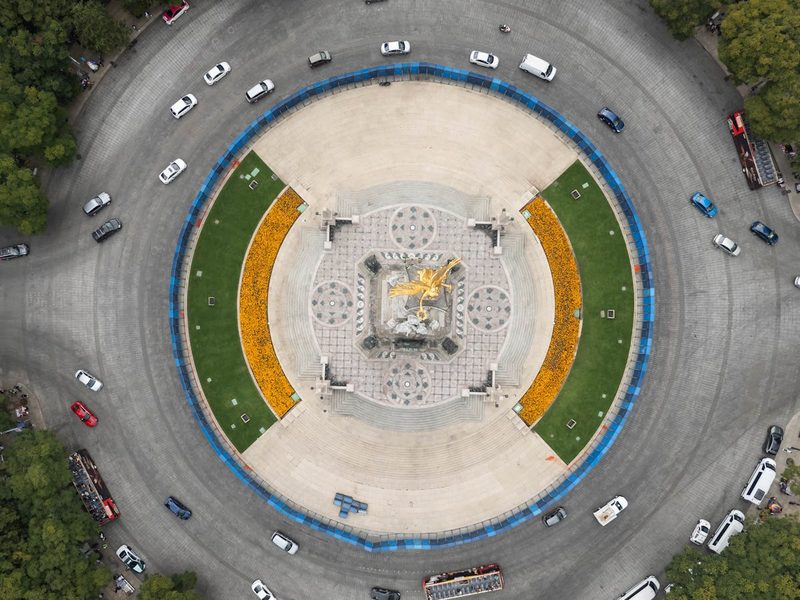
El Angel sits in its own glorieta (roundabout) on Paseo de la Reforma, one of ten major traffic circles along this grand boulevard. Getting to the monument itself means crossing several lanes of traffic — there are crosswalks, but timing matters, especially during rush hour.
The surrounding stretch of Reforma is lined with corporate towers, embassies (the US and British embassies are both within 200 meters), and upscale restaurants. It’s a different world from the street food stalls a few blocks south in Colonia Juarez, which is where you should actually eat.
El Angel as a Gathering Place
More than any other spot in Mexico City, El Angel is where the city goes to celebrate and to rage. After a national football team victory, the roundabout fills with thousands of fans waving flags, honking horns, and setting off fireworks. The green, white, and red smoke alone is worth seeing.
It’s also the traditional starting point for political marches and protests — the monument’s association with independence makes it symbolically irresistible for anyone challenging power. Pride parades, women’s marches, teacher strikes, student demonstrations: they all converge here.
On New Year’s Eve, it’s one of the unofficial gathering spots, though the Zocalo draws bigger crowds.
How to Get There
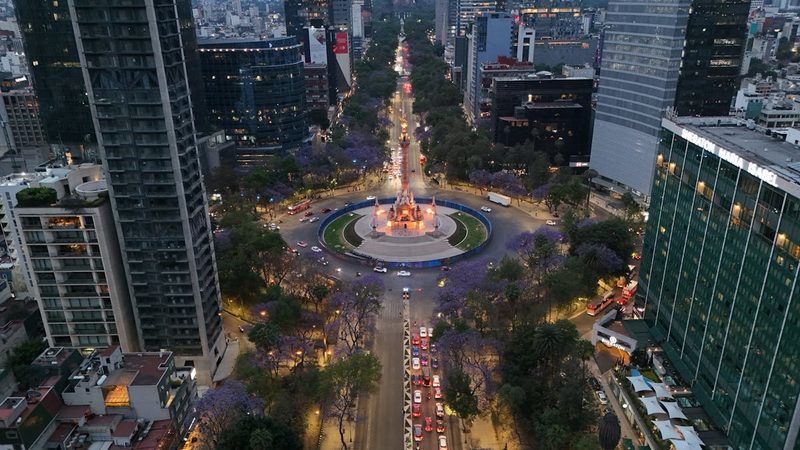
Metro: The nearest station is Insurgentes (Line 1), about a 10-minute walk south along Paseo de la Reforma. It’s flat and straightforward. Alternatively, Sevilla station (Line 1) is roughly the same distance approaching from the south.
Metrobus: Line 1 runs directly along Insurgentes Avenue. Get off at Hamburgo or Reforma and walk east/west to the monument.
Turibus: The tourist hop-on-hop-off bus has stops on both sides of the roundabout. The Historic Center Circuit hits the northwest (westbound) and southeast (eastbound) quadrants. The Coyoacan/South Circuit stops on the northwest quadrant only.
Uber/taxi: Just say “El Angel” — every driver knows it. Traffic in this area is bad during weekday rush hours (roughly 7-10 AM and 5-8 PM). Budget extra time.
Walking: If you’re staying in Condesa, Roma, or Juarez, El Angel is an easy walk. From the Diana Fountain (La Diana Cazadora, another Reforma landmark), it’s about 15 minutes east along the avenue.
Nearby Attractions
El Angel sits at a natural crossroads between several of CDMX’s most visited areas. Within walking distance:
Diana the Huntress Fountain — another Reforma landmark, about 1 km west toward Chapultepec. Worth the stroll along the boulevard.
Paseo de la Reforma — keep walking in either direction. East takes you toward the Historic Center. West leads to Chapultepec Castle and the National Anthropology Museum.
Colonia Juarez — directly south of the roundabout. One of the city’s most rapidly changing neighborhoods, packed with restaurants, rooftop bars, and a growing arts scene.
Zona Rosa — the blocks immediately southeast. Long established as CDMX’s LGBTQ+ district, with plenty of nightlife, Korean restaurants (the Koreatown section is genuinely good), and pedestrian streets.
National Art Museum (MUNAL) — about 2 km east along Reforma toward the Historic Center. One of the country’s best art collections, housed in a building that’s itself worth the visit.
Tips for Visiting
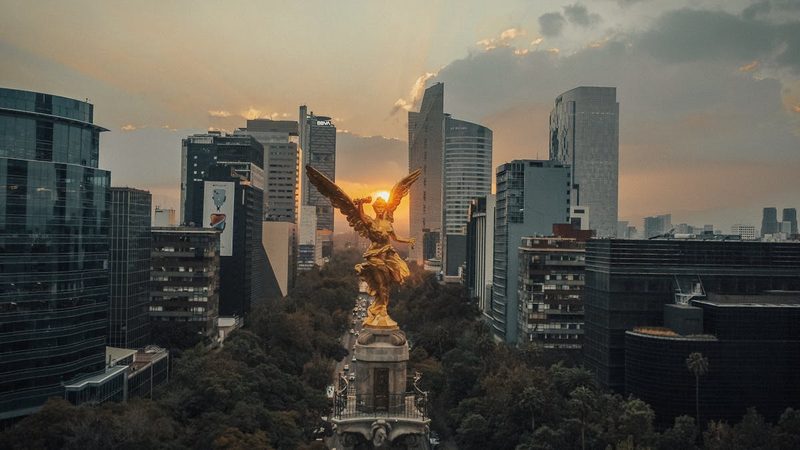
Best time to visit: Early morning or late afternoon for photos — the golden light on the gilded statue is worth planning around. Midday in the dry season (November through May) can be brutally sunny with no shade at the monument itself.
Altitude reminder: Mexico City sits at 2,240 meters (7,350 feet) above sea level. If you’ve just arrived, the 200-step climb inside El Angel will feel significantly harder than it should. Give yourself a day or two to acclimatize before attempting it.
Sunday is best: Traffic is lighter, the interior is open (when available), and the surrounding streets have a more relaxed feel. Reforma occasionally closes to cars on Sunday mornings for cyclists and joggers.
Safety: The Reforma corridor is well-policed and generally safe, including at night when the monument is dramatically lit. The usual big-city awareness applies — watch your phone, don’t flash expensive jewelry — but this isn’t an area where you need to worry much.
Photography: The best angle for a clean photo without traffic is from the southwest corner of the roundabout. For a shot with the full Reforma perspective, stand on the median strip to the east (carefully). The monument is particularly photogenic at night when floodlit.
A Monument That Keeps Changing
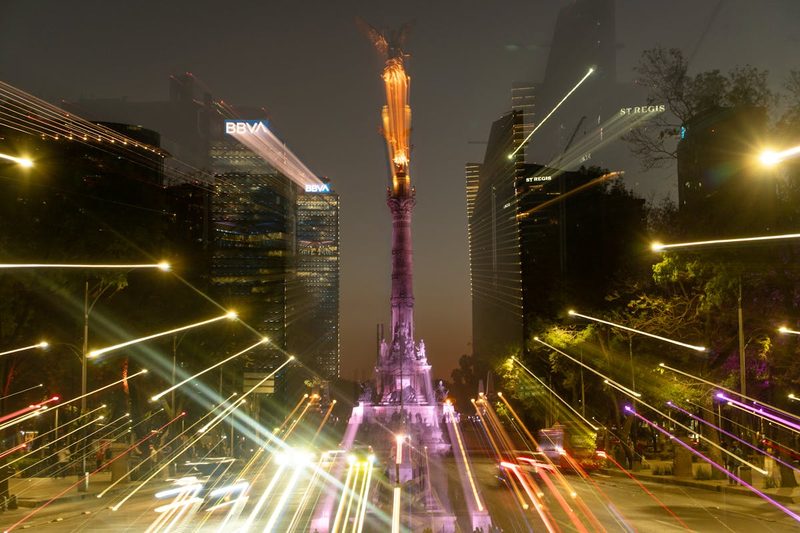
What makes El Angel interesting, beyond the gold and the eagles and the history, is that it hasn’t stopped being relevant. A century-old monument to a two-century-old war could easily be just a traffic obstacle. Instead, it keeps accumulating meaning. Every celebration adds a layer. Every protest adds another. The feminist graffiti of 2019, which authorities tried to scrub away, arguably made the monument more significant, not less.
Antonio Rivas Mercado designed a column to honor the past. Mexico City turned it into something that belongs to the present. That’s the thing about this city — it doesn’t let its monuments just sit there looking pretty. They have to work for a living.