It took 250 years to build Mexico City’s Metropolitan Cathedral. Let that sink in. Construction started in 1573 and didn’t wrap up until 1813. The United States declared independence, fought a revolution, elected its first sixteen presidents, and bought Louisiana in the time it took to finish this church. And honestly? You can see every single one of those years in the building itself.
The Metropolitan Cathedral — its full name is the Catedral Metropolitana de la Asuncion de la Santisima Virgen Maria a los Cielos, which is quite the mouthful even by Catholic standards — sits on the north side of the Zocalo, right in the heart of the Historic Center. It’s the largest cathedral in the Americas, the seat of the Catholic Archdiocese of Mexico, and a building that somehow manages to be Gothic, Baroque, Neoclassical, and Churrigueresque all at once. That’s what happens when your construction project outlasts entire architectural movements.
Built on Conquered Ground
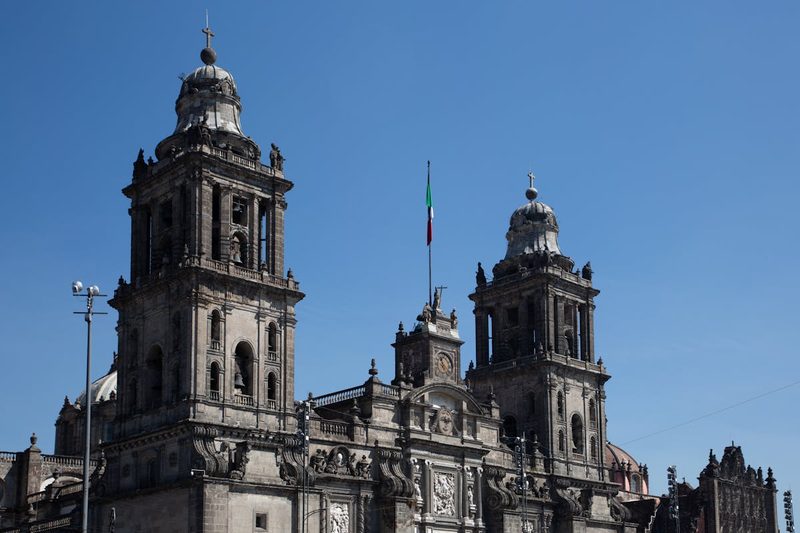
The cathedral’s location isn’t accidental. It sits on top of — and was partially built from — the sacred precinct of the Aztec city of Tenochtitlan. When Hernan Cortes and his conquistadors took the city in 1521, one of their first priorities was replacing Aztec temples with Christian churches. It wasn’t subtle. They literally used stones from the destroyed temple of Huitzilopochtli, the Aztec god of war, to build the first church on this site.
That first church went up around 1524, under architect Martin de Sepulveda. It was small, modest, and — according to every chronicler who wrote about it — thoroughly embarrassing for a city that was supposed to be the crown jewel of New Spain. King Charles V elevated it to a cathedral in 1534, and Pope Paul III named it a Metropolitan Cathedral in 1547. Fancy titles couldn’t fix the fact that the building was, by all accounts, kind of pathetic.
By 1544, church authorities were already demanding something grander. Archbishop Alonso de Montufar proposed a seven-nave monster modeled after the Seville Cathedral, estimating it would take 10 or 12 years. He was off by about 240 years.
250 Years of Construction: A Timeline
The actual construction of the cathedral we see today began in 1573, designed by Spanish architect Claudio de Arciniega and Juan Miguel de Aguero. They drew inspiration from the cathedrals of Jaen and Valladolid in Spain, scaling the plan down from seven naves to five: one central nave, two processional naves, and two lateral naves housing 16 chapels.
The foundation alone was an engineering nightmare. The builders were working on the soft, waterlogged bed of former Lake Texcoco — the same lake the Aztecs had built Tenochtitlan on. To create a stable base, they drove roughly 20,000 wooden logs deep into the mud across 6,000 square meters. It took 42 years just to lay the foundation properly.
Here’s a rough timeline of what happened over those 250 years:
1573-1615: Walls went up. Slowly. By 1581 the walls had started rising, and by 1615 they’d reached about half their total height. The earliest chapels were being carved by stonemasons like Juan Arteaga and Hernan Garcia de Villaverde.
1623-1629: Interior work began with the sacristy. Then disaster struck. In September 1629, Mexico City flooded so badly that water reached two meters high in the main square. Construction halted completely. Officials actually considered abandoning the project and rebuilding in the Tacubaya hills west of the city. They didn’t, thankfully.
1629-1667: Under architect Juan Gomez de Trasmonte, the interior was finally completed and the cathedral was consecrated on December 22, 1667, when the last vault was sealed. At that point, the building had no bell towers, no finished main facade, and no dome. But at least Mass could be held inside. The cost so far: 1,759,000 pesos, paid largely by Spanish Kings Philip II, Philip III, Philip IV, and Charles II.
1675-1689: The central facade was completed by architect Cristobal de Medina Vargas, including the figure of the Assumption of Mary and sculptures of the apostles James and Andrew. The main portal was finished in 1688, the east side portal in 1688, and the west in 1689.
1718-1737: Jeronimo de Balbas — one of the most important names in the cathedral’s history — built the extraordinary Altar of the Kings in Mexican Baroque style. Carved entirely in cedar wood, it took 19 years to complete.
1787-1793: Jose Damian Ortiz de Castro won a competition to design and build the bell towers, main facade, and dome. He was a Xalapan architect who engineered the towers to resist earthquakes. He died unexpectedly in 1793 before finishing.
1793-1813: Manuel Tolsa of Valencia was hired to complete the project. He redesigned the dome (which was too low and looked ridiculous), added the clock tower, placed statues of Faith, Hope, and Charity on the facade, and installed the high balustrade around the entire building. In 1813, the cathedral was finally, officially, done.
A Building That Can’t Pick a Style
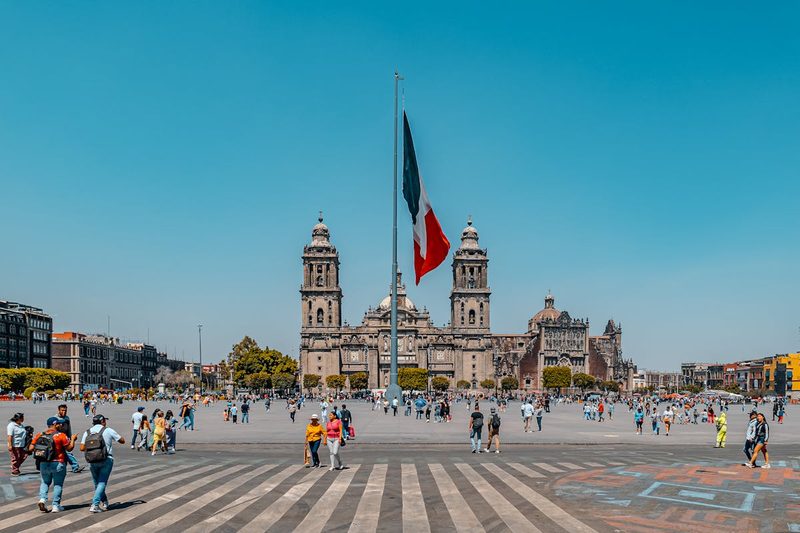
The cathedral’s architectural schizophrenia is actually its most interesting feature. Because the building took a quarter-millennium to complete, every generation of architects brought whatever style was fashionable at the time. The result is a building that reads like a textbook of colonial architecture.
The northern facade, built in the 16th century, is the oldest part — pure Renaissance Herrera style, named after Juan de Herrera who designed El Escorial in Spain. Clean lines, restrained ornamentation. The eastern and western facades are older than most of the building but feature Solomonic columns on their third levels, a distinctly Baroque addition bolted onto Renaissance bones.
The main (southern) facade facing the Zocalo is where things get interesting. The lower portions show Gothic and Plateresque influences from the earliest construction. The middle sections are Baroque. And the clock tower at the very top, added by Tolsa, is firmly Neoclassical. You can literally read the building from bottom to top and watch architectural history unfold.
Inside, the Churrigueresque style dominates the altarpieces — ultra-Baroque taken to its most ornate extreme, with estipite columns (inverted triangle-shaped pilasters) that Balbas introduced to the Americas for the first time. Meanwhile, some chapels are Gothic, others Neoclassical, and the sacristy mixes Renaissance and Gothic elements because it was built early enough to straddle both periods.
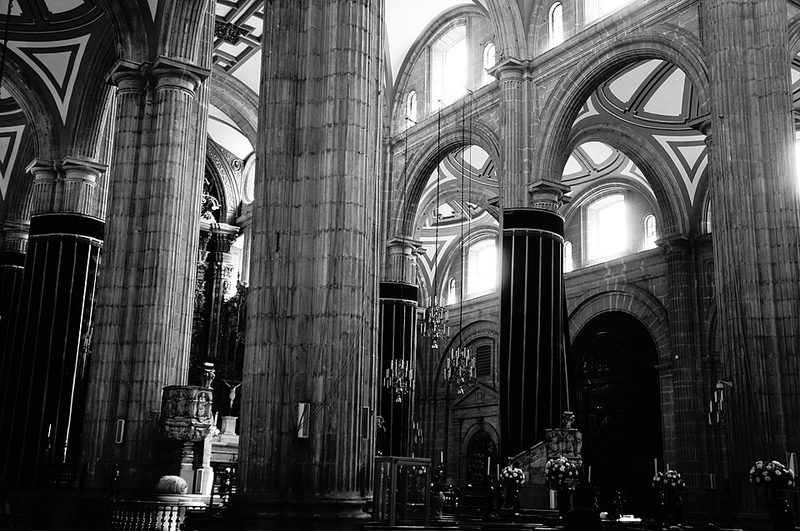
The dimensions are impressive by any standard: 128 meters long, 67 meters wide, 67 meters to the top of the towers. Five naves, 51 vaults, 74 arches, 40 columns, and approximately 150 windows. It’s not just big — it’s the largest cathedral anywhere in the Americas.
The Altar of the Kings
If you see only one thing inside the cathedral, make it the Altar of the Kings (Altar de los Reyes). Located at the far back of the cathedral behind the choir and presbytery, this Churrigueresque masterpiece is 25 meters tall, 13.75 meters wide, and 7.5 meters deep. It’s so large and so deeply recessed that it earned the nickname “la cueva dorada” — the golden cave.
Jeronimo de Balbas carved it from cedar between 1718 and 1737. Francisco Martinez then gilded the whole thing, and it was completed in 1737. The altar takes its name from the saintly royals depicted on it. At the bottom are six female royal saints: Saint Margaret of Scotland, Helena of Constantinople, Elisabeth of Hungary, Elizabeth of Aragon, Empress Cunegunda, and Edith of Wilton. In the middle tier are six canonized kings: Hermenegild the Visigoth martyr, Holy Roman Emperor Henry II, Edward the Confessor, Casimir of Poland, Louis IX of France, and Ferdinand III of Castile.
Between these royal figures, an oil painting of the Adoration of the Magi by Juan Rodriguez Juarez shows Jesus as the King of Kings — outranking all the earthly monarchs surrounding him. At the top, a painting of the Assumption of Mary presides as celestial queen, with angels carrying attributes of the Virgin Mary above. It’s overwhelming. In the best possible way.
The Altar of Forgiveness
The Altar of Forgiveness (Altar del Perdon) is the first major feature you see when entering through the main doors. Also built by Balbas, it’s historically significant as the first use of the estipite column in the Americas — a stylistic innovation that would spread across colonial Mexico like wildfire.
There are two stories about how it got its name, and both are pretty good. The first says that prisoners condemned by the Spanish Inquisition were brought here to beg forgiveness before their execution. The second involves painter Simon Pereyns, who created many of the cathedral’s artworks but was thrown in jail for blasphemy. While imprisoned, he painted such a beautiful image of the Virgin Mary that his crime was forgiven. Whether either story is actually true is anyone’s guess, but the Inquisition one certainly adds atmosphere.
The altar suffered damage in a major fire in January 1967 — an electrical short circuit that also destroyed parts of the choir and damaged both cathedral organs. During the restoration that followed, workers discovered 51 paintings hidden behind the altar, including works by Miguel Cabrera and Jose de Ibarra. Sometimes you have to burn things down to find out what’s behind them.
The Chapels
There are 16 chapels in total, 14 of which are open to the public. Each was sponsored by a different guild and dedicated to a different saint, which means each has its own personality. A few highlights:
Chapel of Saint Philip of Jesus is dedicated to the only martyr from New Spain — a friar crucified in Japan. More notably for history buffs, it contains an urn holding the remains of Agustin de Iturbide, who crowned himself Emperor of Mexico in this very cathedral in 1822. More on Iturbide shortly.
Chapel of Saint Joseph holds the Lord of Cacao (Senor del Cacao), a 16th-century image of Christ named for the indigenous worshippers who gave their alms in cocoa beans. It’s one of those beautiful collisions of pre-Hispanic and Catholic culture that you find all over Mexico.
Chapel of Our Lady of Antigua is home to the Nino Cautivo (Captive Child), a 16th-century Child Jesus sculpted in Spain by Juan Martinez Montanes. Pirates captured the ship carrying it to Veracruz and held the sculpture for ransom. People traditionally pray to it when seeking release from financial problems, addiction — or, since the 2000s, when a family member has been kidnapped.
Chapel of Our Lady of Sorrows contains a ladder in its left wall that descends to the crypts holding the remains of past archbishops. The grandest crypt belongs to Juan de Zumarraga, the first archbishop of Mexico.
The Sacristy and Its Paintings
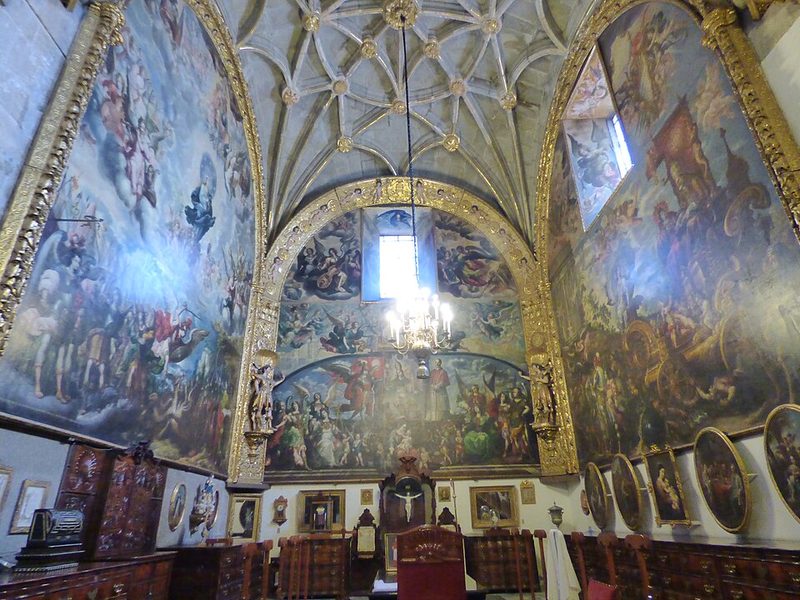
The sacristy is the oldest part of the cathedral — enter through the Herrera door into a space that mixes Renaissance and Gothic styles. The real draw here is the art. The walls hold enormous canvases by Cristobal de Villalpando, arguably the greatest painter of colonial Mexico, including “The Apotheosis of Saint Michael,” “The Triumph of the Eucharist,” and “The Virgin of the Apocalypse.” Two additional canvases by Juan Correa round out what amounts to a small museum of colonial painting.
The Organs
The cathedral houses two of the largest 18th-century organs in the Americas, positioned above the walls of the choir on the east (epistle) and west (gospel) sides. They were built by Spanish-born Jose Nassarre and completed by 1736, incorporating elements from a 17th-century organ built by Jorge de Sesma in Madrid.
Both organs were badly damaged in the 1967 fire, with some pipes partially melting. They were restored in 1978 but fell into disrepair again. The gospel organ was re-restored from 2008 to 2009 by Gerhard Grenzing, and the epistle organ restoration was completed in 2014. Both are now playable — and hearing them during a service or concert is one of those experiences that justifies the whole concept of organ music.
The Crypt of the Archbishops
Beneath the cathedral floor, directly below the Altar of the Kings, lies the Crypt of the Archbishops. You enter through a heavy wooden door and descend a winding yellow staircase. Just past the inner entrance, you’ll encounter a Mexica-style stone skull — incorporated as an offering into the base of a cenotaph to Juan de Zumarraga, the first archbishop. It’s a jarring, powerful reminder of what this building sits on top of.
The walls are lined with dozens of bronze plaques marking where Mexico City’s former archbishops are interred. The floor is covered with small marble slabs over niches containing additional remains. It’s quiet and cool down there, a stark contrast to the cathedral above, and it tends to be less crowded than you’d expect given how fascinating it is.
The Sagrario: The Cathedral’s Neighbor
Attached to the east side of the cathedral is the Sagrario Metropolitano (Metropolitan Tabernacle), built by Lorenzo Rodriguez between 1749 and 1760 during the height of the Baroque period. It was designed to house the archbishop’s archives and vestments, register parishioners, and distribute the Eucharist — functions it still serves today.
The Sagrario is built of red tezontle volcanic rock and white chiluca stone in the shape of a Greek cross. Its southern facade, facing the Zocalo, is one of the most extravagantly decorated surfaces in all of Mexico City. Every inch is covered with Baroque ornamentation — floating drapes, cherubs, carved fruits (grapes and pomegranates symbolizing the Blood of Christ), roses, daisies, and indigenous chalchihuite flowers. It’s so densely decorated it almost looks like a wedding cake designed by someone who couldn’t stop adding layers.
Inside, the principal altar was crafted by indigenous artist Pedro Patino Ixtolinque in Churrigueresque style. The Sagrario is connected to the main cathedral via the Chapel of San Isidro, so you can walk between them without going outside. Many visitors miss it entirely, which is a shame.
Iturbide’s Tomb: The Emperor the Angel Rejected
One of the cathedral’s most historically charged features is the urn containing the remains of Agustin de Iturbide in the Chapel of Saint Philip of Jesus. Iturbide’s story is one of the strangest in Mexican history, and the cathedral is deeply woven into it.
Iturbide was the military leader who actually secured Mexico’s independence from Spain in 1821. He was crowned Emperor Agustin I right here in the cathedral in 1822, in a lavish ceremony performed by the President of Congress. His wife Ana Maria Huarte was crowned alongside him. The coronation painting still hangs in the cathedral.
His reign lasted barely a year. He was forced to abdicate in 1823, went into exile, returned to Mexico in 1824, and was promptly executed by firing squad. His remains ended up in the cathedral.
Here’s the interesting part: when the Angel of Independence monument was built on Paseo de la Reforma, it was designed to honor Mexico’s independence heroes. The remains of Miguel Hidalgo, Jose Maria Morelos, and other heroes were moved there. But Iturbide — the man who actually completed the independence — was pointedly excluded. His conservative politics and self-coronation as emperor made him unacceptable to the liberal governments that followed. So while the generals and priests who started the independence movement rest beneath the Angel’s golden column, the man who finished the job remains here in the cathedral, in a chapel dedicated to a saint who was crucified in Japan.
The heart of President Anastasio Bustamante is also preserved in this chapel, which is just the kind of detail you can’t make up.
The Sinking Cathedral
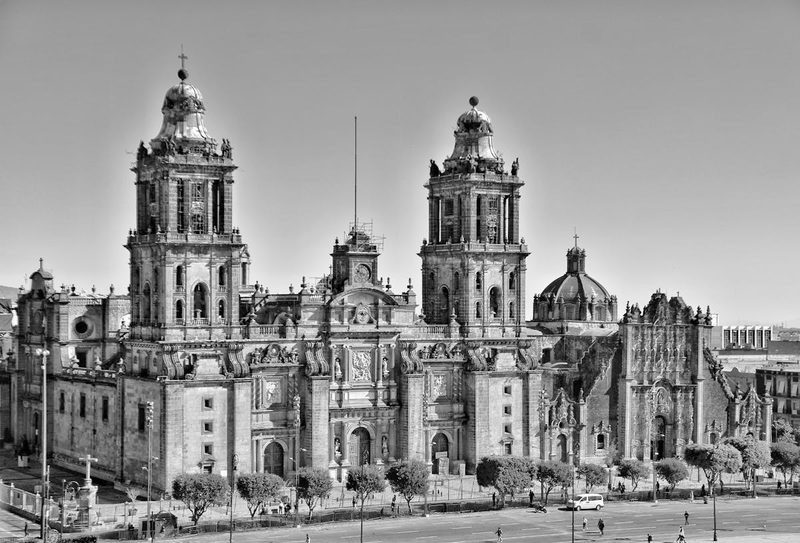
If you stand in front of the cathedral and look carefully, you’ll notice something is off. The building is visibly tilted. Different sections lean in different directions. The bell towers don’t quite line up. This isn’t an optical illusion — the Metropolitan Cathedral has been sinking into the old lakebed since the day it was built.
Mexico City was built on the drained bed of Lake Texcoco, and the soft clay soil underneath has been compressing under the cathedral’s weight for centuries. The problem accelerated dramatically in the 20th century as the growing city — now a megalopolis of over 20 million people — drew more and more water from underground aquifers, causing the water table to drop and the ground to compress faster.
Different sections of the building sat on different substrates — some on the remains of pre-Hispanic structures, some on virgin lakebed — so they sank at different rates. The cathedral itself, the Sagrario, and the bell towers were all settling unevenly, causing dangerous tilting and structural stress. By the 1990s, the situation was serious enough that the World Monuments Fund placed the cathedral on its list of the 100 Most Endangered Sites in 1998.
The rescue effort was genuinely ingenious. Between 1993 and 1998, engineers excavated shafts beneath the cathedral and inserted concrete pilings into the soft ground to give the structure a more solid base. They couldn’t stop the sinking entirely — you can’t really fight the geology of a former lakebed — but they corrected the worst tilting and ensured that the building would at least sink uniformly rather than tearing itself apart. The work was successful enough that the cathedral was removed from the endangered list in 2000.
You can still see evidence of the project. Bases, artifacts, and other items recovered from the foundation excavation are displayed in front of the cathedral. And if you look at the floor inside, you’ll notice it’s not perfectly level. It’s a building that’s still, very slowly, settling into the earth.
The Bell Towers
The cathedral’s two bell towers hold 25 bells between them — 18 in the east tower and 7 in the west. The largest is named Santa Maria de Guadalupe and weighs approximately 13,000 kilograms (about 28,660 pounds). Two other notable bells, Dona Maria (6,900 kg) and La Ronca (“the Hoarse One,” named for its harsh tone), were placed in 1653, with the big one following in 1793.
The bells come with stories. In 1947, a novice bell ringer was killed when a bell swung back and struck him in the head. As punishment — and yes, we’re talking about punishing a bell — the clapper was removed. For 53 years it was known as “la castigada” (the punished one) or “la muda” (the mute one). The clapper was reinstalled in 2000. Apparently half a century was considered sufficient.
In 2007, workers found a time capsule inside a stone ball in the southern bell tower, placed in 1742 to protect the building from harm. The lead box contained religious artifacts, coins, and parchments.
The 1967 Fire
On January 17, 1967, an electrical short circuit started a fire that caused extensive damage to the cathedral’s interior. The Altar of Forgiveness lost significant portions of its structure and decoration, including three paintings: “The Holy Face” by Alonso Lopez de Herrera, “The Martyrdom of Saint Sebastian” by Francisco de Zumaya, and “The Virgin of Forgiveness” by Simon Pereyns. The choir lost 75 of its 99 seats. Both organs were severely damaged, with pipes partially melting.
The aftermath was almost as dramatic as the fire itself. Church authorities actually started demolishing the choir in 1972 without government authorization and had to be forcibly stopped. The government took control of the restoration, and the effort uncovered treasures: those 51 paintings behind the Altar of Forgiveness, a copy of the 1529 nomination of Hernan Cortes as Governor General of New Spain inside one of the organs, and the burial place of Miguel Barrigan, first governor of Veracruz, in the wall of the central arch.
The Coronations and the Closures
The cathedral has been the stage for some of Mexico’s most consequential moments. Two emperors were crowned here: Agustin I in 1822 and Maximilian I (along with Empress Carlota) in 1864. The independence heroes Hidalgo and Morelos were buried here until 1925, when their remains were transferred to the Angel of Independence.
During the Cristero War of the late 1920s, the cathedral was actually closed for four years while President Plutarco Elias Calles enforced anti-religious laws. It sat empty until the government and Vatican reached an agreement, reopening in 1930. More recently, reconstruction after the 2017 earthquake turned up 23 lead boxes containing religious relics and written inscriptions indicating they’d been found once before — by masons in 1810 — and deliberately reburied. The cathedral keeps giving up its secrets.
Visiting the Cathedral
Getting There
The cathedral sits on the north side of the Zocalo, which is the geographic and spiritual center of Mexico City’s Historic Center. The nearest Metro station is Zocalo (Line 2), which drops you practically at the front door. You can also walk from the Alameda Central in about 10-15 minutes along Calle Madero — a pedestrian street that offers one of the best approach views of the cathedral.
If you’re combining it with other Historic Center sights, the Postal Palace and the Palace of Fine Arts are both within easy walking distance. Chapultepec Castle is a short Metro ride away if you want to keep the historical theme going, and Colonia Juarez makes a good base if you’re looking for somewhere central to stay.
Hours and Admission
The cathedral is open daily, generally from 8:00 AM to 8:00 PM, though hours can shift for special religious events. Admission is free. The cathedral is an active place of worship, so services happen throughout the day — Mass is typically celebrated several times daily. You’re welcome to attend or simply observe.
The crypt and bell tower tours are sometimes available through the cathedral’s cultural program, often for a small fee. Availability varies, so ask at the entrance if these interest you.
What to Know Before You Go
This is an active church, so dress respectfully. Shoulders covered, no very short shorts or skirts. Photography is generally allowed, but skip the flash — both out of respect and because flash photography doesn’t do justice to these interiors anyway.
Give yourself at least an hour, ideally 90 minutes. Most visitors beeline for the Altar of the Kings and the Altar of Forgiveness, but the chapels along the side naves are where you’ll find the most interesting individual stories. The sacristy, with its Villalpando paintings, is worth seeking out. And don’t skip the Sagrario next door — its facade alone is worth five minutes of your time.
The Templo Mayor archaeological site is literally next door to the east. If you’re interested in what was here before the cathedral, that’s an essential companion visit.
The cathedral’s floor isn’t level — you’ll notice it, and now you know why. Stand in the center of the nave and look at the columns. They’re not quite plumb. It’s the kind of thing that, once you see it, you can’t unsee. A 450-year-old building slowly being pulled back into the lake that was here before any of us.
Best Times to Visit
Early morning (before 10:00 AM) and late afternoon (after 4:00 PM) tend to be less crowded. Weekday mornings are the quietest. If you can visit during a service, the experience of hearing the restored organs fill that enormous space is worth planning around — though you should be a respectful observer, not a tourist treating Mass as a photo op.
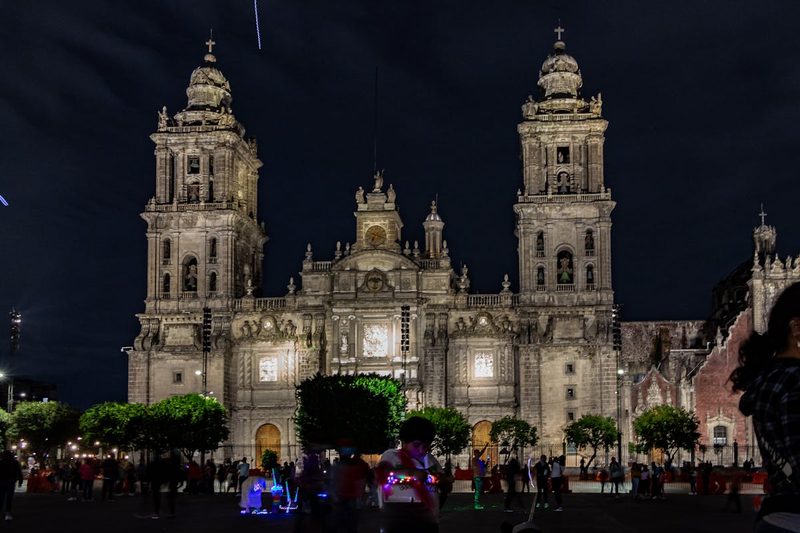
The cathedral is particularly atmospheric at dusk, when the interior light shifts and the gold of the altarpieces catches whatever’s coming through those 150 windows. It’s also worth stepping back across the Zocalo after dark to see the facade illuminated — the lighting picks out architectural details that daylight somehow flattens.
Why the Cathedral Matters
A lot of Mexico City’s landmarks tell you one story. The Metropolitan Cathedral tells all of them. It’s the conquest, built from the stones of Aztec temples on Aztec sacred ground. It’s the colonial period, with 250 years of shifting architectural tastes layered on top of each other. It’s independence, where emperors were crowned and heroes buried. It’s the conflict between church and state, closed during the Cristero War and opened again. It’s the geology of the city itself, sinking into the old lakebed, tilting, being rescued by modern engineering, and sinking again.
We’ve visited hundreds of churches and cathedrals across Latin America. Many are more beautiful than this one. Some are older, some are more architecturally pure. But none of them are a better physical record of the place they stand in. The Metropolitan Cathedral doesn’t just sit in Mexico City’s history — it is Mexico City’s history, stacked up in stone and gold and slowly settling into the earth.