There’s exactly one royal castle in North America that was actually lived in by monarchs. It’s not in Canada. It’s not in some forgotten corner of the Caribbean. It’s sitting on top of a hill in the middle of Mexico City’s biggest park, and you can walk through its rooms for less than the price of a decent taco lunch.
Chapultepec Castle (Castillo de Chapultepec) has been a sacred Aztec site, a colonial viceroy’s summer house, an imperial palace for a Habsburg emperor and his Belgian wife, a military academy where teenage cadets died fighting American invaders, a presidential residence for over fifty years, and now one of Mexico’s most important history museums. That’s a lot of jobs for one building. It’s handled all of them with remarkable style.
We think it’s the single most rewarding attraction in Mexico City — and yes, we’re saying that knowing the National Anthropology Museum sits right down the hill. Here’s everything you need to know before you visit.
A Brief History of Chapultepec Castle
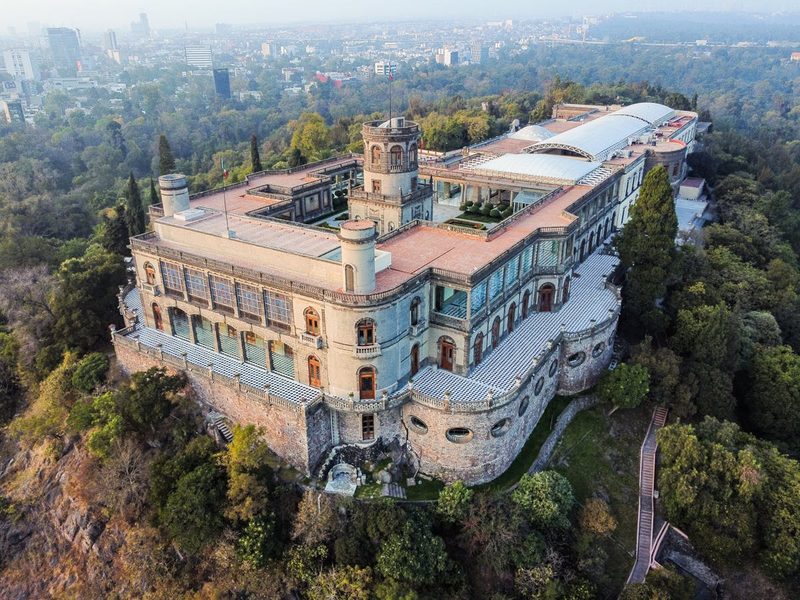
The history of this place reads like the entire story of Mexico compressed into one hilltop. Every era left its fingerprints here, and walking through the castle means walking through five centuries of power, conflict, and reinvention.
The Sacred Hill: Pre-Hispanic Origins
Long before anyone put a building here, Chapultepec Hill was already important. The name comes from the Nahuatl word chapoltepec, meaning “on the hill of the grasshopper.” The Toltecs named it. Remains of a Toltec altar have been found at the summit.
When the Aztecs took control of the Valley of Mexico, they treated the hill as both sacred ground and strategic real estate. Their rulers were cremated here, and the natural springs at the base provided fresh water to the capital city of Tenochtitlan through an aqueduct system. By the 1420s, ruler Nezahualcoyotl had built the first palace on the site. Moctezuma I later ordered his own portrait carved into the rock at the foot of the hill — you can still see it there — and constructed a three-kilometer aqueduct. Moctezuma II added reservoirs for exotic fish and planted trees from across the empire.
This wasn’t a public park. It was the private retreat of the Aztec elite, strictly off-limits to regular people.
Colonial Construction: The Viceroy’s Grand Plan
After the Spanish conquest, Hernan Cortes claimed Chapultepec for himself. But in 1530, Charles V decreed the area as property of Mexico City and opened it to the public. For the next two and a half centuries, the hill sat there without much happening on top of it.
That changed in 1785, when Viceroy Bernardo de Galvez ordered the construction of a grand summer residence at the highest point of the hill. He hired Lieutenant Colonel Francisco Bambitelli, a Spanish military engineer, to draw up the plans. Construction started in August 1785, and when Bambitelli left for Havana, Captain Manuel Agustin Mascaro took over and pushed the project forward at a fast clip.
Then things got politically messy. Mascaro was accused of building a fortress with the intent of rebelling against the Spanish Crown. Viceroy de Galvez died suddenly on November 8, 1786, which naturally fueled rumors of poisoning (no evidence was ever found). Without its patron, the building stalled. The Crown tried to auction it off at a fifth of its construction cost. Nobody wanted it.
The building was essentially abandoned. In 1803, the German scientist Alexander von Humboldt visited and was appalled to discover the Royal Treasury had sold the palace’s windows to raise money. Three years later, the municipal government of Mexico City bought the property. It would sit mostly unused through the War of Independence and for years afterward.
The Military Academy and the Boy Heroes
In 1833, the abandoned building found a new purpose as the Colegio Militar — Mexico’s military academy for cadet training. Several modifications were made, including the addition of the watchtower known as Caballero Alto (“Tall Knight”), which still stands as the castle’s most recognizable feature.
This brings us to September 13, 1847, and one of the most emotionally charged days in Mexican history.
During the Mexican-American War, U.S. General Winfield Scott marched his forces inland from Veracruz toward Mexico City. Chapultepec Castle, sitting on its 60-meter hill surrounded by a 1,600-yard wall, stood between the Americans and the capital. The castle wasn’t designed as a fortress — it was a residence repurposed as a school — but it occupied the high ground, and whoever held it controlled the western approach to the city.
General Nicolas Bravo defended the position with fewer than 1,000 men, including soldiers from several battalions and about 200 military cadets, some as young as 13. When the U.S. bombardment began on September 12, General Antonio Lopez de Santa Anna initially thought the main attack would come from the south and devoted his reserves there. He didn’t realize his mistake until American troops were already climbing the hill.
The San Blas Battalion, with only 400 men, fought at the base of the hill against three U.S. divisions until nearly all were killed. Colonel Felipe Santiago Xicotencatl, their commander, died leading the defense. On the hill itself, the fighting was fierce but brief — roughly 60 to 90 minutes.
Six young cadets — the Ninos Heroes, or “Boy Heroes” — refused orders to retreat and died defending the castle. According to legend, one of them, Juan Escutia, wrapped himself in the Mexican flag and leapt from the ramparts rather than let the banner be captured. Historians debate whether this literally happened, but the story’s power in Mexican culture is absolute. You’ll see their monument at the base of the hill, and a large mural honoring them on the ceiling above the castle’s main entrance.
The battle’s legacy runs deep on both sides. The U.S. Marine Corps honors its role through the opening line of the Marines’ Hymn: “From the Halls of Montezuma.” (The name is factually wrong — the building was Spanish, not Aztec — but it stuck.)
Maximilian and Carlota: The Imperial Palace
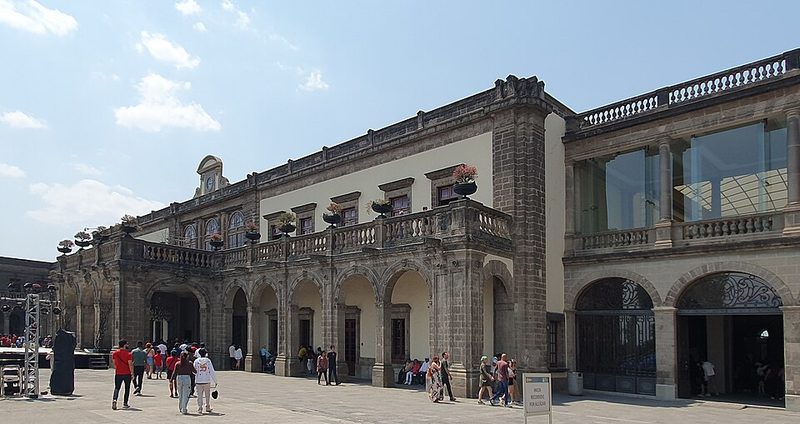
This is where the castle gets glamorous.
In the 1860s, Mexican conservatives invited the Austrian Archduke Maximilian von Habsburg to establish the Second Mexican Empire. He arrived with his wife, Charlotte of Belgium (known in Mexico as Carlota), and the couple moved into Chapultepec Castle in 1864. They renamed it Castillo de Miravalle.
Maximilian hired European and Mexican architects to transform the military academy into a proper royal residence. Among them were Julius Hofmann and Carl Gangolf Kayser — the same architects who later worked on Neuschwanstein Castle in Bavaria, that fairy-tale palace built by Maximilian’s cousin Ludwig II. The connection is fascinating: two of the most photographed castles in the world share designers.
The architects worked in a neoclassical style, making the building livable for royalty. Botanist Wilhelm Knechtel created a roof garden. Maximilian shipped in European furniture, artwork, and household items, many of which are still on display today. He also ordered the construction of a grand boulevard connecting the castle to the city center, modeled after Vienna’s Ringstrasse and the Champs-Elysees. He named it Paseo de la Emperatriz (“Promenade of the Empress”) in honor of Carlota.
After Maximilian was executed by firing squad in 1867 and the Republic was restored under President Benito Juarez, the boulevard was renamed Paseo de la Reforma — the name it carries today, and one of the most important avenues in the city. The Angel of Independence would later rise along its length, and the Diana Fountain would join it as another landmark along the route.
The Presidential Residence
After the fall of the Second Empire, the castle went quiet again. For a while it served as an astronomical observatory. But in 1882, President Manuel Gonzalez declared it the official residence of the President of Mexico, and for the next half-century, nearly every Mexican president lived here.
The presidential years spanned some of Mexico’s most dramatic periods. Porfirio Diaz lived here during his long dictatorship (1876-1880 and 1884-1911), making significant structural changes. After the Mexican Revolution toppled Diaz, the castle stayed in use: Presidents Madero, Carranza, Obregon, Calles, and several others all called it home.
In 1934, President Lazaro Cardenas decided the optics of a president living in a castle were a bit much for a revolutionary republic. He moved the official residence to Los Pinos, elsewhere in Chapultepec Park, and decreed that the castle would become a museum. It opened as the Museo Nacional de Historia (National Museum of History) on September 27, 1944.
One more historical footnote: on January 16, 1992, the Chapultepec Peace Accords were signed inside the castle, ending the Salvadoran civil war. UN Secretary-General Boutros Boutros-Ghali mediated the agreement. It’s a reminder that this building has witnessed consequential moments well into the modern era.
What’s Inside: The National Museum of History
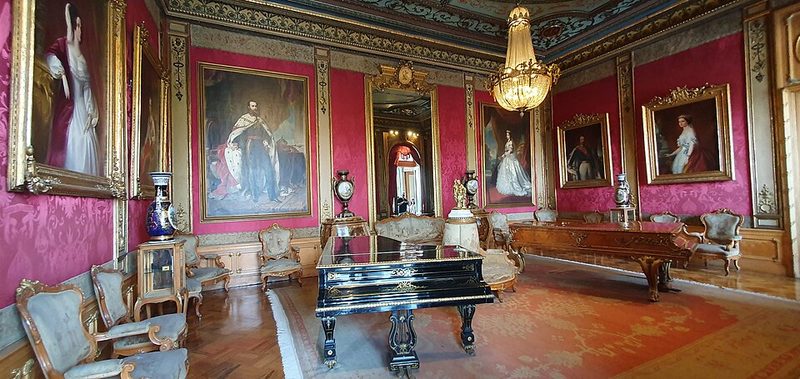
The museum occupies two floors of the castle and covers Mexican history from the Spanish conquest through the 20th century. It’s divided into two main areas: the historical galleries and the restored residential rooms.
The Historical Galleries (Alcazar)
The ground floor galleries walk you through Mexican history in chronological order. The collection includes weapons, uniforms, maps, documents, coins, and religious art from the colonial period forward. There are pieces from the War of Independence, the Reform War, the French Intervention, the Porfiriato, and the Mexican Revolution.
Standout pieces include a suit of armor that belonged to Jose Maria Morelos, banners carried during the War of Independence, and Maximilian’s ornate carriage. There’s also a significant collection of murals by some of Mexico’s most important artists, including David Alfaro Siqueiros, Juan O’Gorman, and Jorge Gonzalez Camarena. These aren’t small works tucked in corners — they’re massive, room-dominating pieces that tell the story of Mexican history with the intensity the muralist movement was known for.
The Imperial and Presidential Rooms
The upper floor is where the castle really earns its name. Here you’ll walk through the restored living quarters of Maximilian and Carlota, followed by rooms used by the various presidents who lived here.
Carlota’s bedroom is extraordinary. European furniture, elaborate floor-to-ceiling decoration, and personal items give you a real sense of how the empress lived. Maximilian’s study and the imperial dining room are similarly impressive. Much of the original European furniture the couple brought over is still in place — it’s one of the few places in the Americas where you can see authentic 19th-century imperial furnishings in their original setting.
The presidential rooms show how the space evolved from the 1880s through the 1930s. You’ll see how different leaders adapted the castle to their tastes, from Porfirio Diaz’s Francophile additions to the simpler post-revolutionary aesthetic.
The Roof Garden and Terrace
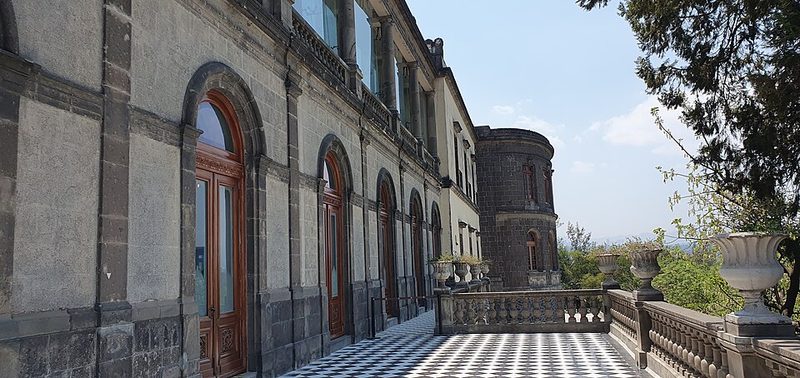
The roof garden that botanist Knechtel designed for Maximilian and Carlota still exists, and it’s one of the most pleasant surprises in the castle. Tropical plants, fountains, and walkways create a peaceful space that feels completely removed from the museum galleries below.
The Views
We need to talk about the views, because they’re legitimately spectacular.
From the castle’s terraces, you get a panoramic sweep of Mexico City that’s hard to beat. To the east, Paseo de la Reforma cuts a straight line toward the Historic Center and the Zocalo, with the towers of the Metropolitan Cathedral visible in the distance. To the north, the high-rises of Polanco glitter. To the south and west, the green expanse of Chapultepec Park stretches out below you. On clear days (increasingly rare, but they happen), you can see the volcanoes.
The view looking down Reforma is particularly striking. You’re standing exactly where Maximilian and Carlota stood, looking down the boulevard the emperor built to connect his castle to the city. The Angel of Independence stands along that same line of sight. It’s one of those rare moments where history and geography click together perfectly.
Practical Information for Visiting
Hours and Admission
The museum is open Tuesday through Sunday, 9:00 AM to 5:00 PM (last entry at 4:15 PM). It’s closed every Monday. Admission is 95 pesos for adults. Mexican citizens and residents with valid ID get in free on Sundays. Children under 13, students, teachers, and seniors with credentials also enter free.
There’s an additional fee if you want to bring a professional camera or tripod, but phone photography is fine throughout the museum.
Getting Up the Hill
Here’s the part nobody warns you about: you have to actually get up the hill. The castle sits at 2,325 meters (7,628 feet) above sea level, on top of a hill that rises roughly 60 meters above the park. That’s a meaningful climb, especially at altitude.
You have two options:
Walk. From the park entrance, it’s about a 15-20 minute uphill walk along a paved, winding road. The road is shaded by trees, and there are benches along the way if you need to rest. It’s not brutal, but at Mexico City’s altitude, you’ll feel it if you’re not acclimatized. Bring water.
Take the “train.” A small shuttle vehicle (more like a glorified golf cart) runs from the base to near the top. It costs a small fee and saves you the uphill walk. It’s worth considering if you have mobility issues or are visiting with small children. The line can get long on weekends.
Either way, once you reach the top, there’s a final stretch of stairs to the castle entrance. There’s no avoiding those.
How Long to Spend
Plan for 2-3 hours minimum. The museum is bigger than it looks, and the imperial rooms and views deserve proper time. If you’re a history buff, you could easily spend 4 hours. If you’re combining this with other Chapultepec attractions, build in at least half a day.
When to Go
Tuesday through Friday mornings are your best bet for smaller crowds. The castle gets very busy on weekends, especially Sundays when admission is free for Mexicans. If you go on a Sunday, arrive right at opening.
Avoid holidays if possible. Mexican school groups visit frequently during the week, but they tend to move through quickly. The best combination of good weather and manageable crowds is a weekday morning between October and March.
Tips for Your Visit
- Wear comfortable shoes. Between the hill climb and the museum’s stone floors, your feet will thank you.
- Bring a light jacket. The castle’s stone walls keep the interior cool, and the terrace gets windy.
- Start with the upper floor (imperial rooms and views), then work your way down through the historical galleries. Most visitors do it backwards and run out of steam before reaching the best parts.
- The museum has a small bookshop near the exit with good options on Mexican history.
- There’s no restaurant inside the castle, but you’ll find food vendors in the park below.
Chapultepec Park: The Bigger Picture
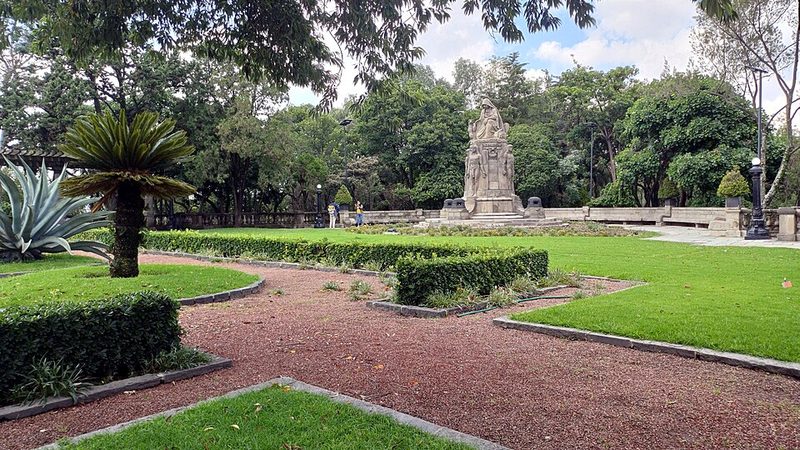
The castle is the crown jewel of Chapultepec Park, but the park itself is an attraction worth understanding. At over 866 hectares (2,140 acres), it’s one of the largest city parks in the Americas — roughly twice the size of Central Park.
The park is divided into four sections. The First Section, where the castle is located, is the oldest and most visited. It receives an estimated 24 million visitors per year. Besides the castle, this section contains the National Anthropology Museum (which we consider one of the best museums on the planet), the Rufino Tamayo Museum, the Chapultepec Zoo, and several lakes and gardens.
The name “Bosque de Chapultepec” (Chapultepec Forest) is apt — despite being surrounded by one of the world’s largest cities, the park is genuinely forested. Walking through the shaded paths between attractions, you’d barely know 22 million people live around you.
If you’re visiting the castle, we strongly recommend combining it with the Anthropology Museum, which is a 15-minute walk downhill through the park. Together, they make one of the best half-day itineraries in the city.
Nearby Neighborhoods and Attractions
Chapultepec sits at the intersection of several of Mexico City’s best neighborhoods, making it easy to combine with other activities.
Polanco borders the park to the north. It’s Mexico City’s most upscale neighborhood, full of high-end restaurants, galleries, and designer shopping. After a morning at the castle, Polanco is an excellent lunch destination.
Condesa is a short walk south of the park. Its tree-lined streets, Art Deco architecture, and cafe culture make it one of the city’s most pleasant neighborhoods for wandering. It’s also where many visitors choose to stay.
Colonia Juarez sits between the park and the Historic Center, right along Reforma. It’s packed with restaurants and bars and makes a natural stopping point if you’re walking from the castle toward the center of the city.
The Historic Center and Zocalo are about 5 kilometers east along Reforma. You can walk it in about an hour (it’s flat and interesting the whole way), take the Metro, or grab an Uber. If you’re connecting the castle to a visit to the Metropolitan Cathedral or the Templo Mayor, the Metro is probably the most efficient option — Chapultepec station is right at the park entrance.
Why Chapultepec Castle Matters
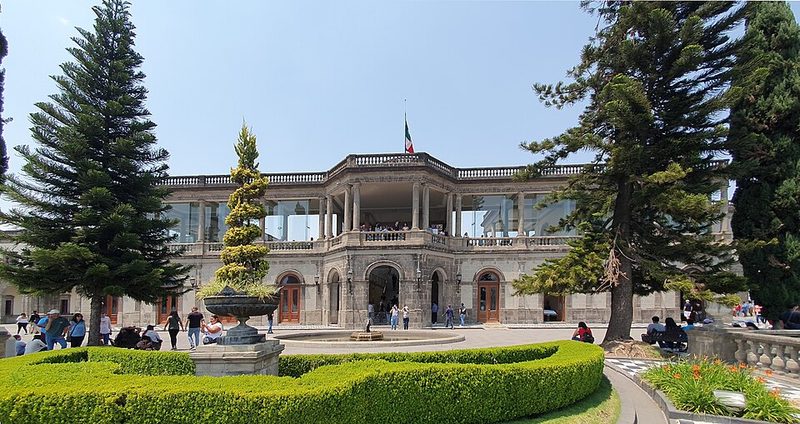
A lot of Mexico City attractions are impressive. The Anthropology Museum has better artifacts. The murals at the National Palace are more famous. The Templo Mayor is more archaeologically significant. But Chapultepec Castle does something none of those places manage: it tells the entire story of Mexico in one building.
You stand in rooms where Aztec rulers retreated from the world. You walk through halls that a Habsburg emperor decorated with European furniture while trying to rule a country that didn’t want him. You see the spot where teenage cadets chose death over surrender. You look out from the same terrace where Mexican presidents surveyed their capital for fifty years.
And then you step outside onto the balcony, and modern Mexico City stretches to the horizon in every direction — 22 million people going about their business around a hilltop that’s been considered special for over 600 years.
It’s the only royal castle in the Americas that was actually inhabited by sovereigns. It’s also, we’d argue, the single best place to begin understanding Mexico City. Start here, then let the rest of the city fill in the details.