
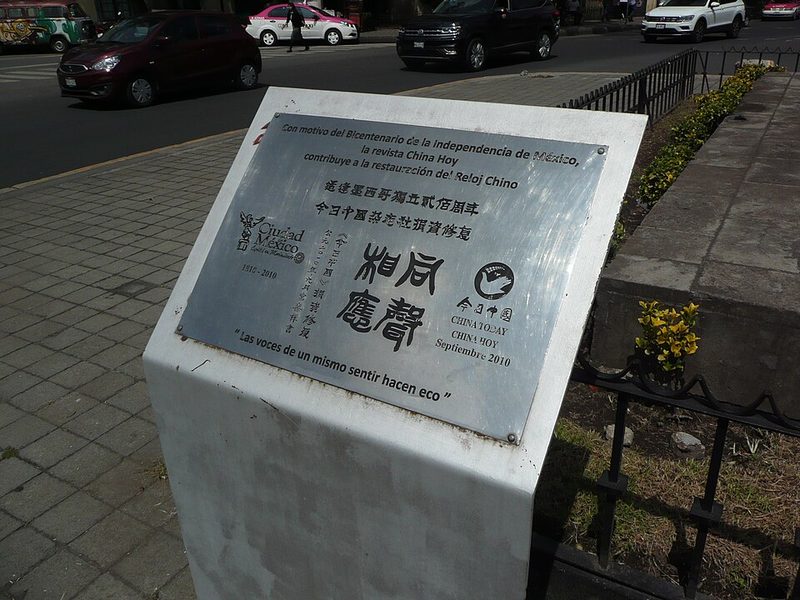
Standing on Avenida Bucareli, in the middle of a traffic island that most people walk past without a second glance, the Reloj Chino is one of Mexico City’s more curious monuments. It’s an Art Nouveau clock tower, roughly 30 feet tall, given to Mexico by the Chinese community in 1910 to celebrate the centennial of Mexican independence. It’s beautiful, odd, and tells a story about a community whose history in Mexico is far more complicated than most visitors realize.
The Monument

The clock is a slender, ornate tower in the Art Nouveau style that was fashionable in the early 1900s. It’s made of metal with decorative elements that mix European design sensibilities with subtle Asian motifs — dragons, stylized vegetation, and flowing lines that could have come from a Parisian metro entrance or a Shanghai garden gate. The combination shouldn’t work, but it does. It’s a genuinely attractive piece of early 20th-century decorative art.
The clock mechanism was made in France, the metalwork was crafted in China, and the whole thing was assembled in Mexico City. It was inaugurated in 1910, just weeks before the Mexican Revolution broke out and turned the country upside down for a decade. The timing was, in retrospect, not great for a monument celebrating national stability and cross-cultural friendship.
The Chinese Community in Mexico
The clock was a gift from Mexico’s Chinese community, which by 1910 had grown to several thousand people, primarily concentrated in northern Mexico and Mexico City. Chinese immigrants had come to Mexico throughout the 19th century as laborers, merchants, and entrepreneurs, building a presence significant enough to warrant this kind of public gesture.
What happened next is one of the darker chapters in Mexican history. During and after the Revolution, anti-Chinese sentiment surged. Chinese businesses were boycotted, Chinese-Mexican marriages were targeted by discriminatory laws, and in 1911, during the Battle of Torreon, over 300 Chinese residents were massacred. Through the 1920s and 1930s, organized anti-Chinese campaigns in northern Mexico forced thousands of Chinese Mexicans to flee the country.
The clock stands as a reminder of a community that gave generously to its adopted country and was repaid with persecution. It’s a small monument, easy to miss, but knowing its backstory gives it a weight that transcends its modest size.
The Location
The Reloj Chino stands on Avenida Bucareli, near the intersection with Avenida Chapultepec, in the Colonia Juarez area. Bucareli is a busy avenue, and the clock sits on a traffic island in the median, which means you’ll need to cross traffic to get a close look. It’s not a destination that requires a special trip — more something you notice while walking through the area and pause to appreciate.
The surrounding stretch of Bucareli has some handsome Porfirian-era buildings, though the avenue has seen better days in terms of maintenance. It’s a transitional area between the Zona Rosa and the Historic Center, busy with pedestrians and traffic at most hours.
Visiting
There’s nothing to “visit” in the traditional sense — it’s a street monument, viewable 24 hours a day, free of charge. The best approach is to incorporate it into a walk through the area. If you’re heading from Colonia Juarez or the Zona Rosa toward the Historic Center, Bucareli is a natural route, and the clock is worth a five-minute stop.
The monument is in decent condition, having been restored several times over the decades. It looks best in the morning light, when the metalwork catches the sun and the Art Nouveau details are most visible. At night, it’s illuminated, which gives it a different but equally attractive character.
For context, the Reloj Chino is one of several monuments scattered along Bucareli and the surrounding avenues that mark different moments in Mexico City’s history. None of them are major attractions individually, but together they form a kind of open-air timeline of the city’s international connections and aspirations. The Chinese Clock, with its complicated history and beautiful design, is arguably the most interesting of the bunch.