
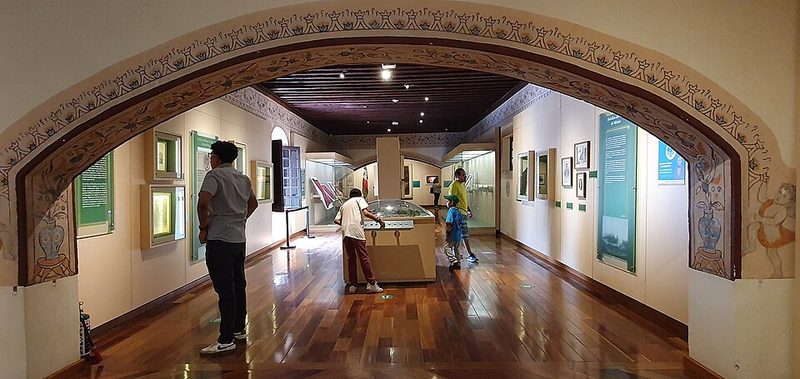
Mexico has been invaded by foreign powers more times than most countries care to think about. The Spanish conquest. Two French interventions. An American war that cost Mexico half its territory. A brief Austrian-backed empire. Various border incursions and diplomatic strong-arming across three centuries. If you want to understand why Mexican national identity has such a sharp edge of defiance, you need to understand this history.
The Museo Nacional de las Intervenciones — the National Museum of Interventions — is the only museum in Mexico dedicated entirely to this subject. It’s housed in a former Franciscan monastery in Coyoacan that was the site of a critical battle during the Mexican-American War, and it doesn’t pull punches. This is Mexico’s story of foreign aggression, told from Mexico’s perspective, and it’s as revealing as it is uncomfortable for visitors from the countries that did the invading.
The Building: Ex-Convento de Churubusco

The Monastery of Our Lady of the Angels at Churubusco was originally a Franciscan friary, built in the 17th century on the site of an Aztec temple dedicated to the war god Huitzilopochtli. The name “Churubusco” is a Spanish corruption of “Huitzilopochco,” which meant “place of Huitzilopochtli.” Even the building’s name carries the history of cultural overwriting that the museum documents.
The monastery was a functioning religious house for nearly two centuries, featuring a church, cloisters, gardens, cells, a refectory, and the typical elements of a well-funded colonial friary. The complex was substantial — the friars cultivated orchards and gardens in what was then a separate town south of Mexico City, connected to the capital by a causeway across the remnants of Lake Texcoco.
The Reform Laws of the 1850s-60s expelled the monks and nationalized the property. The buildings served various military and government purposes before being designated a museum in 1981.
The Battle of Churubusco: August 20, 1847
The monastery’s most dramatic chapter came on a single day in August 1847, during the Mexican-American War. After defeating Mexican forces at the Battle of Padierna (also called Contreras) earlier that morning, American troops under General David Twiggs pushed toward Mexico City. The monastery of Churubusco stood in their path.
Mexican General Pedro Maria Anaya fortified the monastery and its surrounding area with about 1,300 troops, including regular army soldiers and members of the National Guard. Also defending the position were members of the Batallon de San Patricio — the Saint Patrick’s Battalion — a unit of mostly Irish Catholic immigrants who had deserted the U.S. Army to fight for Mexico.
The reasons for the San Patricios’ defection were complex. Many were recent immigrants who faced discrimination in the predominantly Protestant U.S. military. Catholic solidarity with Mexico played a role. So did Mexican offers of land grants and officer commissions. Whatever their motivations, they fought ferociously at Churubusco, manning the monastery’s cannons until they literally ran out of ammunition.
The battle lasted about three hours. The Mexican defenders held out far longer than the Americans expected, repelling multiple assaults. According to Mexican accounts, when the ammunition was exhausted, some defenders wanted to surrender, but others — including members of the San Patricio Battalion — tore down the white flags. The monastery finally fell when American troops breached the walls.
The aftermath was grim. General Anaya, captured inside the monastery, allegedly told American General Twiggs: “If I had ammunition, you would not be here.” (Historians debate whether this actually happened, but the quote is engraved on a plaque inside the museum.) Many of the captured San Patricios were court-martialed and executed by hanging — the largest mass execution in U.S. military history at that time. Others were branded on the cheek with the letter “D” for deserter.
The San Patricios remain heroes in Mexico. A holiday honoring them falls on September 12, and monuments to the battalion exist in both Mexico City and the Irish town of Clifden. In the museum, their story receives prominent attention.
The Museum Collection
The museum covers foreign interventions in Mexico from independence (1821) through the 20th century. The collection is organized chronologically across the monastery’s former rooms and cloisters.
The Spanish Period and Independence
The opening galleries cover the last years of Spanish colonial rule, the War of Independence (1810-1821), and Spain’s 1829 attempt to reconquer Mexico under General Isidro Barradas, which ended in humiliating Spanish defeat at Tampico.
Texas, the Mexican-American War, and the Treaty of Guadalupe Hidalgo
This is the most extensive section and the one that hits hardest, particularly for American visitors. The museum presents the loss of Texas, the disputed border provocations, the U.S. invasion, the battles of Palo Alto, Resaca de la Palma, Monterrey, Buena Vista, Cerro Gordo, and the fall of Mexico City with detailed maps, weapons, uniforms, and documents.
The Treaty of Guadalupe Hidalgo (1848), which stripped Mexico of roughly half its national territory — present-day California, Nevada, Utah, Arizona, New Mexico, and parts of Colorado, Wyoming, Kansas, and Oklahoma — is documented with reproductions of the original treaty and maps showing the scale of territorial loss. It’s a gut punch presented without editorializing, which somehow makes it more effective.
The Battle of Churubusco itself is covered in detail, with the monastery serving as both museum and artifact. You can see the walls where the fighting happened, bullet marks in the stone, and the positions where the defenders made their stand. The connection between the collection and the building is the museum’s greatest asset.
The French Interventions
Both French invasions of Mexico are covered: the “Pastry War” of 1838 (France invaded over unpaid debts and damaged French-owned businesses, including a pastry shop — yes, really) and the much more serious French Intervention of 1861-67, which installed Maximilian von Habsburg as Emperor of Mexico. The section on the Second Empire includes weapons, documents, and a nuanced treatment of Maximilian himself, who the museum portrays as a well-intentioned but doomed pawn of French imperial ambitions.
20th Century Interventions
The later galleries address American interventions in the 20th century: the occupation of Veracruz in 1914, Pershing’s Punitive Expedition into northern Mexico in 1916-17 chasing Pancho Villa, and broader diplomatic pressures. The museum extends its scope to include economic interventions and political interference, making the argument that foreign intervention didn’t end with the departure of armies.
The Building and Grounds
Beyond the collection, the monastery itself is well worth exploring. The main cloister, with its stone arches and central garden, is one of the most photogenic colonial spaces in southern Mexico City. The church, still partially intact, retains some original decorative elements. The former monks’ garden has been restored as a pleasant green space.
The grounds also include the monument to General Anaya and the defenders of Churubusco, and several plaques and markers related to the 1847 battle.
Practical Information
Getting There
The museum is at 20 de Agosto and General Anaya, Colonia San Diego Churubusco, in the Coyoacan borough. The nearest Metro station is General Anaya (Line 2), about a 5-minute walk. From central Coyoacan, it’s about a 15-minute walk or a quick taxi ride.
Hours and Admission
Open Tuesday through Sunday, 9:00 AM to 6:00 PM. Closed Mondays. Admission is approximately 85 MXN. Free on Sundays for Mexican nationals and residents.
How Long to Spend
Plan for 90 minutes to 2 hours. The collection is extensive and text-heavy (primarily in Spanish, with some English signage), so budget more time if you want to read everything.
Combining with Other Visits
The museum pairs naturally with a day in Coyoacan. It also connects thematically with Chapultepec Castle, site of the Boy Heroes’ last stand during the same 1847 campaign, and with Mexico City’s broader history.
Why It’s Worth Visiting
The Museo Nacional de las Intervenciones is the rare museum that makes you reconsider things you thought you knew. American visitors in particular tend to leave thoughtful and somewhat shaken — the Mexican-American War receives roughly two paragraphs in most U.S. history textbooks, and here it fills several rooms with consequences that shaped the entire continent.
It’s also a beautiful building in a pleasant neighborhood, which helps. History doesn’t always need to be depressing to be important, and the monastery’s colonial architecture provides a graceful counterpoint to the difficult stories told inside its walls.