
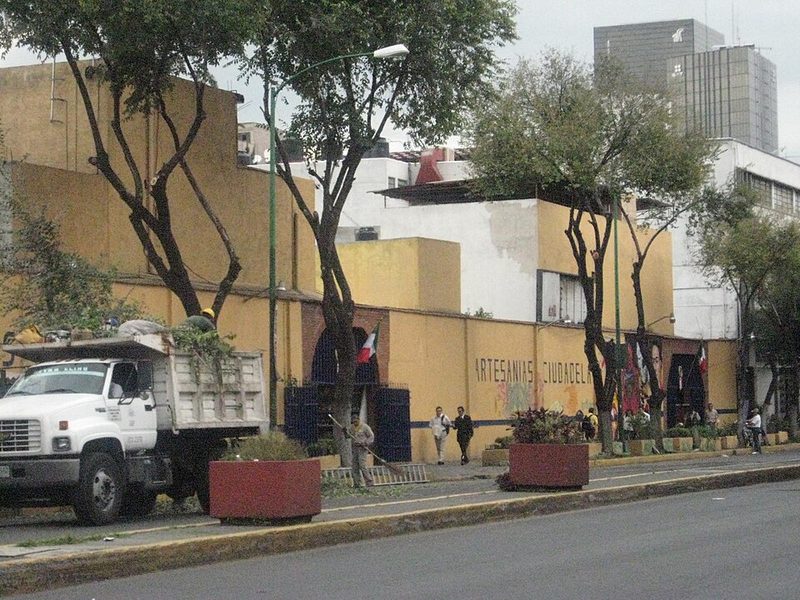
La Ciudadela is one of those Mexico City places that does triple duty. It’s a historically significant building from the late colonial period. It houses one of the most important public libraries in the country. And right next door, there’s a craft market that’s among the best places in the city to buy souvenirs without getting ripped off. Three reasons to visit, all within a block of each other, and most tourists know about only one of them — if they know about any at all.
The complex sits on the southern edge of the Historic Center, on Plaza de la Ciudadela, roughly halfway between the Zocalo and the Revolution Monument. It’s an area that doesn’t see heavy foot traffic from visitors, which is a shame, because the combination of history, culture, and shopping makes it one of the more rewarding stops in central Mexico City.
A Building With a Violent Past
La Ciudadela — “the citadel” — was originally built in 1807 as the Real Fabrica de Tabaco, a royal tobacco factory. The Spanish colonial government controlled tobacco production as a state monopoly, and this massive building was designed to centralize manufacturing in the capital. The architect was Antonio Gonzalez Velazquez, and the building he produced is a solid, fortress-like rectangle organized around interior courtyards. It looks like it was built to withstand a siege, which turned out to be prophetic.
After Mexican independence in 1821, the tobacco factory was converted into a military arsenal and weapons depot. The thick walls and defensible layout made it a natural fit for storing arms and ammunition. And it was in this capacity — as a military installation in the heart of the capital — that La Ciudadela became the scene of one of the bloodiest episodes in Mexican history.
The Decena Tragica
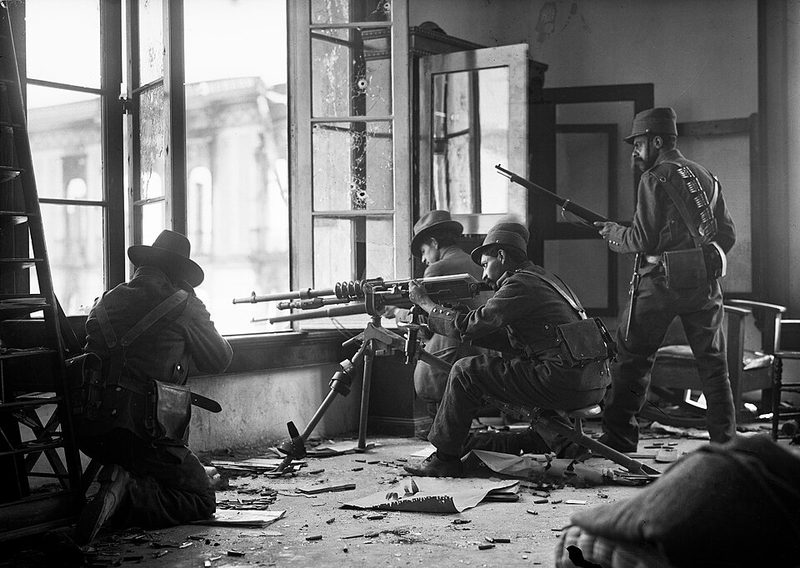
In February 1913, a group of military officers launched a coup against President Francisco Madero, the idealistic revolutionary who had overthrown the Diaz dictatorship only to find that governing Mexico was considerably harder than overthrowing it. The rebels, led by generals Bernardo Reyes and Felix Diaz (nephew of the deposed dictator), seized La Ciudadela as their stronghold on February 9.
What followed was ten days of fighting in the streets of central Mexico City — the Decena Tragica, or “Tragic Ten Days.” Artillery shells flew between La Ciudadela and the National Palace. Buildings were destroyed. Civilians were caught in the crossfire, and hundreds of people died in a part of the city that was (and is) densely populated. The fighting caused tremendous damage to the surrounding blocks, and the psychological impact on the capital was severe.
Behind the scenes, General Victoriano Huerta — who was supposed to be defending President Madero — was secretly negotiating with the rebels. With the connivance of U.S. Ambassador Henry Lane Wilson (one of the most shameful episodes in American diplomatic history), Huerta arrested Madero and his vice president, Jose Maria Pino Suarez. Both were murdered on February 22, 1913, reportedly while being “transferred” between prisons — shot “while trying to escape,” according to the official story that nobody believed then and nobody believes now.
Huerta seized the presidency. The Decena Tragica triggered a new phase of the Mexican Revolution, as leaders across the country rose up against the usurper. The violence that followed would continue for years and cost hundreds of thousands of lives. All of it traces back, in part, to what happened at La Ciudadela in February 1913.
Walking through the building today, with its quiet courtyards and library reading rooms, it’s hard to imagine artillery positions and barricades. But the walls are thick enough to remind you that this place was built to hold things of value — and that for ten terrible days, the most valuable thing it held was a political position.
Biblioteca de Mexico
Since 1946, La Ciudadela has housed the Biblioteca de Mexico, one of the country’s most important public libraries. The library was founded by Jose Vasconcelos, the philosopher and education minister who believed that access to books was the foundation of a democratic society. Vasconcelos is a complicated figure in Mexican history — his later political views were, to put it gently, problematic — but his contribution to Mexican public education and literacy was substantial, and the library bears his imprint.
The library occupies the vast interior of the former tobacco factory, and the spaces have been adapted beautifully. High ceilings, natural light from the courtyards, and a general atmosphere of serious quietude make it a genuinely pleasant place to spend time. The collection includes hundreds of thousands of volumes covering every subject imaginable, and the reading rooms are open to the public without charge or membership.
In recent years, the library has been expanded and modernized. Several important personal libraries — including those of writers Carlos Monsivais, Antonio Castro Leal, Jaime Garcia Terres, and Ali Chumacero — have been incorporated into the collection and given their own dedicated rooms. The Monsivais collection alone is worth a visit for anyone interested in Mexican culture; the man collected everything from books to popular art to political ephemera, and his library reflects the encyclopedic curiosity that made him one of Mexico’s greatest public intellectuals.
The library regularly hosts cultural events, book presentations, lectures, and exhibitions. The courtyards are used for outdoor events, and there’s a general sense that the building is being actively used rather than passively preserved. It’s a living institution inside a historic shell.
Mercado de Artesanias de la Ciudadela

Adjacent to the library, on the east side of the plaza, sits the Mercado de Artesanias de la Ciudadela — the Ciudadela Craft Market. If you want to buy Mexican handicrafts and you only have time for one market, this is a strong candidate.
The market houses several hundred stalls selling crafts from across Mexico. The range is broad: Oaxacan alebrijes (the brightly painted wooden animal figures), Talavera pottery from Puebla, silver jewelry from Taxco, embroidered textiles from Chiapas, leather goods, hammocks, Day of the Dead figurines, lucha libre masks, handmade toys, blown glass, and more. The quality varies from stall to stall, as it does in any large market, but the overall standard is higher than what you’ll find at most tourist-oriented shops, and the prices are reasonable.
Bargaining is expected but doesn’t need to be aggressive. A polite counteroffer of 10-20% below the asking price is standard practice. Many vendors speak some English, and most are happy to explain where their products come from and how they’re made. If you’re interested in a particular craft tradition — say, black pottery from Oaxaca or lacquerware from Michoacan — asking questions will often lead you to the stalls with the best pieces.
The market is particularly good for gifts and souvenirs. The prices are significantly lower than what you’d pay in the Zona Rosa or in boutique shops in Roma or Condesa, and the selection is wider. It’s also a much more pleasant shopping experience than the sprawling markets in some other parts of the city — the Ciudadela market is contained, organized, and easy to navigate.
The market is open daily, typically from around 10 AM to 7 PM, though some stalls may close earlier on slower days. Weekends are busier but also offer the best selection, as some vendors only set up on Saturdays and Sundays.
Visiting La Ciudadela
La Ciudadela is on Plaza de la Ciudadela, bounded by Avenida Balderas, Calle Emilio Donde, and surrounding streets. The nearest metro stations are Balderas (Lines 1 and 3) and Juarez (Line 3), both within a short walk.
The library is free to enter and open Tuesday through Sunday (check current hours, as they can change). The craft market is open daily. Neither requires a reservation or advance planning. You can comfortably visit both in about two hours — an hour browsing the market and an hour exploring the library and building.
From here, it’s a 10-minute walk north to the Alameda Central and the Palace of Fine Arts. Walking east brings you into the Historic Center proper and toward the Zocalo. The Revolution Monument is about 15 minutes northwest on foot. La Ciudadela works well as a stop between these areas, a place to pause and reorient before continuing deeper into the center.