
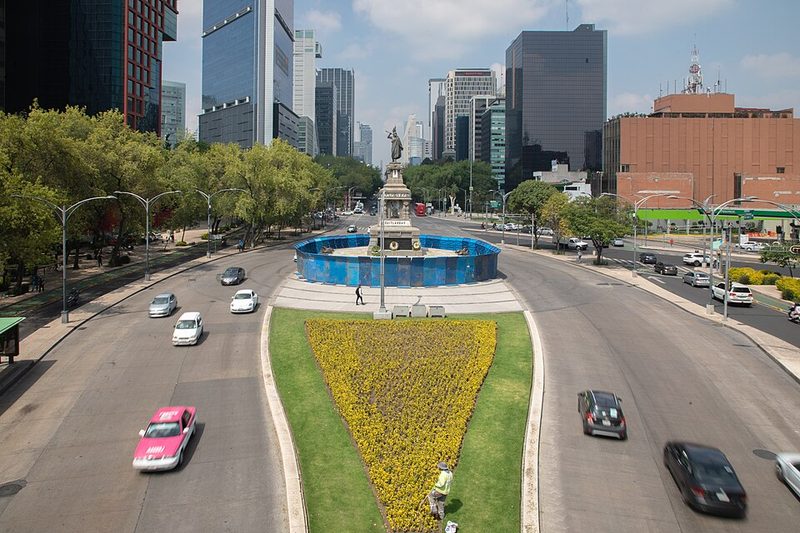
At the intersection of Paseo de la Reforma and Avenida de los Insurgentes — two of the most important avenues in Mexico City — stands a bronze statue of a man holding a spear, looking south toward the land he once ruled. This is the Monumento a Cuauhtemoc, honoring the last tlatoani (ruler) of the Aztec Empire, the young warrior who chose to fight rather than surrender when everything was already lost.
The monument is one of several major landmarks along Paseo de la Reforma, positioned between the Angel of Independence to the west and the Historic Center to the east. It’s smaller in scale than the Angel, easier to miss from a passing car, and far more historically significant than most visitors realize.
Who Was Cuauhtemoc?

Cuauhtemoc (c. 1502-1525) was the last independent ruler of Tenochtitlan, the Aztec capital that stood where Mexico City’s Zocalo is today. His name means “Descending Eagle” or “Eagle That Has Landed” in Nahuatl, and his brief reign was defined entirely by the catastrophe of the Spanish conquest.
He came to power in 1520, at roughly 18 years old, after his predecessor Cuitlahuac died of smallpox — the same epidemic that had been brought by the Spanish and was devastating the indigenous population. Cuauhtemoc inherited an empire under siege: Hernan Cortes had been expelled from Tenochtitlan during the Noche Triste (Night of Sorrows) but was regrouping with indigenous allies from Tlaxcala and other rival city-states.
For 80 days in the summer of 1521, Cuauhtemoc led the defense of Tenochtitlan against Cortes’ combined Spanish-Tlaxcaltec forces. The siege was devastating. The Aztecs fought from canoes on the lake, from rooftops in the city, and street by street as the Spanish advanced, demolishing buildings as they went. By the end, Tenochtitlan was largely destroyed, its population decimated by combat, starvation, and disease.
Cuauhtemoc was captured on August 13, 1521, while attempting to escape by canoe across Lake Texcoco. According to Spanish accounts, he approached Cortes and said: “I have done everything in my power to defend my city and my people. I have failed. Now take that dagger from your belt and kill me with it.” Cortes, who needed Cuauhtemoc alive for political reasons and to locate the Aztec treasury, refused.
What followed was grim. Cortes had Cuauhtemoc tortured — his feet were burned with oil — to extract information about where the Aztec gold was hidden. Cuauhtemoc reportedly endured the torture without revealing anything, or possibly there was nothing significant to reveal. He was kept as a prisoner for four years, useful to the Spanish as a puppet authority figure to help control the indigenous population.
In 1525, during Cortes’ disastrous overland expedition to Honduras, Cuauhtemoc was accused of plotting a rebellion. He was hanged, along with several other indigenous leaders, in what most modern historians consider a political murder rather than a justified execution. He was approximately 23 years old.
Cuauhtemoc as National Symbol
In modern Mexico, Cuauhtemoc represents indigenous resistance to colonialism. He’s the figure who fought to the end, who refused to betray his people under torture, who chose death over submission. Whether all the details of his story are historically verified matters less than what he symbolizes: defiance against overwhelming power.
His image appears on Mexican currency (the 50-peso coin features his likeness), streets and plazas across the country bear his name, and Mexico City’s downtown borough is called Delegacion Cuauhtemoc. The phrase attributed to him during his torture — directed at a fellow captive who was crying out in pain: “Am I on a bed of roses?” — has become proverbial in Mexican Spanish.
Cuauhtemoc is also a touchstone for the complicated relationship between Mexico’s indigenous past and its mestizo (mixed) present. Honoring the last Aztec emperor while living in a Spanish-speaking, Catholic country built on the ruins of the empire he tried to save involves contradictions that Mexicans have navigated for centuries. The monument on Reforma is one physical expression of that ongoing negotiation.
The Monument
The Monumento a Cuauhtemoc was designed by engineer Francisco Jimenez and sculpted by Miguel Norena. It was inaugurated on August 21, 1887, during the presidency of Porfirio Diaz — ironic, given that Diaz’s regime was arguably more sympathetic to European cultural models than indigenous ones. But even Diaz recognized the political utility of honoring pre-Hispanic heroes as symbols of Mexican nationhood.
The monument consists of a large stone pedestal with bronze relief panels, topped by the bronze statue of Cuauhtemoc. The figure stands upright, holding a spear in his right hand, wearing an eagle-feather headdress and a loincloth. The posture is one of readiness rather than attack — Cuauhtemoc is prepared to fight, but the moment captured is one of vigilance.
The pedestal’s relief panels depict scenes from the conquest, including the torture of Cuauhtemoc. The base includes carved elements drawing on pre-Hispanic decorative motifs. The overall style is 19th century academic sculpture with Aztec-inspired ornamentation — typical of the Porfirian era’s attempt to create a national aesthetic that merged European and indigenous references.
Visiting
The monument sits in the center of the Glorieta de Cuauhtemoc, a major traffic roundabout (glorieta) on Paseo de la Reforma at the intersection with Avenida de los Insurgentes. It’s accessible by pedestrians via crosswalks from the surrounding sidewalks.
Getting There
- Metro: Cuauhtemoc station (Line 1) is two blocks south on Insurgentes. Insurgentes station (Line 1) is also close.
- Metrobus: Line 1 runs along Insurgentes with stops at Reforma.
- On foot: The monument is a natural stop during a walk along Reforma between Chapultepec and the Historic Center. It’s about 1.5 km east of the Angel of Independence and about 2 km west of the Alameda Central.
- EcoBici: Multiple bike share stations near the glorieta.
How Long to Spend
The monument itself takes 10-15 minutes to appreciate — walk around the base, look at the relief panels, read the inscriptions. It’s not a destination that requires a dedicated trip; it’s a meaningful stop along the Reforma walk that most visitors are doing anyway.
Context Walk
For the full historical experience, walk Reforma from west to east, passing the major monuments in order: the Angel of Independence (celebrating Mexican independence in 1810), the Diana Fountain (representing the hunt), the Cuauhtemoc Monument (the last Aztec ruler), and eventually reaching the Historic Center where Cuauhtemoc’s capital of Tenochtitlan once stood. The walk tells the story of Mexico in reverse chronological order — modern nation, colonial upheaval, indigenous empire — and the Cuauhtemoc monument is the pivot point where the story shifts from post-colonial to pre-colonial.
Why It Matters
Most tourists walk past the Cuauhtemoc monument without a second glance, focused on reaching the Angel or the Zocalo. That’s understandable — it’s a 19th century statue in a traffic circle, and it doesn’t announce itself the way the golden Angel does.
But if you know who Cuauhtemoc was and what he represents, the monument takes on a weight that the Angel can’t match. This is Mexico honoring the man who fought the last battle before everything changed — before the language changed, before the religion changed, before the city was razed and rebuilt. He’s standing on Reforma, the boulevard that the French-backed emperor Maximilian built, at the intersection with Insurgentes, the avenue named for independence fighters, looking toward the ground where his capital once stood.
Every layer of Mexican history is compressed into that one spot. It takes a minute to see it, but once you do, you won’t walk past it again.