If you’ve ever driven, walked, or been stuck in traffic along Paseo de la Reforma, you’ve seen her. A bronze woman, bow drawn, arrow aimed at the sky, standing on a stone pedestal in the middle of a busy roundabout. She’s the Fuente de la Diana Cazadora — the Diana the Huntress Fountain — and she’s been one of Mexico City’s most photographed, most argued-about, and most stubbornly enduring landmarks since 1942. She’s also, as we’ll get into, the subject of one of the city’s most absurd censorship episodes. But more on that in a moment.
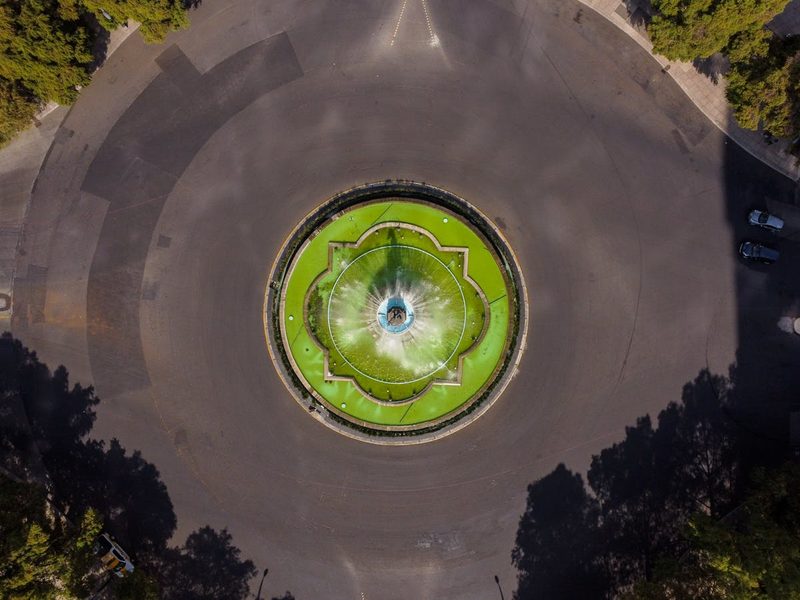
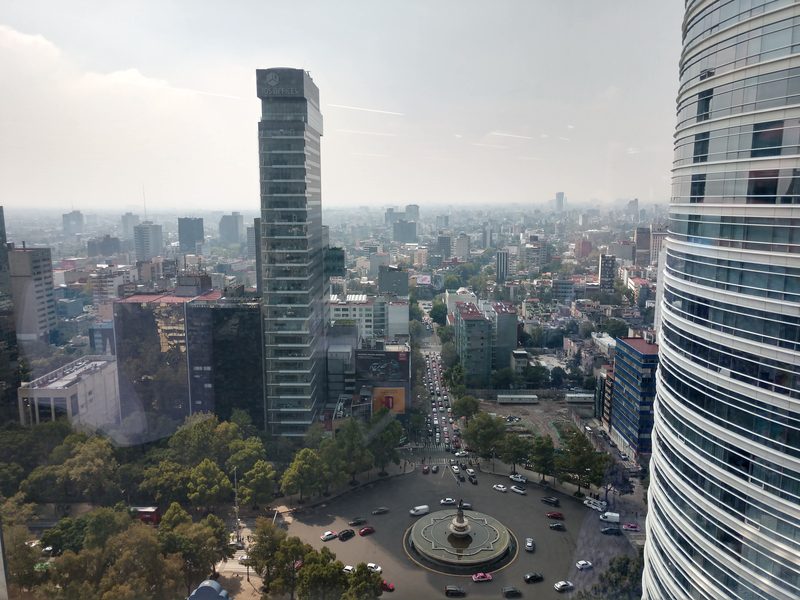
The Diana Fountain sits at the intersection of Paseo de la Reforma, Rio Misisipi, and Calle Sevilla, right on the border between Colonia Juarez and the Zona Rosa. It’s impossible to miss. The fountain itself is large, the statue is tall, and the whole thing commands a glorieta (traffic circle) that sees thousands of cars per day. If you’re walking between the Angel of Independence and the entrance to Chapultepec, you’ll pass right by her.
What You’re Actually Looking At
The statue depicts Diana, the Roman goddess of the hunt. But unlike most classical representations where Diana is shown mid-hunt chasing deer or accompanied by hounds, this version has her aiming her arrow upward — toward the stars of the northern sky. It’s a deliberate choice by the sculptor, and it gives the piece a sense of ambition rather than aggression. She’s not hunting animals. She’s reaching for something bigger.
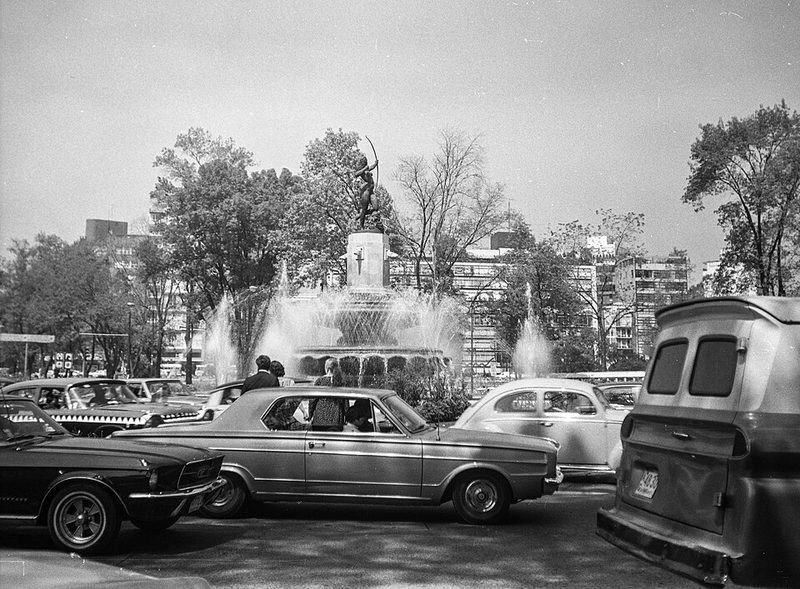
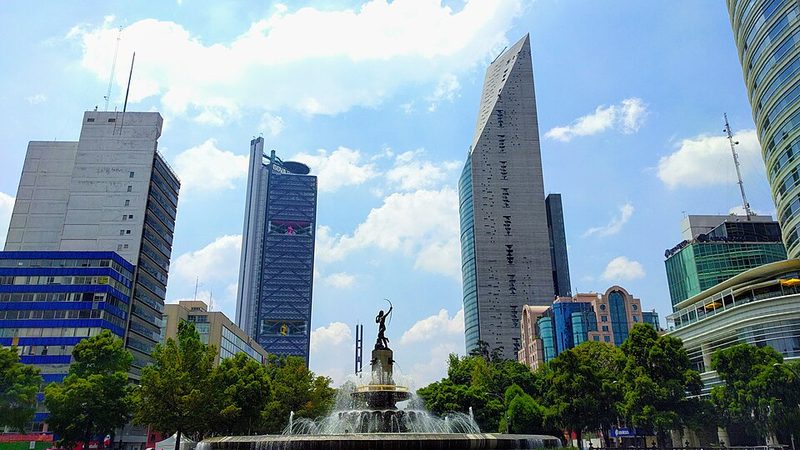
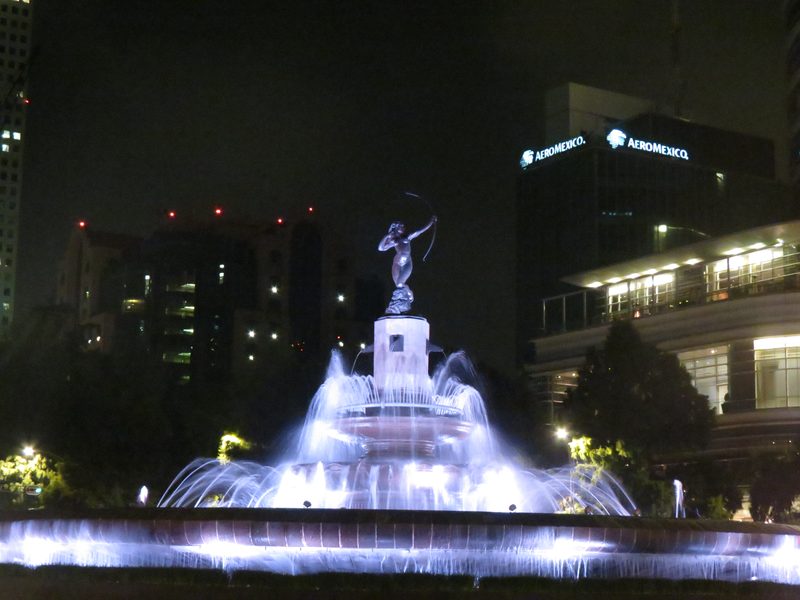
The bronze figure stands atop a stone pedestal decorated with relief carvings, all surrounded by a circular fountain basin. Water jets frame the statue during operating hours, and at night the whole thing is lit up, making it one of Reforma’s more striking sights after dark. The total height from the base of the fountain to the tip of Diana’s arrow is roughly 8 meters.
The statue is fully nude, which — as you might have guessed — is where the trouble started.
The History Behind the Fountain
How It Got Commissioned
In the 1930s and 1940s, Mexico City’s government went on a beautification spree. This was the era of the mural movement, when socialist realism was the dominant aesthetic and the government wanted big, bold public art to match big, bold public infrastructure. Various monuments and monumental fountains were placed along Reforma and other major avenues during this period.
President Manuel Avila Camacho, working through Javier Rojo Gomez (the regent of the Federal District at the time), commissioned a fountain for the roundabout near the entrance to the Bosque de Chapultepec. The project went to architect Vicente Mendiola and sculptor Juan Fernando Olaguibel, a pair who had already collaborated on similar projects around the city, including the fountain at Plaza California in Colonia del Valle and the Fuente del Petroleo (Oil Fountain).
The theme they were given — or perhaps chose, accounts vary slightly — was Diana, Roman goddess of the hunt. The sculpture was created between April and September of 1942, which is impressively fast for a piece of this scale. It was unveiled on October 10, 1942.
The Model: Helvia Martinez Verdadera
Every great statue has a model, and Diana’s was a seventeen-year-old named Helvia Martinez Verdadera. She was reportedly chosen by Olaguibel after a search for someone who could embody the athletic, classical proportions the piece demanded. Helvia posed for the sculptor over the course of several months, and by all accounts the arrangement was entirely professional.
But this being Mexico in the 1940s, the fact that a real, identifiable woman had modeled for a nude public statue was going to become a problem. And it did — though not immediately.
The Censorship Scandal
When the fountain was first unveiled, reactions were generally positive. Mexico City in 1942 was, in many ways, a cosmopolitan place. Art was taken seriously. Public nudity in the context of classical sculpture wasn’t inherently scandalous.
But conservative groups, particularly elements within the Catholic Church, weren’t having it. They launched a sustained campaign against the statue, calling it indecent and demanding it be removed or covered. The pressure was intense enough that the city government eventually caved — but rather than remove the statue entirely, they chose a solution that was arguably more embarrassing than the nudity itself.
They put a bronze loincloth on her.
That’s right. Someone was commissioned to cast a small piece of bronze underwear, and it was welded onto the statue. The Diana Cazadora — an athletic goddess aiming for the stars — was given what amounted to a metal bikini bottom. The artistic community was, understandably, furious. The modification was seen as an act of cultural vandalism, a capitulation to prudishness that made both the government and the statue look ridiculous.
The loincloth stayed on for decades. It wasn’t until 1967 that the city finally removed it and restored the statue to its original, unclothed form. By that point, attitudes had shifted enough that there was no serious opposition. The whole episode remains one of Mexico City’s favorite stories about the clash between art and conservative politics — a reminder that even in a city that prides itself on its cultural sophistication, sometimes the prudes win a round.
Helvia’s Story
As for Helvia Martinez Verdadera, the censorship scandal affected her too. When it became widely known that she was the model, she faced social stigma. In the Mexico of the 1940s, being publicly associated with nudity — even artistic nudity — could damage a young woman’s reputation. For years, the connection between Helvia and the statue was something people whispered about rather than celebrated.
It wasn’t until much later, as Mexico City matured and the statue became beloved rather than controversial, that Helvia’s role was openly acknowledged and honored. She eventually became a point of pride — the woman behind one of the city’s most iconic monuments. She passed away in 2015 at the age of 89.
The Sculptor: Juan Fernando Olaguibel
Olaguibel was one of mid-twentieth century Mexico’s most accomplished sculptors, though he doesn’t always get the recognition he deserves outside of specialist circles. Born in 1896, he trained in the tradition of academic sculpture but was working during an era when Mexican art was being transformed by the muralist movement and its emphasis on public, accessible work.
The Diana Fountain is probably his most famous piece, but he was prolific. He worked with architect Vicente Mendiola on several public fountain projects in Mexico City, and his style — muscular, classical, with a distinctly Mexican sensibility — helped define the look of mid-century public spaces in the capital.
Mendiola, for his part, designed the fountain’s architectural elements: the basin, the pedestal, and the overall spatial relationship between the sculpture and its surroundings. It’s a successful collaboration. The fountain doesn’t just display the statue; it frames it, gives it context, and makes it feel like a natural part of the roundabout rather than something dropped there by accident.
The Fountain’s Journey Across Reforma
Here’s something most visitors don’t know: the Diana Fountain hasn’t always been where it is now. In 1974, the statue was relocated from its original position to make way for road construction and traffic changes along Reforma. It was moved to a spot near the Periférico, the city’s ring road, which was a significant downgrade in terms of visibility and prestige.
The move was unpopular. The Diana had become so associated with its original glorieta that people felt something was wrong with that stretch of Reforma without her. After years of public pressure and cultural advocacy, the statue was returned to its original roundabout in 1992 — exactly 50 years after it was first installed. The restoration was treated as a significant cultural event, and the return of Diana to her proper place on Reforma was widely celebrated.
Today she sits exactly where she was always meant to be, at the heart of one of the most important boulevards in the Americas.
What’s Around the Fountain
The Diana Fountain’s location puts it at a crossroads — literally and figuratively — of several of Mexico City’s most interesting neighborhoods and landmarks.
The Immediate Surroundings
The glorieta itself is surrounded by some of Reforma’s most prominent modern architecture. The Torre Diana and the Corporativo Reforma Diana (also called Torre Reforma Diana) are two sleek skyscrapers that take their names directly from the fountain. There’s also the Cine Diana, a movie theater that’s been a fixture of the area for decades, though it’s gone through various reinventions over the years.
The Zona Rosa, Mexico City’s historically LGBTQ+ friendly entertainment district, is immediately to the south and east. It’s packed with restaurants, bars, and nightlife, though its character has changed significantly over the decades. Colonia Juarez, which borders the fountain to the south, has become one of the city’s most dynamic neighborhoods for food and culture.
Nearby Landmarks
Walking east along Reforma for about 10 minutes brings you to the Angel of Independence, Mexico City’s most recognizable monument. The two landmarks — the Angel and Diana — are the most photographed structures on Reforma, and walking between them gives you a good feel for the boulevard’s scale and character.
Head west from Diana and you’re walking toward Chapultepec, Mexico City’s enormous urban park. Within the park you’ll find Chapultepec Castle, the only royal castle in the Americas, perched on a hill overlooking the city. The National Anthropology Museum, one of the finest museums in Latin America, is also in the park, about a 20-minute walk from the fountain.
To the south, you’ve got Roma Norte and Condesa, two of the city’s most popular neighborhoods for dining, coffee, parks, and walking around. And north of Reforma lies Polanco, the upscale neighborhood known for high-end shopping, galleries, and some of the city’s best restaurants.
Visiting the Diana Fountain: Practical Information
How to Get There
The easiest way to reach the Diana Fountain is via the Metrobus. The Reforma line (Line 7) has a stop called “Diana” that drops you essentially right at the roundabout. You can also take Line 1 of the Metro to Sevilla station, which is about a 5-minute walk south of the fountain.
If you’re already on Paseo de la Reforma — say, walking from the Angel of Independence — the Diana is roughly a 10-minute walk heading west. The sidewalks along Reforma are wide and well-maintained, and the walk gives you a chance to appreciate the boulevard’s other monuments and architecture.
Uber and taxi rides from most central neighborhoods will cost very little to get here, but keep in mind that Reforma traffic can be brutal during rush hours. Walking or using public transit is often faster.
Best Time to Visit
The fountain looks great at any time of day, but we’d particularly recommend two windows:
Early morning (7-9 AM): The light on Reforma is beautiful at this hour, the crowds are thin, and the traffic hasn’t reached its midday intensity. If you want photos without a thousand cars in the background, this is your window.
After dark (8-10 PM): The fountain is illuminated at night, and the combination of the lit bronze figure, the water, and the lights of Reforma’s skyscrapers makes for a completely different experience than daytime. The roundabout has a different energy at night — more atmospheric, less chaotic.
Sunday mornings are also excellent. The city closes Reforma to car traffic for cyclists and pedestrians, which means you can actually walk right up to the fountain’s edge without worrying about being hit by a bus. It’s the best time to get close and really look at the sculptural details.
How Long to Spend
Let’s be honest: the Diana Fountain is a roundabout statue. You’re not going to spend two hours here. Give it 10-15 minutes to walk around, take photos, read the plaques, and appreciate the craftsmanship. Then continue your walk along Reforma in either direction.
The real value of the Diana isn’t as a standalone destination — it’s as a landmark that anchors your understanding of Reforma’s geography. Once you know where Diana is, you can orient yourself relative to the Angel (east), Chapultepec (west), the Zona Rosa (south), and Polanco (north). She’s a compass point as much as she’s a statue.
Photography Tips
The fountain is in the middle of a busy roundabout, which means you can’t get right up next to it during normal traffic hours. The best photos come from the sidewalk on either the north or south side of Reforma, where you can frame the statue against the sky or against the boulevard’s modern towers.
A telephoto lens or phone zoom helps here, since you’re shooting from at least 15-20 meters away during traffic hours. On Sunday mornings when Reforma is closed to cars, you can get much closer and shoot from angles that are impossible the rest of the week.
The Diana’s Place in Mexico City Culture
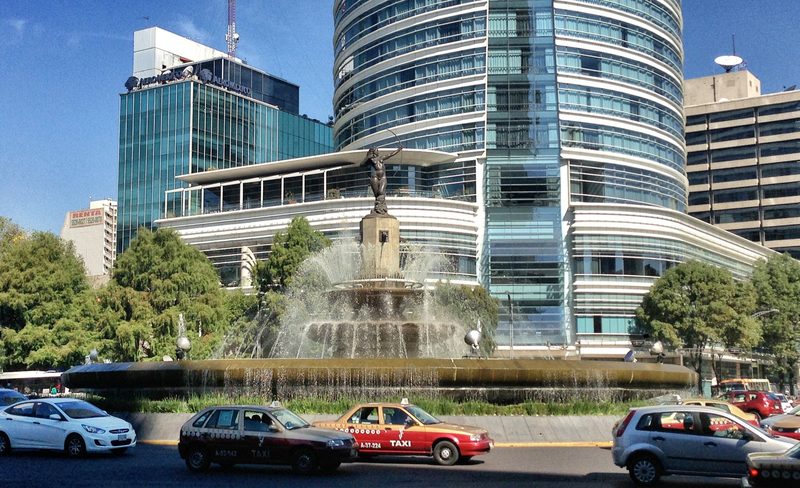
The Diana Fountain has become more than just a statue. It’s a meeting point, a landmark people use to give directions (“turn left at the Diana”), and a symbol of Reforma itself. When the avenue appears in films, TV shows, or photographs meant to represent Mexico City, the Diana is often in the frame alongside the Angel of Independence.
The fountain has also become a rallying point for celebrations and protests alike. After major sporting victories — particularly in soccer — crowds gather at the Diana and the Angel to celebrate. During social movements, the roundabout has served as a site of political expression. The statue’s position at the heart of Reforma means it’s witnessed decades of Mexico City’s public life, from joy to outrage and everything between.
There’s something fitting about the fact that the Diana — a statue that was itself the subject of public controversy — has become a gathering place for public expression. The same culture that once tried to cover her up now celebrates openly around her. Mexico City has a way of absorbing its contradictions like that.
How Diana Compares to Reforma’s Other Monuments
Paseo de la Reforma is essentially an open-air sculpture gallery. Walking its length, you’ll pass a dozen significant monuments, each occupying its own glorieta. The Angel of Independence gets the most attention — it’s taller, more gilded, and has become the city’s unofficial symbol. But we’d argue the Diana is the more interesting piece of public art.
Where the Angel is grand and symbolic in a straightforward way (victory, independence, national pride), the Diana is more complex. She’s classical but modern. She’s mythological but grounded in a real woman’s body. She has a history of controversy that adds layers of meaning the Angel simply doesn’t have. The Angel is a statement. The Diana is a story.
Other notable monuments on Reforma include the Cuauhtemoc monument (honoring the last Aztec emperor), the Monument to the Revolution (a few blocks north), and various smaller statues donated by foreign governments. None of them have the Diana’s combination of beauty, scandal, and cultural weight.
Nearby Dining and Drinks
After visiting the fountain, you’ve got excellent eating options in every direction. The Zona Rosa, just south of the roundabout, is packed with everything from Korean BBQ to traditional cantinas. Colonia Juarez has seen an explosion of new restaurants in recent years, with everything from high-end tasting menus to excellent street-level taquerias.
If you’re heading west toward Chapultepec, there are several good cafes and restaurants along Reforma itself. And if you continue past the park into Polanco, you’ll find some of the city’s finest dining, including several restaurants that regularly appear on “best in the world” lists.
For a more casual experience, grab a coffee and a bench in the area and just watch the Reforma parade go by. There’s always something happening on this avenue — cyclists, runners, street vendors, businesspeople in suits, tourists with cameras — and the Diana is one of the best spots to sit and take it all in.
Quick Reference
Full name: Fuente de la Diana Cazadora (Diana the Huntress Fountain)
Location: Glorieta at Paseo de la Reforma, Rio Misisipi, and Calle Sevilla
Neighborhood: Border of Colonia Cuauhtemoc and Colonia Juarez / Zona Rosa
Sculptor: Juan Fernando Olaguibel
Architect: Vicente Mendiola
Unveiled: October 10, 1942
Nearest Metro: Sevilla (Line 1), about a 5-minute walk
Nearest Metrobus: Diana (Line 7), right at the roundabout
Cost: Free — it’s a public fountain on a public street
Best day to visit: Sunday morning, when Reforma is car-free