Most visitors to Mexico City make a beeline for the Frida Kahlo Museum in Coyoacan — the famous Blue House where she was born, lived, and died. We get it. It’s a powerful place. But if that’s the only Frida-and-Diego spot on your itinerary, you’re missing something arguably more interesting: the Museo Casa Estudio Diego Rivera y Frida Kahlo, a pair of connected studio-houses in San Angel that are as much about revolutionary architecture as they are about revolutionary art.
This isn’t just another house museum. It’s the place where Mexico’s most famous artist couple actually worked, fought, reconciled, and produced some of their most important pieces. And the building itself? It was the first functionalist residential architecture ever built in Mexico, designed by a 24-year-old architect named Juan O’Gorman who would go on to become one of the country’s most important creative minds. The architecture alone is worth the trip.
The Architecture: Juan O’Gorman’s Bold Experiment
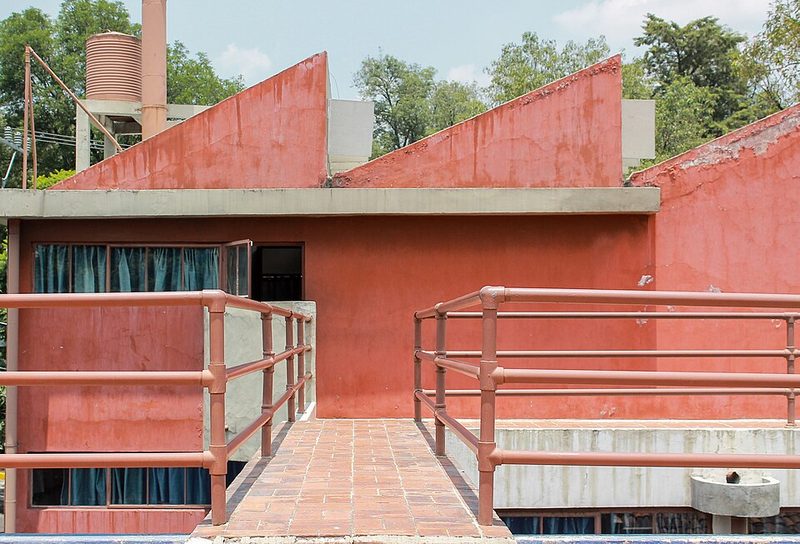
Before we talk about the art inside, we need to talk about the building. Because honestly, the building is the art.
In 1931, a young architect named Juan O’Gorman — half Irish, half Mexican, all ambition — designed and built two houses on a lot in San Angel for his friends Diego Rivera and Frida Kahlo. O’Gorman was obsessed with Le Corbusier and the European functionalist movement. He believed architecture should serve its purpose with maximum efficiency and minimum waste. No decorative nonsense. No colonial pretensions. Just honest structure doing honest work.
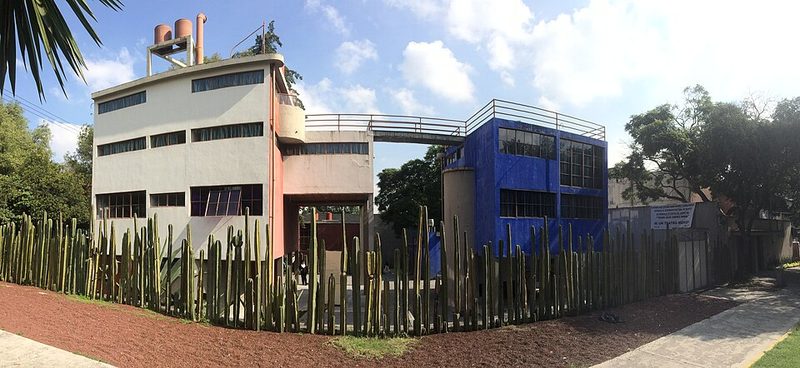
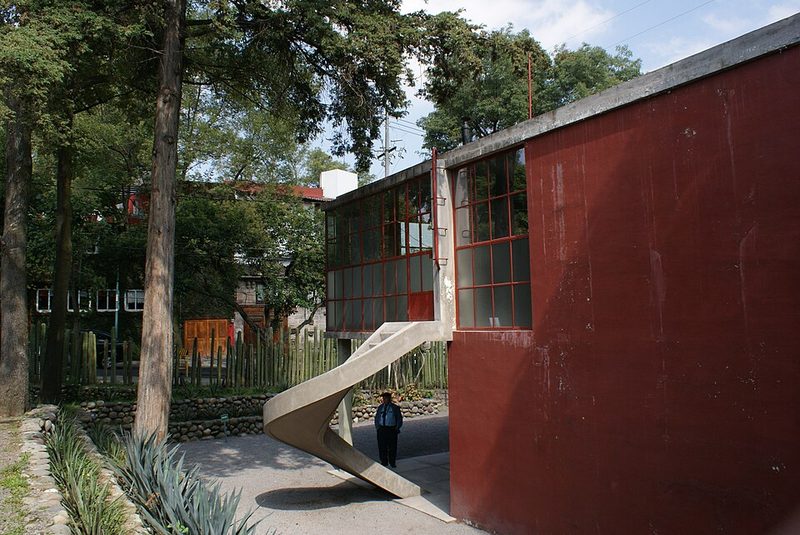
The result was something Mexico had never seen before: two separate box-like structures, one large and one small, connected by a rooftop bridge. Diego got the big one — a massive studio with soaring double-height ceilings and enormous windows that flooded the workspace with natural light. Frida got the smaller blue house next door, more intimate and personal. The two buildings were separated by a cactus fence, which tells you pretty much everything you need to know about the state of their relationship at any given moment.
Why These Houses Matter
O’Gorman built these houses on exposed concrete columns, with flat roofs, ribbon windows, and open floor plans. The facades are painted in bold primary colors — Diego’s studio in red and white, Frida’s in blue. The rooftop bridge allowed them to visit each other when they felt like it and, crucially, to stay apart when they didn’t. It was domestic architecture as relationship management.
These weren’t just homes. They were a manifesto. O’Gorman was declaring that Mexico’s architecture didn’t need to copy colonial Spain or pre-Hispanic pyramids. It could be modern, functional, international — and still distinctly Mexican. The cactus fence surrounding the property was his nod to that: industrial materials married to indigenous plants. European rationalism with Mexican roots, literally planted in the ground.
The houses were completed in 1932, making them the first functionalist residential buildings in Mexico. O’Gorman was just 26 when they were finished. He’d go on to design the famous mosaic-covered Central Library at UNAM, but these paired studio-houses were where it all started. Architecture historians consider them a turning point in Mexican modernism.
Diego and Frida’s Life in San Angel
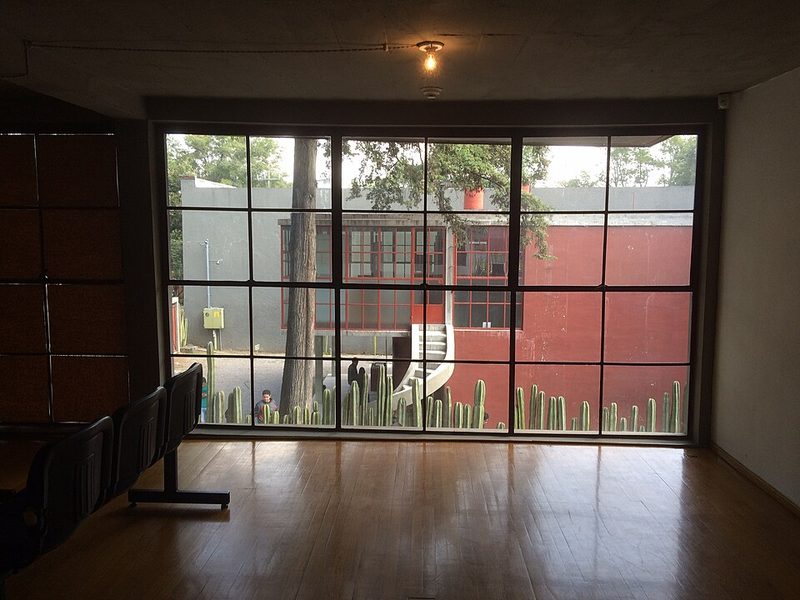
Diego Rivera and Frida Kahlo moved into the San Angel studios in 1934, after returning from several years in the United States where Diego had been painting murals in San Francisco, Detroit, and — infamously — New York’s Rockefeller Center, where his mural was destroyed because he included a portrait of Lenin. (Diego was not a man who compromised easily.)
The couple’s time in these houses was productive but turbulent. This was where Diego painted many of his later easel works, surrounded by his enormous collection of pre-Hispanic art, papier-mache figures (known as judas figures), and folk art objects that he hoarded obsessively. His studio was a controlled chaos of canvases, brushes, and artifacts. The man painted standing at his easel for hours, sometimes forgetting to eat — though given his substantial frame, he clearly made up for it later.
The Troubled Romance
It was also here that some of the most painful episodes of their marriage played out. Diego had an affair with Frida’s younger sister Cristina in this very house — a betrayal that devastated Frida and led to their temporary separation. Frida moved out, then moved back. They divorced in 1939, then remarried in 1940. The bridge between their two houses became an apt metaphor: always there, sometimes crossed, sometimes deliberately ignored.
Frida painted some of her most emotionally raw self-portraits during this period, works that dealt explicitly with betrayal, physical pain, and the complicated arithmetic of loving someone who couldn’t stop hurting you. Diego, meanwhile, kept painting. He always kept painting.
After their remarriage, Frida primarily lived at the Blue House in Coyoacan, while Diego continued to use the San Angel studio as his main workspace until his death in 1957. So while the Blue House is more associated with Frida’s personal life, the San Angel studio is where much of Diego’s actual artistic production happened.
What You’ll See Inside
The museum opened in 1986, nearly three decades after Diego’s death, and it’s been carefully restored to give visitors a sense of how the artists lived and worked here. It’s a smaller museum than the Blue House, and significantly less crowded — which we consider a major advantage.
Diego’s Studio
The main attraction is Diego’s enormous studio on the upper floor of the larger red-and-white building. The space is dominated by those massive industrial windows that O’Gorman designed specifically for painting — north-facing to provide consistent, diffused natural light without harsh shadows. It’s the kind of studio that any artist would sell a kidney for.
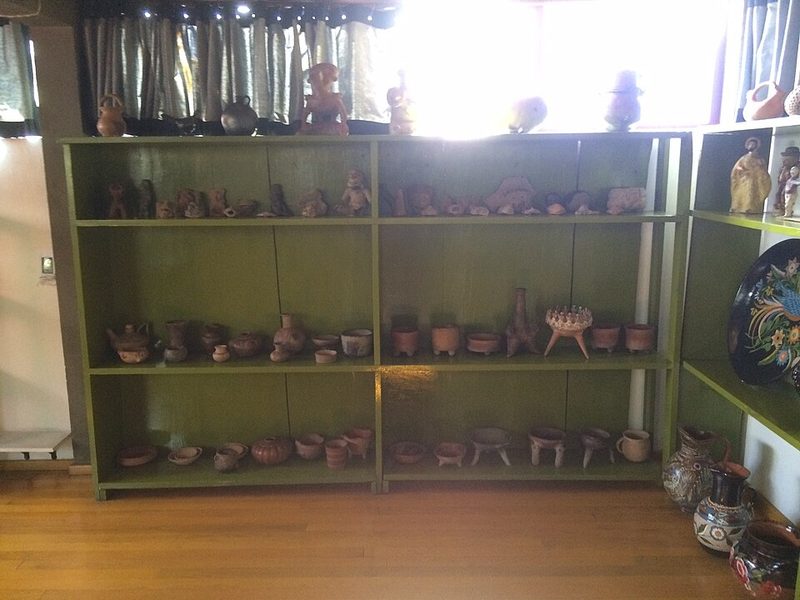
You’ll find Diego’s easel still positioned near the windows, along with his paint supplies, personal objects, and some of his collection of pre-Columbian artifacts. The judas figures — those giant papier-mache skeletons and devils that are traditionally burned during Easter Week celebrations — hang from the ceiling and walls, giving the space an appropriately surreal atmosphere. Diego collected these folk art pieces obsessively, seeing in them a connection to Mexico’s popular artistic traditions that he championed throughout his career.
Several of Diego’s paintings are displayed in the studio, along with photographs documenting his life and work process. You get a real sense of scale here — both of the man’s ambitions and of the physical space he needed to realize them.
Frida’s House
The smaller blue building that served as Frida’s studio and living quarters has a noticeably different feeling. It’s more compact, more personal, with lower ceilings and a more domestic scale. While Frida didn’t spend as much time here as at the Blue House in Coyoacan, the space contains personal items, photographs, and exhibits about her life and connection to this place.
The upstairs room where she painted is modest compared to Diego’s grand atelier next door, but there’s something fitting about that contrast. Frida’s art was intensely personal and interior — she didn’t need cathedral ceilings to paint her small, devastating self-portraits.
The Photographic Archive
One of the museum’s underrated features is its photographic archive, which includes images of both artists at work, photographs of the construction of the houses, and documentation of their social circle. Rivera and Kahlo were friends with everyone from Leon Trotsky to Andre Breton, and the photographs offer glimpses into a world where art, politics, and personal drama were hopelessly tangled together.
Temporary Exhibitions
The museum regularly hosts temporary exhibitions related to Rivera, Kahlo, O’Gorman, and Mexican modernism more broadly. These rotate throughout the year and can be excellent — we’ve seen shows focused on O’Gorman’s architectural drawings and Rivera’s lesser-known landscape paintings, both of which added real depth to a visit.
The Art Collection
Don’t come here expecting to see Diego’s most famous murals — those are at the Palace of Fine Arts and the National Palace in the Historic Center. What you’ll find instead is a more intimate look at his working process and his lesser-exhibited pieces.
The collection includes easel paintings, sketches, studies for larger works, and personal items that illuminate how Rivera worked. There are landscapes, portraits, and still lifes that show a different side of an artist most people know only through his massive public murals. Some of his preparatory drawings for those murals are on display here, and they’re fascinating — you can see him working out compositions, adjusting figures, solving the enormous spatial puzzles that mural painting demanded.
The pre-Columbian art collection is also significant. Rivera was one of the first major collectors of Mexican archaeological artifacts, and he saw his collection as directly connected to his artistic mission. He believed that Mexico’s pre-Hispanic cultures had produced some of the greatest art in human history, and that modern Mexican artists had an obligation to engage with that legacy. The artifacts displayed here were his daily companions, the things he looked at while he painted.
For a broader look at Diego’s archaeological obsession, you could also visit the Anahuacalli Museum in the south of the city — a massive volcanic stone building that Rivera designed to house his collection of over 50,000 pre-Columbian pieces. But that’s a different trip for a different day.
The San Angel Connection
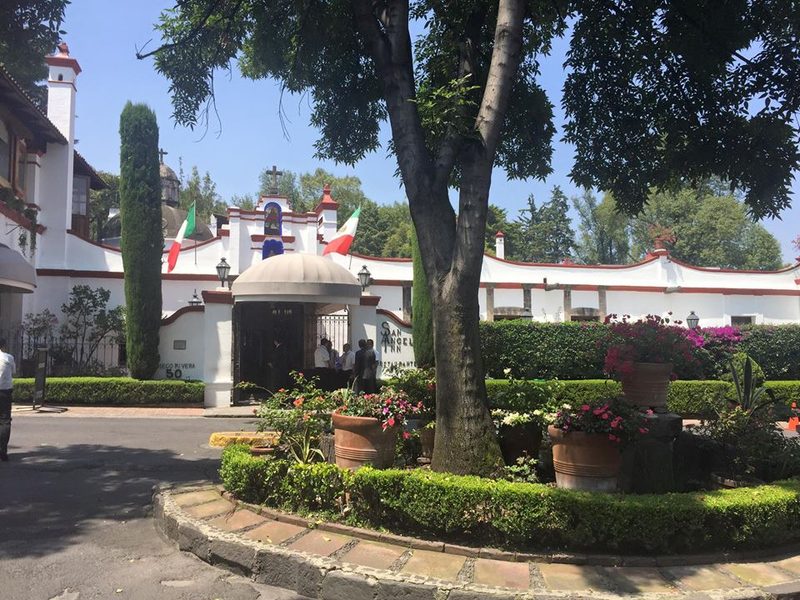
San Angel wasn’t a random choice for these houses. In the 1930s, it was a semi-rural area on the outskirts of Mexico City, popular with artists and intellectuals who wanted space and quiet without being too far from the capital’s cultural life. The neighborhood had old colonial-era haciendas, cobblestone streets, and a village atmosphere that contrasted sharply with O’Gorman’s aggressively modern architecture.
That contrast was intentional. Planting these functionalist boxes in a neighborhood of colonial stone houses was itself a statement. O’Gorman, Rivera, and Kahlo were all, in their different ways, arguing that Mexico needed to look forward, not backward. The houses were a provocation, and they were meant to be.
Today, San Angel has been absorbed into the larger city but retains its leafy, upscale character. The museum sits on a busy corner at the intersection of Avenida Altavista and Calle Diego Rivera (yes, they named the street after him), surrounded by restaurants, shops, and the general pleasant hum of one of Mexico City’s most livable neighborhoods.
If you’re visiting on a Saturday, you’re in luck. The famous Bazar Sabado (Saturday Bazaar) is just a short walk away in Plaza San Jacinto, where artists and artisans sell high-quality crafts, jewelry, and art. It’s been running since 1960 and it’s one of the best markets in the city — genuinely good stuff, not tourist trinkets. Combining the museum with the Bazar makes for an excellent Saturday morning.
Visiting Information
Hours
The museum is open Tuesday through Sunday, from 10:00 AM to 5:30 PM. It’s closed on Mondays, like most museums in Mexico City. The last entry is typically around 5:00 PM. Plan to spend about an hour to 90 minutes here, depending on how deeply you want to engage with the architecture and exhibitions.
Admission
Admission is around 40 MXN for general entry — essentially pocket change. Mexican nationals and residents with valid ID get in free on Sundays. Students and teachers with credentials also receive discounts. Photography without flash is generally permitted inside the museum.
How to Get There
The museum’s address is Calle Diego Rivera s/n, corner of Avenida Altavista, Colonia San Angel Inn. Getting there is straightforward but requires a bit more effort than reaching museums in the city center.
By Metro and Metrobus: The closest Metro station is M.A. de Quevedo (Line 3), which is about a 15-minute walk from the museum. Alternatively, you can take the Metrobus Line 1 to the La Bombilla station, which is closer — about a 10-minute walk through pleasant San Angel streets. From either station, the walk is flat and well-signposted.
By taxi or rideshare: An Uber or Didi from the Condesa or Roma Norte neighborhoods takes about 20-30 minutes depending on traffic, which in Mexico City is always the operative variable. From the Historic Center, expect 30-45 minutes. Tell your driver “Museo Casa Estudio Diego Rivera en San Angel” and they’ll know where to go.
By car: If you’re driving (brave soul), there’s limited street parking in the area. On weekends, especially Saturdays when the Bazar Sabado draws crowds, parking becomes more challenging. The museum doesn’t have its own parking lot.
Tips for Your Visit
Go in the morning when the light is best and the crowds are thinnest. The afternoon light through those enormous studio windows is beautiful, but mornings give you the most breathing room.
The museum is small enough that you don’t need a guide, but the informational panels (in Spanish and English) are worth reading carefully. They provide good context about the architectural significance and the personal histories that unfolded here.
Wear comfortable shoes. The houses have stairs between floors and the rooftop bridge is accessible — you’ll want to cross it, both for the view and for the symbolic experience of walking the same path between Diego’s world and Frida’s.
Nearby Attractions Worth Your Time
San Angel’s location makes it easy to combine with other stops in the southern part of the city.
The San Angel neighborhood itself deserves exploration beyond the museum. Wander the cobblestone streets around Plaza San Jacinto, peek into the 17th-century Ex-Convento del Carmen (now a museum with actual mummified bodies in the basement — you’ve been warned), and grab lunch at one of the neighborhood’s excellent restaurants. San Angel Inn, housed in a former 18th-century hacienda, is the classic choice for a special meal.
Coyoacan is just one neighborhood over, about 15 minutes by car or a 30-minute walk. If you’re doing the full Frida-and-Diego circuit, the Blue House (Museo Frida Kahlo) is the obvious companion visit. Book tickets online in advance — unlike the San Angel studio, the Blue House gets absolutely mobbed.
UNAM’s University City campus is a short drive south and is itself a UNESCO World Heritage Site, packed with murals by Rivera, David Alfaro Siqueiros, and — fittingly — Juan O’Gorman, whose mosaic-covered Central Library is one of Mexico City’s most photographed buildings. Seeing O’Gorman’s work here and at the Rivera-Kahlo studio in the same day gives you a powerful sense of his range.
For a different kind of museum experience, head north to the Chapultepec Castle or the National Anthropology Museum in Chapultepec Park — though those are full-day commitments on their own.
The Building’s Journey From Home to Museum
The path from private residence to public museum wasn’t straightforward. After Diego Rivera died in 1957, the houses went through various uses and periods of neglect. It wasn’t until the 1980s that INBA (Mexico’s National Institute of Fine Arts) took control and began the restoration process.
The restoration was careful and respectful, guided by O’Gorman’s original plans and historical photographs. The goal was to return the spaces to something approximating their appearance during the 1930s and 1940s, when Diego and Frida were actively using them. Some compromises were necessary — the buildings needed modern safety and climate systems — but the essential character of O’Gorman’s design was preserved.
The museum was officially inaugurated in 1986 and has been managed by INBA (now INBAL, the National Institute of Fine Arts and Literature) ever since. In 2012, it underwent a significant renovation that improved accessibility, updated the permanent exhibition, and restored architectural elements that had deteriorated over the decades.
Today, the museum holds the designation of Monumento Artistico — an official recognition of its architectural and cultural importance. It’s a fitting status for buildings that were revolutionary when they were built and remain striking nearly a century later.
Understanding O’Gorman: The Architect’s Own Story
Juan O’Gorman deserves more attention than most visitors give him. Born in 1905 to a Mexican mother and an Irish father, he studied architecture at the National University and became a disciple of Le Corbusier’s ideas about functionalism and the machine for living. But unlike many architects who simply imported European modernism wholesale, O’Gorman wrestled with how to make functionalism Mexican.
The Rivera-Kahlo houses were his first major statement, but they were followed by an extraordinary career. Between 1932 and 1935, he designed and built 26 public schools for the Mexican government, applying the same functionalist principles: maximum space, minimum cost, no ornamentation. He designed Diego Rivera’s Anahuacalli Museum. And he created the Central Library at UNAM, covering its exterior in a massive mosaic that depicted Mexican history from pre-Hispanic times through the colonial period to the modern era.
That library represents O’Gorman’s later shift away from pure functionalism toward what he called “organic architecture” — a synthesis of modern technique and Mexican cultural identity. He eventually grew disillusioned with functionalism, believing it had become sterile and disconnected from human experience. It’s an interesting irony: the man who built Mexico’s first functionalist houses came to reject functionalism itself.
O’Gorman’s personal life was as complicated as those of his famous clients. He struggled with depression and took his own life in 1982. His legacy, though, endures in the buildings he left behind — and nowhere more powerfully than in these twin houses in San Angel, where modernism first put down roots in Mexican soil.
Why This Museum Matters More Than You Think
Here’s our honest take: if you only have time for one Frida-and-Diego museum, most people will tell you to go to the Blue House in Coyoacan. And they’re not wrong — it’s a more emotionally immediate experience, filled with personal artifacts and the weight of Frida’s suffering and genius.
But the San Angel studio offers something the Blue House can’t: a sense of how radical these artists were not just in their painting, but in how they chose to live. They commissioned a young architect to build them something that had never existed in Mexico before. They lived in separate-but-connected houses designed around their work, not around domestic convention. The architecture itself was a creative act, as bold and provocative as anything they ever put on canvas.
And because the San Angel studio gets a fraction of the Blue House’s visitors, you can actually experience the spaces in relative quiet. You can stand in Diego’s studio and look out through O’Gorman’s enormous windows at the same light that fell on Rivera’s canvases. You can cross the bridge between the two houses and feel, just for a moment, the strange geography of a marriage conducted between two buildings.
It’s also a more interesting building, architecturally speaking. The Blue House is a beautiful traditional Mexican home that Frida made extraordinary through her life in it. The San Angel studio was extraordinary from the day it was built — a piece of architectural history that happens to contain art history inside it.
If you care about art, architecture, or the messy intersection of creative ambition and personal life, the Museo Casa Estudio Diego Rivera y Frida Kahlo is one of the most rewarding museums in Mexico City. It just doesn’t shout about it as loudly as some others, which — given the personalities it celebrates — is perhaps the only modest thing about the place.