
The Panteon Frances de la Piedad is a hidden Victorian-era cemetery in the middle of Mexico City, a walled enclave of ornate 19th-century tombs and mausoleums that feels transported from Pere Lachaise in Paris. It’s small, it’s quiet, and almost nobody visits it. If you’re the type of traveler who finds old cemeteries fascinating rather than depressing, this is one of the best-kept secrets in the city.
History
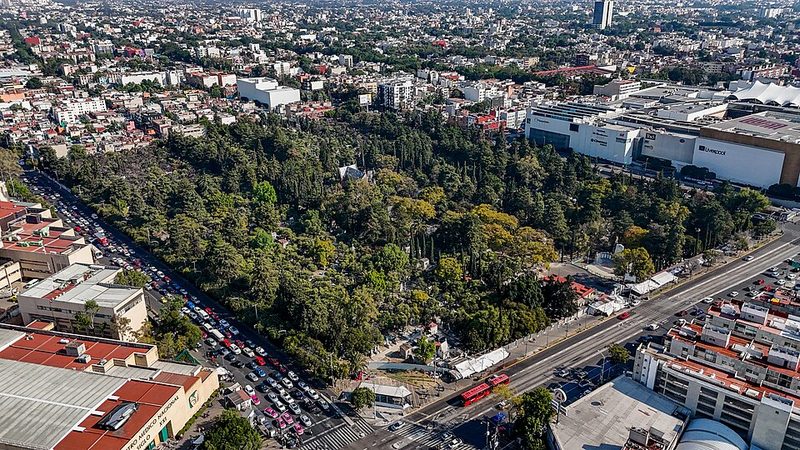
The cemetery was established in 1865 by Mexico City’s French community, at a time when that community was substantial and prosperous. French immigration to Mexico increased during the mid-19th century, driven by commercial opportunities and, for a brief period, the French-installed Emperor Maximilian’s government. Even after the French intervention ended and Maximilian was executed in 1867, the French community remained, and their cemetery continued to serve as a final resting place for several generations.
The cemetery’s full name reflects its origins: it was French, Catholic (hence “Piedad,” meaning piety), and designed to serve a specific immigrant community. Over time, non-French families also acquired plots, and the cemetery became more broadly used by Mexico City’s upper-middle class, though its French character remained dominant in the architecture and design of its monuments.
The Tombs
This is where the cemetery distinguishes itself. The mausoleums and tombstones at the Panteon Frances are elaborately crafted in the European funerary style of the late 19th and early 20th centuries. You’ll find Gothic Revival chapels in miniature, neoclassical columns, weeping angels, broken columns symbolizing lives cut short, and the full repertoire of Victorian-era memorial symbolism.
The craftsmanship is exceptional. Many of the monuments were carved from imported marble, with detailing that shows real artistry — draped fabric rendered in stone, expressive faces on sculptural figures, inscriptions in French that have weathered 150 years with varying degrees of legibility. Some tombs are modest; others are ambitious enough to qualify as serious architectural miniatures.
The overall atmosphere is one of genteel decay. Some monuments are beautifully maintained by descendants who still tend them. Others show the effects of time, weather, and neglect — cracked marble, vegetation growing through crevices, tilted headstones slowly sinking into the ground. The combination of beauty and entropy gives the place a melancholy charm that’s hard to replicate.
What to Look For
Wander without a plan. The cemetery is small enough to cover entirely in an hour, and the best discoveries come from simply walking the paths and stopping when something catches your eye. Look for the oldest monuments near the center of the grounds — these tend to be the most elaborate and the most French in style.
Pay attention to the symbolism carved into the monuments. Victorian funerary art had a detailed visual vocabulary: an hourglass meant the passage of time, a broken column represented a life ended prematurely, clasped hands symbolized a farewell or reunion in the afterlife, and specific flowers carried specific meanings. Once you start reading the symbols, the tombstones become much more than decoration.
Also look for the inscriptions. Many are in French, some in Spanish, a few in other languages. The French inscriptions often include origin cities in France, giving you a map of where Mexico City’s French community came from.
Getting There
The Panteon Frances de la Piedad is on Avenida Cuauhtemoc, in the Colonia Piedad Narvarte area, south of the Historic Center. Metro Etiopia (Line 3) is nearby, about a five-minute walk. From Roma Norte, it’s a 15-minute walk south. The cemetery is enclosed by walls and has limited entrance hours, so check before making a special trip.
The surrounding neighborhood is residential and commercial, without much of tourist interest. The cemetery is best combined with other activities in the southern-central part of the city rather than treated as a standalone destination.
Who This Is For
Cemetery tourists, architecture lovers, and history buffs will find the Panteon Frances genuinely rewarding. Photographers will be in heaven — the combination of ornate stonework, weathered surfaces, and filtered light makes for compelling images. If none of those descriptions fit you, this is an easy skip. But if any of them do, the Panteon Frances offers a quiet, beautiful, and historically layered experience that’s completely unlike the rest of Mexico City’s attractions.