When the Torre Latinoamericana opened in 1956, it was the tallest building in Latin America. That record is long gone, but the tower still does something no modern skyscraper in Mexico City can match: it survived the catastrophic 1985 earthquake without structural damage. A 44-story building on a lake bed, standing through an 8.0 magnitude quake that killed thousands and leveled blocks around it. The engineering alone makes it worth a visit. The views from the top don’t hurt either.
The tower sits at the corner of Eje Central Lazaro Cardenas and Avenida Madero, at the eastern edge of Alameda Central and directly across from the Palace of Fine Arts. It’s impossible to miss — a modernist glass-and-steel column rising out of the colonial Historic Center like a bookmark someone left in the wrong century.
The Engineering Story
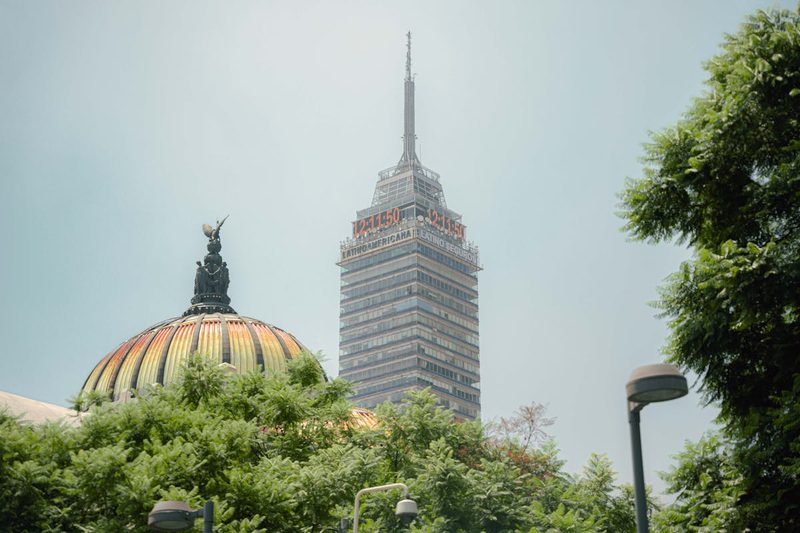
The Torre Latinoamericana was designed by architect Augusto H. Alvarez and engineer Leonardo Zeevaert. The fundamental problem they faced was the same one that plagues every large structure in central Mexico City: the ground is former lake bed — soft clay that compresses, shifts, and amplifies seismic waves.
Zeevaert’s solution was a deep foundation system using 361 concrete piles driven down to the firm layer beneath the clay, combined with a steel frame designed to flex rather than resist seismic movement. The building sways during earthquakes instead of fighting them. During the 1985 quake, workers on the upper floors reported the building moving dramatically — but nothing broke. The tower became an international case study in earthquake engineering.
It also survived the 2017 earthquake with no damage. At this point, it would take something truly exceptional to bring it down.
The Observation Deck
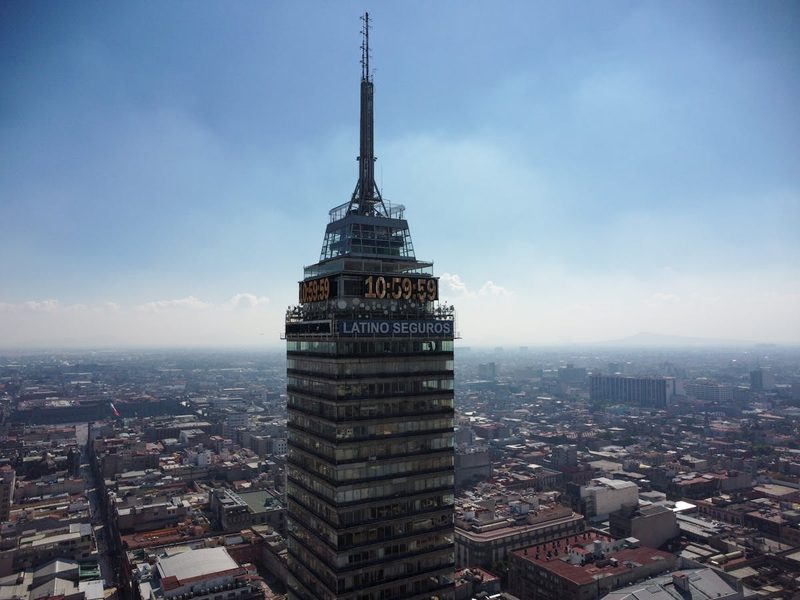
The main attraction for visitors is the mirador (observation deck) on the 44th floor, about 183 meters above street level. The 360-degree view covers the entire Valley of Mexico — on clear days, you can see the volcanoes Popocatepetl and Iztaccihuatl to the southeast, the Sierra de Guadalupe to the north, and the sprawl of the city in every direction.
“Clear days” is the important qualifier. Mexico City’s air quality varies dramatically. Winter mornings (November through February) tend to be clearest. The rainy season (June through October) can produce crystal-clear views after afternoon storms wash the air. Midday in the dry season (March through May) is often the haziest.
The 42nd floor has a small aquarium — it’s modest and clearly aimed at families, not marine biology enthusiasts. The 43rd floor has a cafe. The 44th floor is the open observation deck with floor-to-ceiling windows.
What You’ll See
East: The Zocalo, the Metropolitan Cathedral (you can see how it leans), the National Palace, and the dense grid of the Historic Center stretching toward the airport.
West: Alameda Central directly below, the Palace of Fine Arts (its green-tiled dome is unmistakable from above), and Paseo de la Reforma cutting diagonally toward Chapultepec Castle, visible on its hilltop.
South: The neighborhoods of Roma, Condesa, and the southern sprawl toward Coyoacan and Tlalpan.
North: The Tlatelolco housing complex (site of the 1968 student massacre), the Basilica de Guadalupe in the distance, and the mountains beyond.
Visiting
Hours: Daily, typically 9 AM to 10 PM. Evening visits are popular for sunset and city lights.
Cost: Around $130 MXN for adults to access the observation deck. The aquarium is included.
How long: 30-45 minutes is enough for the views and a coffee. The elevator ride is fast.
Best time: Late afternoon for the best combination of light and visibility — you catch the golden hour and then the city lights coming on. Weekend mornings are also good for clearer air.
Tip: The windows are glass, not open air, so photography can be tricky with reflections. Cup your hands around the lens and press close to the glass. The west-facing windows toward Bellas Artes give the most iconic shots.
Getting There
Metro: Bellas Artes (Lines 2 and 8) exits right next to the tower. You’re literally looking at it when you come up the stairs.
Walking: If you’re on Calle Madero (the pedestrian street from the Zocalo), the tower is at the western end — about a 10-minute walk from the Cathedral. From Colonia Juarez, it’s about 15 minutes east.
Worth It?
Yes, particularly if visibility is good. The views contextualize the city in a way that street-level walking can’t — you see how the colonial grid gives way to curved Art Deco streets in Condesa, how Reforma cuts diagonally through everything, how Chapultepec’s forest interrupts the concrete. The $130 MXN admission is reasonable for one of the better panoramic views in the Americas. And the earthquake survival story gives the building a narrative weight that the newer, taller towers on Reforma lack.
Pair it with the Palace of Fine Arts across the street, a walk through Alameda Central, and the Postal Palace a block northeast. That’s a concentrated hour of the best the western Historic Center has to offer, plus a view from 44 stories above it.