
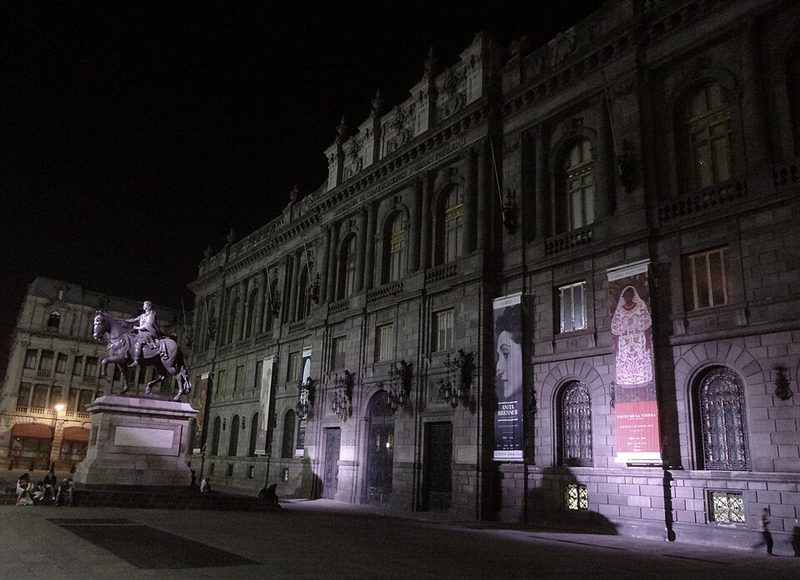
Mexico City has an almost unreasonable number of art museums. You could spend a full week doing nothing but gallery-hopping and still not see everything. But if you want to understand Mexican art — really understand the full arc from colonial-era religious painting through the landscape revolution of the 19th century to the modernist explosion of the 20th — there’s one place that lays it all out in chronological order, inside a building that’s itself a work of art. That place is the Museo Nacional de Arte, universally known as MUNAL.
Sitting on Calle Tacuba in the Historic Center, MUNAL is one of those museums that somehow doesn’t get the tourist crowds it deserves. Everyone flocks to the National Anthropology Museum or the Palace of Fine Arts, and for good reason — both are extraordinary. But MUNAL fills a gap neither of those can. It’s the definitive collection of Mexican art spanning four centuries, and it does the job with a confidence that’s hard to argue with.
The Building Itself

Before you even step inside, MUNAL makes an impression. The building is a full-blown neoclassical palace, designed by Italian architect Silvio Contri and completed in 1911, right at the tail end of the Porfirio Diaz era. Diaz loved European-style grandeur, and this building is pure Porfiriato ambition — all columns, ornate stonework, and a monumental staircase inside that could hold its own against anything in Paris or Rome.
Contri built it as the Palacio de Comunicaciones y Obras Publicas (the Palace of Communications and Public Works), which is a spectacularly fancy home for a government ministry. The interior features marble floors, bronze fixtures, and a central staircase with wrought-iron railings that’s become one of the most photographed spots in the Historic Center. The building was converted into the national art museum in 1982, and the architecture suits its new purpose beautifully. Walking through the galleries, you’re simultaneously looking at art on the walls and art in the walls, the ceilings, the doorframes.
Don’t rush through the lobby to get to the galleries. The staircase alone deserves five minutes of your time. The ironwork is intricate, the proportions are grand without being oppressive, and the light that comes through the upper windows gives the whole space a warmth that most museum lobbies can’t match.
El Caballito: The Statue Out Front

Standing in the plaza directly in front of MUNAL is one of Mexico City’s great equestrian statues — El Caballito, officially the Equestrian Statue of Charles IV. It depicts the Spanish king on horseback, cast in bronze by sculptor Manuel Tolsa in 1803. The statue weighs roughly 30 tons, and when it was unveiled, it was considered one of the finest equestrian bronzes in the world. Alexander von Humboldt, who visited Mexico City around the same time, called it second only to the Marcus Aurelius statue in Rome.
The statue has had a nomadic life around the city. It originally stood in the Zocalo, was moved to the courtyard of the university, then spent years at a major Reforma intersection, and finally landed here in 1979. Mexicans call it El Caballito (“the little horse”), which is either affectionate or ironic given that there’s nothing little about it. The name has stuck so thoroughly that most people don’t even remember it’s technically a portrait of a Spanish colonial monarch.
The Collection: Four Centuries of Mexican Art

MUNAL’s permanent collection is organized chronologically, moving from the 16th century through the mid-20th century. This isn’t a small selection of highlights — it’s a deep, comprehensive survey with over 3,000 works. The galleries are divided into three main sections that correspond to broad historical periods.
Colonial Art (16th-18th Century)
The earliest rooms cover the colonial period, when Mexican art was dominated by religious painting and sculpture produced for the Catholic Church. If you’ve seen colonial churches around the Historic Center or in the Zocalo area, you’ve already encountered this tradition — altarpieces dripping with gold leaf, solemn portraits of saints, and detailed depictions of biblical scenes painted by artists trained in European techniques but working in a distinctly New World context.
The standout names here include Cristobal de Villalpando and Miguel Cabrera, both of whom produced enormous religious canvases that rival anything being made in Spain during the same period. Cabrera, in particular, was prolific — his work turns up in churches and museums all over Mexico — and MUNAL has some of his finest pieces. There’s also a fascinating collection of casta paintings, the genre unique to colonial Mexico that depicted racial mixing through carefully categorized family portraits. They’re simultaneously beautiful, sociologically fascinating, and deeply uncomfortable.
19th Century: Landscapes, Portraits, and National Identity
This is where the museum really comes alive. The 19th century galleries cover the period when Mexican artists stopped looking exclusively to Europe for guidance and started paying attention to their own country — its landscapes, its people, its light.
The undisputed star of this section is Jose Maria Velasco. If you’ve never heard of him, you’re in for a revelation. Velasco painted the Valley of Mexico with a precision and emotional depth that’s staggering. His large-format landscapes capture the light, atmosphere, and geography of central Mexico with a clarity that feels almost photographic, except photographs couldn’t do what he did with color and composition. Standing in front of his panoramic views of the Valley of Mexico, with its volcanoes, its lakes, and its vast sky, you understand why this painter is considered one of the greatest landscape artists the Americas ever produced.
Velasco wasn’t working in isolation. The museum also has strong holdings of academic painting from the San Carlos Academy, which trained generations of Mexican artists in European techniques. Portraits, historical scenes, and allegorical works fill these rooms, and the quality is consistently high. But Velasco is the reason people come back to this section again and again.
Early 20th Century and Modernism
The final section of the permanent collection bridges the gap between the academic tradition and the explosive modernism of the Mexican Revolution era. You’ll find early works by some of the names that would go on to define 20th century Mexican art — though if you want the full muralist experience, the Palace of Fine Arts and the Secretariat of Public Education building are better destinations for that.
What MUNAL does particularly well is show the transition. You can trace how Mexican art moved from European-influenced academic work to something rawer, more politically charged, and more distinctly Mexican. The pieces from the 1910s and 1920s capture a country in the middle of revolutionary upheaval, and the art reflects that turmoil — increasingly bold colors, indigenous subjects treated with dignity rather than exoticism, and a growing sense that Mexican art should serve Mexican purposes rather than imitating foreign models.
Temporary Exhibitions
MUNAL regularly hosts temporary exhibitions that are worth checking before your visit. These rotate every few months and have covered everything from individual artist retrospectives to thematic shows exploring specific periods or movements in Mexican art. The museum’s website lists current and upcoming exhibitions, and they occasionally bring in international shows as well. The quality of these temporary exhibitions is generally high — this is the national art museum, after all, and it has the curatorial muscle to pull together serious shows.
Visiting MUNAL
The museum is open Tuesday through Sunday, typically from 10 AM to 5:30 PM (closed Mondays, like most Mexican museums). Admission is around 85 pesos for foreign visitors, and free on Sundays for Mexican nationals. The galleries are well-lit and reasonably well-labeled, though the information is predominantly in Spanish.
Plan for at least 90 minutes if you want to see the full collection without rushing. The Velasco rooms alone deserve a solid half hour. The building itself will eat up some time too — the staircase, the hallways, the details in the ceiling work are all worth pausing for.
The museum has a small gift shop with art books and prints, and there’s usually a cafe or refreshment area on the ground floor. Bag check is required for large bags but the process is quick.
What’s Nearby
MUNAL sits on Calle Tacuba, one of the oldest streets in Mexico City, running east-west through the Historic Center. The location is excellent for combining with other visits.
Walking east takes you toward the Zocalo in about ten minutes — the massive central plaza anchored by the Metropolitan Cathedral and the National Palace. Head west and you’ll reach the Alameda Central, the city’s oldest public park, which sits directly in front of the Palace of Fine Arts. Just a block south of the Alameda, the Postal Palace is another Porfiriato-era architectural gem that’s worth a quick detour — it’s a functioning post office inside one of the most beautiful buildings in the city.
If you’re planning a full museum day, pairing MUNAL with the Palace of Fine Arts makes sense geographically and thematically. MUNAL gives you the deep historical sweep; Fine Arts gives you the murals and the building itself. Together, they cover the full range of what Mexican art has accomplished, and you can walk between them in under ten minutes.
For the city’s other heavyweight museum — the one with the Aztec Sun Stone and the anthropology collections — the National Anthropology Museum is over in Chapultepec Park, about a 20-minute taxi ride or a pleasant Reforma walk from here.