Most cities would put their post office in a concrete box with fluorescent lighting and call it a day. Mexico City decided to put theirs in a palace. And not a modest, restrained sort of palace — we’re talking gilded ironwork, Venetian-style staircases, marble floors from Italy, and stained glass ceilings that make you forget you came in to buy stamps.
The Palacio de Correos de Mexico (known locally as the Palacio Postal or Correo Mayor) sits on the Eje Central in the Historic Center, directly across from the Palace of Fine Arts. It’s been a functioning post office since 1907. That’s not a typo. This building has processed mail continuously for over a century, surviving revolution, earthquakes, and the slow decline of handwritten letters, all while looking like something that should charge admission.
It doesn’t charge admission, by the way. You can walk in for free any day it’s open.
What Makes the Postal Palace Special
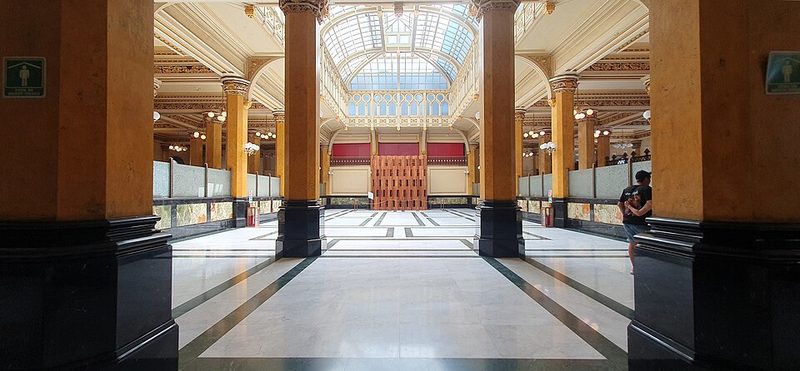
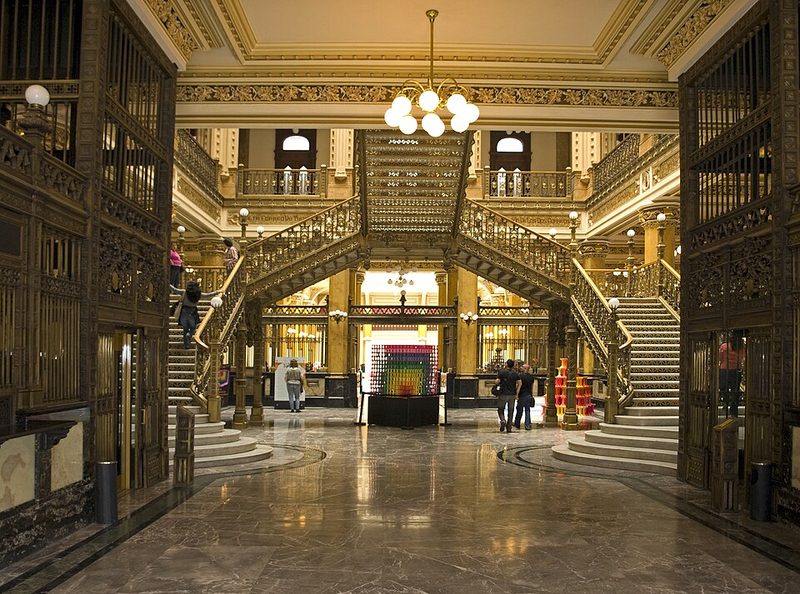
The central joke of the Palacio Postal — and the reason it’s worth visiting even if you haven’t sent a letter since 2004 — is the absurd contrast between what the building is and what it does. This is a place where you can buy a sheet of stamps while standing under a hand-forged iron staircase made in Florence. Where the ceiling above the service windows is gilded in 24-karat gold. Where the floor is polished marble, and the brass fixtures were shipped from Italian workshops.
The building’s exterior, made of pale “chiluca” stone, is attractive but gives only a hint of what’s inside. The carved stone details around the windows and the iron dragon light fixtures along the facade are nice enough. But they don’t prepare you for the interior, which hits you the moment you step through the Art Nouveau ironwork canopy over the main entrance.
Inside, it’s all gold and light. The main staircase is the centerpiece — two ramps that rise separately, appear to cross on the second landing, then diverge again in opposite directions. The ironwork throughout the building is Venetian in style, intricate and delicate in a way that seems impossible for metal. Bronze window frames. Stained glass ceiling panels that filter daylight into something warm and amber. Marble shelves and countertops that are still used for actual postal business.
People walk in to mail a package and end up standing in the lobby for twenty minutes, necks craned upward, trying to process what they’re seeing. We’ve seen it happen dozens of times. It never gets old.
The Architect: Adamo Boari
If the Palacio Postal looks like it was designed by the same person who created the Palace of Fine Arts, that’s because it was. Italian architect Adamo Boari drew up both buildings, and you can see his fingerprints all over the neighborhood. The man had a thing for mixing architectural styles the way a bartender mixes cocktails — a little of this, a little of that, and somehow the result works.
Boari was chosen for the project by President Porfirio Diaz, who wanted to modernize Mexico City and wasn’t shy about spending money to do it. The Porfiriato era (1876-1911) was all about proving that Mexico could stand alongside European capitals in culture and infrastructure, and nothing says “we’re serious about this” quite like building your mail sorting facility in a palace.
The military engineer Gonzalo Garita y Frontera supervised the actual construction, handling the practical engineering while Boari focused on design. It was a good partnership. Garita kept the building standing; Boari made it beautiful.
An Eclectic Design That Somehow Works
Art historians have been arguing about how to classify this building for over a hundred years, and they still can’t agree. The official description usually mentions “Plateresque Revival,” but that barely scratches the surface. Look closely enough and you’ll find Art Nouveau, Spanish Renaissance Revival, Venetian Gothic, Moorish influences, Neoclassical elements, Baroque flourishes, and even some Art Deco touches that seem ahead of their time.
Each floor has windows in a different architectural style, which sounds like it should be a mess. Boari held it together through the repetition of arches across the facade, creating a visual rhythm that unifies the whole thing. The fourth-floor gallery features slender Solomonic columns — those twisted, spiraling columns you see in Baroque churches — topped with a delicate filigree cresting that runs around the entire building.
It shouldn’t work. It absolutely does.
A Brief History of the Building
Before the Palacio Postal existed, the General Direction of Mail was just a division within the Ministry of Communications and Transportation. In 1901, it became its own government agency, and at the time, Mexico’s postal system was handling roughly 130 million pieces of mail per year. That volume demanded a proper headquarters.
The site chosen was occupied by the old Hospital of Terceros Franciscanos, a colonial-era building that was demolished in 1902 to make way for construction. The first stone was laid on September 14, 1902, and work continued for five years.
The Foundation
Here’s something that matters more than you’d think in a city built on a drained lakebed: the foundation. Boari and Garita used a technique called the “Chicago method” — a massive concrete slab 70 centimeters thick, reinforced with steel beams. The steel framework was manufactured by the Millinken Brothers in New York and shipped to Mexico in 1903. This foundation is a big part of why the building survived what came later, while other structures in the Historic Center sank, tilted, or collapsed.
Opening Day
The building was inaugurated in 1907 by Porfirio Diaz himself, in what might be the most on-brand presidential gesture in Mexican history. Diaz walked in and dropped two postcards into the receiving bin — one addressed to somewhere in Mexico City, the other to a different part of the country. The message was clear: this postal system connects the entire nation, and it operates from a building worthy of the task.
For a while afterward, the building was called the “Quinta Casa de Correos” (Fifth House of Mail), since it was the fifth building to serve as the capital’s main post office.
Surviving Earthquakes and Bank Takeovers
The Palacio Postal has had a rougher life than its appearance suggests. The building ran smoothly for its first few decades, but in the 1950s, Mexico’s growing economy created a problem. The Bank of Mexico, headquartered in the building next door on Madero Street, needed more space. So they took over a large section of the Palacio de Correos.
This was bad for the building. The Bank constructed security walls, roofed over the open-air terraces, and generally treated their section of this architectural masterpiece like a storage unit. These modifications destroyed many of the original decorative elements in the occupied area and — more dangerously — added enormous weight to a structure designed to be light and balanced on its steel-beam foundation.
The 1985 Earthquake
When the devastating 1985 earthquake hit Mexico City, the Palacio Postal was already weakened by the Bank’s modifications. The quake caused serious damage, particularly to the sections carrying extra weight from the Bank’s additions. The surrounding area of the Historic Center was hit hard, with numerous buildings damaged or destroyed.
In the aftermath, the Bank of Mexico decided to move out and build new facilities elsewhere. Good riddance, frankly. Their departure allowed restoration work to begin in earnest.
Restoration
The building was declared an Artistic Monument on May 4, 1987, giving it legal protection and opening the door for serious restoration funding. Work began in the 1990s and proceeded in a logical order: first the structure (repairing and reinforcing the damaged columns and steel beams), then the removal of the Bank’s additions (bringing floors back to their original weight), and finally the painstaking reconstruction of destroyed interior decoration.
A stroke of luck made the decorative restoration possible. Researchers located Boari’s daughter in Italy, and she donated her father’s original plans and construction notes. Combined with extensive photographs and documents from Mexico’s National Archives, these plans allowed restorers to recreate what had been lost with remarkable accuracy. You can see Boari’s original plans at the National Museum of Architecture inside the Palace of Fine Arts, right across the street.
What to See Inside
The Main Staircase
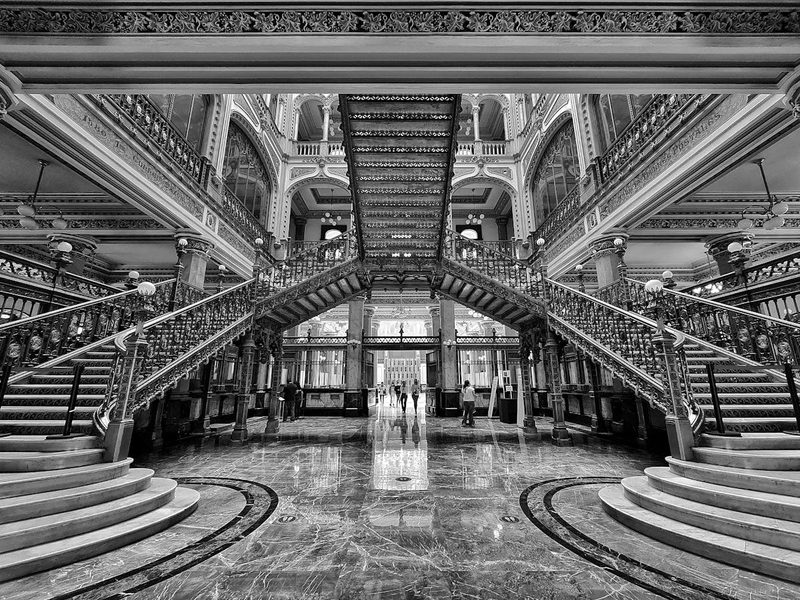
This is the showstopper. The central staircase features two separate iron ramps that rise from the ground floor, appear to intersect at the second landing, and then move off in opposite directions. The ironwork was manufactured in Florence, and it shows — every railing, every balustrade, every decorative flourish was made by people who clearly understood that metalwork could be art. The style is often described as Venetian, and the level of detail will have you leaning in close and discovering new patterns every time you look.
The Ceiling and Dome
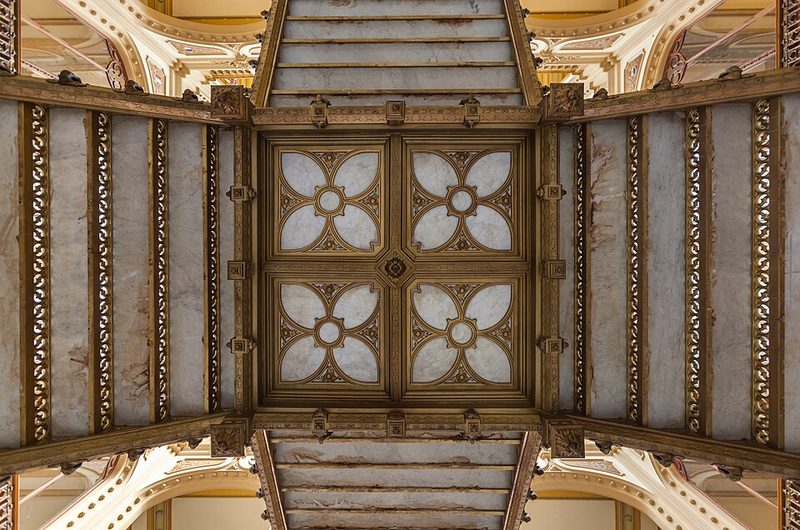
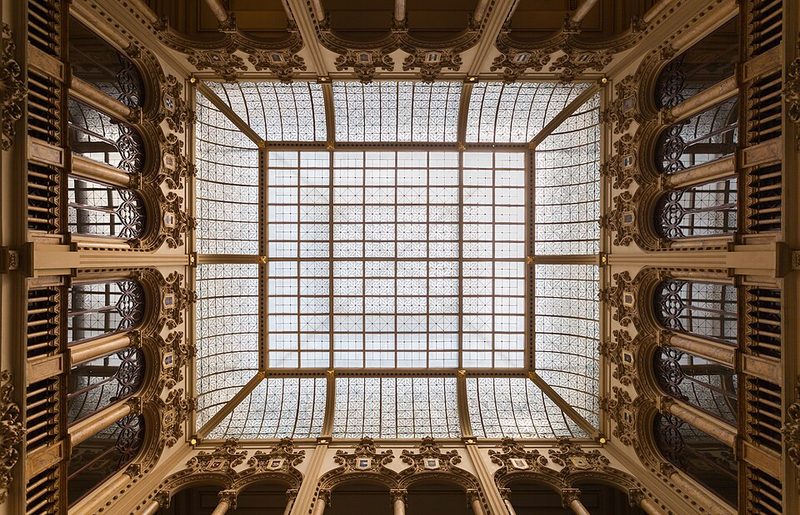
Look up. The staircase hall features a dome with leaded stained glass panels that cast colored light across the ironwork below. On a sunny morning, the effect is genuinely stunning — gold light bouncing off bronze fixtures, colored shadows playing across marble. It’s the kind of thing that makes you want to become a photographer.
The Service Windows
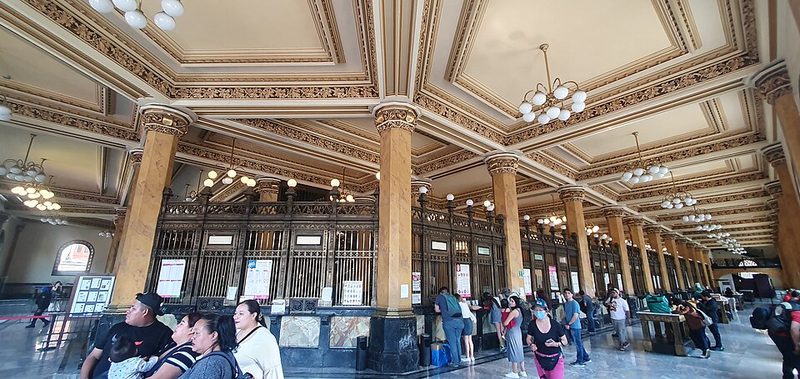
The postal service windows on the ground floor are framed in ornate bronze and iron, designed to look like they belong in a Venetian palazzo rather than a government office. People still line up here to mail letters, buy stamps, and conduct postal business, completely unfazed by the fact that they’re doing it in surroundings that most European palaces would envy.
The Meeting Room
If you can get a look at the meeting room (it’s not always accessible), you’ll find frescoes by the Italian artist Bartolome Gallotti, painted over a base of 24-karat gold. The themes relate to the history of written communication and message-sending, which is exactly the kind of thematically appropriate decoration that makes this building a cohesive work of art rather than a random collection of expensive materials.
Exterior Details
Don’t rush inside without giving the exterior a proper look. The facade is covered in carved stone details, and the iron dragon light fixtures flanking the entrance are fantastic. The brass work around the windows — made in Italy, like seemingly everything else in this building — has been polished and maintained for over a century. The main entrance canopy is pure Art Nouveau, with the flowing organic lines that defined the style at the turn of the 20th century.
The Postal Museum (Museo de Historia Postal)
The upper floors of the Palacio house a small museum dedicated to the history of Mexico’s postal service. It’s free, it’s interesting, and almost nobody visits it, which means you’ll likely have the place to yourself.
The collection traces the evolution of mail delivery in Mexico from pre-Hispanic messaging systems through the colonial era and into the modern period. The star attraction for serious collectors is Mexico’s very first postage stamp, which philatelists consider one of the more significant postal relics in the world. Even if stamps aren’t your thing, the museum gives you access to upper floors of the building, which means better views of the staircase, the dome, and the architectural details you can’t fully appreciate from the ground floor.
The building also housed a Naval History Museum on its fourth floor until 2013, occupying over 1,300 square meters with models, photographs, and maps spanning Mexico’s maritime history from pre-Columbian navigation through World War II. That collection has since moved, but the space itself remains impressive.
Yes, You Can Actually Mail Something
This is the part that delights people the most. The Palacio Postal isn’t a museum pretending to be a post office — it’s a post office that happens to be a museum-quality building. Walk up to the counter, buy some stamps, and mail a postcard back home. Your friends will receive mail postmarked from one of the most beautiful post offices on Earth.
The service windows on the ground floor handle all standard postal operations: domestic and international mail, registered letters, package shipping, and stamp sales. Lines are usually short, staff are generally patient with tourists who are clearly there more for the architecture than the postal services, and the whole experience takes maybe ten minutes.
We strongly recommend it. There’s something deeply satisfying about using a building for its intended purpose, especially when that purpose is so wonderfully mundane compared to the setting. Buying stamps in a palace is a specific kind of joy.
Practical Information
Hours
The post office operates Monday through Friday, generally from 8:00 AM to 4:00 PM, and Saturdays from 9:00 AM to 1:00 PM. It’s closed on Sundays and public holidays. The museum hours may vary, so check at the front desk when you arrive. Morning visits are best for photography — the natural light through the stained glass is at its peak before noon.
Cost
Free. There’s no entrance fee to visit the building or the museum. You’ll only spend money if you actually want to mail something, and even then, stamps and postcards are cheap.
How Long to Spend
Plan for 30 to 45 minutes if you want to properly explore the building, photograph the staircase and ceiling, and browse the postal museum. You could technically speed through in 15 minutes, but the details reward slow looking. If you’re mailing postcards, add another 10-15 minutes for the queue.
How to Get There
The Palacio Postal sits at the corner of Eje Central Lazaro Cardenas and Calle Tacuba, in the heart of the Historic Center. The address is Eje Central Lazaro Cardenas 2, Centro Historico, Cuauhtemoc, 06000.
By Metro
Bellas Artes station (Lines 2 and 8) puts you practically at the front door. Exit toward Eje Central and the building is impossible to miss — look for the ornate pale stone facade across from the Palace of Fine Arts. Allende station (Line 2) is also a short walk away.
On Foot
If you’re already exploring the Historic Center, the Palacio Postal is an easy add to any walking route. It’s roughly a 10-minute walk from the Zocalo heading west along Calle Tacuba or Madero. From Alameda Central, it’s directly on the east side of the park. Torre Latinoamericana is practically next door — you can see it from the Palacio’s entrance.
By Rideshare
Uber and DiDi work well for getting to the area, though traffic in the Historic Center can be heavy. Getting dropped off on Eje Central near Bellas Artes is your best bet. The building is on the east side of the street.
Nearby Attractions
The Palacio Postal sits in one of the most attraction-dense neighborhoods in Mexico City. You could spend an entire day within a few blocks of this building and not run out of things to see.
The Palace of Fine Arts is directly across Eje Central — and since it shares an architect with the Postal Palace, visiting both gives you a fascinating study in how Boari’s style evolved between the two projects. Bellas Artes is the grander building, but many people (ourselves included) find the Postal Palace more charming precisely because it’s still doing its original job.
Alameda Central, the oldest public park in the Americas, is steps away to the west. It’s a good place to sit on a bench and process the architectural overload before moving on. Torre Latinoamericana, the iconic Art Deco skyscraper, looms over the neighborhood and offers observation deck views that put everything in context.
Walking east toward the Zocalo, you’ll pass through the pedestrianized section of Calle Madero, one of the city’s most popular walking streets. The Metropolitan Cathedral and the Templo Mayor archaeological site anchor the far end of that walk. The whole route from the Palacio Postal to the Zocalo takes about 10 minutes and covers roughly 500 years of Mexican architecture along the way.
Tips for Visiting
- Go on a weekday morning. The light is best, the crowds are thinnest, and the building is fully operational so you get the authentic experience of a working post office in a palace.
- Bring a camera with a wide-angle lens. The staircase and ceiling demand it. Phone cameras work fine, but the interior spaces are large and the details are high above you.
- Mail a postcard. Seriously. You can buy postcards from vendors on Madero or near the Zocalo, bring them here, buy stamps at the counter, and drop them in the box. It’s the single best souvenir activity in the Historic Center.
- Look at the floor. Everyone looks up (understandably), but the marble floors are beautiful in their own right. Take a moment to appreciate the complete package.
- Combine it with Bellas Artes. Visiting both Boari buildings back-to-back is one of the best architecture experiences in the city. Start with the Postal Palace (free, quicker visit) and then cross the street for Bellas Artes.
- Don’t skip the upper floors. If the postal museum is open, go up. The staircase is the whole point, and you need to climb it to fully appreciate the ironwork and the dome above.
Why We Love It
There are more famous buildings in Mexico City. There are bigger museums, taller towers, and older ruins. But the Palacio Postal occupies a unique space in the city’s landscape because of what it represents: a total, unapologetic commitment to beauty in the most everyday of settings.
This building was designed to process mail. That’s it. And someone decided it should have a staircase forged in Florence, frescoes painted in gold, and a stone facade carved with the precision of a cathedral. Not because mail is glamorous, but because the people using this building — ordinary people sending letters to their families — deserved to do it somewhere extraordinary.
That philosophy is something Mexico City does better than almost any other city we know. The idea that public spaces should be beautiful, that government buildings should inspire rather than depress, that the daily business of life deserves a worthy stage. The Palacio Postal is proof that this idea works, and it’s been proving it every working day since 1907.
Walk in. Look up. Mail a postcard. You’ll be glad you did.