
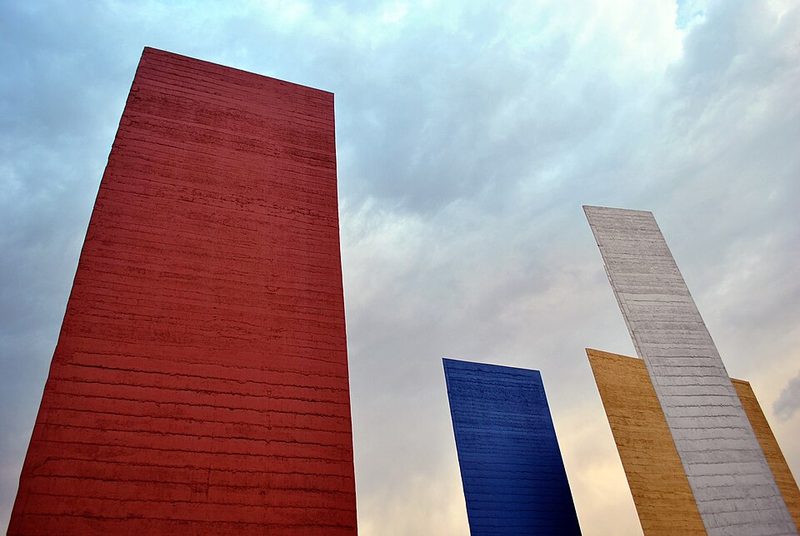
Five concrete towers, painted in bold primary colors, rising between 30 and 52 meters above a traffic island on the northern edge of Mexico City. No windows. No doors. No function whatsoever beyond looking absolutely magnificent. The Torres de Satelite are one of the most iconic pieces of public art in Latin America, and most visitors to CDMX never see them because they’re nowhere near the tourist circuit.
That’s a mistake worth correcting if you care about architecture, modernism, or the intersection of art and urban planning. These towers were radical when they went up in 1957-58, and they haven’t lost a bit of their visual punch in the decades since.
The Story Behind the Towers

In the 1950s, Mexico City was expanding rapidly to the north. A new suburban development called Ciudad Satelite was being built in the municipality of Naucalpan de Juarez, just beyond the city’s northern boundary. The developer, Mario Pani (one of Mexico’s most important modern architects), wanted a landmark at the entrance to the new community — something dramatic enough to announce that this wasn’t just another housing tract.
Pani approached Luis Barragan, already recognized as one of Mexico’s greatest architects, to design the project. Barragan brought in the German-Mexican sculptor Mathias Goeritz, with whom he’d previously collaborated on experimental art projects. The two of them conceived the Torres de Satelite as a piece of “emotional architecture” — Goeritz’s term for art that provokes a direct psychological response through scale, color, and spatial relationships.
The original concept was even more ambitious than what was built. Barragan and Goeritz initially planned seven towers, the tallest reaching 200 meters, surrounded by a massive reflecting pool. Budget constraints scaled the project down to five towers without the water feature, but even in reduced form, the result was extraordinary.
Design and Construction
The five towers are triangular prisms in cross-section, arranged in a cluster on a triangular traffic island where the Periferico highway meets the Queretaro highway. Their heights stagger upward: approximately 30, 34, 37, 45, and 52 meters. Each tower is a reinforced concrete shell, hollow inside, with no interior floors, stairs, or usable space. They’re pure sculpture.
The proportional relationships between the towers were carefully calibrated. Seen from a car approaching at highway speed — which is exactly how they were designed to be experienced — the towers create a shifting geometric composition. They overlap, separate, and regroup as your angle changes. From one direction they look like a dense cluster; from another, they spread out into individual forms. Barragan and Goeritz understood that this would be architecture experienced in motion, not from a fixed viewpoint, and they designed accordingly.
Construction took about a year. The engineering was handled by structural specialists who had to solve the challenge of building tall, thin, hollow concrete structures that could resist both wind loads and seismic forces in one of the world’s most earthquake-prone cities. The towers have survived every major earthquake since 1957, including the devastating 1985 and 2017 events.
The Color Question
The towers were originally white. Then orange and yellow. Then red. The current color scheme — which includes white, yellow, orange, and red depending on who you ask and when you look, since they’ve been repainted multiple times — has varied over the decades.
Barragan chose the initial colors and was deeply invested in the chromatic relationships. Color was central to his entire architectural philosophy (as anyone who’s visited his house in Tacubaya can confirm). After the first painting, various repaints changed the scheme without Barragan’s input, which irritated him enormously. A 2012 restoration attempted to return to something close to Barragan’s original intentions, using historical photographs as reference, but the exact “correct” colors remain a matter of debate among architectural historians.
What’s not debatable is that the colors work. Against CDMX’s typically hazy sky, the warm tones give the towers a presence that white concrete alone couldn’t achieve. They photograph brilliantly at different times of day, with sunrise and late afternoon being particularly good.
The Barragan-Goeritz Partnership (and Falling Out)
The collaboration between Barragan and Goeritz on the Satellite Towers produced one of the masterpieces of 20th century Latin American art. It also destroyed their friendship.
Both men claimed primary authorship of the design. Goeritz said he conceived the towers and Barragan contributed the color scheme. Barragan said the design was his and Goeritz was a collaborator. The dispute became bitter and public. Art historians have generally concluded that the conceptual design was primarily Goeritz’s, while Barragan contributed the proportional refinements and, crucially, the color — which is arguably what makes the composition work. Both men were essential.
Goeritz went on to create other major works in CDMX, including the Museo Experimental El Eco, which he’d actually completed before the towers project. Barragan continued his architectural practice, eventually winning the Pritzker Prize in 1980. They never worked together again.
Visiting the Towers
Where They Are
The Torres de Satelite sit on a traffic island at the junction of the Periferico Norte (Anillo Periferico) and the Autopista Mexico-Queretaro, in Ciudad Satelite, municipality of Naucalpan de Juarez. This is well north of central CDMX — about 18 km from the Paseo de la Reforma midpoint.
How to Get There
Here’s the honest truth: reaching the towers isn’t particularly convenient, and once you’re there, the viewing experience is shaped by the fact that they sit in the middle of a highway interchange.
- By car: This is the most practical option. Drive north on the Periferico toward Queretaro. The towers are visible from a considerable distance. There’s no dedicated parking, but you can pull off on side streets in Ciudad Satelite and walk to viewing points.
- By Metrobus/Metro: Take Metro Line 2 to Cuatro Caminos, then catch a bus or combi heading north toward Ciudad Satelite along the Periferico. Tell the driver you want to get off at the Torres. It’s doable but time-consuming.
- By taxi/Uber: The most comfortable option if you don’t have a car. Budget for a 30-60 minute ride from central CDMX depending on traffic, which on the Periferico can be apocalyptic.
What to Expect
There’s no visitor center, no gift shop, no entrance fee, no guided tour. The towers are public art in the most literal sense — they’re just there, surrounded by traffic. You can’t go inside them (there’s nothing inside). You can walk up to them if you navigate the traffic island carefully, but the best views are actually from a short distance away where the full height registers.
The experience is primarily visual and photographic. Bring a good camera or phone. The shifting perspectives as you move around the base are what make the visit worthwhile. Early morning light is ideal — the towers face roughly north-south, and morning sun from the east illuminates the warm-colored surfaces beautifully.
Is It Worth the Trip?
If you’re an architecture or art enthusiast, absolutely yes. The Satellite Towers are a genuinely important work of 20th century art, recognized by Mexican authorities as a national monument. They represent a moment when Mexico’s avant-garde architects and artists were producing work as innovative as anything happening in Europe or the United States.
If you’re a casual tourist with limited time, we’d be honest — the journey is long, the setting is a highway interchange, and you’ll get more out of the same time spent at the Museo Experimental El Eco in the Colonia San Rafael, which is much more accessible and gives you a direct experience of Goeritz’s spatial philosophy.
But if you do make the trip, especially on a clear morning, the towers reward you with something you genuinely can’t find anywhere else. There’s nothing like them. Five triangles of color punching up from a sea of suburban sprawl, completely useless, completely confident, completely magnificent.
The Towers in Mexican Culture
The Torres de Satelite have become one of the most recognizable symbols of Mexico City’s mid-century modernist identity. They appear on album covers, in films, on postcards, and as a recurring motif in Mexican graphic design. For residents of the northern suburbs, they’re a daily landmark — the thing you see from the Periferico that tells you where you are.
They’ve also sparked decades of discussion about the role of public art in urban spaces, about whether art designed for car-speed viewing can survive in an era of pedestrian-focused urbanism, and about what happens when a masterpiece ends up in the middle of a traffic circle. Those questions don’t have easy answers, which is part of what keeps the towers interesting.
In 2012, the towers were declared an Artistic Monument by Mexico’s National Institute of Fine Arts, granting them legal protection against modification or demolition. Given the pace of development in the northern suburbs, that protection matters.