
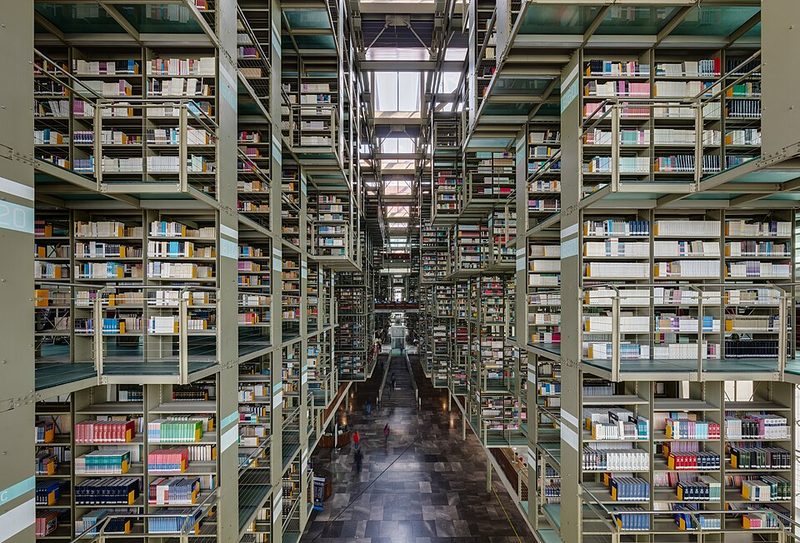
There’s a building near the Buenavista train station that looks like it was designed by someone who thought libraries were too boring and decided to fix the problem with steel, glass, and a whale skeleton. They weren’t wrong.
The Biblioteca Vasconcelos is one of the most visually dramatic public libraries on the planet. Opened in 2006, it’s a 38,000-square-meter monument to the idea that free public access to books should come with architecture that makes your jaw drop. The Mexican press called it the “mega-biblioteca” when it opened, and the name stuck — because that’s exactly what it is.
It’s also free to enter, open to the public, and takes about 30 minutes to reach from most tourist areas. We think it’s one of the most underrated stops in Mexico City.
The Building

The library was designed by Mexican architect Alberto Kalach, with structural engineering by Ove Arup & Partners (the same firm behind the Sydney Opera House and the Centre Pompidou). Kalach’s concept was radical: a long, narrow building where the bookshelves are suspended in mid-air on steel platforms that hang from the ceiling structure, creating a cathedral-like central void that runs the entire 250-meter length of the building.
When you walk in, you’re looking at roughly 580,000 books arranged on translucent shelving units that float above and below your sightline, connected by bridges and walkways. Light pours in from glass walls at either end and from skylights running the length of the roof. The effect is vertiginous in the best way — it feels like you’re standing inside a giant filing cabinet designed by an aerospace engineer.
The structure is steel-framed with a concrete base, and the long axis runs roughly north-south. The suspended shelving units are organized by subject using a modified Dewey Decimal system, with each level corresponding to a different field of knowledge. It can hold up to 2 million volumes at capacity, though the current collection is smaller.
The Whale
The signature piece of art inside the library is “Mátrix Móvil” by Mexican-Canadian artist Gabriel Orozco. It’s a real gray whale skeleton (Eschrichtius robustus), about 12 meters long, suspended from the ceiling of the central atrium and painted with a geometric graphite pattern. The skeleton floats among the bookshelves, roughly at eye level if you’re on the upper walkways, and it’s become the library’s most photographed feature.
Orozco’s piece is a commentary on the relationship between natural and artificial systems of classification — the whale’s bones as a biological taxonomy suspended within a human system of organizing knowledge. Or you can just appreciate it as a massive whale skeleton covered in beautiful geometric patterns floating in a cathedral of books. Either way works.
The Botanical Garden
Surrounding the library building is a 26,000-square-meter botanical garden designed by Kalach himself. It features over 60,000 plants representing species native to Mexico’s diverse ecosystems, organized around a series of reflecting pools and walking paths. The garden serves a practical purpose too — it functions as a buffer between the building and the busy streets surrounding it, absorbing noise and cleaning air.
The garden is particularly well maintained and offers a surprisingly peaceful place to sit after visiting the library interior. The contrast between the steel-and-glass architecture and the greenery is deliberate and effective.
The Backstory
The library is named after Jose Vasconcelos (1882-1959), the Mexican philosopher, politician, and educator who served as Secretary of Public Education under President Alvaro Obregon in the 1920s. Vasconcelos was the driving force behind Mexico’s post-revolutionary public education campaign, commissioning the mural programs that gave Diego Rivera, Jose Clemente Orozco, and David Alfaro Siqueiros their first major works. He believed passionately in the power of culture and education to transform society.
The project to build the library was announced in 2003 by President Vicente Fox as part of an urban renewal initiative for the Buenavista area, then a rough and run-down corner of northern downtown CDMX. The library was intended as an anchor project that would spark wider development.
Construction took three years and cost approximately 2 billion pesos (about $180 million USD at the time). It was controversial from the start. Critics questioned whether Mexico needed a showpiece library when existing libraries were underfunded, and the project faced cost overruns and political battles. When the library opened in May 2006, structural defects were quickly discovered, and it had to close for repairs less than a year later. It reopened in November 2008 after extensive fixes.
Despite the rocky start, the library has become one of Mexico City’s most beloved public spaces. It serves thousands of visitors daily, hosts cultural events and exhibitions, and has achieved its original goal of anchoring urban development in the Buenavista district.
What You Can Do There
It’s a functioning library, so everything you’d expect is available:
- Browse and read: The collection covers everything from Mexican literature and history to science, philosophy, and children’s books. Materials are primarily in Spanish, with a smaller English-language section.
- Photography: Interior photography for personal use is permitted and actively encouraged. The building was designed to be photogenic, and it delivers. Best spots: the upper walkways looking down the central atrium, the bridges between shelf units, and any angle that includes the whale skeleton.
- Events: The library hosts regular cultural programming including author talks, film screenings, workshops, and exhibitions. Check the CONACULTA (now Secretaria de Cultura) website for current schedules.
- Wi-Fi and workspaces: Free Wi-Fi throughout. There are reading tables, individual study carrels, and computer terminals available for public use.
- Multimedia center: Audio and video collections, listening stations, and a small auditorium.
Visiting
Getting There
The library is at Eje 1 Norte Mosqueta, Colonia Buenavista, directly adjacent to the Buenavista train/bus station.
- Metro: Buenavista station (Suburban Rail) is right next door. Alternatively, Guerrero station (Lines 3 and B) is about a 10-minute walk, or Revolution station (Line 2) is about 15 minutes on foot.
- Metrobus: Line 1 stops at Buenavista, steps from the library entrance.
- From the Historic Center: It’s about 2 km north of the Alameda Central. Walk or take a quick Metro/Metrobus hop.
Hours and Cost
Open daily from 8:30 AM to 7:30 PM. Closed on official holidays. Admission is completely free. No reservation needed.
How Long to Spend
Most visitors spend 30-60 minutes exploring the building, taking photos, and walking through the garden. If you actually want to sit and read, you could spend half a day here easily.
Neighborhood Notes
The Buenavista area has improved significantly since the library opened, but it’s still rougher around the edges than Roma, Condesa, or Polanco. Exercise normal urban awareness, particularly if you’re walking to or from the Metro after dark. The immediate library grounds are well-maintained and patrolled.
Nearby, the Monument to the Revolution is about a 15-minute walk south, and the Moorish Kiosk in Santa Maria la Ribera is about 15 minutes west — both make natural additions to a Vasconcelos Library visit. The Historic Center is an easy 20-minute walk or one Metro stop south.
Is It Worth It?
Absolutely. The Biblioteca Vasconcelos is one of those rare buildings that photographs beautifully and is even better in person. The scale of the interior is hard to appreciate in pictures — you need to stand on one of the upper walkways and look down the 250-meter canyon of floating bookshelves to feel the full impact.
It’s free, it’s easy to reach, it takes under an hour, and it’s a working public institution rather than a monument to itself. Jose Vasconcelos believed that public culture should be ambitious and available to everyone. His namesake library delivers on that promise spectacularly.