
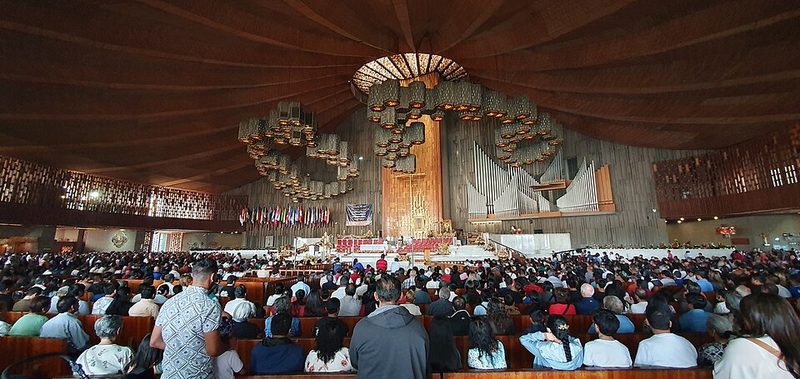
Every year, somewhere between 20 and 30 million people visit the Basilica de Guadalupe in northern Mexico City. That makes it the most visited Catholic pilgrimage site in the Americas and one of the most visited religious sites on Earth, on par with the Vatican and Lourdes. On December 12th — the Feast of Our Lady of Guadalupe — roughly 10 million pilgrims arrive in a single 24-hour period. Ten million. In one day.
Whether you’re a believer, a student of history, or simply curious about what drives that kind of devotion, the Basilica complex on Tepeyac Hill is worth your time. It’s the spiritual center of Mexico, the place where indigenous and Catholic traditions fused into something entirely new, and the origin point of the most important religious symbol in the Western Hemisphere.
The Story of the Virgin of Guadalupe
Here’s the account that every Mexican child knows by heart.
On December 9, 1531 — just ten years after the fall of Tenochtitlan — a Nahua peasant named Juan Diego Cuauhtlatoatzin was walking across Tepeyac Hill on his way to morning Mass. He heard music and saw a brilliant light, and a woman appeared to him speaking in Nahuatl. She identified herself as the Virgin Mary and asked him to tell the bishop, Fray Juan de Zumarraga, to build a church on the hill.
Juan Diego went to the bishop. The bishop didn’t believe him. The Virgin appeared again and sent Juan Diego back. The bishop asked for a miraculous sign as proof. On December 12, the Virgin appeared a third time and told Juan Diego to gather roses from the hilltop — an impossibility in December, on a barren hill. He found Castilian roses blooming there, gathered them in his tilma (cloak), and brought them to the bishop. When he opened the tilma and the roses fell out, the image of the Virgin was imprinted on the cloth.
That tilma — a coarse agave fiber garment that by all material science logic should have disintegrated within 20 years — has been preserved for nearly 500 years. It’s now displayed above the main altar of the new Basilica, and it’s what those millions of pilgrims come to see.
Why It Matters So Much
The Guadalupe story isn’t just a religious miracle narrative. It’s the foundational myth of Mexican identity. The Virgin appeared as an indigenous woman, speaking Nahuatl, to an indigenous man, on a hill that had previously been the site of a temple to Tonantzin, the Aztec mother goddess. She appeared just a decade after the conquest, when the indigenous population was reeling from military defeat, disease, and forced conversion.
The image became a bridge between worlds. It gave indigenous Mexicans a path into Catholicism on their own terms, incorporating their own imagery and symbolism. Father Miguel Hidalgo carried a banner of the Virgin of Guadalupe when he launched the Mexican War of Independence in 1810. Emiliano Zapata’s soldiers wore her image during the Revolution. She’s on murals, taxi dashboards, tattoos, and protest signs. Pope John Paul II canonized Juan Diego in 2002, making him the first indigenous saint from the Americas.
Whether or not you accept the miraculous origin of the image, its cultural impact is beyond dispute. The Virgin of Guadalupe is the most powerful symbol in Mexican life, period.
The Basilica Complex

The pilgrimage site occupies a large complex at the base and summit of Tepeyac Hill, in the Gustavo A. Madero borough of northern Mexico City. Several buildings share the site, spanning nearly 500 years of construction.
The New Basilica (1976)
The main event. The new Basilica de Guadalupe was designed by architect Pedro Ramirez Vazquez (who also designed the National Anthropology Museum) and completed in 1976. It’s a circular, tent-like structure with a capacity of 10,000 people, built to replace the old basilica whose foundations were sinking into the soft lake bed soil that underlies much of Mexico City.
The interior is a single vast space with no columns obstructing the view, so every seat has a sightline to the main altar. Above the altar hangs the tilma of Juan Diego, displayed behind bulletproof glass in a gold frame. A moving walkway (flat escalator) runs beneath and behind the altar, allowing pilgrims to pass directly under the image for a close-up view without creating a bottleneck. It’s a smart piece of crowd engineering for a site that handles these volumes.
The architecture is divisive. It’s functional — Ramirez Vazquez was solving a logistics problem, and he solved it — but the building doesn’t have the emotional weight of a Gothic cathedral or even the old basilica next door. It looks like a convention center from certain angles. But when it’s full of worshippers and the acoustics carry the sound of thousands of voices, the space works.
The Old Basilica (1709)
The original Basilica, completed in 1709 after decades of construction, is a handsome Baroque church that sat on this site for nearly 300 years before structural problems forced its closure. The building was literally sinking — unevenly, so the floor tilted and the walls cracked. Major stabilization work in the late 20th and early 21st century saved the structure, and it’s now open as the Templo Expiatorio a Cristo Rey, used for smaller services and as an exhibition space.
The exterior, with its twin bell towers and ornate stone facade, is architecturally far more interesting than the new basilica. It’s worth walking around the outside even if you don’t go in.
Tepeyac Hill and the Capilla del Cerrito
The hill where Juan Diego reportedly saw the Virgin rises behind the basilica complex. A path of stairs and ramps winds to the summit, where the Capilla del Cerrito (Chapel of the Little Hill) sits on the alleged spot of the apparition. The chapel was built in 1666 and renovated multiple times.
The climb is moderate — maybe 15 minutes at a steady pace. From the top, you get panoramic views of the basilica complex below and the sprawl of northern Mexico City extending to the horizon. On the Feast Day, this hill is a solid mass of humanity.
Other Structures
The complex includes several other buildings:
- Capilla del Pocito (1791): A small Baroque chapel with a distinctive tiled dome, built over a well that reportedly sprang up at the site of one of Juan Diego’s visions. It’s architecturally the most beautiful individual building in the complex.
- Museum of the Basilica: Houses colonial-era religious art, ex-votos (small devotional paintings), and artifacts related to the Guadalupe cult. Worth 30 minutes if you have the time.
- Parroquia de Capuchinas: An 18th century church within the complex.
- Jardines del Tepeyac: Gardens and plazas connecting the various buildings, with sculptures and monuments.
Visiting: Practical Details
Getting There
The Basilica is in the La Villa neighborhood. The easiest route is Metro Line 6 to La Villa-Basilica station, which puts you about a 5-minute walk from the main entrance. You can also take Line 3 to Deportivo 18 de Marzo and walk about 15 minutes. Metrobus Line 1 has a stop at Misterios, roughly 10 minutes’ walk away.
From the Historic Center or the Zocalo, the Metro trip takes about 25 minutes including the walk.
Hours and Admission
The basilica is open daily from 6:00 AM to 9:00 PM. Admission is free. The museum has separate hours (typically 10:00 AM to 6:00 PM, closed Mondays) and charges a small admission fee.
When to Visit
On regular weekdays, the basilica is busy but manageable. Weekends see larger crowds, especially Sundays when families come for Mass. If you want to actually see the tilma without a long wait for the moving walkway, go on a Tuesday or Wednesday morning.
The period around December 12 (Feast of Our Lady of Guadalupe) is extraordinary but overwhelming. Pilgrims begin arriving days in advance, many walking from other states or crawling the final kilometers on their knees. The atmosphere is electric and deeply moving, but the crowds are immense and the surrounding streets become impassable. If you want to experience the feast, commit to the crowd. If you want to actually tour the buildings, come another time.
How Long to Spend
A thorough visit covering the new basilica, old basilica exterior, Tepeyac Hill, Capilla del Pocito, and the museum takes 2-3 hours. If you’re only seeing the new basilica and the tilma, an hour is sufficient.
What to Wear
This is an active place of worship. Dress respectfully — no shorts, no tank tops, no hats inside the basilica. This is more strictly observed here than at most Mexican churches because of the site’s religious significance.
Context for Non-Catholic Visitors
You don’t need to be Catholic to appreciate the Basilica de Guadalupe. The history alone — the collision of indigenous and European religions, the political uses of the Virgin’s image, the architectural evolution of the complex — makes it one of the most historically significant sites in the Americas.
But what’s most striking is watching the pilgrims. People arrive with flowers, with candles, with photos of sick relatives, with babies to be blessed. Many have walked for days. The emotional intensity is real and, regardless of your own beliefs, deeply affecting. This isn’t a tourist attraction that happens to be religious. It’s a religious site that happens to accept tourists, and the difference matters.
Pair it with a visit to the Historic Center or the Zocalo to round out your understanding of how Mexico City’s history layered indigenous, colonial, and modern identities on top of each other. The Basilica is where that layering is most visible and most alive.