
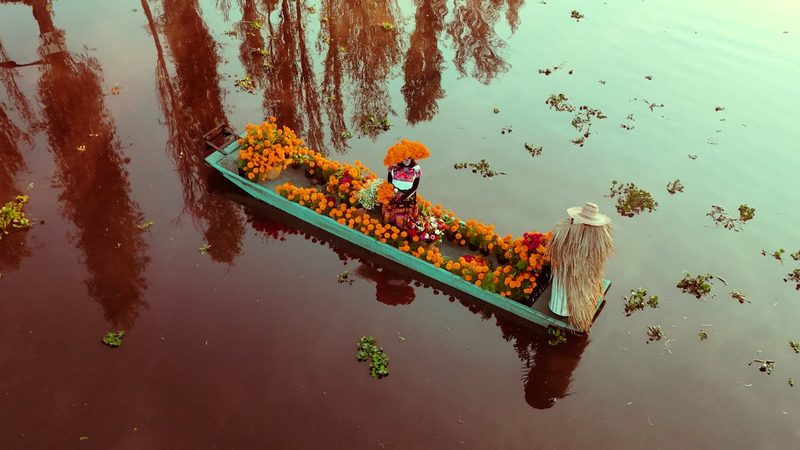
Xochimilco: The Last Canals of an Ancient Lake City
Xochimilco is unlike anything else in Mexico City. Actually, it’s unlike anything else in the world. This is the last surviving fragment of the vast canal and lake system that defined the Valley of Mexico for thousands of years, the same waterways the Aztecs used to haul food, build cities, and connect an empire. Everything else was drained centuries ago. Only Xochimilco remains.
And what remains is strange, beautiful, contradictory, and sometimes a little chaotic. On a Sunday afternoon, you’ll find yourself floating on a brightly painted boat called a trajinera through 170 kilometers of canals, while mariachi bands serenade you from passing boats, vendors paddle up selling corn on the cob and cold beers, and somewhere in the distance somebody’s birthday party has gotten very loud. It’s one of the most surreal experiences you can have in the city.
But Xochimilco is also a UNESCO World Heritage Site with serious ecological problems, the last natural habitat of the critically endangered axolotl, and a place where pre-Hispanic agricultural techniques are still practiced on artificial islands that date back centuries. There’s a lot going on here, and a short boat ride barely scratches the surface.
We’ll cover all of it: the boats, the canals, the floating gardens, the creepy Island of the Dolls, the axolotl situation, and how to plan a visit that actually makes sense. Xochimilco sits in the far south of the city, about 25 kilometers from the Historic Center, so you need to plan ahead. This isn’t a place you stumble into on a casual walk from your hotel in Roma Norte.
A History Written in Water

The name Xochimilco comes from Nahuatl meaning “where the flowers grow.” Before the Spanish arrived, the entire southern Valley of Mexico was a network of shallow freshwater lakes, and Xochimilco sat on the southern shore of one of them.
The people here were among the first in the valley to develop chinampas, the so-called “floating gardens” that are actually artificial islands built on the lakebed. They’d anchor rectangular plots using wooden stakes and ahuejote trees (a native willow), pile up lake sediment, vegetation, and soil, and farm intensively on these raised beds surrounded by canal water. The system was incredibly productive, capable of up to seven harvests per year, which is why it fed not just Xochimilco but the entire Aztec capital of Tenochtitlan.
When the Spanish conquered the valley, they found a water world. Cities sat on islands and lake shores, connected by causeways and canals. Xochimilco’s waterways remained the main shipping route for agricultural products to Mexico City well into the early 20th century.
Then the draining started. The Spanish began reducing the lakes in the colonial period, but the real damage came in the 20th century when Mexico City pumped massive amounts of groundwater from aquifers beneath the southern boroughs. Lake Texcoco, Lake Chalco, and most other bodies of water disappeared entirely. Only Xochimilco’s canals survived, fed by freshwater springs later supplemented by treated wastewater when the water table dropped too low.
In 1987, UNESCO declared the canals and chinampas a World Heritage Site, recognizing them as the last vestige of a pre-Hispanic landscape that once defined the entire valley. The designation was meant to protect what remained. Whether it’s actually worked is debatable, and we’ll get to that.
The Canals and Trajineras: What You’re Actually Signing Up For

Let’s talk about what most visitors actually come for: riding a trajinera through the canals.
Trajineras are flat-bottomed, gondola-style boats, typically about 10 to 15 meters long, painted in bright colors and decorated with flowers. Each boat has a colorful arch at one end with a woman’s name spelled out in flowers or painted letters. They’re propelled by a boatman (or occasionally a boatwoman) standing at the back with a long pole, pushing against the shallow canal bed. There are no motors. It’s peaceful, slow, and scenic.
Each trajinera seats about 15 to 20 people on chairs or benches arranged around a central table. Groups typically rent an entire boat and bring food, drinks, and speakers. Yes, this is how people party in Xochimilco. On weekends, the main canals look like a floating festival, with dozens of boats packed together, music blasting from multiple directions, and the distinct smell of barbecue drifting across the water.
The boats depart from embarcaderos, which are the official docks. There are nine of them scattered around the canal system, each offering a slightly different experience. The most popular ones are Embarcadero Nativitas and Embarcadero Nuevo Nativitas, which are the most tourist-oriented, the easiest to reach, and the most crowded. Embarcadero Cuemanco is near the ecological park and tends to draw a slightly quieter crowd. Embarcadero Fernando Celada is another good option that’s less hectic than Nativitas.
If you’re visiting specifically to see the chinampas and the ecological side of Xochimilco rather than the party scene, head to Embarcadero Cuemanco or ask specifically for a route through the chinampa agricultural zone, where farmers still cultivate plots using traditional methods. The wider canal routes near Nativitas are the main party corridor.
Pricing and How It Works
Trajinera prices are set by the borough government and posted at each embarcadero. As of our last check, the official rate is around 500 to 600 pesos per hour per boat (not per person). A typical ride lasts about two hours, so you’re looking at 1,000 to 1,200 pesos for the whole boat. If you’re a couple or a small group, that’s a great deal since you’re splitting the cost. Solo travelers can sometimes join other groups or negotiate a shorter ride, but it’s less common.
Boatmen may try to charge more than the posted rate, especially at the busier embarcaderos on weekends. Check the posted prices before negotiating, and don’t be afraid to walk to a different dock. There are also vendors on the water selling food (elotes, esquites, fruit, snacks) and others offering mariachi or marimba music from their own boats that pull up alongside yours. Music is negotiated separately and typically runs 200 to 400 pesos per song or set. It’s all part of the experience, but it adds up if you say yes to everything.
Bring your own food and drinks to keep costs down. Most groups do this. There’s no rule against it, and the table on the trajinera is basically designed for a picnic. Beer, micheladas, snacks, tacos from a nearby market — load up before you board.
Weekday vs. Weekend: Two Different Worlds
This is important. Xochimilco on a Tuesday afternoon and Xochimilco on a Saturday afternoon are barely recognizable as the same place.
On weekdays, the canals are quiet. You might be one of a handful of boats on the water. The ahuejote trees arch over the narrow channels. Birds land on the chinampa edges. You can hear the water and the wind. It’s genuinely tranquil and you can appreciate the ecology, the history, and the beauty of a landscape that’s been here for over 500 years.
On weekends, especially Sundays, it’s a floating party. Hundreds of boats crowd the main canals, bumping into each other, with competing music creating a wall of sound. It’s fun in its own way, lively, social, very Mexican, and it’s certainly the more authentic local experience since this is how Mexico City residents have been using Xochimilco for generations. But if you came expecting a serene float through ancient gardens, you’ll be surprised.
Our recommendation: visit on a weekday if you want to actually see Xochimilco. Visit on a weekend if you want to experience it as a party. Both are valid, but go in with the right expectations.
The Chinampas: Still-Functioning Pre-Hispanic Agriculture

The chinampas are the real story of Xochimilco, even if most visitors barely notice them beyond the scenery sliding past their trajinera. These artificial agricultural islands represent one of the most productive farming systems ever developed, and some are still in active use.
At their peak, the chinampa system covered about 9,000 hectares across the Valley of Mexico’s lakes. Today, roughly 2,000 hectares remain in Xochimilco, though not all are actively farmed. The ones that are still produce lettuces, herbs, spinach, quelites (wild greens), and flowers. Xochimilco supplies a large percentage of Mexico City’s cut flowers, continuing the tradition that literally gave the place its name.
The chinampa farmers, called chinamperos, face enormous challenges. Water quality has deteriorated, with treated wastewater replacing the clean spring water that originally fed the system. Urban encroachment is eating away at the protected zone, with an estimated 90,000 people living in illegal settlements in the ecological reserve. And younger generations aren’t interested in the backbreaking work of traditional agriculture.
Some chinamperos have started offering farm tours, selling directly to restaurants in neighborhoods like Condesa and Roma Norte, or growing organic produce that commands higher prices. If you’re interested in the agricultural side, ask at Embarcadero Cuemanco about tours that visit active chinampas. It’s a different experience from the standard canal ride and one we think is more rewarding.
The Island of the Dolls (Isla de las Munecas)
We need to talk about the dolls.
Deep in the canals of Xochimilco, on a chinampa in the Laguna de Tequila, there’s a small island covered in hundreds of old, weathered, decaying dolls. They hang from trees, they’re nailed to walls, they stare out from behind fences with their one remaining eye. Spiders have colonized many of them. The paint has peeled off their faces. Some are missing limbs. It looks exactly like the set of a horror movie, and Guinness World Records officially recognized it in 2022 as hosting the world’s largest collection of haunted dolls.
The story behind it is this: sometime in the mid-20th century, a man named Julian Santana Barrera began living as a recluse on this chinampa. According to legend, he either found the body of a drowned girl in the canal or failed to save her from drowning. The next day, a doll appeared floating in the water. Believing it belonged to the girl, he hung it from a tree. Then he started collecting more dolls, trading produce from his garden for them, pulling them from trash, accepting donations. He kept hanging them, hundreds of them, supposedly to appease the drowned girl’s spirit.
In 2001, Barrera was found dead, face-down in the canal, reportedly in the same spot where the girl was said to have drowned. His nephew had been with him earlier that day and said Barrera was singing to “mermaids” he claimed were calling to him from the water. After his death, the family opened the island to visitors.
Is it genuinely creepy? Yes. We won’t pretend otherwise. Even in broad daylight with other tourists around, there’s something unsettling about hundreds of disembodied doll heads watching you from the trees. Visitors report hearing whispers and seeing the dolls move their eyes, though we’ll chalk that up to wind and imagination. Some people leave offerings around the dolls.
Getting there requires a trajinera ride of about two hours each way from most embarcaderos, so plan on a dedicated half-day trip. Not all boatmen will take you; some refuse out of superstition. The route passes through the ecological area, the Ajolote Museum, the Apatlaco Canal, and the Teshuilo Lagoon.
Our honest take: worth the trip if you have a full day and interest in the macabre. If you’re short on time and have to choose between the dolls and a chinampa tour, pick the chinampas. More interesting, more important.
The Axolotl: Xochimilco’s Most Famous Resident

If you’ve been on the internet in the last decade, you’ve seen an axolotl. Those pink, smiling, feathery-gilled creatures that look like Pokemon characters are real animals, and Xochimilco’s canals are the only place on Earth where they still exist in the wild.
The axolotl (Ambystoma mexicanum) is an amphibian that never fully metamorphoses. It stays aquatic its entire life, retaining its larval features including external gills into adulthood. It can regenerate lost limbs, parts of its heart, spinal cord, and even portions of its brain, which is why medical researchers worldwide study it obsessively.
The Aztecs considered the axolotl an incarnation of the god Xolotl, brother of Quetzalcoatl, who supposedly transformed himself into an axolotl to avoid being sacrificed. They ate them as food and used them in medicine. Today, we’re the ones trying to keep them from disappearing.
The situation is dire. A 2003 survey found about 600 axolotls per square kilometer. More recent counts have found fewer than 35. The threats are multiple: deteriorating water quality, invasive tilapia and carp (introduced in the 1960s) that eat axolotl eggs, and ongoing habitat loss from urbanization.
Conservation efforts exist. The Grupo de Investigacion del Ajolote en Xochimilco (GIA-X) works to understand and preserve the species. Some chinamperos have created axolotl-friendly habitats on their plots. Captive breeding programs maintain populations in labs worldwide, so the species won’t go fully extinct even if the wild population does. But losing wild axolotls would mean losing something irreplaceable.
You probably won’t see one. They’re nocturnal, shy, and vanishingly rare. But the Ajolote Museum near the ecological area has live specimens and explains the conservation work, and it’s a worthwhile stop if your boatman routes you that way.
Museo Dolores Olmedo
While you’re making the trek to southern Mexico City, the Museo Dolores Olmedo is worth combining with a Xochimilco visit. Located in the La Noria neighborhood of the borough, the museum occupies a beautiful hacienda-style estate that businesswoman and art collector Dolores Olmedo acquired in 1962 and converted into a museum in 1994.
The collection is staggering: 145 paintings by Diego Rivera, 25 by Frida Kahlo, works by Angelina Beloff (Rivera’s first wife), nearly 6,000 pre-Hispanic figurines and sculptures, and a rotating selection of folk art and contemporary pieces. If you’re interested in Rivera and Kahlo, this is the largest single collection of their work anywhere, bigger than the collections at the Chapultepec museums or the Frida Kahlo Museum in Coyoacan.
The grounds are as much a draw as the art. The gardens are home to peacocks, Xoloitzcuintli dogs (the hairless Mexican breed you see in pre-Hispanic art), geese, and ducks that roam freely. On a sunny day, the gardens alone justify the visit.
Note: at the time of writing, there have been plans to relocate the museum to Chapultepec. Check current status before visiting, as the Xochimilco location may or may not still be operating. If it has moved, that’s one less reason to visit the borough, but the canals and chinampas remain the main attraction regardless.
The San Bernardino de Siena Monastery
Before or after your canal ride, walk through the historic center of Xochimilco town, anchored by the 16th-century San Bernardino de Siena monastery. The main plaza has food stalls (the “Tianguis de Comida” is a popular lunch spot) and vendors selling ice cream, which Xochimilco is oddly famous for. The town center was renovated in 2002, with businesses agreeing with INAH to paint their facades in coordinated colors.
The main street, Calle Guadalupe I. Ramirez, was originally a land bridge connecting what was then an island to the causeway leading to Tenochtitlan. As the lake dried, the bridge became a road. Walking it knowing you’re on what used to be a bridge over open water changes how you see the whole area.
Getting to Xochimilco
Xochimilco is far from the tourist core of Mexico City, and getting there takes some planning. From the Zocalo or neighborhoods like Condesa and Roma Norte, expect the journey to take 60 to 90 minutes depending on traffic and your chosen route.
Tren Ligero (best option): Take Metro Line 2 to Tasquena, transfer to the Tren Ligero light rail south to Xochimilco terminal. Short walk or taxi to the embarcaderos. About an hour from central CDMX, costs almost nothing, clean, safe, frequent.
Uber or taxi: Faster in theory, slower in practice. Traffic on the Periferico Sur can be brutal on weekends. Expect 200 to 400 pesos from the Historic Center. Coming back is harder — ride-hail availability in Xochimilco isn’t great.
Organized tour: Many companies offer packages with transport, trajinera ride, and stops at the Dolores Olmedo museum or Coyoacan. More expensive but solves logistics, and solo travelers don’t have to pay for a whole boat.
Food and Drink on the Water

Eating on a trajinera is half the experience. As mentioned, most groups bring their own food. If you’re stocking up beforehand, the Mercado de Xochimilco near the town center is a good place to grab supplies: tortas, tacos, fruit, chips, and whatever else you want to load onto the boat table.
Once on the water, vendor boats will find you. Smaller canoes paddled by women selling elotes, esquites, quesadillas, tlacoyos, and tamales. The food is simple, cheap, and generally good. Other boats sell beer, pulque, and micheladas. On weekends, dedicated food boats with grills set up in the wider canal areas — floating restaurants, basically.
One thing to know: the canal water is not clean. It’s supplemented with treated wastewater and receives untreated sewage in some areas. Don’t trail your hands in it, and don’t let kids splash around. You’re fine staying in the boat, but you don’t want contact with the water.
Safety and Practical Considerations
Xochimilco is generally safe for tourists, particularly during the day and at the main embarcaderos. The borough actually has lower crime statistics than most areas of Mexico City, along with other southern boroughs like Tlalpan and Milpa Alta. That said, a few practical points:
Stick to the tourist zone around the embarcaderos and historic center. The borough has pockets of poverty and thin police coverage — about one officer per 550 residents by the borough’s own count.
On the water, the biggest risk is getting too drunk on a boat with no railings. People do fall in. The canals are shallow, so drowning is unlikely, but you’ll be wading out of water you really don’t want to swim in. Keep phones secure too — the main loss is devices going overboard when boats bump together on crowded weekends.
The Honest Assessment: Tourist Spectacle vs. Ecological Reality
We want to be straight about something: Xochimilco is simultaneously one of the most special places you can visit in Mexico City and an ecosystem in serious trouble.
The trajinera experience is wonderful. Floating through canals that predate the Spanish, under arching ahuejote trees, past chinampas where people still grow food — it’s a connection to pre-Hispanic Mexico you can’t get anywhere else. We’d never tell someone not to go.
But UNESCO has repeatedly warned that Xochimilco could lose its World Heritage status. A joint study with the Universidad Autonoma Metropolitana found dangerously high pollution levels in the canals. The protected zone loses about six hectares per year to illegal settlements. Over 33,000 families live illegally on the chinampas. The ground is sinking 18 centimeters annually from groundwater over-pumping. Invasive water lilies from Brazil choke the waterways. The axolotl population has crashed. Native species are declining across the board.
None of this means you shouldn’t visit. Tourism provides economic incentive to preserve the canals rather than fill them in for development. Your trajinera ride supports local boatmen. Buying from chinamperos supports traditional agriculture. Just go in with open eyes. This isn’t a pristine nature preserve. It’s a living, struggling, complicated place that’s been fighting for survival for 500 years. Its persistence is remarkable. Its future is uncertain.
Planning Your Visit
Here’s how we’d structure a Xochimilco day:
For a half day (canals only): Take the Tren Ligero to Xochimilco. Walk or cab to Embarcadero Nativitas (or Cuemanco for something quieter). Rent a trajinera for two hours. Head back. Total time from central CDMX: about four to five hours including transit.
For a full day (canals + town + museum): Start at the Museo Dolores Olmedo in the morning when it opens. Then head to the Xochimilco town center for lunch at the food market. Walk to an embarcadero and do a two-hour canal ride in the early afternoon. Take the Tren Ligero back. Total time: seven to eight hours.
For a full day with Coyoacan: Do Xochimilco in the morning (get to an embarcadero by 10 AM for a quiet ride), then head to Coyoacan for the afternoon. They’re relatively close to each other in the southern part of the city, and this is the classic day-trip pairing.
For the Island of the Dolls: Dedicate a half day to this alone. The round trip takes about four hours from most embarcaderos. Start early.
Best months: The dry season (November through April) is ideal. The canals are cleaner, the weather is better, and the ahuejote trees are at their greenest. During the rainy season (June through October), afternoon downpours can cut boat rides short.
Best days: Tuesday through Thursday for calm canals. Sunday for the full festive experience.
Xochimilco isn’t the easiest place to visit in Mexico City. It’s far from the center, the logistics require some thought, and the ecological reality can be sobering if you look closely. But it’s one of the most important places in the entire Valley of Mexico, a living remnant of a world that was mostly destroyed, still hanging on against extraordinary odds. That alone makes it worth the trip south.