
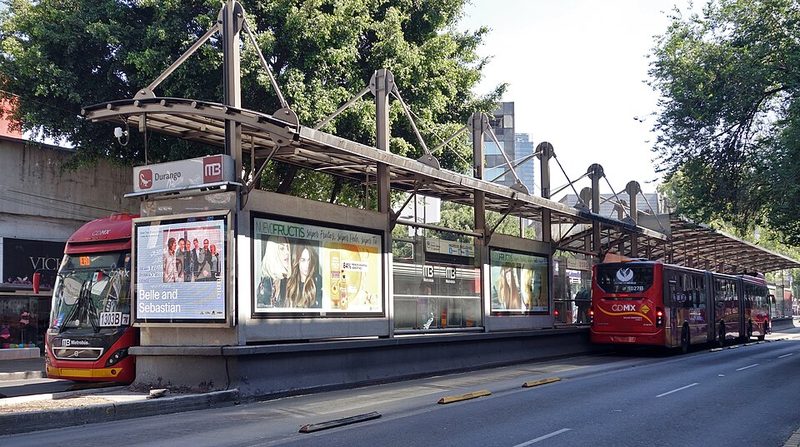
Mexico City’s bus system is the part of public transit that most tourists avoid, and honestly, parts of it deserve that reputation. But the system has multiple tiers, ranging from the excellent (Metrobus) to the chaotic (peseros), and understanding which is which can save you time, money, and the particular anxiety of being on a minibus doing 80 km/h through a narrow colonial street.
Here’s the complete guide to buses in CDMX, from the modern BRT system to the intercity terminals that connect Mexico City to the rest of the country.
Metrobus (Bus Rapid Transit)

The Metrobus is the good part. Launched in 2005, it’s a bus rapid transit (BRT) system running on dedicated lanes separated from regular traffic by physical barriers. The buses are long, articulated vehicles that stop at enclosed stations with raised platforms — you pay before boarding, like a Metro, not when you get on the bus.
The system currently has 7 lines covering over 140 km of routes:
Line 1: Insurgentes
The flagship line. Runs the full length of Avenida de los Insurgentes from Indios Verdes in the north to El Caminero in the south — roughly 30 km. This is one of the most useful transit routes in the city, connecting the northern suburbs through the Historic Center, Roma, Condesa (via the Insurgentes-Sonora transfer), and south to UNAM and beyond. Stations every 400-500 meters. Frequency: every 2-5 minutes during peak hours.
Line 2: Eje 4 Sur
Runs east-west along Eje 4 Sur from Tepalcates to Tacubaya, connecting the eastern city to the western hub at Tacubaya. Useful for reaching areas south of the center.
Line 3: Eje 1 Poniente
Runs from Etiopia in the south to Tenayuca in the north, along the western side of the central city.
Line 4: Airport – Centro – Buenavista
Connects both terminals of the AICM airport to the Historic Center and Buenavista station. The most useful line for arriving and departing travelers. Dedicated lanes keep it relatively fast despite the heavy traffic in the airport corridor.
Line 5: Rio de los Remedios – San Lazaro
Serves the northeastern city.
Line 6: El Rosario – Villa de Aragon
Runs east-west across the northern city.
Line 7: Indios Verdes – Campo de Tiro
Serves the northern corridor.
How to Use the Metrobus
You need a rechargeable smartcard (tarjeta de movilidad integrada) to ride. Cards are available from machines at any Metrobus station. Buy the card (about 16 MXN for the card itself), load it with credit, and tap it at the station turnstile before boarding. Each ride costs 6 MXN regardless of distance.
The same card works on the Metro, the Tren Ligero (light rail to Xochimilco), the Trolebus (trolleybus), and the Cablebus (cable car). Load it with enough credit for your trip and you’re covered across most of CDMX’s transit network.
Metrobus stations have route maps and digital arrival signs showing the next bus. During rush hours (7:30-9:30 AM and 5:30-8:00 PM), buses are packed. Outside peak hours, they’re comfortable and efficient.
Metrobus Tips
- Stations have designated zones for boarding and alighting — pay attention to the floor markings.
- Many stations have women-only sections at one end of the platform, marked in pink. During rush hours, men are not allowed in these sections.
- The buses run from approximately 4:30 AM to midnight. After midnight, you’ll need a taxi or Uber.
- Don’t lose your card — it’s not linked to your identity and can’t be replaced if lost with credit on it.
Peseros / Microbuses
Peseros are the green-and-white (or sometimes other colors) minibuses that run on hundreds of routes throughout the city. They’re the workhorses of CDMX public transit, carrying millions of passengers daily to areas the Metro and Metrobus don’t reach. They’re also loud, uncomfortable, driven aggressively, and confusing for newcomers.
How They Work
Peseros run fixed routes but don’t have formal stops — they’ll pick up and drop off passengers anywhere along their route when you flag them down or shout “baja” (getting off). The route is indicated by a sign in the windshield, but the signs use abbreviations and destination names that only make sense if you already know the route. There are no route maps posted at “stops” because there are no official stops.
You pay the driver in cash when you board (have coins or small bills ready) or sometimes when you exit. Fares are cheap — typically 5-7 MXN for short routes, up to 10-12 MXN for longer ones.
The Experience
Peseros are cramped. The seats are small, the aisles are narrow, and during rush hours people are pressed together standing. Drivers are notoriously aggressive — rapid acceleration, hard braking, and competitive behavior with other peseros are standard. The city has been gradually replacing the older, smaller microbuses with larger, safer units, but the transition is ongoing.
Should Tourists Use Them?
For most visitors, no. The Metro, Metrobus, Uber, and walking will cover nearly everything you need. Peseros are useful if you’re going somewhere specific that’s not served by the Metro or Metrobus, and a local has told you exactly which pesero to take and where to get off. Without that guidance, the system is impenetrable.
That said, if you’re the type of traveler who enjoys navigating local transit systems as an experience in itself, a pesero ride is an authentic slice of daily CDMX life. Just guard your belongings, have small cash ready, and know your stop in advance.
RTP Buses
The Red de Transporte de Pasajeros (RTP) operates full-size government buses on fixed routes. They’re larger, more comfortable, and safer than peseros, with designated stops. They’re painted pink or red and are particularly used on routes connecting outer neighborhoods to Metro stations and major destinations.
RTP buses accept the same smartcard as the Metrobus and Metro. Fares are around 4-6 MXN. They run on more predictable schedules than peseros and are a decent option for routes the Metro doesn’t cover, though frequencies can be low outside peak hours.
Trolebus (Trolleybus)
Mexico City still operates electric trolleybuses on several routes, primarily along Eje Central (Line 1 of the trolleybus system, running from Politecnico to El Caminero — roughly the same north-south corridor as Eje Central Lazaro Cardenas). They use the same smartcard and fare structure as the Metrobus. Trolleybuses are quiet, clean, and uncrowded compared to peseros. The Eje Central route is actually a useful corridor for reaching some Historic Center locations.
Intercity Buses
Mexico City is the hub of Mexico’s extensive intercity bus network. If you’re traveling to other cities — Puebla, Oaxaca, Guanajuato, San Miguel de Allende, Queretaro, Taxco — you’ll likely depart from one of four major terminals:
Terminal Norte (Central de Autobuses del Norte)
The largest terminal. Serves destinations north and northeast of Mexico City: Queretaro, San Miguel de Allende, Guanajuato, Leon, Aguascalientes, Monterrey, Guadalajara (some services), Teotihuacan, and Pachuca. Metro: Autobuses del Norte (Line 5).
Terminal Sur (Central de Autobuses del Sur / Taxquena)
Serves destinations south: Cuernavaca, Taxco, Acapulco, and some Oaxaca services. Metro: Taxquena (Line 2). Smaller and more manageable than Terminal Norte.
Terminal Oriente (TAPO)
Serves destinations east and southeast: Puebla, Oaxaca, Veracruz, Villahermosa, and the Yucatan Peninsula. Metro: San Lazaro (Lines 1 and B). TAPO is modern and well-organized, with good food options and luggage storage.
Terminal Poniente (Observatorio)
Serves destinations west: Toluca, Valle de Bravo, Morelia. Metro: Observatorio (Line 1). The smallest of the four terminals.
Bus Classes
Mexican intercity buses come in several classes:
- Ejecutivo/Lujo (Executive/Luxury): Wide reclining seats, air conditioning, onboard toilets, entertainment screens, sometimes snacks and drinks. Companies like ETN, Primera Plus, and ADO GL/Platino offer this level. The quality rivals business class on a short-haul flight.
- Primera Clase (First Class): Comfortable seats, AC, restroom. ADO, Estrella Roja, and others. Good for most trips.
- Segunda Clase (Second Class): Basic buses that make more stops. Cheaper, slower, and less comfortable. The ride from CDMX to Puebla that takes 2 hours on first class takes 3+ on second class.
For trips under 4 hours (Puebla, Queretaro, Cuernavaca), first class is fine. For longer trips (Oaxaca at 6+ hours, Monterrey at 12), splurge on executive class. The price difference is often modest.
Booking
You can buy tickets at the terminal on the day of travel for most routes, but popular services (Friday evening departures, holiday weekends) sell out. ADO and ETN allow online booking through their websites and apps. Digital tickets on your phone are accepted.
Practical Summary
| System | Best For | Cost | Tourist-Friendly? |
|---|---|---|---|
| Metrobus | Major corridors, airport | 6 MXN | Yes |
| RTP Buses | Secondary routes | 4-6 MXN | Moderate |
| Trolleybus | Eje Central corridor | 4-5 MXN | Yes |
| Peseros | Local routes, everywhere | 5-12 MXN | No |
| Intercity (1st class) | Other cities | 200-800+ MXN | Yes |
The Metrobus is the system you’ll use most. The Metro handles the rest of your urban transit needs. Peseros are for locals and adventurous travelers. And the intercity terminals are your gateway to the rest of Mexico — well-organized, comfortable at the right class level, and serving virtually every destination in the country from one of four convenient hubs.
For a complete overview of all transit options, see our Getting Around Mexico City guide.