
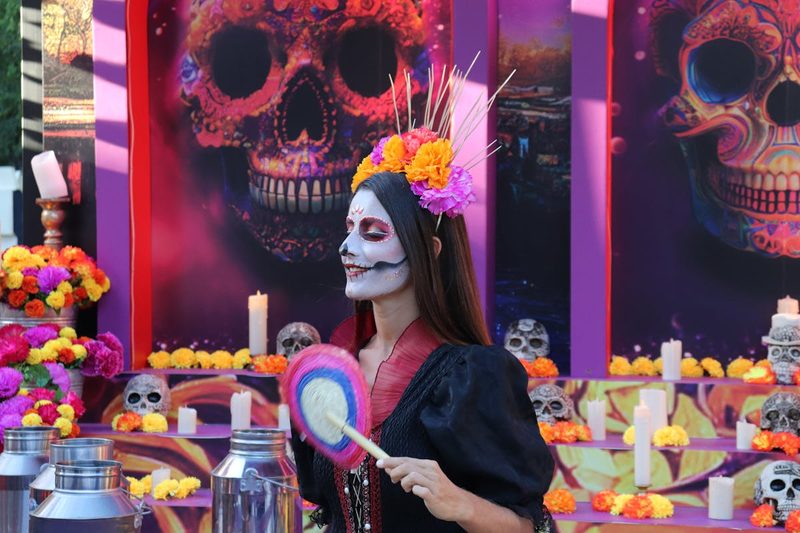
Day of the Dead is the most misunderstood holiday in the Americas. Tourists show up expecting Mexican Halloween. What they get is something far stranger, older, and more emotionally complex — a multi-day practice of honoring deceased family members that mixes pre-Hispanic beliefs about death with Catholic ritual, and does it with flowers, food, music, sugar skulls, and a spirit of celebration that strikes most outsiders as paradoxical until they experience it firsthand.
In Mexico City, Dia de los Muertos has exploded in visibility over the past decade, partly due to genuine cultural revival and partly due to a James Bond movie. We’ll explain both. But first, the fundamentals.
What Day of the Dead Actually Is

Dia de los Muertos is not a single day. It’s a period centered on November 1st (Dia de los Inocentes or Dia de los Angelitos, honoring deceased children) and November 2nd (Dia de los Muertos proper, honoring deceased adults). Preparations begin in mid-October, and in many communities the observance extends for a week or more.
The core belief, rooted in Mesoamerican cosmology far older than Christianity, is that the dead return to visit the living during this period. They’re not ghosts in the horror-movie sense. They’re family members coming home for a visit, and they expect to find their favorite foods, drinks, music, and personal belongings waiting for them. The living’s job is to make them feel welcome.
Ofrendas (Altars)
The ofrenda is the centerpiece of Day of the Dead observance. It’s an altar set up in a home, workplace, school, or public space, dedicated to specific deceased individuals. A proper ofrenda includes:
- Photos of the deceased
- Cempasuchil (marigolds): The orange flowers whose scent is believed to guide the dead back to the living. You’ll see them everywhere in late October — markets, streets, doorways, cemeteries, covering entire altars in brilliant orange. Mexico produces an estimated 15,000 tons of marigolds annually for the holiday.
- Food and drink: The deceased’s favorite meals, plus pan de muerto (bread of the dead, a sweet bread with bone-shaped decorations), mole, tamales, fruit, and whatever specific dishes the person enjoyed in life. Alcoholic beverages are common — tequila, mezcal, beer.
- Sugar skulls (calaveras de azucar): Decorative skulls made from sugar paste, often with the name of the deceased written on the forehead. They’re beautiful, edible (technically), and one of the holiday’s most recognizable symbols.
- Papel picado: Cut tissue paper banners in purple and orange, hung above the ofrenda.
- Candles and copal incense: Light and smoke to guide the spirits home.
- Personal objects: Toys for deceased children, tools or instruments for adults, clothing, books, anything the person valued.
- Salt and water: Basic sustenance for the journey between worlds.
The care and specificity of ofrendas is what makes Day of the Dead emotionally powerful. These aren’t generic decorations. They’re personalized tributes to real people, assembled by family members who remember exactly what Grandma liked to eat and what songs Uncle Jorge played on his guitar. The grief is real, but so is the joy of remembering.
Calaveras Literarias
A tradition unique to Mexico: humorous satirical poems called calaveras literarias (literary skulls) that describe living people as though they’ve already died. They’re published in newspapers, shared at workplaces, and read aloud at gatherings. Nobody is spared — politicians, celebrities, bosses, teachers, friends. The tone is affectionate mockery, and writing a good calavera is a genuine literary skill. The tradition dates to the 19th century and remains alive and well.
La Catrina
The skeleton woman in the fancy hat that you see on every Day of the Dead souvenir was originally a political cartoon. Jose Guadalupe Posada, the great Mexican printmaker, created “La Calavera Catrina” around 1910-13 as a satire of Mexican society women who adopted European fashions and denied their indigenous heritage. Diego Rivera later incorporated Catrina into his famous mural “Sueno de una Tarde Dominical en la Alameda Central” (now at the Museo Mural Diego Rivera near the Alameda).
The figure has since become the universal symbol of Day of the Dead, and the face painting you see everywhere — skull makeup, often with elaborate floral designs — is a direct descendant of Posada’s original image.
The James Bond Effect
Here’s something that surprises many visitors: the massive Day of the Dead parade that now takes over Mexico City every year didn’t exist before 2016.
In the 2015 James Bond film “Spectre,” the opening sequence features Bond chasing a villain through an enormous Day of the Dead parade in the Zocalo and Historic Center. The scene was spectacular, but it was fiction — no such parade existed in real life. The filmmakers created it for the movie.
After the film’s release, the Mexican government decided to make the fictional parade real. In 2016, Mexico City held its first official Mega Desfile de Dia de Muertos (Grand Day of the Dead Parade), sending giant skull floats, costumed performers, and marching bands down Paseo de la Reforma to the Zocalo. Over 250,000 people attended the first year. The parade has grown annually since, and it’s now one of the biggest public events in the city, typically held on the Saturday before November 2nd.
Some cultural purists object to the parade, arguing it commercializes and Americanizes a deeply personal tradition. Others point out that Day of the Dead has always been evolving, and a public celebration that brings people together isn’t necessarily a betrayal of private observance. Both perspectives have merit. What’s undeniable is that the parade is a massive, visually spectacular event that’s worth seeing if you’re in town.
Where to Experience Day of the Dead in Mexico City

The Zocalo and Historic Center
The Zocalo hosts the city’s largest public ofrenda, typically a monumental installation that fills much of the plaza. The surrounding streets of the Historic Center are decorated with marigolds, papel picado, and skull motifs. Museums, cultural centers, and businesses set up their own ofrendas, many of which are open to the public. The overall effect during the last week of October and first week of November is of an entire city center transformed.
The Reforma Parade
The Grand Parade runs along Paseo de la Reforma from the Chapultepec area to the Zocalo on a Saturday in late October or early November. Giant puppets, floats, skull costumes, live music, and tens of thousands of spectators line the route. Arrive early to get a good viewing spot. The best sections are along Reforma between the Angel of Independence and the Alameda.
Coyoacan
Coyoacan’s plazas and streets go all out for Day of the Dead, with community ofrendas, live performances, and face-painting stations. The neighborhood’s colonial atmosphere and large public spaces make it one of the most atmospheric places in the city for the holiday. Expect massive crowds on the actual dates.
San Andres Mixquic
For the most traditional observance near Mexico City, head to San Andres Mixquic, a small town in the Tlahuac borough on the southeastern edge of the city. Mixquic’s cemetery tradition is famous: on the night of November 1-2, families gather at the graves of their loved ones, decorating them with marigolds and candles, sharing food, and spending the night in the cemetery. The atmosphere is intimate, communal, and deeply moving.
Getting to Mixquic requires effort — it’s about 35 km from central CDMX, and on the nights of November 1-2, traffic is terrible. Many organized tours offer transport. If you go independently, leave early and be prepared for crowds and limited parking.
Museums
Nearly every museum in Mexico City creates an ofrenda for the holiday. The ones at the National Anthropology Museum, the Anahuacalli Museum, and the Dolores Olmedo Museum are typically the most elaborate. The Anahuacalli’s setting — Diego Rivera’s volcanic stone pyramid — is particularly atmospheric for Day of the Dead.
Day of the Dead vs. Halloween
They’re different holidays with different origins, different meanings, and different practices. Day of the Dead is about remembering specific deceased individuals with love, humor, and ritual. Halloween is about scares, costumes, and candy. Day of the Dead predates the Spanish conquest in its core beliefs. Halloween has Celtic and Christian roots.
That said, the two holidays overlap in timing and have increasingly influenced each other. Mexican children now trick-or-treat in some neighborhoods (particularly wealthier areas influenced by American media). Halloween costume shops appear alongside Day of the Dead marigold vendors. Some traditionalists view this blending with alarm; others see it as natural cultural exchange.
In Mexico City, you’ll see both holidays coexisting during the last week of October. The Day of the Dead elements are dominant, particularly in public spaces and institutions, but don’t be surprised to see jack-o-lanterns alongside sugar skulls.
Practical Tips for Visitors
- Peak dates: October 31 – November 2 are the most intense. The Reforma parade is typically the last Saturday of October or first Saturday of November.
- Book accommodation early: Day of the Dead has become a major tourist draw. Hotels in central areas sell out weeks in advance, and prices surge. Book as early as possible if you’re planning to visit during this period.
- Buy pan de muerto everywhere: Bakeries across the city produce pan de muerto starting in October. The sweet bread, topped with bone-shaped dough and sugar, is available at every bakery, supermarket, and street stall. Some upscale bakeries produce flavored versions (chocolate, guava, etc.), but the traditional orange-blossom version is the classic.
- Respect the ofrendas: Public ofrendas are for looking, not touching. Don’t eat the food or move the objects. Photographs are generally fine.
- Face painting: Getting your face painted as a Catrina skull is widely available at public celebrations. It’s become a common tourist activity and nobody will think it’s disrespectful — it’s participatory.
- Markets: The Jamaica flower market in the Historic Center becomes marigold central in October. It’s worth visiting just for the overwhelming visual impact of thousands of orange blooms.
Why It Matters
Day of the Dead was inscribed on UNESCO’s Representative List of the Intangible Cultural Heritage of Humanity in 2008. The recognition was well-deserved. It’s one of the world’s most sophisticated cultural practices around death and memory, and experiencing it in Mexico City — where the public celebrations have reached extraordinary scale while private family observances continue in homes throughout the city — is one of the most powerful things you can do as a visitor to this country.
It’s also, frankly, one of the most beautiful. A city covered in marigolds, alive with music, full of people celebrating the people they’ve lost — there’s nothing else like it anywhere. Come if you can. It’ll change how you think about death, memory, and what a holiday can actually mean.