
Mexico City has produced some of the finest design hotels in the Americas over the last decade. The combination of extraordinary architecture (the city has buildings from every century since the 16th), a deep pool of design talent, and real estate prices that allow for ambitious conversions has created conditions where architects and hoteliers can take risks that wouldn’t pencil out in New York or London. The result is a collection of hotels where the building itself is part of the experience — places where the architecture, the furniture, and the spatial design are as carefully considered as the thread count.
Here are the design-forward hotels we think are worth booking specifically for the architecture.
Downtown Mexico
Check prices and availability at Downtown Mexico on Booking.com
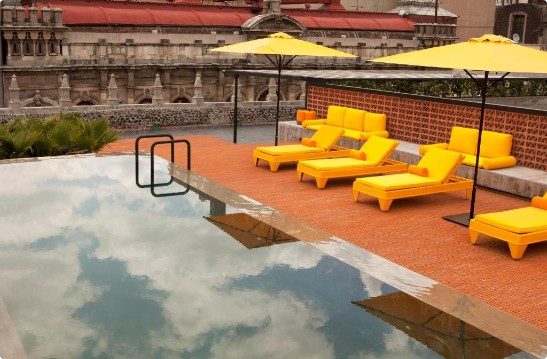
Downtown Mexico occupies a 17th-century palace in the Historic Center, and the restoration is one of the most impressive adaptive reuse projects in the city. The original colonial structure — thick stone walls, arched doorways, a central courtyard — has been preserved and combined with contemporary Mexican design in a way that feels respectful rather than jarring.
The 17 rooms are individually designed, each with a distinct layout dictated by the quirks of the original building. Some have original stone walls and wooden beams; others look out onto the central courtyard through floor-to-ceiling glass that clearly wasn’t there in the 17th century. The furniture is by Mexican designers, the art on the walls is by Mexican artists, and the overall aesthetic lands somewhere between colonial grandeur and contemporary restraint.
The rooftop terrace and pool have become one of the Historic Center’s social hubs, drawing non-guests for drinks and views of the Metropolitan Cathedral. The ground-floor restaurant and bar are also popular with locals, which is always a good sign.
The Historic Center location means you’re within walking distance of the Zocalo, Templo Mayor, the Palace of Fine Arts, and dozens of colonial buildings. It also means street noise, foot traffic, and the general intensity of the Centro, which can be either thrilling or exhausting depending on your temperament.
Price range: $200-400 USD/night.
Best for: Architecture and design enthusiasts, travelers who want to be immersed in the Historic Center, anyone who finds colonial buildings more interesting than glass towers.
Design highlight: The tension between the 400-year-old bones of the building and the contemporary interventions is the whole point. The architects (Cherem Serrano and Grupo Habita) understood that the building’s history is an asset, not an obstacle.
Nima Local House
Nima occupies a converted house in Roma Norte, and the concept is closer to a design-forward guest house than a traditional hotel. The property has a small number of rooms, each designed with Mexican craft objects, contemporary furniture, and a color palette drawn from the Mexican landscape — terracotta, sage, deep blue.
What makes Nima distinctive is its commitment to locality. The soaps are made by a Mexican producer. The ceramics are from Mexican artisans. The coffee is Mexican single-origin. The mezcal at the bar is from small Oaxacan producers. This approach could feel performative, but at Nima it feels genuine — the sourcing reflects a real philosophy about what a Mexican hotel should be, not a marketing exercise.
The Roma location puts you in the middle of the city’s best restaurant and gallery district. The staff knows the neighborhood intimately and gives recommendations that go well beyond the usual tourist suggestions.
Price range: $150-300 USD/night.
Best for: Travelers who value craft and locality over luxury amenities, design-conscious visitors on a moderate budget, anyone who prefers small properties with personality.
Design highlight: The integration of artisan objects into the interior design — not as decoration, but as functional elements. The room feels like a curated collection of things someone actually uses.
Hotel Carlota
Check prices and availability at Hotel Carlota on Booking.com
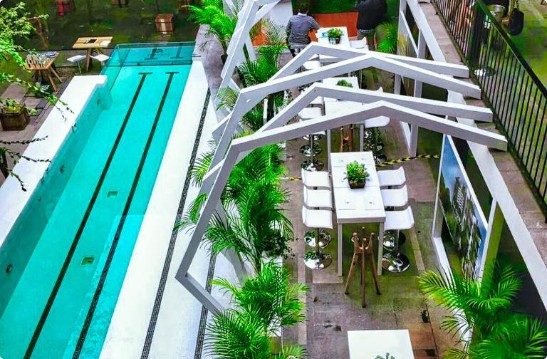
Hotel Carlota occupies a mid-century modern building on Rio Amazonas in the Cuauhtemoc/Juarez area, and it’s one of the most architecturally interesting hotels in the city. Originally built in the 1960s as a residential building, it was converted into a hotel by JSa Arquitectura, who kept the Brutalist concrete bones and added a glass-and-steel swimming pool that cantilevers over the courtyard. That pool — visible from the street and from the courtyard below — is the building’s signature element and one of the most photographed architectural details of any hotel in Mexico City.
The rooms are compact but thoughtfully designed, with polished concrete floors, custom furniture, and a minimalist aesthetic that complements the building’s mid-century character. The common areas include a courtyard lounge, a restaurant, and a co-working space that draws local creatives.
The location is central — between Roma and Reforma, walkable to both — and the surrounding streets have a gritty energy that’s more authentic than Condesa or Polanco. This isn’t a pristine neighborhood, and the hotel doesn’t pretend it is.
Price range: $150-280 USD/night.
Best for: Architecture buffs (especially mid-century modernism fans), younger travelers who want design on a budget, anyone who values a hotel that takes creative risks.
Design highlight: The cantilevered pool. It’s a genuine piece of architecture, not a gimmick. The way it interacts with the courtyard below and the sky above makes the entire building feel like a designed experience rather than just a building with rooms.
Other Design Hotels Worth Knowing
Circulo Mexicano — In the Historic Center, from the same group behind Downtown Mexico. A newer property in a colonial building, with a communal, social concept — shared workspaces, a coffee roastery, rooftop dining. More affordable than Downtown Mexico, with a younger energy. $120-250/night.
Chaya B&B — A tiny bed and breakfast in Roma with just a handful of rooms, designed by architect Hector Esrawe. The attention to material and spatial detail is extraordinary for the price point. Booking is competitive because of the limited rooms. $100-200/night.
Casa Decu — An Art Deco building in the Historic Center converted into a boutique hotel. The original 1930s architectural details — stained glass, tile work, geometric ironwork — are preserved and complemented by contemporary furnishings. $100-180/night.
Hotel Casa Awolly — In Juarez, this property combines a restaurant, gallery space, and small hotel in a Porfirian-era building. The design is eclectic and artistic, with each room individually styled. The ground-floor restaurant is one of the neighborhood’s better dining options. $120-220/night.
The Design Hotel Philosophy
What connects these hotels is a conviction that the building matters as much as the bed. They’re not just places to sleep — they’re places to be, designed with the same care and intention that goes into a gallery or a restaurant. The best of them use architecture and design to connect guests to Mexico City’s specific character: its colonial stonework, its mid-century concrete, its volcanic landscape, its artisan traditions.
The trade-off, as with all boutique hotels, is amenities. These properties don’t have extensive gyms, business centers, or the institutional infrastructure of a Marriott. The rooms are often smaller than what you’d get at a standard hotel for the same price. What you’re paying for is the design experience, the sense of place, and the conviction that where you stay should be as memorable as what you do.
If that proposition appeals to you, Mexico City’s design hotels are among the best in the world for the price. If you’d rather have a king-size bed, a reliable gym, and a twenty-four-hour room service menu, the five-star chains will serve you better.
For all accommodation options, from luxury towers to budget hostels, see our complete lodging guide.