
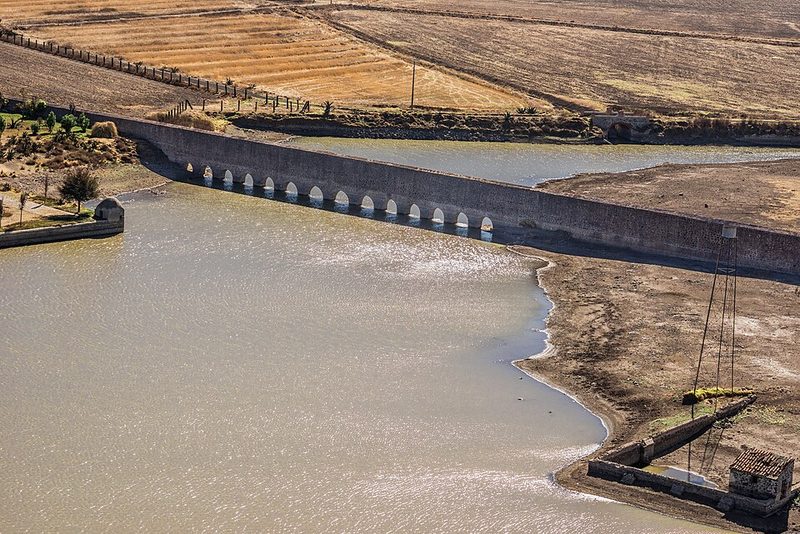
About 100 kilometers northeast of Mexico City, in a dry valley in the state of Hidalgo, a 16th-century aqueduct stretches across the landscape with arches so tall and so perfectly proportioned that they stop you in your tracks. The Aqueduct of Padre Tembleque is a UNESCO World Heritage Site, one of the most impressive hydraulic engineering works in the Americas, and almost nobody outside of Mexico has heard of it.
That’s fine with us. Some places are better without crowds.
What You’re Looking At

The full name is the Hydraulic System of the Padre Tembleque Aqueduct, and it’s a system rather than a single structure. Built between 1554 and 1571, it runs approximately 48 kilometers from springs on the slopes of Mount Tecajete to the town of Otumba, carrying water across ravines via a series of arcaded bridges. The total system includes multiple sections of arched bridges, distribution channels, and water collection points.
The star is the main arcade that crosses the Tepeyahualco ravine. This single span includes the tallest single-tier arch ever built in an aqueduct, rising 33.84 meters from the ravine floor. The entire arcade is 1,020 meters long and contains 68 arches. Standing at the base and looking up, the scale is difficult to process — this was built by hand, in the 16th century, in a remote Mexican valley, and it’s larger than anything the Romans constructed.
That’s not hyperbole. Roman aqueducts used multiple tiers of smaller arches to achieve height. Padre Tembleque achieved its height with a single tier of progressively larger arches that peak at the ravine’s center. The engineering is audacious, and the fact that it’s still standing after nearly five centuries is testament to how well it was built.
The Man Behind It
Fray Francisco de Tembleque was a Franciscan friar who arrived in New Spain in 1542. He observed that the communities around Otumba and Zempoala had no reliable water source and depended on seasonal rainfall and distant springs. The existing water infrastructure, built during Aztec times, had deteriorated.
Tembleque organized the construction of the aqueduct using indigenous labor — an estimated 400 workers over 17 years. The engineering combined European aqueduct design with local building techniques and materials: the arches were made from local stone and a morite-based morite mortar, and the construction methods drew on both Spanish and indigenous knowledge.
The friar himself had no formal engineering training. He was self-taught, working from principles he’d studied and adapted. The fact that a self-taught Franciscan designed and oversaw the construction of what remains one of the most ambitious hydraulic structures in the Western Hemisphere is, frankly, remarkable.
The aqueduct served its intended purpose for centuries, delivering water to communities along its route. Parts of the system remained in use into the 20th century.
UNESCO Recognition
The aqueduct was inscribed as a World Heritage Site in 2015, recognized for its outstanding universal value as an example of hydraulic engineering that combined European and Mesoamerican building traditions. The UNESCO designation specifically notes the height of the main arcade, the integration of indigenous and European techniques, and the system’s importance as evidence of the cultural exchange that occurred in 16th-century New Spain.
The inscription helped bring attention to the site and funded some conservation work, though the aqueduct remains less visited than Mexico’s more famous UNESCO properties. For context: Teotihuacan, less than an hour away, gets millions of visitors annually. Padre Tembleque might see a few thousand in a good year.
Visiting the Aqueduct
The main arcade — the dramatic one with the tall arches — is located near the community of Santiago Tepeyahualco, in the municipality of Zempoala, Hidalgo. Access is via a paved road that leads to a small parking area and viewing platform near the base of the arches.
There’s not much in the way of tourist infrastructure. A small information display explains the site’s history, and there may be a guide available (tip-based, no fixed schedule). What there is, overwhelmingly, is the aqueduct itself — and that’s plenty.
Take time to walk the length of the arcade at ground level. The arches increase in size as they approach the ravine’s center, creating a perspective effect that’s powerful even in photographs and astonishing in person. If you’re reasonably fit, you can scramble up the hillside on either end for a view along the top of the aqueduct, where the water channel runs.
The surrounding landscape is semi-arid highland: scrubby vegetation, agricultural fields, scattered communities. It’s not conventionally pretty, but the aqueduct against this backdrop has a stark, monumental quality that more lush settings wouldn’t provide.
Getting There
From Mexico City, the drive takes about two hours via the Mexico-Pachuca highway (85D) to Ecatepec, then east toward Otumba and Zempoala. The roads are paved but signage to the aqueduct itself can be sparse — have GPS or a map ready for the final stretch.
You can combine a visit to Padre Tembleque with Teotihuacan, which is roughly on the way. The pyramids in the morning, the aqueduct in the afternoon, makes for a full and varied day trip. Alternatively, combine it with a visit to the pulque country around Apan, which is further northeast along the same general route.
There’s no regular public transport to the aqueduct site itself. You’ll need a car, a hired driver, or a private tour. Some Mexico City tour operators offer Padre Tembleque as an add-on to Teotihuacan excursions, though this is less common than the standard pyramid-only tours.
For more day trip ideas from Mexico City, see our surroundings guide.
Practical Notes
Bring sun protection — there’s almost no shade at the site, and the high-altitude sun is strong. Water and snacks are essential, as there’s nowhere to buy food near the main arcade. The small towns along the route have basic restaurants and shops if you need supplies.
The site is open during daylight hours and there’s no admission fee. Early morning or late afternoon light is best for photographs — the midday sun flattens the arches.
Plan at least an hour at the main arcade, more if you’re photographing or want to explore the surrounding area. The full aqueduct system extends for many more kilometers, with other arcaded sections visible near Zempoala and along the route toward Otumba, but the Tepeyahualco arcade is the essential stop.
Why This Matters
Padre Tembleque won’t give you the tourist-trail satisfaction of Teotihuacan or the cultural buzz of a pueblo magico. What it gives you is a quiet encounter with something genuinely extraordinary — a structure that shouldn’t exist, built by people who shouldn’t have been able to build it, standing in a valley where almost nobody goes to see it. That combination of ambition, ingenuity, and obscurity makes it one of our favorite day trips from Mexico City. It won’t be on your friends’ Instagram feeds. Good.