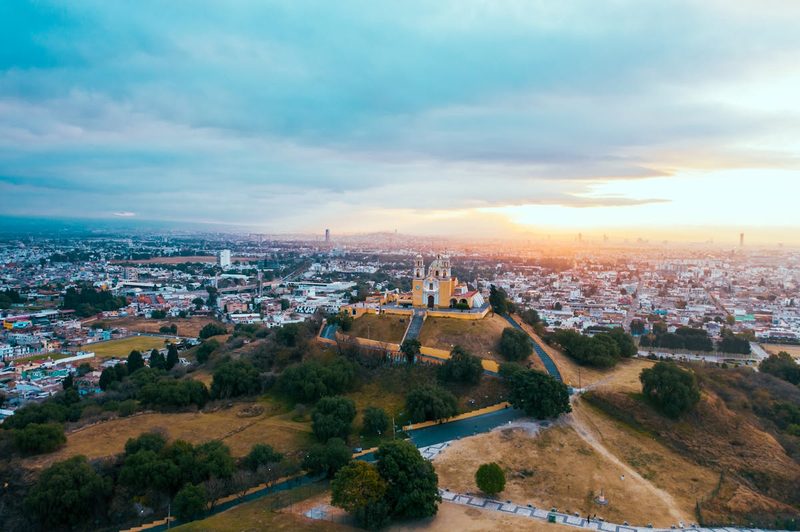
There’s a hill in Cholula with a bright yellow church on top of it. It’s a pretty church, and the views from up there are fantastic on a clear day — you can see the snow-capped volcanoes Popocatepetl and Iztaccihuatl looming in the distance. But that “hill” isn’t a hill at all. It’s the Great Pyramid of Cholula, the largest pyramid in the world by volume, and you’re standing on top of it.
That single fact makes Cholula worth the trip. A Spanish colonial church built directly on top of a Mesoamerican pyramid that’s bigger than the Great Pyramid of Giza — it’s the kind of thing that sounds made up until you’re there looking at it. The pyramid’s base covers roughly 450 by 450 meters (about 45 acres), and it rises to about 55 meters in height. By total volume, it’s estimated at 4.45 million cubic meters, compared to Giza’s 2.5 million. It’s not taller. It’s not flashier. But it’s the biggest thing humans have ever stacked on top of other things, and it’s been hiding under grass and a church for centuries.
Cholula is about 2 to 2.5 hours east of Mexico City, right next to the larger city of Puebla. You can do both in a long day trip, though we’d argue Cholula deserves most of your time.
The Great Pyramid

What You’re Actually Looking At
The Great Pyramid of Cholula — known in Nahuatl as Tlachihualtepetl, “the hand-made mountain” — wasn’t built all at once. It grew over nearly a thousand years, from roughly the 3rd century BC to the 9th century AD, as successive cultures built new layers over older structures. Think of it as a nesting doll of pyramids: at least four major construction phases, each one covering the previous pyramid entirely. The outer layer you see today (mostly covered in earth and vegetation) dates to the final phase.
When the Spanish arrived in the 1500s, the pyramid was already covered in enough soil and vegetation that it looked like a natural hill. Hernan Cortes reportedly didn’t even realize what it was when he ordered the construction of the Iglesia de Nuestra Senora de los Remedios on its summit in 1594. Whether the Spanish genuinely didn’t know or simply didn’t care is a question historians still debate — the practice of building churches on top of indigenous sacred sites was deliberate policy throughout New Spain.
The Tunnels
This is the part that surprises most visitors. Starting in the 1930s, archaeologists began tunneling into the pyramid to study its internal structure. Today, there are roughly 8 kilometers of excavated tunnels running through the pyramid’s interior, and about 800 meters of those are open to the public.
Walking through them is genuinely fascinating. You can see the different construction phases layered on top of each other — adobe walls from different centuries, painted murals in some sections, and the sheer mass of the structure pressing in around you. It’s cool, dim, and slightly claustrophobic in places. The tunnels aren’t for the severely claustrophobic, but they’re well-lit and tall enough that most people can walk upright.
The tunnel entrance is at the archaeological zone on the south side of the pyramid. Entry is included in the site admission fee (about 85 pesos). The tunnels take roughly 20-30 minutes to walk through, and they’re the single best way to understand that you’re inside an artificial mountain, not a natural one.
The Archaeological Zone
Outside the tunnels, the excavated portions of the pyramid’s base and surrounding structures are worth exploring. The south and west sides have been partially uncovered, revealing stepped platforms, ceremonial plazas, and the remains of altars. The Patio de los Altares (Patio of the Altars) on the south side is particularly well-preserved, with carved stone altars and a long wall decorated with a distinctive architectural style.
There’s a small but decent site museum near the tunnel entrance that provides context for what you’re seeing. The collection includes ceramics, figurines, and a scale model of the pyramid showing all its construction phases. Don’t skip it — it takes maybe 20 minutes and makes everything else make more sense.
The Church on Top
The Iglesia de Nuestra Senora de los Remedios (Church of Our Lady of Remedies) is a functioning Catholic church that sits at the pyramid’s summit. You reach it by climbing a path on the west side — it’s a short but steep walk that takes about 10-15 minutes. The church itself is pretty standard Mexican colonial Baroque: bright yellow facade, ornate interior, a modest bell tower. What makes it special is the context. You’re standing on top of the Americas’ largest ancient structure, inside a building that represents the civilization that displaced the one that built what you’re standing on. It’s a lot to process.
The views from the churchyard are the main reason to climb up even if you’re not interested in the church itself. On clear days — typically mornings, especially from November to February — you can see Popocatepetl volcano rising to the southeast, often with a wisp of smoke from its crater. When visibility is good, the volcano, the surrounding valley, and the sprawl of Cholula and Puebla below create one of the most dramatic panoramas in central Mexico.
The 365 Churches

You’ll hear the claim that Cholula has 365 churches — one for every day of the year. It’s one of those facts that gets repeated so often that everyone assumes it’s true. The reality is more complicated and, we think, more interesting.
Cholula does have an extraordinary concentration of churches and chapels. The actual count depends on how you define “church” and whether you include chapels, hermitages, and ruins. Modern counts put the number somewhere between 37 and 159 within the municipality, depending on the criteria. But there’s no way it’s 365.
What’s genuinely remarkable is the density. Walking through Cholula’s streets, you encounter a church, chapel, or religious structure every few blocks. Many of them are beautiful — richly decorated with Talavera tiles, gilt altarpieces, and painted ceilings. The Convento de San Gabriel on the main plaza is particularly worth visiting: its Capilla Real features 49 domes in a Moorish-influenced style unlike anything else in Mexico.
The legend probably originated as a way to express just how many religious buildings the Spanish crammed into this town. Before the conquest, Cholula was one of the holiest cities in Mesoamerica, with temples to dozens of deities. The Spanish replaced them systematically with Christian structures. The number 365 is myth, but the underlying truth — that this was a sacred place where one form of worship was replaced with another — is real and visible everywhere you walk.
Puebla: The Neighbor You Shouldn’t Skip
Cholula and Puebla are essentially one continuous urban area now, separated by about 15 minutes by car or bus. If you’re coming all this way, spending at least a few hours in Puebla makes sense.
Puebla is Mexico’s fourth-largest city and has one of the best-preserved colonial centers in the country. The food alone justifies the detour. Mole poblano — that complex, rich sauce with chocolate, chili peppers, and dozens of other ingredients — was invented here (or at least that’s what Puebla claims, and nobody has successfully challenged them). Chiles en nogada, a dish of stuffed poblano peppers in walnut cream sauce topped with pomegranate seeds, is another Puebla original and is available fresh between July and September.
The Talavera tile tradition is the other big draw. Puebla has been producing hand-painted Talavera pottery and tiles since the 16th century, and the tradition is protected by denomination of origin (like Champagne). You can visit workshops, watch artisans paint individual tiles by hand, and buy pieces directly. The prices are higher than cheap imitations sold elsewhere in Mexico, but the quality difference is obvious.
The main plaza, the cathedral, the Biblioteca Palafoxiana (one of the oldest public libraries in the Americas), and the Museo Amparo (a superb pre-Columbian art museum) can fill a solid afternoon if you have time after Cholula.
Getting There
By Bus
First-class buses to Puebla run frequently from Mexico City’s TAPO terminal (Terminal de Autobuses de Pasajeros de Oriente, Metro Line 1 to San Lazaro). ADO and Estrella Roja are the main operators. The trip takes about 2 to 2.5 hours, and tickets cost 200-350 pesos one way depending on the service class. Some buses go directly to Cholula; otherwise, take any Puebla bus and then a local bus or taxi to Cholula (about 20 minutes).
Estrella Roja also runs direct buses to Cholula from TAPO, though they run less frequently than the Puebla services.
By Car
The drive via the Mexico-Puebla highway (Highway 150D) takes about 2 hours with normal traffic. Tolls total roughly 250-300 pesos each way. The road is in good condition and well-signed. Parking in Cholula is straightforward — there’s a lot near the archaeological zone.
By Organized Tour
Many tour companies in Mexico City offer day trips to Cholula and Puebla, typically ranging from 800-2,000 pesos per person. These usually include transport, a guide, and some meals. The advantage is not having to navigate logistics. The disadvantage is being on a schedule that usually gives you too little time in Cholula and too much time at a Talavera workshop where the guide gets a commission.
Practical Tips
The archaeological zone is open daily from 9 AM to 6 PM. Bring sunscreen and a hat — the climb to the church and the exposed archaeological areas get hot by midday. The tunnels provide welcome relief from the heat.
Cholula has a good food scene of its own, separate from Puebla’s. The area around the main plaza (Plaza de la Concordia) has restaurants and cafes ranging from cheap market stalls to upscale spots. Don’t eat at the tourist restaurants right next to the pyramid entrance — walk a few blocks into town for better food at lower prices.
If you’re combining Cholula and Puebla, start with Cholula in the morning (when the views are clearest and the archaeological zone is least crowded), then head to Puebla for a late lunch and an afternoon of exploring.
Cholula sits at about 2,170 meters elevation — similar to Mexico City — so altitude shouldn’t be an additional concern if you’ve already acclimatized to the capital.
For more on what to explore before your trip, check our guides to the Historic Center and the Zocalo, where you can see how the Spanish applied similar church-on-temple building strategies in the capital itself.