The Aztec emperors had summer homes in Cuernavaca. Hernan Cortes built his palace here. Emperor Maximilian kept a weekend retreat. The Shah of Iran lived here in exile. And every generation of wealthy Chilangos has followed the same instinct: when Mexico City gets to be too much, go to Cuernavaca.
They call it the “City of Eternal Spring,” which sounds like marketing until you experience it. Sitting at about 1,500 meters — roughly 700 meters lower than Mexico City — Cuernavaca enjoys warm, mild weather year-round, with average temperatures between 20 and 27 degrees Celsius. It rarely gets truly hot, it almost never gets cold, and the air feels softer than the capital’s. The Aztecs called it Cuauhnahuac, “near the forest,” and the Spanish mangled that into Cuernavaca (“cow horn”), which is one of history’s more unfortunate mistranslations.
It’s about 1.5 hours south of Mexico City by car or bus, making it one of the easiest day trips from the capital. The city has a genuine colonial center, a few excellent museums, one of the oldest cathedrals in the Americas, and — if you venture outside town — some of the most impressive gardens in Mexico. Here’s what’s worth your time.
Palacio de Cortes

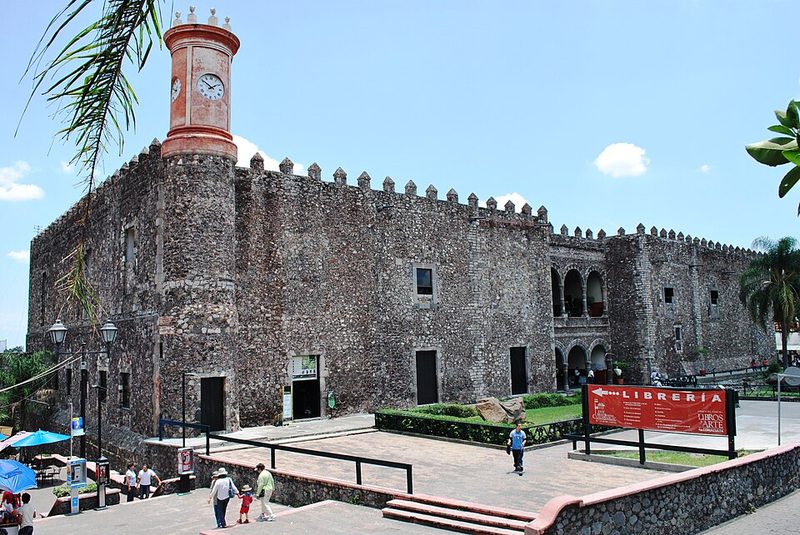
Hernan Cortes began building this palace in 1526, just five years after the fall of Tenochtitlan, on the ruins of a pre-existing indigenous structure. It’s one of the oldest colonial-era secular buildings in the Americas, and it looks like what it is: a fortress disguised as a residence, built by a conquistador who wasn’t entirely sure the locals had accepted their new situation.
The building now houses the Museo Regional Cuauhnahuac (Regional Museum of Cuauhnahuac), which covers the history of the state of Morelos from prehistoric times through the Mexican Revolution. The archaeological collection is solid, and the colonial-era rooms give you a sense of how the early Spanish elite lived in New Spain.
But the real draw is on the second-floor balcony: a series of murals painted by Diego Rivera in 1929-1930, commissioned by Dwight Morrow, the U.S. ambassador to Mexico. Rivera’s murals depict the history of Cuernavaca and Morelos from the pre-Hispanic era through the Spanish conquest and into the colonial period, with a particular focus on the brutality of the encomienda system and the exploitation of indigenous labor. They’re classic Rivera — politically charged, technically brilliant, and filled with details that reward close inspection.
The palace sits on the main plaza (Plaza de Armas), so you can’t miss it. Admission is about 85 pesos. Budget at least an hour, more if you want to study the murals properly.
The Cathedral
The Cathedral of the Assumption of Mary (Catedral de la Asuncion de Maria), also called the Former Convent of the Assumption, is one of the oldest churches in mainland America. Franciscan friars began construction in 1529, and the building has the fortress-like character typical of early colonial monasteries — thick walls, crenellated parapets, a general sense that this was designed to withstand a siege as much as to host services.
The cathedral made international headlines in the 1990s when a restoration project uncovered a series of 17th-century murals hidden under layers of plaster and paint. The murals depict the martyrdom of Saint Philip of Jesus and other early Christian missionaries in Japan — a subject that reflects the remarkable global reach of the Spanish colonial church. These murals had been covered for centuries, and their discovery was a significant event in Mexican art history.
The building is part of a larger complex that includes a monastery, an atrium with a stone cross, and several chapels. The Open Chapel (Capilla Abierta), an outdoor worship space built to accommodate large numbers of newly converted indigenous people, is particularly interesting as an architectural solution to a colonial-era problem. The entire complex was designated a UNESCO World Heritage site in 1994 as part of the “Earliest 16th-Century Monasteries on the Slopes of Popocatepetl.”
Admission is free. It’s a few blocks northwest of the main plaza.
Robert Brady Museum
This is one of the most underrated small museums in Mexico, and we say that without hesitation. Robert Brady was an American artist and collector who moved to Cuernavaca in 1960 and spent the next 26 years filling a colonial-era house (formerly part of the cathedral’s monastery complex) with an astonishing collection of art and artifacts from around the world.
The collection includes over 1,300 pieces: paintings by Frida Kahlo, Rufino Tamayo, and other major Mexican artists; folk art from Africa, Asia, and the Americas; textiles, pottery, furniture, and decorative objects arranged exactly as Brady placed them during his lifetime. The house itself — with its tropical garden, tiled rooms, and painted walls — is as much a work of art as anything in it.
What makes the Brady Museum special is that it feels lived in. This isn’t a sterile gallery with objects behind glass. It’s someone’s home, preserved as they left it, and every room reveals something surprising. The bathroom alone is worth a photo.
The museum is a short walk from the main plaza, on Calle Netzahualcoyotl. Admission is about 60 pesos. Guided tours are available and recommended — the guides know the stories behind individual pieces that you’d never discover on your own. Allow about 45 minutes to an hour.
Jardines de Mexico
About 30 minutes south of Cuernavaca (and technically in the municipality of Jojutla), Jardines de Mexico bills itself as the largest flower garden in the world. Whether that claim is strictly true depends on definitions, but at roughly 80 hectares of landscaped gardens, it’s undeniably massive.
The gardens are divided into themed sections: a Japanese garden, an Italian garden, a tropical garden, a cactus and succulent garden, and several others. The Tulip Festival (February to March) and the Dahlia Festival (November) are the peak events, drawing thousands of visitors for displays that are genuinely spectacular. Even outside festival season, the gardens are beautifully maintained and surprisingly uncrowded on weekdays.
It’s not exactly a spontaneous day-trip add-on — getting there requires a car or taxi — but if you’re interested in gardens, botany, or just want to walk through an absurdly beautiful landscape, it’s worth the detour. Admission is about 250 pesos, and you’ll want at least 2-3 hours.
Spanish Language Schools
This isn’t a tourist attraction, but it’s a significant part of Cuernavaca’s identity and worth mentioning. The city has been Mexico’s most popular destination for Spanish language immersion programs since the 1960s. The appeal is obvious: warm weather, relatively small and walkable city center, proximity to Mexico City, and a local population that speaks clear, standard Mexican Spanish without strong regional accents.
Dozens of language schools operate in the city, ranging from intensive university-affiliated programs to small, family-run operations offering one-on-one tutoring. Many programs include homestays with local families, which accelerates learning dramatically. If you’re considering combining travel with Spanish study, Cuernavaca is one of the best places in the Western Hemisphere to do it — and a day trip here can serve as a scouting mission for a longer stay.
Other Worthwhile Stops
Jardin Borda
Built in the 1780s as the private garden of a wealthy silver mining family, Jardin Borda later became Emperor Maximilian and Carlota’s favorite weekend retreat. The gardens feature fountains, walking paths, mango trees, and a small lake with rowboats. There’s also a gallery space that hosts rotating art exhibitions. It’s right on the main street near the cathedral. Admission is about 55 pesos.
Museo Morelense de Arte Contemporaneo (MMAC)
A small but well-curated contemporary art museum housed in a former movie theater. The collection focuses on Mexican and Latin American contemporary art, with rotating exhibitions that are usually worth a look. It’s on the main plaza, easy to combine with the Palacio de Cortes. Free admission on Sundays.
The Market
The Mercado Adolfo Lopez Mateos, a few blocks from the main plaza, is a solid traditional Mexican market with produce, prepared food, flowers, and household goods. The food stalls serve regional specialties including cecina (thin-dried beef), tacos acorazados (rice, meat, and salsa on a tortilla), and tepache (fermented pineapple drink). Prices are local, not tourist.
Getting There
By Bus
Pullman de Morelos runs frequent first-class buses from Mexico City’s Terminal Sur (Metro Taxquena, Line 2) to Cuernavaca. The trip takes about 1.5 hours, and buses depart every 20-30 minutes throughout the day. Tickets cost 130-180 pesos one way. The bus drops you at Cuernavaca’s bus terminal, which is about a 10-minute taxi ride from the city center.
There are also buses from Mexico City’s Terminal Poniente (Metro Observatorio) via a different route.
By Car
The Mexico-Cuernavaca highway (Highway 95D) is one of the most heavily traveled toll roads in the country. The drive takes about 1.5 hours from central Mexico City, less if traffic cooperates. Tolls run about 120-150 pesos each way. The toll road passes through stunning mountain scenery as it drops from the Valley of Mexico into the valley of Morelos. The free road (Highway 95) is an option but adds significant time and passes through congested areas.
Practical Tips
Cuernavaca is warmer than Mexico City, so dress for it. A light layer for the bus ride (air conditioning can be aggressive) and otherwise summer clothes. Sunscreen matters here — the lower altitude and warmer temperatures mean stronger sun exposure than you might expect.
The city center is walkable. The Palacio de Cortes, cathedral, Robert Brady Museum, Jardin Borda, and the market are all within a 15-minute walk of each other. Start at the main plaza and work outward.
Weekdays are less crowded than weekends, when Mexico City residents flood in. If you’re driving, weekend traffic on the Mexico-Cuernavaca highway can be brutal in both directions — leave early and return late, or go on a weekday.
For context on the history you’ll encounter here — particularly the conquest-era material in the Palacio de Cortes and the cathedral — visiting the Historic Center and Chapultepec Castle in Mexico City first will give you a framework that makes everything in Cuernavaca more meaningful. The Rivera murals in the Palacio de Cortes complement the murals you’ll find in Mexico City’s Palacio Nacional, and seeing both gives you a much richer understanding of how Rivera used public art to tell the story of Mexico.