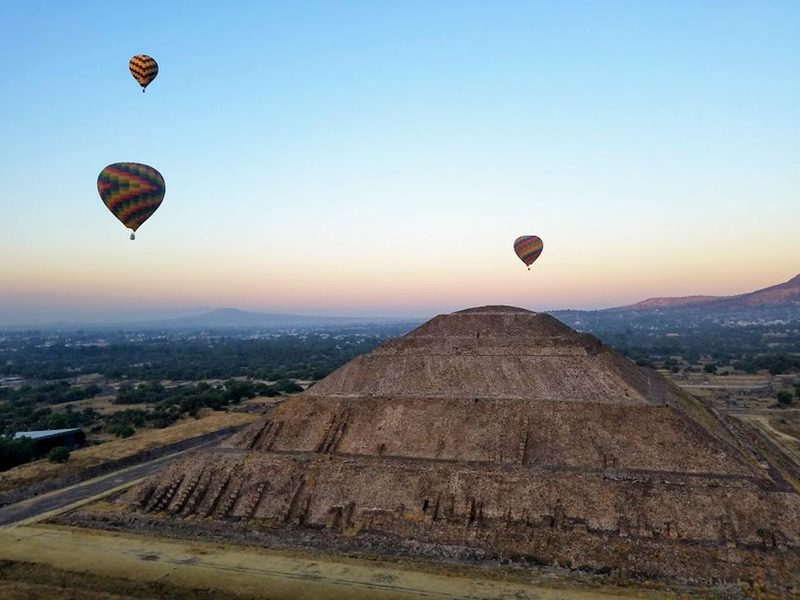
About 50 kilometers northeast of Mexico City, in a wide valley surrounded by scrubby hills, sits the ruins of a city that was once among the largest in the ancient world. At its peak around 450 AD, Teotihuacan had a population of over 125,000 people — bigger than most European cities would be for another thousand years. Nobody knows exactly who built it. The Aztecs, who arrived centuries after Teotihuacan’s collapse, were so awed by the ruins that they named the place “the city where the gods were born.” They assumed only gods could have built something this massive.
They weren’t entirely wrong to be impressed. The Pyramid of the Sun is the third-largest pyramid on Earth. The Avenue of the Dead runs nearly two kilometers in a straight line. The entire complex covers roughly 83 square kilometers. This wasn’t some minor settlement — it was a metropolis that influenced cultures across Mesoamerica for centuries.
It’s also the most visited archaeological site in Mexico, which means it can feel like a theme park if you time your visit wrong. Here’s how to do it right.
The Major Monuments

Pyramid of the Sun

This is the one everyone comes for, and it doesn’t disappoint. The Pyramid of the Sun stands about 65 meters tall and measures roughly 225 meters on each side at its base, making it the third-largest pyramid in the world after the Great Pyramid of Cholula and the Great Pyramid of Giza. It was built in two phases, the first around 100 AD, using an estimated 1.2 million cubic meters of material — mostly adobe bricks, rubble, and a volcanic stone exterior.
You can climb it. The ascent involves 248 steps divided across five terraces, and it’s steeper than it looks from below. At 2,300 meters elevation with the sun beating down, it’s a genuine workout. Take your time. The view from the top spans the entire archaeological zone and the surrounding valley, with the mountains framing everything. On clear days, you can see the volcanoes Popocatepetl and Iztaccihuatl to the southeast.
Go early. By 11 AM on any given day, there’s a queue just to start climbing, and the sun on the exposed stone makes the afternoon brutal. If you arrive when the gates open, you can have the top nearly to yourself.
Pyramid of the Moon
Smaller than the Pyramid of the Sun but arguably more photogenic, the Pyramid of the Moon sits at the northern end of the Avenue of the Dead with the hill Cerro Gordo rising directly behind it — a deliberate architectural choice that makes the pyramid look like it’s emerging from the mountain itself. It’s about 43 meters tall, and you can climb to a platform on the second terrace (the upper levels are closed).
The view from that platform is our favorite in the entire complex. You’re looking straight down the Avenue of the Dead with the Pyramid of the Sun on your left and the entire city laid out before you. Every photo you’ve ever seen of Teotihuacan was probably taken from this spot, and it’s even better in person.
Archaeological excavations here have uncovered some of the most disturbing finds at the site: sacrificial burials with bound captives, decapitated heads, and animal offerings including wolves, eagles, jaguars, and rattlesnakes. The pyramid was rebuilt at least six times over several centuries, with each new layer larger than the last.
Avenue of the Dead

The main thoroughfare of Teotihuacan runs roughly north-south for about 1.9 kilometers, connecting the major monuments. The Aztecs named it Miccaotli — “Avenue of the Dead” — because they believed the platforms lining both sides were tombs. They were actually residential and ceremonial compounds, but the name stuck.
Walking the full length gives you a sense of scale that photographs can’t capture. The avenue is about 40 meters wide, flanked by stepped platforms, smaller temples, and apartment compounds. At its peak, this would have been a bustling, colorful corridor painted in reds, greens, and blues — traces of the original pigments are still visible in a few spots.
Temple of the Feathered Serpent (Quetzalcoatl)
Located in the Ciudadela complex at the southern end of the site, this temple is smaller than the two big pyramids but arguably the most artistically impressive structure at Teotihuacan. The facade is covered in carved stone heads of feathered serpents and a goggle-eyed figure that may represent the rain deity Tlaloc (scholars still argue about this). The carvings are remarkably well-preserved and give you the best sense of how ornate these buildings originally looked.
This is also where some of the site’s most significant archaeological discoveries were made. In 2003, a tunnel was found beneath the temple that hadn’t been opened in nearly 2,000 years. Excavations over the following decade uncovered thousands of artifacts including jade figurines, shells, pyrite mirrors, and what appeared to be ritual offerings placed at the end of the tunnel. It was one of the most important archaeological finds in Mexico in decades.
Getting There
By Bus (Our Recommendation)
The cheapest and simplest option. Head to Terminal Norte (also called Central de Autobuses del Norte), which is accessible via Metro Line 5 to the Autobuses del Norte station. From the terminal, look for buses marked “Piramides” — they leave from Gate 8 (Puerta 8) roughly every 15-30 minutes starting around 7 AM. The company is Autobuses Teotihuacan, and the ride takes about an hour depending on traffic.
The bus drops you right at Gate 1 of the archaeological zone, which is the main entrance near the Ciudadela and the Temple of Quetzalcoatl. One-way tickets cost around 60-70 pesos (roughly $3.50 USD). The return buses run until early evening from the same stop.
This is genuinely easy. You don’t need to speak Spanish beyond asking for “un boleto a las Piramides” (one ticket to the pyramids). The buses are comfortable, air-conditioned, and direct.
By Organized Tour
Dozens of companies run tours to Teotihuacan from Mexico City, ranging from basic transport-only options ($15-20 USD) to full-day experiences with guides, food, and stops at obsidian workshops ($40-80 USD). The main advantage is convenience and a guide who can explain what you’re looking at. The main disadvantage is that you’re on someone else’s schedule, which usually means arriving after the crowds.
If you do a tour, pick one that leaves early — before 7 AM ideally. Tours that depart at 9 or 10 AM will have you climbing the Pyramid of the Sun at the hottest part of the day alongside several hundred other people. That’s not the experience you want.
By Car or Uber
Driving takes 45 minutes to an hour via the Mexico-Pachuca highway (Highway 132D, toll road). The toll is about 60 pesos. Parking at the site costs around 45 pesos. An Uber from central Mexico City will run you roughly 400-600 pesos one way, which makes it competitive with tours if you’re splitting the cost with a few people.
Practical Details

Entrance Fee and Hours
The archaeological zone charges 90 pesos per person (about $5 USD). It’s open daily from 9 AM to 5 PM, with last entry at 4 PM. Sunday entry is free for Mexican nationals and residents, which means Sundays are significantly more crowded — avoid them if you can.
There’s an additional fee of about 45 pesos if you want to bring a professional camera (meaning anything with a detachable lens). Tripods technically require a permit. In practice, nobody enforces the camera fee for standard tourist photography.
When to Go
Arrive when the site opens at 9 AM or as close to it as possible. The first bus from Terminal Norte leaves around 7 AM, putting you at the gates right at opening. By 11 AM, the tour buses arrive in force, and by noon, the combination of crowds and sun makes the experience significantly worse.
Weekdays are better than weekends. Tuesday through Thursday tends to be the quietest. The spring equinox (around March 20) draws massive crowds — hundreds of thousands of people come to “charge their energy” on the pyramids. It’s a cultural experience in itself, but if you want to actually see the ruins without being packed shoulder-to-shoulder, avoid that week entirely.
The dry season (November to April) offers the best visibility and most comfortable temperatures. During the rainy season, afternoon storms can roll in fast, and the pyramid steps get slippery.
What to Bring
Sunscreen, a hat, and water are mandatory. There’s almost no shade on the site, and the sun at this altitude is fierce. Comfortable shoes with good grip — the pyramid steps are uneven and steep. A light layer for the morning if you’re going early, since it can be cool before the sun hits.
There are small shops and snack vendors near the entrances, but prices are inflated and selection is limited. Bring your own water and snacks if you can.
What to Skip
The restaurants and shops clustered along the road leading to the site entrances are classic tourist traps. Overpriced, underwhelming food served with aggressive sales pitches for obsidian trinkets and “ancient Aztec remedies.” You’ll be approached by guys offering to blow a conch shell or put on a feathered headdress for a photo. It’s all harmless, but none of it is worth your money or time. Eat before you come or after you leave.
The obsidian workshops that many tours stop at are similarly overpriced. Obsidian from the Teotihuacan area is genuine — the region was a major obsidian trade center — but you can find the same items for a fraction of the price at markets in Mexico City.
Combining Teotihuacan with the Basilica de Guadalupe
The Basilica de Guadalupe, the most visited Catholic pilgrimage site in the Americas, sits in northern Mexico City roughly on the route between the city center and Teotihuacan. If you’re driving or taking an Uber, it makes sense to stop on the way back. The basilica complex is free to enter and takes about 45 minutes to an hour to explore.
The original basilica, built in the 1700s, is slowly sinking into the soft lakebed soil — you can see the tilt inside. The modern basilica next door, designed by architect Pedro Ramirez Vazquez (who also designed the National Anthropology Museum), is a massive circular structure that can hold 10,000 people. Inside, a moving walkway carries you past the tilma of Juan Diego — the cloak that, according to Catholic tradition, bears the miraculously imprinted image of the Virgin of Guadalupe from 1531.
Whether you’re religious or not, the cultural significance of this place is staggering. The Virgin of Guadalupe is arguably the single most important cultural symbol in Mexico, appearing on everything from taxi dashboards to protest banners. Seeing the original image and the devotion it inspires gives you context that enriches everything else you’ll experience in the country.
Context Before You Go
Teotihuacan is impressive on its own, but it’s dramatically more meaningful if you understand what you’re looking at. We’d strongly recommend visiting the National Anthropology Museum in Chapultepec Park before your day trip. The Teotihuacan gallery there contains artifacts, models, and murals that give you a framework for understanding the site. The famous stone mask of Teotihuacan, the reconstructed murals from apartment compounds, and the obsidian workshop displays all provide context you won’t get from the ruins alone.
If you’re visiting the Historic Center and the Zocalo, remember that the Aztec capital of Tenochtitlan was built centuries after Teotihuacan fell — but the Aztecs revered the older city as a sacred origin point. Understanding that relationship adds a layer to both sites.
Teotihuacan isn’t just Mexico’s most famous archaeological site. It’s a place that reshaped our understanding of pre-Columbian civilization, and it continues to yield discoveries. The tunnel found under the Temple of Quetzalcoatl in 2003 wasn’t fully explored until 2017. There’s still a lot we don’t know about who built this place and why they abandoned it. That mystery, honestly, is part of what makes walking through it so compelling.