Tepoztlan is the kind of town where a barefoot guy selling artisanal mezcal on a street corner will casually recommend you visit a temazcal practitioner who does sweat lodges in a cave, and you’ll realize he’s not joking and that you should probably go. It’s a small mountain town about 1.5 hours south of Mexico City that has developed a reputation as a spiritual, slightly countercultural retreat without losing its identity as a genuine Mexican pueblo.
The headline attraction is the hike up Cerro del Tepozteco to a small Aztec pyramid perched on a cliff edge 600 meters above the valley floor. But Tepoztlan is more than one hike. The weekend market is among the best in central Mexico. The mezcal bars are serious. The organic food scene is thriving. And the setting — a valley ringed by dramatic, jagged cliffs that look like something out of a fantasy novel — gives the whole place an atmosphere that Mexico City, for all its charms, simply can’t match.
It’s classified as a Pueblo Magico, which is a government designation that can mean anything from “genuinely special place” to “we stuck a sign on it and hoped tourists would come.” Tepoztlan falls firmly in the first category.
The Hike to the Tepozteco Pyramid

What You’re Getting Into
Let’s be clear: this isn’t a gentle stroll. The hike to the Tepozteco pyramid is a steep, rocky climb that gains roughly 400 meters of elevation over about 2.5 kilometers. Most of the trail is a mix of stone steps and worn rock paths through dry scrub forest. Some sections have metal railings; others are just loose rock. It takes most people 45 minutes to 1.5 hours to reach the top, depending on fitness and how often you stop to catch your breath (you will stop).
The trailhead is at the northern end of town, accessible by walking through the main streets past the Ex-Convento Dominico. The entrance fee to the national park is about 70 pesos, and the trail is open daily from 9 AM to 5:30 PM (last entry at 4 PM, though we’d suggest starting no later than 2 PM to have a comfortable return before closing).
Bring plenty of water — at least a liter per person, more if it’s hot. Wear proper shoes with grip, not sandals. The trail gets slippery when wet, and during the rainy season (June-October), afternoon thunderstorms can roll in fast. A hiking pole wouldn’t be overkill for the steeper sections, though most people manage without one.
The Pyramid
At the top, you’ll find the Pyramid of Tepozteco (also called the Temple of Tepoztecatl), a small Aztec structure dedicated to Tepoztecatl, the god of pulque — the fermented agave drink that predates mezcal and tequila by centuries. The temple dates to around 1150-1350 AD and was built by the Xochimilca people before the Aztecs took control of the area.
The pyramid itself is modest — don’t expect Teotihuacan. It’s a small platform structure about 10 meters high with the remains of two chambers. Carved reliefs on the stones depict glyphs related to the pulque deity and calendar dates. The original carved stones are partially eroded but still readable if you know what to look for.
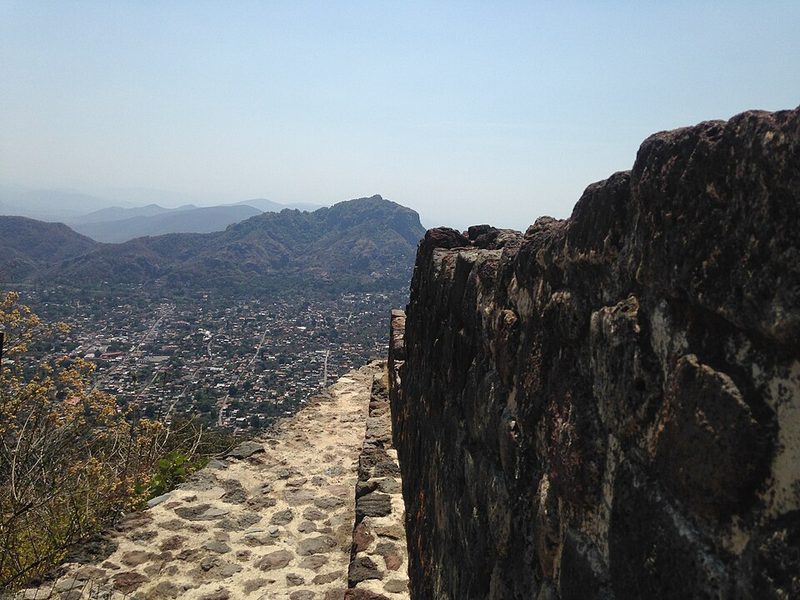
But nobody comes here for the pyramid alone. They come for the view. Standing on the cliff edge next to the temple, you’re looking out over the entire Tepoztlan valley — the town below, the surrounding cliffs, and on clear days, the volcanos in the distance. It’s one of those views that makes the suffering of the climb evaporate instantly. Sit down, catch your breath, eat a snack, and take it in. You’ve earned it.
The Descent
Going down is harder on the knees than going up. The stone steps are uneven, and after rain, they can be genuinely treacherous. Take your time. Plenty of people have twisted ankles on the descent because they rushed. Allow 30-45 minutes to get back down, more if conditions are wet.
The Weekend Market
Every Saturday and Sunday, Tepoztlan’s central streets fill with a tianguis (open-air market) that’s become one of the best in central Mexico. It’s not a tourist market in the usual sense — locals shop here for their weekly produce alongside visitors looking for artisanal goods.
What you’ll find: handmade textiles, local honey, organic produce, herbal remedies, mezcal and pulque from small producers, pottery, leather goods, handmade soap, and a lot of food. The food stalls are the real draw. Tlacoyos (thick masa patties stuffed with beans or cheese), quesadillas on handmade tortillas, mole in several colors, and itacates (triangular stuffed corn cakes) that are a Tepoztlan specialty. Don’t eat breakfast before you come.
The market fills the streets around the main plaza and the Ex-Convento, creating a winding labyrinth of stalls. Get there before noon if you want the full selection — by mid-afternoon, vendors start packing up. The vibe is relaxed, unhurried, and distinctly different from Mexico City markets. Nobody’s going to pressure you into buying anything.
Mezcal and Pulque
Tepoztlan has become a serious mezcal destination, which makes sense given that the town’s patron deity was literally the god of pulque. Several bars and small producers in town offer tastings of artisanal mezcals from Oaxaca, Guerrero, and Puebla, along with local pulque.
Pulque — the fermented sap of the maguey plant — has been made in this region for at least 2,000 years, and Tepoztlan is one of the best places near Mexico City to try the real thing. Fresh pulque has a milky, slightly sour taste with a viscous texture that takes some getting used to. The flavored versions (curados) mixed with fruits like guava, mango, or pine nut are more approachable for first-timers. Several pulquerias in town serve it fresh, and the weekend market usually has a few vendors with their own production.
For mezcal, the bars along Avenida 5 de Mayo and the streets near the main plaza range from rustic spots with a few bottles behind the counter to more curated mezcalerias with extensive selections. Prices are reasonable compared to Mexico City — you can do a tasting flight of three or four mezcals for 150-250 pesos.
The Temazcal Experience
Tepoztlan is the temazcal capital of central Mexico. The temazcal is a pre-Hispanic sweat lodge ceremony that involves sitting in a small, enclosed structure while a guide (temazcalero) pours water over heated volcanic stones, fills the space with steam and herbal smoke, and leads participants through a ritual that blends physical purification with spiritual elements. It’s been practiced in this region for thousands of years.
We’ll be honest: the quality varies wildly. Some temazcal operators in Tepoztlan offer genuinely traditional, respectful ceremonies led by experienced practitioners. Others are more “wellness retreat” than cultural experience, marketed primarily to tourists and Mexico City weekenders. A few are outright gimmicks.
If you want to try one, ask locals for recommendations rather than booking the first one you find on a review site. Expect to pay 300-600 pesos per person for a group ceremony, more for a private session. The experience lasts 1-2 hours and can be intensely hot — it’s not recommended if you have heart conditions, blood pressure issues, or are pregnant. Bring a change of clothes and a towel.
The Organic Food Scene
Over the past two decades, Tepoztlan has quietly become a hub for organic and farm-to-table food. The town’s fertile valley, mild climate, and influx of health-conscious residents (both Mexican and international) have created a food culture that emphasizes local, seasonal, and often organic ingredients.
Several restaurants in town serve dishes built around locally grown produce, heritage corn varieties, and traditional techniques. Los Colorines, housed in a beautifully decorated building on Avenida del Tepozteco, has been serving traditional Mexican food for decades and is a reliable choice. For something more contemporary, restaurants along the main streets offer menus that wouldn’t look out of place in Condesa or Roma Norte — but with the advantage of ingredients that were growing in a field that morning.
The weekend market is also a goldmine for organic and artisanal food products. Small-batch chocolate, local honey, herb-infused oils, and handmade tortillas from heritage corn are all common finds.
The Ex-Convento Dominico
Before you hit the trail or the market, take 30 minutes to visit the Ex-Convento de la Natividad, a Dominican monastery built between 1555 and 1580. It’s at the base of the hill leading to the Tepozteco trail, so you’ll pass it regardless.
The building is a UNESCO World Heritage site (as part of the “Earliest 16th-Century Monasteries on the Slopes of Popocatepetl” designation) and features well-preserved murals that blend Catholic imagery with indigenous artistic styles — a visual record of the cultural collision that defined colonial Mexico. The cloister is peaceful and usually uncrowded. There’s a small museum inside with archaeological finds from the area.
Getting There
By Bus
Pullman de Morelos runs direct buses from Mexico City’s Terminal Sur (Metro Taxquena, Line 2) to Tepoztlan. The trip takes about 1.5 hours, and buses run every 30-60 minutes throughout the day. Tickets cost around 100-130 pesos one way. The bus drops you on the highway at the edge of town, and it’s a 10-15 minute walk or a quick taxi ride to the center.
OCC (part of the ADO group) also runs services, though less frequently.
By Car
Take the Mexico-Cuernavaca highway (Highway 95D) south, then exit at Tepoztlan. The drive is about 1.5 hours with moderate traffic, longer on weekend mornings when half of Mexico City has the same idea. Parking in town is limited, especially on weekends — arrive early or be prepared to park on the outskirts and walk.
When to Go
Weekdays are dramatically less crowded than weekends. The market only runs Saturday and Sunday, so if you want the market experience, go on a Saturday morning and plan to do the hike first thing when it’s cooler and quieter.
The dry season (November to April) is ideal for the hike — clear skies, cooler temperatures, and the best views from the top. During the rainy season, go in the morning, because afternoon rains are almost guaranteed and make the trail genuinely dangerous.
September brings the Festival del Tepozteco, a week-long celebration blending pre-Hispanic and Catholic traditions that includes music, dance, theatrical performances, and a lot of pulque. It’s the town at its most alive, but also at its most crowded.
Tepoztlan works beautifully as a half-day or full-day trip. If you’ve got the energy for the hike, the market, a long lunch, and some mezcal tasting, you’ll want the full day. If you’re short on time, the hike alone justifies the journey — just make sure you leave Mexico City early enough to start climbing before the heat sets in.