Condesa is one of those neighborhoods that gets described in superlatives so often that the descriptions have lost all meaning. “The coolest neighborhood in Mexico City.” “Latin America’s Brooklyn.” “The place where everyone wants to live.” Some of that is earned. Some of it is the kind of hype that makes longtime residents roll their eyes so hard you can hear it from across Parque Mexico.
Here’s what we can tell you for certain: Condesa was literally built on a horse racing track. The elliptical street pattern you’ll walk — Avenida Amsterdam looping in an elegant oval — follows the outline of a racetrack that closed over a century ago. The neighborhood that grew up around it became one of Mexico City’s finest collections of Art Deco architecture, anchored by two genuinely beautiful parks, fed by an absurd density of restaurants and cafes, and complicated in recent years by an influx of remote workers that has reshaped both its economy and its identity.
It’s a great neighborhood. It’s also a neighborhood in the middle of an argument with itself. We’ll cover both.
The Racetrack That Became a Neighborhood
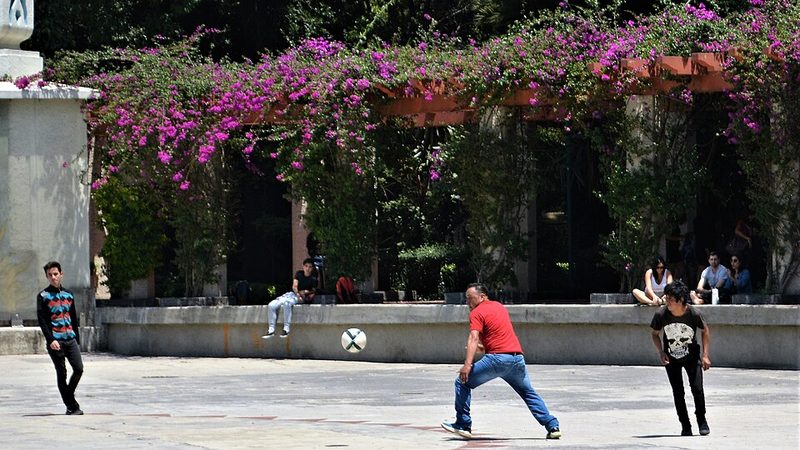
The land that is now Condesa once belonged to Maria Magdalena Davalos de Bracamontes y Orozco, the Countess (Condesa) of Miravalle. Her estate stretched from what is now Colonia Roma all the way to Tacubaya — an enormous tract of land that would eventually become several of Mexico City’s most important neighborhoods.
By the late 19th century, the estate had changed hands and a private horse racing track was built here, operated by the Sociedad del Jockey Club Mexicano. President Porfirio Diaz himself inaugurated it in 1910, just before the Mexican Revolution made horse racing seem like a low priority. The track also hosted automobile racing — this was Mexico City’s playground for the wealthy, and they liked their entertainment fast.
When the Revolution broke out, the neighborhood’s upper-class residents found themselves under siege. The racetrack closed. The land sat idle. And then, in the 1920s, someone had a genuinely brilliant idea: instead of demolishing the track’s footprint, they’d build a neighborhood around it. Environmental laws prevented the old track area from being parceled into residential lots, so it became Parque Mexico instead. The oval of the track became Avenida Amsterdam.
This is why Condesa’s street plan looks nothing like the grid pattern you’ll find in the Historic Center or even neighboring Colonia Juarez. The curves are intentional. They’re also what make this neighborhood so pleasant to walk — you’re always gently turning, always seeing something new around the bend.
Three Colonias, One Neighborhood
Technically, “Condesa” as visitors use the term encompasses three officially recognized colonias: Colonia Condesa, Colonia Hipodromo, and Colonia Hipodromo Condesa. Nobody outside of city bureaucrats distinguishes between them in daily conversation. We mention it only because you might see the different names on maps or addresses and wonder if you’ve wandered somewhere else. You haven’t.
The boundaries are roughly: Avenida Alvaro Obregon and Avenida Veracruz to the north (where Roma Norte begins), Avenida de los Insurgentes Sur to the east, Eje 4 Sur to the south, and Circuito Interior to the west (where San Miguel Chapultepec starts). Chapultepec Park is a short walk to the northwest. The whole area is compact enough to cover on foot in an afternoon, though you’ll want longer than that.
Art Deco Capital of Mexico
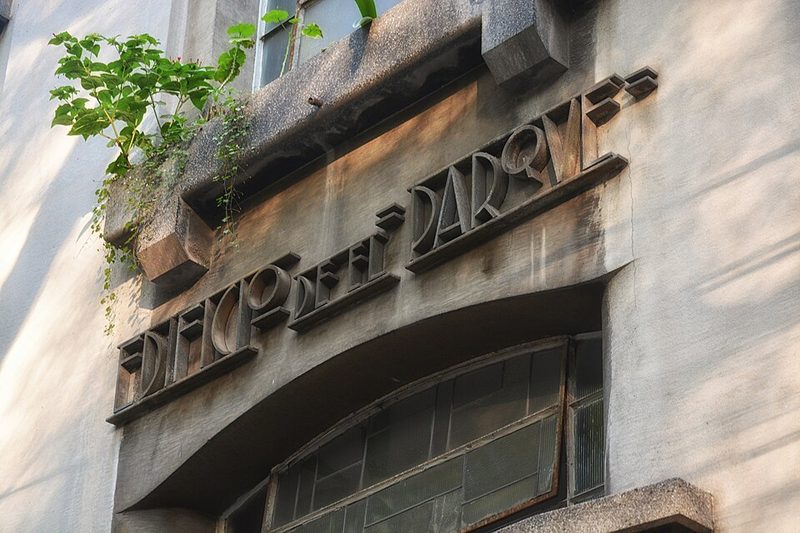
If you care about architecture at all — even casually — Condesa will stop you in your tracks. The neighborhood was developed primarily in the 1920s through the 1940s, which happened to coincide with the height of the Art Deco movement. The result is one of the densest concentrations of Art Deco buildings in Latin America, and it’s not the museum-piece kind. People live and work in these buildings. They’re real.
The Basurto Building
The most photographed Art Deco building in Condesa sits on Avenida Mexico with views over Parque Mexico and Plaza Popocatepetl. Designed by architect Francisco J. Serrano and built on irregularly shaped land that once belonged to a man named Basurto (who authorized the use of his name but didn’t build it himself), the structure uses both curved and straight lines in ways that make it look like it’s in motion even when you’re standing still. The curved corner facade is extraordinary. You’ll see it on every Instagram account that’s ever visited Condesa, and for once the hype is justified.
Edificio San Martin
This building, designed by Ernesto Buenrostro, is a textbook example of Mexican Art Deco. By the late 1990s it was nearly in ruins. Architect Carlos Duclaud restored it between 1998 and 2001, keeping the facades faithful to the original while rearranging some interior spaces. One smart change: in the 1930s, apartments put the best views in bedrooms. Duclaud swapped this to favor living rooms. The exterior, though, is pure 1930s.
Walking the Architecture
The best approach is to walk Avenida Mexico and Avenida Amsterdam slowly, looking up. Art Deco details are everywhere: geometric facades, ornamental ironwork, rounded corners, porthole windows, stylized floral motifs carved into stone. Many buildings have been well maintained or restored. Others are in various states of gorgeous decay — peeling paint revealing original colors, ornamental details half-hidden by decades of grime. Both states have their appeal.
On Veracruz 42, look for the house known as “El Barco” — this was the home of Italian photographer and activist Tina Modotti from 1924 to 1926. Knowing she walked these same streets adds a layer to the neighborhood.
New apartment buildings have gone up on sites where original houses were demolished, and the architectural quality of these replacements varies from respectful to depressing. The same appeal that preserves some buildings creates the economic pressure that destroys others.
The Parks
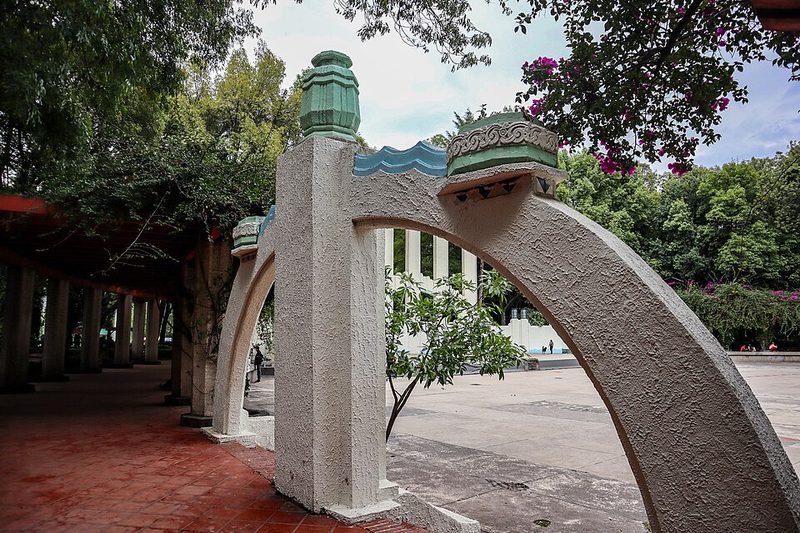
Condesa’s two parks are the neighborhood’s living rooms. On any given morning, you’ll find dog walkers (Condesa is famously dog-obsessed — the neighborhood’s unofficial mascot is probably a French bulldog in a bandana), joggers, parents with strollers, elderly couples on benches, and people doing yoga on the grass. The parks are why people who live here put up with the rent.
Parque Mexico

The centerpiece. Parque Mexico occupies what was the interior of the old racetrack, which is why Avenida Amsterdam curves around it in that distinctive oval. The park was designed in the 1920s as the focal point of the new neighborhood — the former hacienda land was parceled into residential lots, but the track area couldn’t be developed, so it became the green space that gives Condesa its character.
The park has been recognized by INAH (Mexico’s National Institute of Anthropology and History) as part of the city’s cultural heritage. It contains some genuinely beautiful Art Deco elements, including a clock tower and the “Fuente de los Cantaros” fountain, whose central figure was modeled after Luz Jimenez, an indigenous woman who posed for many of Mexico’s most famous artists and became a symbol of “mexicanidad.” The Lindbergh open-air theater hosts occasional cultural events.
The paths are lined with massive trees that create a canopy effect, making the park feel like its own world. Dogs are everywhere. On weekends it fills up with families, vendors, and what seems like every dog owner in the Cuauhtemoc borough.
In the 1930s and ’40s, Yiddish was reportedly the unofficial language of Parque Mexico — a testament to the large wave of Ashkenazi Jewish immigrants who settled in Condesa during that period. Synagogues, community centers, and kosher bakeries multiplied. Most of the Jewish community later moved west to Polanco and Lomas de Chapultepec, but a few synagogues remain, including some small orthodox ones tucked inside houses along Avenida Amsterdam.
Parque Espana
Smaller than Parque Mexico but with its own charm, Parque Espana sits at the border between Condesa and Roma, between Nuevo Leon, Sonora, and Parque Espana streets. It was established in 1921 to commemorate the 100th anniversary of Mexican independence — a date that carries some irony given the park’s name honors Spain, the country Mexico won its independence from. Politics aside, it’s a lovely green space that was renovated in 2008 at a cost of over 12 million pesos.
The park contains a monument to Lazaro Cardenas, Mexico’s president from 1934 to 1940, depicted with an outstretched hand — a gesture representing his welcome of Spanish Civil War refugees to Mexico. Many of those refugees settled right here in Condesa. The monument connects Paseo de la Reforma‘s grand political statements to the intimate, neighborhood-level story of the people who actually arrived and made new lives.
In 2009, Parque Espana was declared “Territory of Music and Poetry,” which sounds like a bureaucratic flourish but actually means it hosts regular cultural programming. If you’re nearby on a weekend, it’s worth checking what’s on.
Avenida Amsterdam: The Best Walk in Condesa
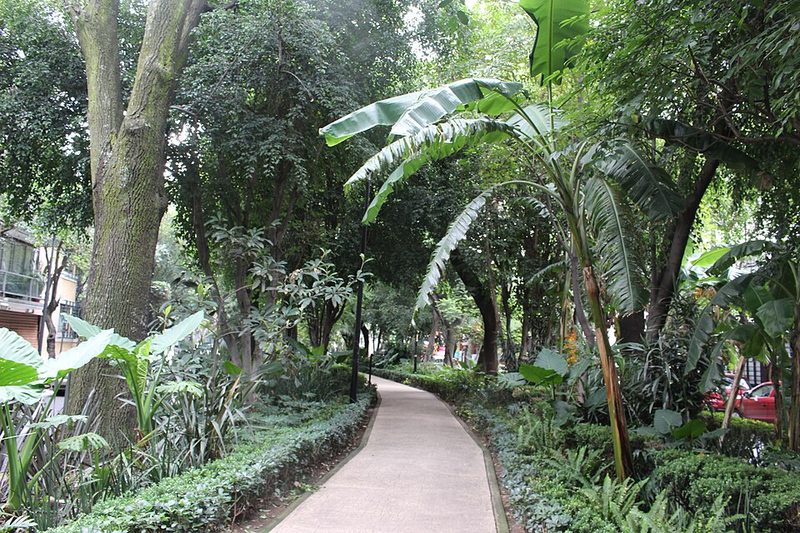
If you do one thing in Condesa, walk the full loop of Avenida Amsterdam. The median — the wide, tree-lined strip running down the middle of the street — is essentially a linear park, with a pedestrian path that follows the old racetrack oval for about 1.5 kilometers. On both sides, Art Deco apartment buildings rise above the trees. Cafes and restaurants spill onto sidewalks. Dogs trot alongside their owners. The pace is slow because the path gently curves and there’s always something worth pausing for.
The Amsterdam median connects to similar tree-lined paths along avenidas Campeche, Benjamin Hill, and Alfonso Reyes, creating a network of green corridors that makes Condesa one of the most walkable neighborhoods in a city that isn’t always kind to pedestrians.
We’d argue this is one of the most pleasant urban walks in all of Mexico City. It doesn’t have the monumental scale of Reforma or the historical weight of the Historic Center, but it has something those places don’t: the feeling of a neighborhood that was designed, from the ground up, for people to enjoy being outside.
The Cafe and Restaurant Scene
Condesa has an estimated 120-plus restaurants concentrated in a relatively small area, most of them clustered along Avenida Michoacan, Avenida Mazatlan, Avenida Tamaulipas, and the Amsterdam loop. The density is remarkable. You can’t walk half a block without passing a cafe with sidewalk tables, a taqueria, a sushi place, an Italian restaurant, or some fusion concept that didn’t exist two years ago.
The outdoor dining culture here is relatively recent — sidewalk tables were a rarity in Mexico City as late as the 1990s. Condesa, with its wide sidewalks, mild climate, and tree shade, was where the concept took off. Now it’s hard to imagine the neighborhood without it. On a Saturday afternoon, the sidewalk tables along Michoacan are packed and the people-watching is world-class.
What’s Good
The quality is genuinely high. Competition has pushed the restaurant scene upward. You’ll find excellent Mexican regional cuisine, strong coffee culture (Mexico City’s third-wave coffee movement has deep roots here), creative cocktail bars, and international options ranging from Japanese to Argentine to Middle Eastern. The Michoacan Market, a 1946 Functionalist-style building, has market stalls and prepared food stands that offer a more traditional counterpoint to the trendy restaurants outside.
What’s Not
Prices are higher than in most of Mexico City. You’re paying a Condesa premium at many spots, and some restaurants coast on location rather than quality. The places that cater primarily to tourists and expats can be mediocre. If a restaurant has an English-first menu, a “brunch” section, and Instagram-ready plating but nothing that actually tastes like Mexico, keep walking. The best food in Condesa is still the food being made by people who’ve been here longer than the latest wave of arrivals.
The Expat Question
We need to talk about this, because you can’t write honestly about Condesa in 2026 without addressing it.
Starting around 2020, and accelerating dramatically through 2021 and 2022, Condesa experienced an enormous influx of foreign remote workers — primarily Americans, but also Europeans, Canadians, and others. The math was simple: earn dollars, spend pesos, live in a beautiful neighborhood with fast Wi-Fi and good coffee for a fraction of what the same lifestyle would cost in New York, San Francisco, or London.
We’re not going to pretend this is a simple issue, because it isn’t.
What Happened
Rents in Condesa roughly doubled between 2019 and 2023. Apartments that Mexican professionals could afford at $8,000-12,000 pesos per month suddenly listed at $18,000-25,000 or more, because landlords could charge remote workers paying in dollars significantly higher rates. Some buildings converted entirely to short-term Airbnb-style rentals. Local businesses that had served the neighborhood for decades were replaced by cafes and coworking spaces targeting the laptop crowd.
The Spanish you hear on Condesa’s streets shifted. On some blocks, English became the dominant language. Restaurants that had operated in Spanish added English menus, then made English the default. Some establishments started pricing in dollars. For longtime residents — people who’d lived through the neighborhood’s abandonment in the 1980s, its slow recovery in the ’90s, and its transformation into a desirable address — watching this happen was painful.
The Other Side
It’s also true that foreign spending has funded the restoration of buildings that were deteriorating. It’s true that the restaurant scene, already strong, has gotten even more creative and competitive. It’s true that some local business owners have thrived. And it’s true that the gentrification conversation in Condesa didn’t start with remote workers — it started in the 1990s, when young, affluent Mexicans began moving in and the same dynamics of displacement played out at a smaller scale.
Where It Stands Now
The situation has moderated somewhat. Mexico City passed regulations on short-term rentals. The peso strengthened against the dollar, making the arbitrage less extreme. Some remote workers moved on to cheaper cities. But the changes aren’t reversible — rents haven’t come back down to pre-2020 levels, and the neighborhood’s character has permanently shifted.
Our honest take: if you’re visiting Condesa as a tourist, you’ll probably love it. The cafes are great, the parks are beautiful, the architecture is stunning. But we’d encourage you to spend your money at places that have been here a while rather than the newest spot targeting Instagram tourists. Learn some Spanish beyond “la cuenta, por favor.” And recognize that the affordability that made this neighborhood attractive to foreign residents was built on a wage gap that real people live on the wrong side of.
Condesa is still a wonderful place to visit. The conversation about what visiting means, and who benefits, is one worth having.
The 2017 Earthquake
On September 19, 2017 — exactly 32 years after the devastating 1985 earthquake that first damaged the neighborhood — a 7.1 magnitude earthquake struck central Mexico. Condesa was one of the hardest-hit areas in the city.
Two major building collapses made international news: one at Alvaro Obregon 286 and another at the corner of Amsterdam and Laredo. Rescue efforts continued around the clock for days, with volunteers forming human chains to pass rubble and supplies. The images of collapsed buildings on Amsterdam — the same elegant, curved street where people walk their dogs on sunny mornings — were devastating.
El Plaza Condesa, a 1,900-capacity concert hall, was damaged and closed. Several residential buildings were condemned. Others were evacuated and took months or years to repair. The earthquake revealed that some of the neighborhood’s older buildings, including some Art Deco structures, had structural vulnerabilities that decades of neglect had worsened.
But it also revealed something about the neighborhood’s community. Volunteers came from across the city to help. Condesa residents organized relief efforts from their apartments and cafes. The recovery, while slow and imperfect, demonstrated a social cohesion that the neighborhood’s reputation as a trendy, transient place sometimes obscures.
Some earthquake damage is still visible if you know where to look. A few lots remain empty where buildings once stood. It’s a reminder that Mexico City sits on a former lakebed, and that the same soft soil that made the old racetrack possible also amplifies seismic waves. The next big earthquake isn’t a question of if but when.
Getting Around
Metro
Condesa is not well served by the Metro — the stations ring the neighborhood’s edges rather than penetrating it. Your options are:
Chapultepec (Line 1) — northwest corner, useful if you’re coming from Chapultepec Park
Juanacatlan (Line 1) — west side
Patriotismo (Line 9) — southwest corner
Chilpancingo (Line 9) — south side
From any of these stations, you’ll walk 5-15 minutes to reach the heart of the neighborhood around Parque Mexico. It’s not a hardship — the walking is pleasant — but it means the Metro is better for arriving than for hopping around within Condesa.
Metrobus
More useful for getting around the neighborhood itself. Metrobus Line 1 runs along Insurgentes on Condesa’s eastern edge, with stops at Sonora, Campeche, and Chilpancingo. This connects you directly to Roma Norte, Colonia Juarez, and north toward Reforma and the Angel of Independence.
EcoBici
Condesa is one of the best neighborhoods in Mexico City for the EcoBici bike-sharing system. The streets are relatively flat, bike stations are plentiful, and the tree-lined medians of Amsterdam and other avenues make cycling pleasant rather than terrifying. A day pass costs $111 MXN. If you’re spending a full day exploring Condesa and Roma, this is the way to move.
Walking
Honestly, this is a walking neighborhood. The whole area is compact enough to cover on foot, the sidewalks are generally in good condition (by Mexico City standards — watch for uneven tiles and tree roots), and the street layout rewards wandering. Get slightly lost. Turn down a street you hadn’t planned on. That’s how you find Condesa’s best moments.
Practical Information
Best Time to Visit
Condesa is pleasant year-round, but mornings and late afternoons are ideal for walking. The parks are at their best in the early morning — fewer crowds, soft light filtering through the trees, dogs at peak enthusiasm. Midday can be warm, especially from March through May, though the tree cover helps.
Weekday mornings give you the neighborhood at its most local — people heading to work, cafes filling up with regulars rather than tourists. Weekend afternoons are the social peak, when the parks and restaurant terraces are packed and the people-watching reaches its maximum potential.
Safety
Condesa is one of the safer neighborhoods in Mexico City. It’s well-lit, well-populated at most hours, and has a visible police presence. Standard urban awareness applies — don’t flash expensive electronics unnecessarily, use ride-hailing apps rather than hailing cabs on the street at night, and keep an eye on your belongings in crowded cafes. But this is not a neighborhood where you need to be on high alert. Walk around, enjoy yourself.
How Long to Spend
A focused walk through the main streets, both parks, and lunch will take about half a day. But Condesa rewards a slower pace. If your schedule allows, come once in the morning for the parks and architecture, then return another evening for dinner and the cafe scene. Combining it with adjacent Roma Norte — perhaps starting at Parque Rio de Janeiro and walking west into Condesa — makes for one of the best full-day walks in Mexico City.
Where Condesa Fits in Your Trip
Most visitors to Mexico City spend time in Condesa whether they plan to or not — it’s that centrally located and that well-known. If you’re basing yourself here, you’re within easy reach of Chapultepec and its museums, Roma Norte next door, Colonia Juarez and the Zona Rosa to the north, and Paseo de la Reforma with its monuments including the Angel of Independence and the Diana Fountain.
It’s a strong base for a Mexico City trip, with the caveat that staying here means you’ll need to make deliberate trips to the Historic Center, Coyoacan, Xochimilco, and the city’s southern neighborhoods. Those are all worth the travel. Condesa is comfortable enough that it can become a bubble if you let it — and you shouldn’t let it. Mexico City is enormous and varied, and the version of it you see from a Condesa cafe terrace, while lovely, is a very specific slice.
The Bottom Line
Condesa is a genuinely special neighborhood. The racetrack-origin story isn’t just a fun fact — it shaped a street plan that makes the whole area feel different from the rest of Mexico City. The Art Deco architecture is real and remarkable. The parks are among the best urban green spaces in the country. The cafe culture is strong. The walking is superb.
It’s also a neighborhood that’s been changed by its own popularity, in ways that are complicated and worth thinking about. The prices have risen. The character has shifted. The tension between what Condesa was and what it’s becoming is real, and pretending otherwise would be dishonest.
Go. Walk the Amsterdam loop. Sit in Parque Mexico. Look up at the Basurto Building. Eat well. But also look past the prettiest surface and notice who’s been here longest. Those are usually the people, and the places, most worth your time.