
Nuevo Polanco is what happens when you take an old industrial zone, add a couple of billionaire-funded museums, throw in some of the tallest residential towers in Mexico City, and wait about fifteen years. The result is a neighborhood that didn’t exist in any meaningful sense before the mid-2000s and now has some of the most visited cultural attractions in the country.
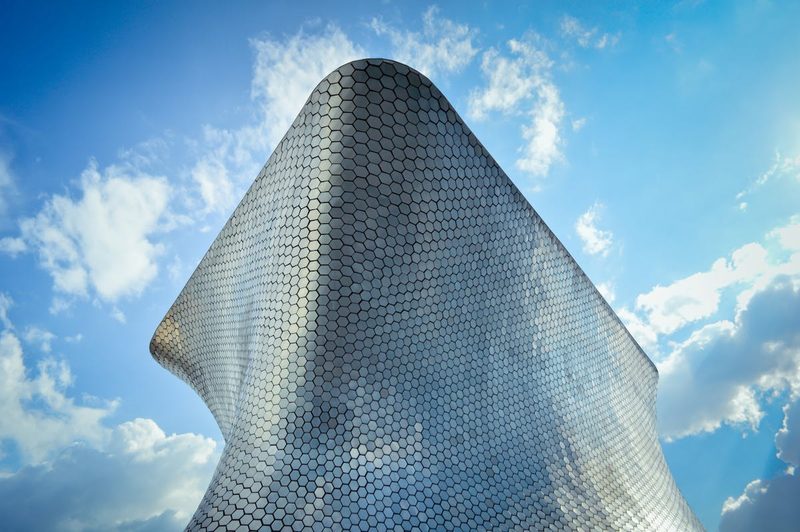
The area sits northwest of traditional Polanco, roughly bounded by the Periferico highway, Ferrocarril de Cuernavaca, and Ejercito Nacional. It was once dominated by factories and industrial warehouses. Now it’s dominated by the Museo Soumaya’s shimmering, anvil-shaped building, the Museo Jumex’s sharp modernist box next door, the massive Antara shopping center, and a forest of luxury apartment towers that went up almost overnight.
Whether this is a neighborhood or a real estate project disguised as one is a question worth asking. We’ll try to give you an honest answer.
The Museums: Why People Actually Come Here
Let’s start with what Nuevo Polanco does well, because it does this very well.
Museo Soumaya
The Museo Soumaya is the pet project of Carlos Slim, frequently cited as the richest person in Mexico and sometimes the richest in the world. The building itself — designed by Slim’s son-in-law, architect Fernando Romero — is impossible to miss: a six-story, organic-shaped structure covered in 16,000 hexagonal aluminum tiles that catch the light differently depending on the time of day and weather. Love it or hate it (and people do both, loudly), it’s one of the most distinctive buildings in Mexico City.
Inside, the museum houses Slim’s personal art collection, which is enormous and eclectic. There’s a significant collection of Rodin sculptures — one of the largest outside France — alongside European Old Masters, Mexican art from the colonial period to the present, and decorative arts spanning several centuries. The top floor, with its spiraling ramp and natural light, is architecturally stunning regardless of what’s hanging on the walls.
The best part: admission is free. Always. No tickets, no reservations, no catch. You walk in, you look at art, you leave. For a museum of this caliber, that’s remarkable, and it’s Slim’s deliberate choice — he wants the collection accessible to everyone.
Museo Jumex
Next door, the Museo Jumex is the contemporary art counterpart to Soumaya’s broader collection. Built by British architect David Chipperfield, the building is everything Soumaya isn’t: angular, restrained, precise. It houses the collection of Eugenio Lopez Alonso, heir to the Jumex juice company fortune, and it focuses on contemporary and conceptual art.
The exhibitions rotate and tend toward the challenging — this isn’t a place for pretty landscapes. But the curation is excellent, the space is beautiful, and together with Soumaya, the two museums create a cultural corridor that would be the envy of cities much larger than Mexico City. Check what’s on before you visit; some exhibitions have been genuinely world-class.
The Plaza Between
The public plaza between the two museums — Plaza Carso — is where the neighborhood reveals both its strengths and its contradictions. The space is well-designed, open, and usually populated. On weekends, families, skateboarders, and museum-goers share the plaza. Food trucks and temporary installations appear regularly.
But look around the edges and you’ll see what Nuevo Polanco actually is: a master-planned development where the public spaces are owned by private entities. Plaza Carso isn’t a public plaza in the traditional Mexican sense — it’s a commercial development with curated access. The difference matters less to visitors than to urbanists, but it’s worth noting that the “neighborhood” feel here is manufactured rather than organic.
Antara and the Commercial Side
The Antara Fashion Hall is a large outdoor shopping center that anchors the commercial side of Nuevo Polanco. It’s upscale, international, and perfectly pleasant if you need to shop or eat in a controlled environment. The restaurant options are good — better than most mall food — and the open-air design makes it feel less claustrophobic than typical shopping centers.
Beyond Antara, the streets of Nuevo Polanco have filled in with restaurants, cafes, and bars that cater to the residents of the surrounding towers and the office workers in nearby corporate buildings. The food is generally good, though priced at Polanco levels, and the scene skews young and professional.
The Honest Assessment
Nuevo Polanco is impressive. It’s also hollow in ways that traditional Mexican neighborhoods aren’t. There’s no history here — no colonial church, no market that’s been operating for fifty years, no street vendor whose grandmother worked the same corner. Everything is new, planned, and funded by the same few economic interests.
That’s not inherently bad. Cities grow, and they need new districts. The museums are genuinely excellent. The architecture is interesting. The infrastructure works. But if you’re looking for the lived-in, layered quality that makes neighborhoods like Roma, Coyoacan, or even old Polanco compelling, you won’t find it here. Nuevo Polanco is a destination, not a neighborhood — and knowing the difference before you visit will calibrate your expectations correctly.
For more on Mexico City’s museum scene across all neighborhoods, we cover the full landscape in a separate guide.
Getting Here
Metro Line 7 to Polanco or San Joaquin, then a ten-minute walk north. Metrobus Line 2 (Chapultepec-Buenavista) has a stop nearby. Taxis and ride-hailing apps are the easiest option from most parts of the city.
Combine Nuevo Polanco with a visit to traditional Polanco for restaurants and shopping, then walk south to Chapultepec Park for green space. The three areas together make a solid full-day itinerary for the western side of the city.
Bottom Line
Come for Soumaya and Jumex. They’re free (Soumaya) or cheap (Jumex) and they’re world-class. Walk the plaza, get a sense of what 21st-century Mexico City development looks like, and eat well. Then cross south into old Polanco, where the streets are narrower, the trees are taller, and the neighborhood has had fifty years to develop the kind of character that money alone can’t buy.