Roma Norte is the neighborhood everyone tells you to visit, and for once, everyone is right. Not because it’s some hidden gem — those days ended about fifteen years ago — but because the density of good food, interesting architecture, and genuine neighborhood life packed into these few dozen blocks is hard to match anywhere else in Mexico City.
We’ll be honest upfront: Roma Norte has been called “the Williamsburg of Mexico City,” and the comparison isn’t entirely unfair. There’s gentrification here, there are overpriced cocktail bars, and you’ll hear more English on Alvaro Obregon than you used to. But underneath all that, Roma Norte is a neighborhood with over a century of real history — Porfirian mansions crumbling next to Art Nouveau facades, earthquake scars that haven’t fully healed, a circular park with a replica of Michelangelo’s David, and a food scene that genuinely earns the word “best.”
How Roma Norte Became Roma Norte
The land beneath Roma Norte was once a shallow section of Lake Texcoco, dotted with tiny islands. One held a small Aztec village called Aztacalco. During the colonial period, the lake dried up and the area became rural pastureland — first owned by Hernan Cortes himself, then by the Counts of Miravalle. A village called La Romita grew up here, connected to San Miguel Chapultepec by a tree-lined road that reminded someone of Rome. The surrounding pastures became the “Potreros de Romita,” and eventually, the whole area inherited the name.
The neighborhood as we know it was born in the early 1900s, when Mexico’s wealthy class was fleeing the deteriorating Historic Center for new, “modern” colonias on the city’s western edge. Roma was planned as an upper-class Porfirian enclave — wide boulevards, European-style mansions, leafy plazas. The residents were bankers, factory owners, politicians, and artists who worked downtown but didn’t want to live there. Think of it as Mexico City’s first real suburb for the rich, except it was built with actual architectural ambition.
Roma’s golden age lasted from roughly 1906 to the 1940s. Around 1,100 mansions and historically important structures were built during this period, mostly between 1906 and 1939. That’s a staggering number — neighboring Colonia Juarez and Santa Maria la Ribera each retained only 500 to 600 comparable structures. Roma kept more of its architectural heritage than almost any other Porfirian-era neighborhood in the city.
By the 1940s, the wealthy had started migrating to Polanco and Lomas de Chapultepec, and Roma began its slow slide into elegant decay. Mansions were subdivided into apartments. Commercial buildings replaced residential ones. The graceful deterioration had a certain romance — partly why writers and filmmakers were drawn here — but it was deterioration all the same.
The Earthquakes: 1985 and 2017
You can’t understand Roma Norte without understanding what earthquakes have done to it. The neighborhood sits on the former lakebed of Texcoco — soft, waterlogged soil that amplifies seismic waves like a speaker amplifies sound. When the ground shakes in Mexico City, neighborhoods built on the old lake suffer the most. Roma is one of them.
September 19, 1985
The 1985 earthquake — magnitude 8.0, originating off the Pacific coast of Michoacan — devastated Roma Norte. The soft soil beneath the neighborhood turned the seismic waves into something monstrous. Newer commercial buildings and apartment blocks, built without adequate earthquake standards, collapsed or pancaked. One major residential development essentially disappeared. The Multifamiliar Juarez, a massive apartment complex in Roma Sur designed by architect Mario Pani in the 1940s, was largely destroyed, taking with it Carlos Merida’s murals — the largest mural project in Mexico’s 20th century.
The irony is that many of the older Porfirian mansions survived better than the newer construction. They were lower, lighter, built with different techniques. The earthquake was selective in its destruction: it punished the neighborhood’s attempts at modernization while leaving much of its original character standing.
The aftermath reshaped Roma for a generation. Buildings were demolished, lots sat empty, residents left. For years, Roma was a place of rubble lots and abandoned buildings, inhabited by squatters and a small community of Otomi indigenous people living in extreme poverty.
September 19, 2017
Exactly 32 years later — same date, which felt like a cruel joke — a magnitude 7.1 earthquake struck again. This time, the most devastating symbol was the collapse of the apartment building at Alvaro Obregon 286, right on Roma Norte’s signature boulevard. The building pancaked, killing 49 people, including children at a school in the ground floor. Rescue efforts at the site became a focal point for the entire city’s grief and solidarity. Volunteers formed human chains to pass rubble. The city held its breath for days as rescuers searched for survivors.
The site at Alvaro Obregon 286 is now a memorial. If you walk the boulevard, you’ll pass it. There’s no way to avoid it, and you shouldn’t try to. It’s not a tourist attraction — it’s a place where something terrible happened and where the city’s response showed what Mexico City is capable of when things go wrong.
The 2017 earthquake damaged other buildings throughout Roma too, some of which still show cracks and structural bracing. The neighborhood heals, but slowly, and the next earthquake is always a question of when, not if.
Architecture: A Century on Display
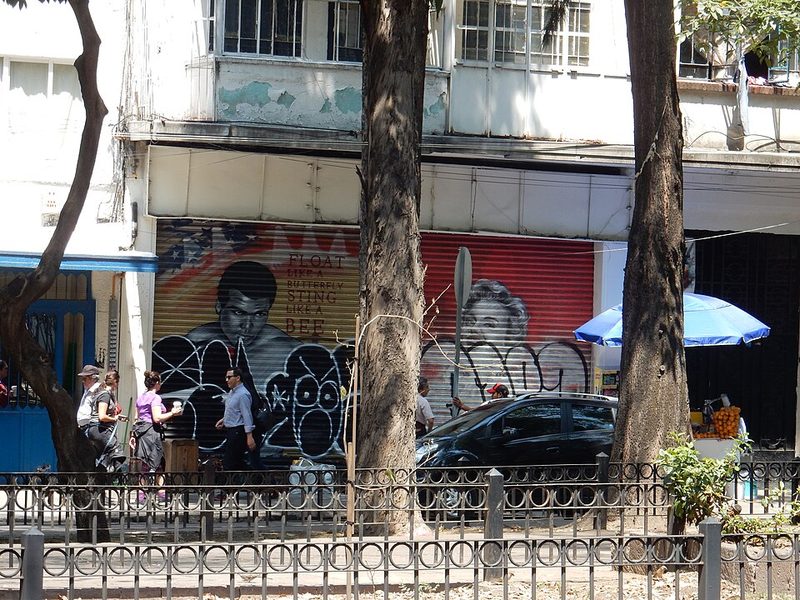
Walking Roma Norte is essentially walking through a timeline of Mexican architectural ambition. The streets are an open-air museum — except the museum is alive, with people living and working in the exhibits.
The Porfirian Mansions
The dominant style is what’s called “Porfirian” — a mix of French, Roman, Gothic, and Moorish elements fashionable during the reign of President Porfirio Diaz (1876-1911). Ornate facades, wrought iron balconies, carved stone details, grand entrances designed for horse-drawn carriages. The best-preserved examples line Orizaba, Alvaro Obregon, Colima, and Tonala streets.
Most of these mansions are no longer private residences. They’ve been converted into offices, cultural centers, restaurants, galleries, and boutique hotels — a process that’s actually preserved many of them. A mansion that becomes a restaurant gets a new roof and restored facade. One that sits empty gets rain damage and squatters.
Art Nouveau and Beyond
Mixed in with the Porfirian mansions, you’ll find Art Nouveau buildings, Neo-colonial structures (imitating Mexico’s colonial-era styles), and some genuine Art Deco. Casa Prunes, on Orizaba Street, is one of the finest Art Nouveau mansions in Mexico City. The Universidad de Londres occupies another landmark building. On Colima Street, a row of galleries has taken over former mansions, creating an informal art corridor.
The Casa de las Brujas — the “House of the Witches” — faces Parque Rio de Janeiro and is probably the most photographed building in Roma. Its official name is Edificio Rio de Janeiro, but nobody calls it that. Built in 1908, this red-brick, castle-like structure got its nickname from the face that seems to form in the windows at the top of the corner tower. An Art Deco entrance was added in the 1930s, giving it a slightly schizophrenic personality — Gothic fairy tale meets geometric modernism. It works, somehow.
The Modern Intrusions
Not everything in Roma is beautiful. Since the 1950s, modern apartment blocks and office buildings have replaced many original structures. These newer buildings are taller, heavier, and architecturally bland. Worse, their weight affects the soft soil around them, causing damage to the older structures nearby. It’s a frustrating cycle: the appeal of the neighborhood drives up land values, which creates pressure to demolish old mansions and build something taller and more profitable.
Since the 1990s, restrictions on changes to historic facades have helped. But you’ll still see construction cranes next to Porfirian mansions, and not every new building respects its neighbors.
Avenida Alvaro Obregon: The Neighborhood’s Spine
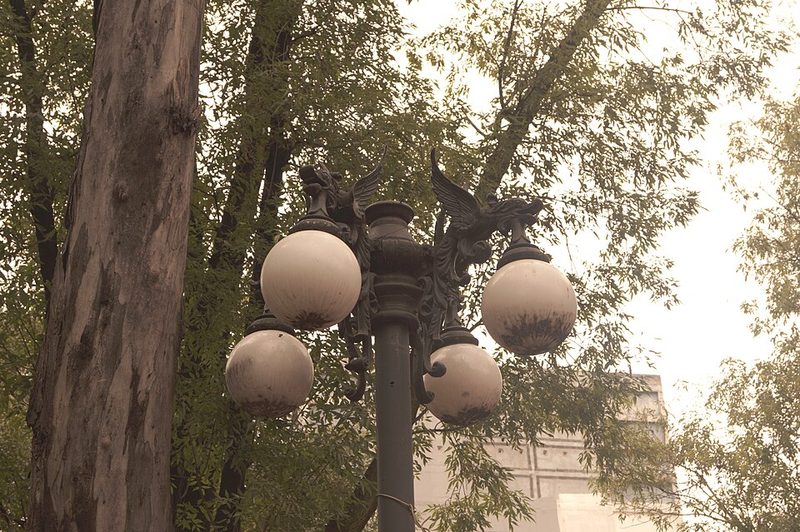

Every neighborhood needs a main street, and Alvaro Obregon is Roma Norte’s. It runs east-west, bisecting the neighborhood, and its wide, tree-lined median — with walking paths, metal benches, and massive old trees — is where much of Roma’s street life happens. On weekends, vendors set up along the median selling art, antiques, and collectibles. On weekday mornings, it’s dog walkers and coffee-carrying professionals heading to work.
The boulevard connects Roma to the Condesa neighborhood to the west (they share a border at Insurgentes) and runs toward the Historic Center to the east. Walking its full length gives you a cross-section of the neighborhood: Porfirian mansions, modern apartment towers, restaurants with sidewalk tables, the earthquake memorial at number 286, galleries, bookshops, and the occasional building that’s been standing empty since 1985.
Alvaro Obregon is beautiful but loud — it was designated as an “eje” (axis street) for through traffic in the 1950s, so trucks and buses compete with the tree-lined charm. The median offers some buffer, but this isn’t the quiet stroll you’ll get on Orizaba or Colima.
Parque Rio de Janeiro and the Naked David
Parque Rio de Janeiro is the heart of Roma Norte — a small, circular plaza surrounded by some of the neighborhood’s finest old mansions, including the Casa de las Brujas. In the center stands a fountain topped with a replica of Michelangelo’s David, which has become the unofficial symbol of the colonia. The statue is smaller than you’d expect if you’ve seen the original in Florence, but it’s still a full-frontal nude Renaissance masterpiece plopped into the middle of a Mexico City park, which is a sentence that pretty much captures Roma Norte’s personality.
The plaza was originally called Plaza Roma and was designed as the neighborhood’s social center. The old mansions surrounding it give the space a European feel — you could squint and think you’re in a small Italian piazza, especially on a sunny morning when the light filters through the trees and someone’s walking a ridiculously small dog past the David.
A couple of tall modern towers have been built nearby, disrupting the otherwise low-rise character. But the plaza itself remains one of the most pleasant places to sit in the neighborhood. Bring a coffee, find a bench, and watch the city happen around a naked Florentine.
The Food Scene: Why Roma Norte Might Be the Best Restaurant Neighborhood in Mexico
Here’s where we drop the measured tone and just say it: Roma Norte has the best restaurant density in Mexico City, and possibly in all of Mexico. Not every restaurant is great — the neighborhood has its share of overpriced mediocrity catering to tourists and digital nomads — but the concentration of genuinely excellent food within these few blocks is remarkable.
The area rivals Polanco as the center of the city’s culinary scene, but Roma’s advantage is variety. Polanco is expensive. Roma gives you everything from world-class fine dining to 40-peso tacos, sometimes on the same block.
The Restaurant Streets
The highest concentrations of restaurants cluster along Alvaro Obregon, Colima, Orizaba, Tonala, and around the plazas. Colima Street, in particular, has evolved into a food-and-gallery corridor where every other doorway is either a restaurant or an art space, and sometimes both.
Many of Roma’s best restaurants occupy converted Porfirian mansions. Eating in a high-ceilinged dining room that was someone’s parlor in 1910, with original tile floors and wrought iron details, is a pleasure this neighborhood delivers better than anywhere else in the city.
What to Expect
The food spans everything: traditional Mexican, contemporary Mexican (the kind that wins international awards), Japanese, Italian, Argentine, Middle Eastern, vegetarian, vegan, and whatever fusion category someone invented last month. Third-wave coffee shops have colonized Roma like nowhere else in the city.
Prices vary wildly. You can eat a full comida corrida (set lunch) for 80 pesos at a no-name spot off the main streets, or spend 2,000 pesos per person at a chef-driven restaurant. Both experiences are worth having. The expensive restaurants are expensive because the food is actually that good, not because someone put a succulent on the table and added a surcharge.
Market Culture
Roma Sur’s Mercado Medellin is technically just south of Roma Norte proper, but it’s essential to the neighborhood’s food identity. The market is famous for its Latin American products — Colombian, Cuban, Venezuelan, and Central American ingredients that reflect the immigrant communities in Roma Sur. Alfonso Cuaron’s 2018 film “Roma” brought international attention to Roma Sur (Cuaron grew up on Tepeji Street), but the market was already a destination for anyone serious about cooking.
Galleries, Bookshops, and Culture
Roma Norte’s cultural life goes well beyond restaurants. The neighborhood is one of Mexico City’s primary gallery districts, with Colima Street serving as the unofficial gallery row. Most galleries occupy converted mansions, giving them a domestic intimacy that larger spaces in Polanco or along Paseo de la Reforma can’t match.
Casa Lamm
The Casa Lamm Cultural Center, housed in a beautifully restored Porfirian mansion on Alvaro Obregon, is probably Roma’s most important cultural institution. It functions as an art school, gallery, event space, and restaurant. The building itself is the real draw — a reminder of what these mansions looked like when the bankers who built them were still alive and spending money.
Bookshops
Roma Norte has a bookshop density that puts most neighborhoods to shame. The Casa Universitaria del Libro is an academic bookstore in another converted mansion. Beyond the institutional players, independent bookshops are scattered throughout — new books, used books, art books, books in Spanish and English, with the kind of curated selections that suggest someone who actually reads is making the purchasing decisions.
The literary connection runs deep. Jose Emilio Pacheco set his story “Las batallas en el desierto” partly in Roma. Carlos Fuentes wrote about the neighborhood in “Agua Quemada.” Luis Zapata’s “El vampiro de la colonia Roma” took its title from the colonia itself. Luis Bunuel filmed “Los Olvidados” in La Romita, the ancient village that still exists in Roma’s northeastern corner. The neighborhood doesn’t just sell books — it’s been the subject of them.
The Gallery Walk
If you’re interested in contemporary Mexican art, spend a Saturday afternoon walking Colima and the surrounding streets. Galleries here tend toward the accessible and interesting rather than the intimidatingly avant-garde. Opening nights (typically Thursday or Saturday evenings) are free, social, and a good way to see the neighborhood’s creative community in action.
The Museo Objeto del Objeto (MODO), which occupies — naturally — another converted historic building, is worth a visit for its rotating exhibitions focused on design and everyday objects. It’s the kind of museum that makes you think differently about things you normally wouldn’t think about at all.
La Romita: The Village Inside the Neighborhood
In Roma Norte’s northeastern corner, near Metro Cuauhtemoc, there’s a section that feels nothing like the rest of the neighborhood. La Romita is the remnant of the original pre-Hispanic village of Aztacalco — a tiny settlement that predates not just Roma but the Spanish conquest itself. When Colonia Roma was created in the early 1900s, Romita was officially incorporated into it, but the residents fought redevelopment. They’ve been semi-independent ever since.
The streets here are narrow and don’t follow Roma’s grid. They lead to a small plaza and the church of Santa Maria de la Natividad de Aztacalco, established in 1550. The area has historically been poorer than the rest of Roma, with a reputation for petty crime that persists (somewhat unfairly) today. It’s a fascinating pocket of the city — proof that neighborhoods have layers, and that Roma Norte wasn’t always cocktail bars and converted mansions.
Roma Norte vs. Condesa: The Eternal Comparison
People always ask which is better, Roma Norte or Condesa. The neighborhoods share a border at Avenida Insurgentes and have a lot in common — tree-lined streets, converted historic buildings, food and coffee everywhere. But they’re genuinely different.
Condesa is Art Deco; Roma is Porfirian. Condesa is built around two parks (Parque Mexico and Parque Espana); Roma is built around a boulevard and a small plaza. Condesa feels more residential; Roma feels more commercial and cultural. Condesa’s restaurant scene is excellent; Roma’s is better. Condesa is where you go to walk the Amsterdam loop and sit in a park; Roma is where you go to eat, gallery-hop, and look at a wider variety of architecture.
The honest answer: if you can only visit one, visit Roma Norte. If you have two days (and you should), visit both. They’re separated by one avenue. Walking from one to the other takes about three minutes.
The Touristification Question
We’d be dishonest if we didn’t address this. Roma Norte has changed dramatically in the past decade, and not everyone is happy about it. The influx of digital nomads, short-term rental tourists, and foreign residents has driven up rents, displaced long-term residents, and turned some blocks into what feels like a curated experience rather than a living neighborhood. You’ll see menus in English. You’ll hear conversations about coworking spaces. Some of the newer restaurants feel designed for Instagram rather than for eating.
This is real, and it matters. The gentrification that saved Roma’s architecture is the same gentrification that’s pricing out families who lived here for decades. It’s the same tension you’ll find in Brooklyn or Kreuzberg. Roma Norte isn’t unique in facing it, but it’s facing it right now, visibly.
That said, Roma Norte isn’t a theme park. Walk two blocks off Alvaro Obregon and you’re in residential streets where families have lived for generations, where the corner tienda still operates on trust. The touristification is concentrated on the main corridors. The real Roma Norte is still there if you’re willing to look for it.
Living Here vs. Visiting
If you’re visiting Mexico City for a week, Roma Norte is one of the best neighborhoods to base yourself. The location is central — you’re walking distance from Condesa, Colonia Juarez, and Paseo de la Reforma, with easy metro access to the Historic Center, the Zocalo, and Chapultepec. The food options are endless. The streets are walkable and interesting. You won’t run out of things to do.
If you’re thinking about living here longer-term — as many remote workers now do — the calculus is different. Rents have climbed sharply. The neighborhood is noisy on weekends. Street parking is a nightmare. And the earthquake risk is real — living on a former lakebed means accepting that seismic events will hit this neighborhood harder than areas built on firmer ground.
The tradeoff is that you’re living in one of the most interesting, walkable, culturally rich neighborhoods in the Western Hemisphere. For many people, that’s enough.
Practical Information
Getting There
Metro Insurgentes (Line 1) sits at the neighborhood’s western edge. Metro Cuauhtemoc (Line 1) is on the northeastern corner. Metrobus Line 1 runs along Insurgentes with stops at Alvaro Obregon and Sonora.
From Chapultepec, walk east along Alvaro Obregon or take the metro one stop to Insurgentes. From the Historic Center, take Line 1 westbound. From the Angel of Independence on Reforma, walk south through Colonia Juarez — about 15 minutes on foot.
Getting Around
Roma Norte is compact and best explored on foot. The grid layout makes navigation straightforward — streets are named after Mexican states (Oaxaca, Queretaro, Guanajuato, Durango, Colima, Orizaba, Jalapa) running roughly east-west, and after cities and rivers (Alvaro Obregon, Insurgentes, Cuauhtemoc) running north-south. Once you’ve oriented yourself to the grid, you won’t get lost.
Ride-hailing apps work well here. The Ecobici bike-sharing system has stations scattered through Roma, and cycling is viable — the streets are mostly flat with some dedicated bike lanes.
Safety
Roma Norte is generally safe, particularly along the main corridors and during the day. Standard Mexico City precautions apply: keep your phone in your pocket, be aware on quieter streets after dark, and don’t leave valuables visible in parked cars. La Romita in the northeast has a rougher reputation, though it’s mostly fine during daylight.
The biggest actual hazard in Roma Norte isn’t crime — it’s the sidewalks. Uneven paving, tree roots pushing up concrete, and the occasional uncovered drainage hole make walking while looking at your phone a genuinely bad idea.
Best Times to Visit
The best months are October through April — dry season, comfortable temperatures, and the jacaranda trees bloom in late February and March, turning the whole neighborhood purple. Weekday mornings are quiet and pleasant for architecture walks. Weekend afternoons bring crowds to Alvaro Obregon. Thursday through Saturday nights are when the restaurant scene hits peak intensity.
How Long to Spend
You can walk the highlights in half a day: Alvaro Obregon end to end, Parque Rio de Janeiro, Colima Street galleries, a meal or two. But Roma Norte rewards longer stays. Give it a full day if you want to eat properly and explore the side streets. Give it two or three days if you want to experience it the way residents do — morning coffee at a sidewalk table, an afternoon in a bookshop, dinner at a place you discovered because you turned down a street you hadn’t planned on.
Roma Norte isn’t the kind of neighborhood that reveals itself on a rushed visit. It’s the kind that gets better the more time you give it.