
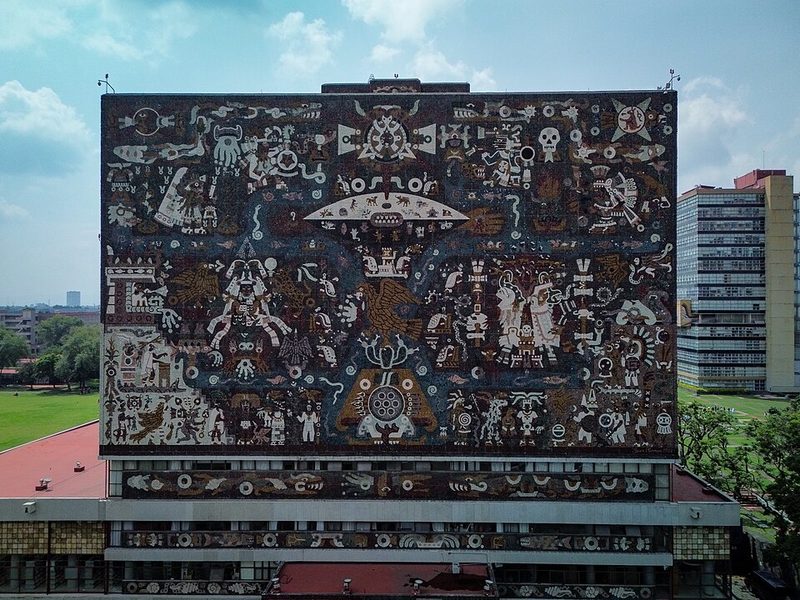
There’s a place in southern Mexico City where 60 architects tried to outdo each other on a canvas of prehistoric lava, and the result is one of the most audacious university campuses ever built. Ciudad Universitaria — the main campus of the National Autonomous University of Mexico (UNAM) — isn’t just a school. It’s a UNESCO World Heritage Site, an open-air museum, an ecological reserve, and a functioning city within a city where 350,000 students go about their daily lives surrounded by murals that most countries would lock behind museum glass.
We’ve walked dozens of Mexico City neighborhoods, and CU (as locals call it) remains one of the places that genuinely stops us in our tracks. The scale is staggering. The art is confrontational. And the volcanic landscape underneath it all is a reminder that this city was built on geology that doesn’t care about human timelines.
A Brief History: Why Build a University on a Lava Field
By the 1940s, UNAM had a problem. Founded in its modern form in 1910 (though its roots trace back to 1551, making it one of the oldest universities in the Americas), the institution was scattered across crumbling buildings in downtown Mexico City. Classes happened in converted colonial houses. Labs shared space with administrative offices. The whole setup was a logistical disaster.
The solution was ambitious bordering on reckless: build an entirely new campus from scratch on El Pedregal, a vast expanse of volcanic rock in the south of the city left behind by the eruption of the Xitle volcano roughly 1,700 years ago. The land was cheap because nobody wanted it. It was, quite literally, a field of jagged basalt where almost nothing grew.
Architects Mario Pani and Enrique del Moral drew up the master plan, but this wasn’t a two-person job. Over 60 architects, engineers, and artists collaborated on the project, turning what could have been a sterile modernist grid into something far more interesting — a campus where every major building doubles as a work of art. Construction ran through the early 1950s, and the campus opened in 1954 at a cost of about $25 million (a bargain that seems almost fictional today).
In 2007, UNESCO inscribed the central campus as a World Heritage Site, recognizing it as “an outstanding example of 20th-century modernism integrated with pre-existing natural features and with the local artistic tradition, especially the Mexican mural movement.” That description barely scratches the surface.
The Central Library: Juan O’Gorman’s Masterpiece

If you’ve seen one photograph of UNAM, it was probably the Central Library. And honestly, no photograph does it justice. Juan O’Gorman — architect, painter, and magnificently stubborn idealist — covered all four exterior walls of the ten-story building with mosaic murals made from naturally colored stones sourced from across Mexico. The result is the largest mural project of its kind in the world.
The work is called Historical Representation of Culture, and it tells the story of Mexico from the pre-Hispanic era through the colonial period to the modern age. The north wall depicts the Aztec world. The south wall covers the colonial period. The east and west walls deal with the modern university and contemporary Mexico. O’Gorman didn’t use paint — every square centimeter is composed of small stones in their natural colors, painstakingly set into the concrete facade.
O’Gorman was a complicated figure. He designed some of Mexico’s most important functionalist buildings (including a house and studio for Diego Rivera in San Angel that you can still visit today), then basically renounced functionalism and devoted himself to this kind of mosaic work. The Central Library was his definitive statement: architecture and art aren’t separate disciplines. They’re the same thing.
The library opened to users on April 5, 1956, and it holds one of the largest collections in Mexico. You can walk inside during university hours, though honestly the exterior is the main event. Stand on the broad esplanade to the west and let the scale hit you. It’s a building that looks like it was decorated by a civilization, not an individual.
The Olympic Stadium and Diego Rivera’s Mosaic
The Estadio Olimpico Universitario is sunk into the volcanic landscape like a crater within a crater — a deliberate design choice that makes the structure feel organic rather than imposed. Built in 1952 by architects Augusto Perez Palacios, Raul Salinas Moro, and Jorge Bravo Jimenez, it held 63,000 spectators at the time (since expanded to 69,000) and was the largest stadium in Mexico when it opened.
The stadium hosted the main track and field events during the 1968 Summer Olympics, making it one of the most historically significant sporting venues in Latin America. This is where the famous Black Power salute by Tommie Smith and John Carlos happened. This is where Bob Beamon shattered the long jump world record by nearly two feet. The ghosts of those moments are still here.
But we’re not just here for sports history. The stadium’s exterior features a massive high-relief mosaic by Diego Rivera depicting the history of Mexican sport from pre-Hispanic times to the modern era. Rivera created the work using colored volcanic stone — the same material the stadium sits on. It’s a circle of storytelling that starts with the land itself.
If you visit on a Sunday during football season, you can catch the Pumas (UNAM’s football team) playing a Liga MX match. The atmosphere is electric, the crowd is overwhelmingly young, and the ticket prices are a fraction of what you’d pay at Estadio Azteca. More on that later.
The Rectoria Tower: Siqueiros Goes Three-Dimensional
The Rectoria (administration building) is where David Alfaro Siqueiros, the third titan of Mexican muralism alongside Rivera and Orozco, left his mark on the campus. His contribution here is a mural-sculpture called The People to the University, the University to the People, and it does something genuinely innovative: the mural wraps around the building in three dimensions, incorporating the architecture itself as part of the artwork.
Siqueiros was obsessed with the idea that murals shouldn’t be flat. He called his approach “polyangular perspective” — designing the work so that it changes as you walk around the building, revealing new compositions from every angle. The Rectoria mural is one of the best examples of this technique anywhere. The figures seem to burst out of the walls, their outstretched arms following the architectural lines of the tower.
The building also features mosaic work by other artists, but it’s the Siqueiros piece that commands attention. Walk slowly around all four sides. The mural rewards movement in a way that static art simply can’t.
MUAC: Contemporary Art in a Concrete Shell
Not everything at UNAM is from the 1950s. The Museo Universitario Arte Contemporaneo (MUAC), which opened in November 2008, is the first public museum in Mexico dedicated exclusively to contemporary art of the 21st century. Designed by architect Teodoro Gonzalez de Leon, the building is a series of interlocking white concrete volumes that somehow manage to feel both monumental and airy.
The permanent collection spans everything from video installations to performance documentation to large-scale sculpture, with a strong focus on Latin American artists. Temporary exhibitions rotate regularly and tend to be challenging rather than decorative — this isn’t a museum that plays it safe.
Curator in chief Cuauhtemoc Medina, appointed in 2013, has pushed the museum toward increasingly ambitious programming. If you’re the kind of person who goes to galleries like Tate Modern or MACBA in Barcelona, MUAC will feel familiar in the best way. Admission is cheap, and the museum cafe isn’t bad either.
MUAC sits in the Centro Cultural Universitario, the cultural district at the southern end of campus. The Sala Nezahualcoyotl concert hall and several theaters are nearby, making this corner of CU worth an entire afternoon if you’re into performing arts.
The Espacio Escultorico: Art That Doesn’t Explain Itself
Tucked into the ecological reserve at the southern edge of campus, the Espacio Escultorico (Sculptural Space) is one of Mexico City’s most extraordinary and least-visited landmarks. Built in 1979 by a collective of six artists — including Mathias Goeritz, Manuel Felguerez, Helen Escobedo, Federico Silva, Hersua, and Sebastian — it’s a monumental ring of 64 concrete wedge-shaped modules arranged in a circle around a core of raw volcanic rock.
The piece is 120 meters in diameter, and walking into it feels genuinely disorienting. The concrete teeth rise around you while the volcanic rock at the center remains untouched — wild, dark, and sharp. It’s a deliberate confrontation between human geometry and geological chaos, and it hits harder than we expected.
The surrounding area contains additional sculptural works scattered across the lava field, each responding to the landscape in its own way. This isn’t a sculpture garden in the manicured European sense. It’s art dropped onto raw geology, and the geology is winning. Bring sturdy shoes — the paths are uneven and the volcanic rock is genuinely sharp.
The Pedregal Ecological Reserve
Here’s something most visitors don’t know: UNAM sits on one of the last remaining patches of the original Pedregal ecosystem — a volcanic lava field that once covered roughly 80 square kilometers of southern Mexico City. The Reserva Ecologica del Pedregal de San Angel protects 237 hectares of this landscape within the campus boundaries.
The reserve is home to over 1,800 species of flora and fauna, including some that exist nowhere else. The vegetation is scrubby and tough — prickly pear cactus, wild dahlias, and hardy grasses that have slowly colonized the lava over centuries. It doesn’t look like much at first glance, but biologists consider it one of the most important urban ecological areas in Latin America.
Parts of the reserve are open to the public via maintained trails. The contrast is startling: one moment you’re walking past modernist concrete buildings full of students, and the next you’re standing on a lava field that looks like it could be on another planet. The ecological reserve is a reminder that Mexico City isn’t just built on a lakebed — it’s built on volcanoes, too. The city’s geological history is right here, exposed and unapologetic.
The reserve connects naturally to the Espacio Escultorico, so you can combine the two into a single walk. Early morning is best, before the heat builds and while the birding is good.
Student Life and the Pumas
UNAM enrolls over 324,000 students, making it one of the largest universities in the world. On a weekday, the campus buzzes with the particular energy that only a university this size can generate — students sprawled on lawns reading, pickup football games on every available patch of grass, food vendors selling tlacoyos and quesadillas for pocket change, political posters plastered on every surface.
The student movement of 1968, which culminated in the Tlatelolco massacre, began here. UNAM has always been deeply political, and that tradition continues. Don’t be surprised to see protest banners, strike notices, or impromptu debates in the open spaces. It’s part of the character of the place, and it’s one of the reasons the campus feels alive rather than preserved.
Then there’s football. Club Universidad Nacional, better known as the Pumas, plays in Mexico’s top division and has one of the most passionate fan bases in the country. Their home ground is the Olympic Stadium, which means you can watch Liga MX football in a UNESCO World Heritage Site with a Diego Rivera mural on the outside. Try finding that combination anywhere else on earth.
Match days transform the campus. The blue and gold of the Pumas is everywhere, the food stalls multiply, and the atmosphere shifts from academic calm to barely contained excitement. If your visit coincides with a home match, go. Tickets for the general sections are remarkably affordable, and the experience is pure Mexico City.
Other Highlights Worth Your Time
We’ve covered the headliners, but CU is enormous — roughly 730 hectares — and there’s more here than you can see in a single visit. A few additional spots worth seeking out:
The Universum Science Museum. Mexico’s largest interactive science museum, excellent for kids but genuinely interesting for adults too. The exhibits on Mexican biodiversity and space exploration are particularly well done.
The Botanical Garden. Adjacent to the ecological reserve, this is one of the best collections of Mexican native plants in the country. The cactus and succulent sections are outstanding, and you’ll see species here that you won’t find in any European or North American botanical garden.
The Faculty of Medicine Murals. Several faculty buildings have their own murals that don’t make it into the tourist literature. The Faculty of Medicine features work by Francisco Eppens Helguera, whose mosaic on the exterior is a study in pre-Hispanic medical knowledge that deserves more attention than it gets.
The Islas (Islands). The campus is organized around a series of “islas” — island-like groupings of buildings separated by green spaces and roadways. The Islas area near the central esplanade is where student life concentrates, and it’s the best place to grab cheap food and absorb the atmosphere.
How to Visit UNAM
The campus is open to the public and there’s no admission fee to walk the grounds. Individual museums and cultural venues have their own (generally modest) admission charges. Here’s what you need to know:
When to go. Weekdays during the semester give you the full student-life experience, but the campus can feel crowded and parking is a nightmare. Saturday mornings are ideal for a relaxed visit — the grounds are quieter, most outdoor areas are accessible, and you can move at your own pace. Sundays work too, though some buildings may be closed.
How long to spend. A focused visit hitting the Central Library, Olympic Stadium, Rectoria Tower, and Espacio Escultorico takes about three to four hours. Add MUAC, the ecological reserve, and a meal, and you’re looking at a full day. We’d suggest the full day.
What to wear. Comfortable walking shoes are non-negotiable — the campus is spread out and the volcanic rock near the ecological reserve and Espacio Escultorico is genuinely hazardous in sandals. Sun protection matters too; large portions of the campus are exposed.
Guided tours. UNAM offers free guided tours on certain days, usually departing from the Rectoria. Check the university’s cultural programming website for current schedules. The tours are in Spanish, but even with limited Spanish they’re worth joining for the access and context.
Getting There
UNAM sits in the south of the city, straddling the border between Coyoacan and Tlalpan. Several options for getting there:
Metro. The most practical approach is Line 3 (green line) to the Universidad station, which drops you at the northeast corner of the campus. From there, the Central Library and main esplanade are about a 10-minute walk. This is the cheapest option and avoids the traffic that plagues Insurgentes Sur.
Metrobus. Line 1 of the Metrobus runs along Insurgentes Sur and has a stop at Ciudad Universitaria. This is convenient if you’re coming from the Historic Center, Roma, or Condesa.
Pumabus. Once you’re on campus, UNAM operates a free internal bus system called the Pumabus. Multiple routes connect different parts of the campus, and it’s the easiest way to get from, say, the Central Library area to the Centro Cultural in the south without a 30-minute walk. The buses are frequent during school hours and clearly marked.
Taxi or rideshare. Works fine for getting to the campus, but traffic on Insurgentes Sur during rush hour can be brutal. If you’re coming from the center of the city, the Metro is honestly faster during peak hours. Once on campus, a taxi to the Espacio Escultorico or MUAC saves significant walking time.
What to Combine It With
UNAM sits in one of the richest cultural corridors in Mexico City. You’d be mad not to combine your visit with at least one or two nearby destinations.
Coyoacan is the obvious pairing. The bohemian neighborhood with its colonial center, the Frida Kahlo Museum, and excellent food markets is just north of the campus. A morning at UNAM followed by a late lunch in Coyoacan is one of the best day plans in the city.
Tlalpan, the quiet colonial town center to the south, is less touristed and rewards exploration with beautiful plazas, old churches, and some of the best tlacoyos in the city.
If you’re on a museum tear, the National Museum of Anthropology in Chapultepec is the other essential cultural destination in Mexico City. It pairs well with UNAM thematically — the pre-Hispanic world referenced in O’Gorman’s and Rivera’s murals comes to life in three dimensions at the Anthropology Museum.
For more muralism, the Palace of Fine Arts downtown holds major works by Rivera, Siqueiros, and Orozco in an interior setting. Seeing their campus-scale works at UNAM first, then their gallery-scale pieces at Bellas Artes, gives you a sense of range that neither location provides alone.
Why It Matters
There’s a tendency to treat UNAM as a checklist item — see the library, take a photo, leave. That’s a mistake. What makes this campus genuinely special isn’t any single building or mural. It’s the idea behind the whole project: that a public university should be a work of art. That students deserve to learn surrounded by beauty. That architecture, painting, sculpture, and landscape aren’t luxuries to be added after the functional buildings are finished — they’re the point.
The 60-plus architects and artists who built Ciudad Universitaria weren’t decorating a campus. They were making an argument about what a society owes its young people. Seven decades later, walking through CU, we think they won that argument convincingly.
Mexico City has no shortage of extraordinary places to visit. UNAM belongs in the top five. Don’t skip it.