
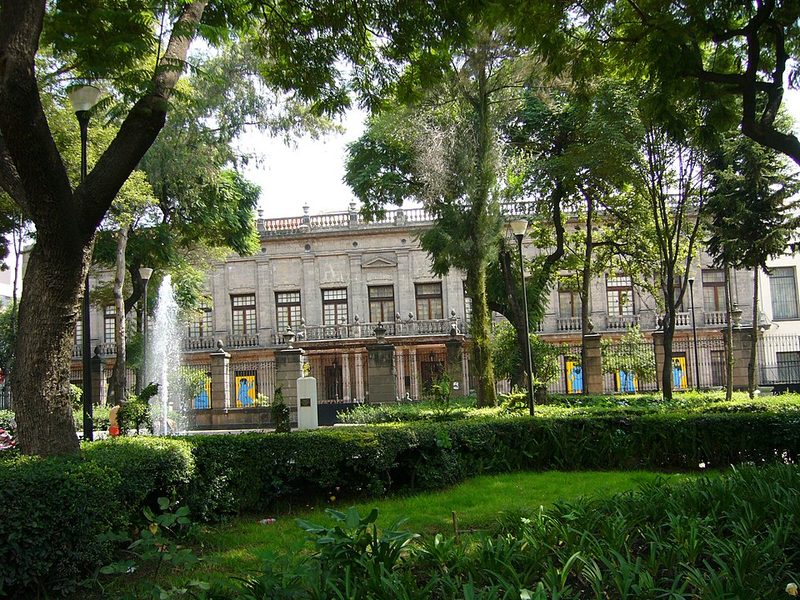
Mexico City has world-class museums covering pre-Columbian civilizations, colonial history, modern Mexican art, and revolutionary muralism. What it doesn’t have much of is European art. In fact, the Museo Nacional de San Carlos is essentially the only dedicated European art museum in the entire country, which makes it a bit of an anomaly — and a very good one.
If you’ve been immersing yourself in Mexican culture for days and suddenly have the urge to look at a Rubens or a Cranach, this is your place. It’s also housed in one of the most handsome Neoclassical buildings in the city, close to the Monument to the Revolution, and it rarely has crowds. We consider it one of the best-kept quiet spots in the center of CDMX.
The Building

The museum occupies the Palacio del Conde de Buenavista, an 18th century mansion designed by Manuel Tolsa, the same architect responsible for the Palacio de Mineria and the equestrian statue of Charles IV (the “Caballito”) on Paseo de la Reforma. Tolsa was the leading Neoclassical architect in New Spain, and this building is one of his finest residential works.
The palace was commissioned by the Countess of Buenavista, Maria Josefa Rodriguez de Pinillos, and completed around 1805. It features an oval central courtyard — unusual for Mexican colonial architecture, which typically favored rectangular courtyards — surrounded by Doric columns on the ground floor and Ionic columns on the upper level. The proportions are elegant, the stonework is precise, and the building has aged remarkably well.
Over the centuries, the palace served as a tobacco company headquarters, a military facility, a lottery office, and various government functions before being assigned to the San Carlos Museum in 1968. The fit is appropriate: Tolsa also directed the Royal Academy of San Carlos, the institution whose art collection forms the nucleus of the museum’s holdings.
The Collection
The collection spans European art from the 14th through the early 20th century, with particular strength in Spanish, Flemish, and Italian works. It began as the teaching collection of the Royal Academy of San Carlos, founded in 1781 as the first art academy in the Americas. The Academy used European paintings, sculptures, and prints as models for its students, and over the centuries the collection grew through purchases, donations, and transfers from other institutions.
Medieval and Renaissance
The earliest works include panel paintings from the 14th and 15th centuries, primarily Italian and Spanish. There are pieces attributed to workshops associated with major figures, and a small but interesting group of Flemish primitives. The collection isn’t deep enough in this period to rival major European museums, but the pieces are well-chosen and well-displayed.
Baroque and Golden Age
This is where the museum’s collection is strongest. There are works by or attributed to Peter Paul Rubens, Lucas Cranach the Elder, Anthony van Dyck, and several significant Spanish Golden Age painters including Bartolome Esteban Murillo and Francisco de Zurbaran. The Flemish and Dutch holdings include genre scenes, still lifes, and landscapes that show the northern European tradition at a high level.
Several large-format religious paintings from the Spanish tradition demonstrate the intensity of Counter-Reformation art that directly influenced the colonial Mexican painting you’ll see elsewhere in the city. Making the connection between these European originals and their Mexican adaptations is one of the museum’s most rewarding intellectual exercises.
18th and 19th Century
Neoclassical and Romantic period works reflect the Academy’s own aesthetic preferences during its most influential years. There are academic nudes, historical scenes, landscape paintings, and sculptural studies that were used as teaching tools. The sculpture collection includes plaster casts of classical works that the Academy imported from Europe for students to study.
Prints and Drawings
The museum holds a significant collection of European prints and drawings, including works by Piranesi, whose architectural fantasies were influential in Mexican academic circles. This collection is not always on display but appears in rotating exhibitions.
The Oval Courtyard
Even if European art isn’t your primary interest, the building’s oval courtyard alone justifies a visit. The double-height colonnade, the proportions, and the light quality create one of the most architecturally refined interior spaces in Mexico City. It’s used for temporary exhibitions and cultural events, and on a quiet weekday you might have it almost to yourself.
The courtyard also functions as a sculpture garden, displaying pieces from the collection in a setting that enhances rather than competes with them.
Practical Information
Location
The museum is at Puente de Alvarado 50, Colonia Tabacalera, about two blocks from the Monument to the Revolution. It’s an easy walk from the Historic Center — about 15 minutes from the Alameda Central.
Getting There
- Metro: Revolution station (Line 2) is the closest, about a 5-minute walk. San Cosme station (Line 2) is also nearby.
- Metrobus: Line 1 stops at the Monument to the Revolution, a short walk from the museum.
- Walking: From the Historic Center hotels, it’s a straightforward walk west along Puente de Alvarado or north from the Alameda.
Hours and Admission
Open Tuesday through Sunday, 10:00 AM to 6:00 PM. Closed Mondays. Admission is approximately 65 MXN. Free on Sundays for Mexican nationals and permanent residents.
How Long to Spend
The museum is moderate in size — you can see the entire permanent collection in about an hour. Add 30 minutes if there’s a temporary exhibition that interests you. It’s a pleasant, unhurried visit that works well as a morning stop before lunch in the Tabacalera or San Rafael neighborhoods.
What to Pair It With
The museum’s location near the Monument to the Revolution makes it easy to combine with several nearby attractions:
- Monument to the Revolution — the massive Art Deco dome is a five-minute walk south.
- Historic Center — continue east for the Alameda, the National Art Museum (MUNAL), and the Zocalo.
- The National Art Museum makes a particularly good companion visit, as it covers Mexican art from the colonial period through the 20th century. Together, San Carlos and MUNAL give you a comprehensive picture of the artistic traditions — European and Mexican — that shaped this country’s visual culture.
Why We Recommend It
The Museo Nacional de San Carlos rarely appears on “must-see” lists for Mexico City, and that’s exactly why we like it. It’s a high-quality collection in a beautiful building without the crowds that make some of CDMX’s bigger museums exhausting. The European art provides useful context for understanding Mexican colonial art — you can see the sources that Mexican painters were working from and transforming into something distinctly their own.
And the Tolsa building is genuinely one of the finest pieces of Neoclassical architecture in the Americas. That oval courtyard alone is worth the price of admission.