
Reviewed · FRIDA KAHLO & COYOACAN TOURS
In the Footsteps of Frida Kahlo and Diego: Coyoacan and San Angel
Frida Kahlo’s Mexico City makes the most sense on foot, among old cobblestone lanes, leafy plazas, churches, markets, and the homes tied to her life. This four-hour walk links Coyoacán with the artistic world of Diego Rivera, Leon Trotsky, Tina Modotti, and other figures who shaped Mexico’s modern story.
In This Article
- Key points to know before booking
- Why this walk is really about place, not just Frida
- Starting among the trees at Viveros de Coyoacán
- Plaza de Santa Catarina and the old road of Francisco Sosa
- Jardín Centenario, the social center of Coyoacán
- San Juan Bautista and the Coyoacán market
- Casa Azul: the tour’s biggest limitation
- Trotsky’s final Mexico City home
- The Diego Rivera and Frida Kahlo Studio House
- What $95 gets you
- Walking conditions and how to prepare
- Who should book this Coyoacán and San Ángel walk?
- Should you book it?
- FAQ
- How long does the tour last?
- Where does the tour begin?
- Are tickets to Casa Azul included?
- Can I enter the Leon Trotsky House Museum?
- Is the Diego Rivera and Frida Kahlo Studio House included?
- What should I wear for the walk?
I like the opening at Viveros de Coyoacán, where a quiet urban forest gives you a soft start before the streets grow busier. I also like the personal touch offered by Adriana, whose local knowledge and stories from growing up in the area can make the neighborhoods feel lived-in rather than simply labeled on a map.
The main catch is important: you do not go inside the Frida Kahlo Blue House or Leon Trotsky House Museum. You see them from outside, and the only interior connected directly to Frida and Diego is the Diego Rivera and Frida Kahlo Studio House, which some people may find less compelling than Casa Azul.
Key points to know before booking
- Frida’s world from the outside: Learn about Casa Azul, Trotsky, Tina Modotti, and the Riveras without paying the entry fees for the two museums.
- A gentle start in Viveros: Begin among tall trees, birds, walking paths, and Mexico City’s long-running plant nursery tradition.
- Coyoacán’s best old streets: Stroll Avenida Francisco Sosa, Plaza de Santa Catarina, Jardín Centenario, and the Mercado de Coyoacán.
- A local guide matters: Adriana has a strong connection to the neighborhood, while Carlos is also part of the guiding team.
- Food and refreshment included: Coffee or tea and snacks are part of the four-hour outing.
- Plan for uneven ground: Cobblestones and old sidewalks call for comfortable walking shoes.
Why this walk is really about place, not just Frida
Many people arrive in Coyoacán hoping for a Frida Kahlo experience and expect Casa Azul to carry the day. This outing takes a wider view. It connects Frida and Diego to the streets where they lived, worked, entertained friends, and crossed paths with political exiles and artists.
That wider frame is the tour’s best quality. You get architecture, food, religion, public squares, conservation, and art in one route. The result is less a museum visit and more a portrait of two Mexico City neighborhoods.
The tour is private, so only your group takes part. That can make a real difference on a walking route filled with photo stops and questions. Adriana has been praised for giving thoughtful answers from more than one angle, and for creating an easy, friendly mood. Carlos is also described as calm and generous with his knowledge.
I would still set your expectations carefully. The advertised length is about four hours, and the route contains many stops. If your group spends a long time taking posed photos, the schedule can slip. On one outing, a large group’s repeated picture stops meant that a family with young children left before reaching the final studio. A private booking gives you a better chance to manage the pace, but it is still wise to tell your guide early which stops matter most.
A few more Mexico City tours and experiences worth a look

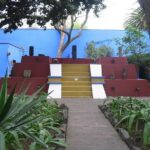
Starting among the trees at Viveros de Coyoacán
Meet at 9:00 a.m. at Puerta 5 of Viveros de Coyoacán, on G. Pérez Valenzuela 58BIS in Santa Catarina. The tour ends back at this same meeting point.
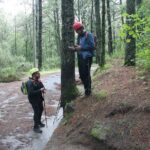
Viveros is more than a pleasant park. It functions as an urban forest and plant nursery, with a long role in conservation. You begin along paths shaded by large trees, with birds overhead and locals using the space for jogging, quiet thought, or a break from the city.
I like this first stop because it eases you into the day. Mexico City can feel loud and crowded, especially when you are still finding your bearings. Here, the pace is slower, and your guide can explain how the capital protects pockets of green space.
This part also gives the tour a useful balance. You are not spending four straight hours looking at houses and plaques. Instead, you start with nature, then move into old Coyoacán and its streets.
Plaza de Santa Catarina and the old road of Francisco Sosa
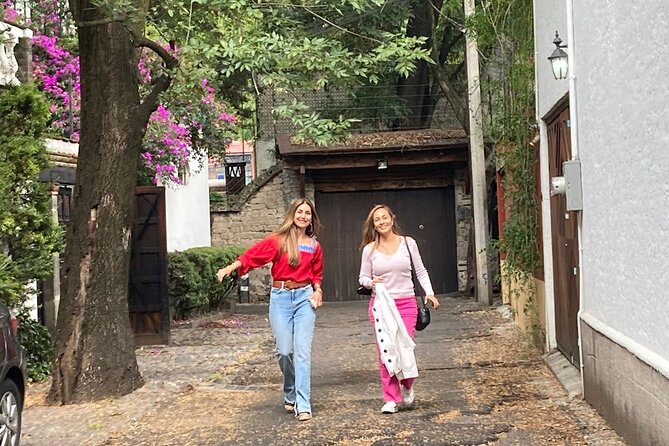
The Church of St. Catherine sits beside Plaza de Santa Catarina, a small square with cobblestones, bougainvillea, colonial houses, a chapel, and art studios. It has a quieter feel than Coyoacán’s main plazas, which makes it a good place to notice the neighborhood’s older character.
The stop lasts about 20 minutes, with admission included. That is enough time to take in the square and hear why this corner mattered to artists and intellectuals who lived nearby. You might find the setting more appealing than the church interior itself, since the charm comes from the full scene: plants, old walls, low buildings, and a peaceful public space.
From there, you walk along Avenida Francisco Sosa. This is one of the prettiest stretches of the route, lined with colonial-era homes, courtyards, jacaranda trees, cafés, artisan shops, and historic buildings.
The avenue also carries an older story. It once served as a route for Indigenous people heading toward the sacred waters of Coyoacán. That detail helps you see the street as more than a photogenic row of houses. It is part of a much older settlement pattern, layered beneath the modern cafés and galleries.
Bring your camera, but do not let it control the whole walk. The street rewards slow looking: doorways, tree shade, painted walls, and the contrast between private homes and public paths.
Jardín Centenario, the social center of Coyoacán
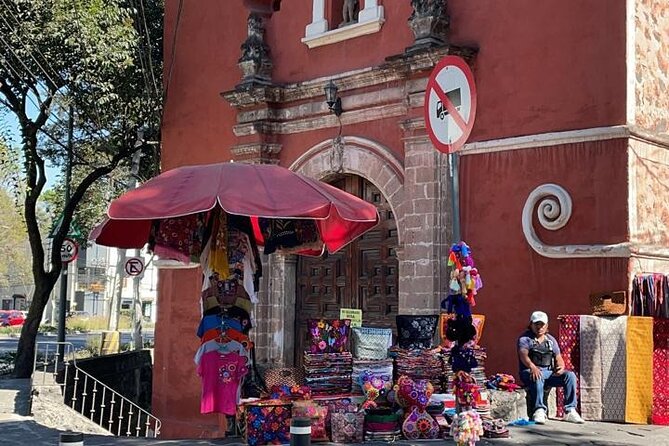
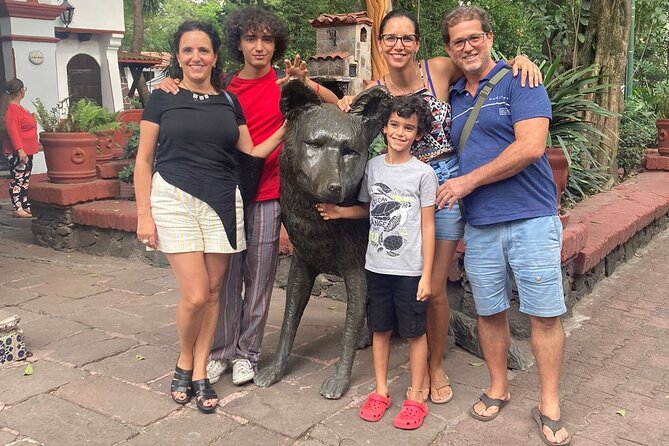
Jardín Centenario is where Coyoacán shifts from quiet lane to public theater. The plaza is known for its fountain and coyote statue, and it draws musicians, performers, artisans, shoppers, and people simply meeting friends.
The planned stop lasts around 30 minutes, with admission included. That makes it a good place to pause and watch local life rather than rush from one sight to the next. You can sit with a coffee, listen to street music, and see how strongly the neighborhood uses its public spaces.
The coyote image is especially fitting because Coyoacán’s name is linked to coyotes. Your guide can give the plaza more meaning by tying its symbols to the area’s older identity and its present-day culture.
This is also one of the best points to ask questions. If you are curious about Frida’s circle, neighborhood life, art, or Mexico City traditions, the open setting allows for a natural conversation. Adriana’s strength, based on the information available, is not only recalling facts but explaining them from several viewpoints.
San Juan Bautista and the Coyoacán market

The Parish of St. John the Baptist is a brief stop, about 10 minutes, and admission is free. Its baroque façade gives you a look at the religious architecture that helped shape Coyoacán. Inside, woodwork, paintings, and a calm atmosphere offer a sharp contrast to the noisy squares outside.
Do not expect a long church visit. Ten minutes is enough for a look and a short explanation, not a full study of the art. Still, the pause adds cultural range to a tour that could otherwise focus only on famous artists.
Next comes the Mercado de Coyoacán, where you get the most direct contact with daily food and shopping. The market sells crafts, piñatas, and souvenirs, but its real draw is the food: tacos, tostadas, and quesadillas sin queso, a Mexico City specialty whose name often surprises first-time visitors.
Coffee or tea and snacks are included in the tour, but you should not assume every market purchase is covered. If you want a full meal, extra snacks, or gifts, carry money for your own spending.
I like this stop because food explains a place faster than a long lecture can. You see what people buy, how ingredients are presented, and which dishes are part of ordinary life. The market can be busy, so keep your belongings close and stay aware of the meeting point within the group.




Casa Azul: the tour’s biggest limitation
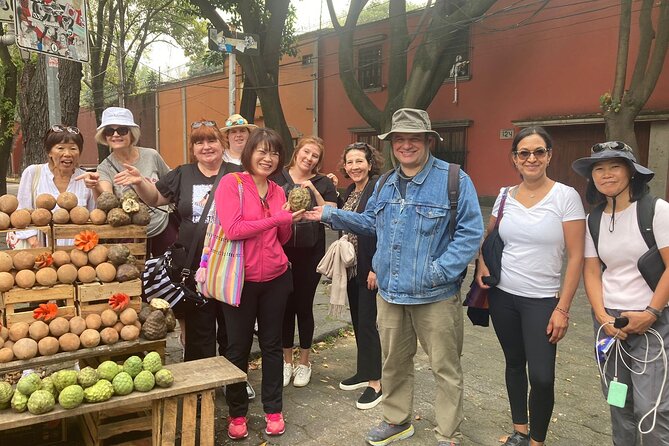
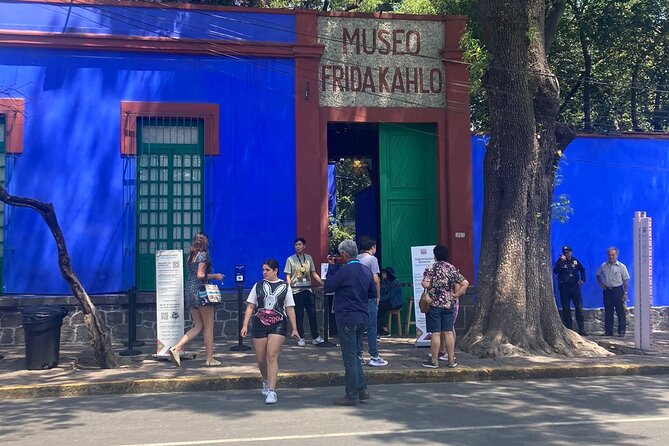
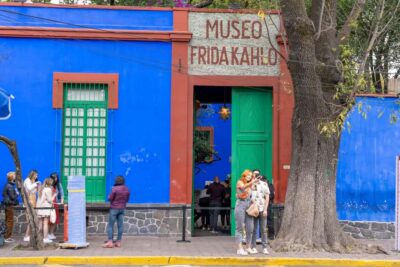
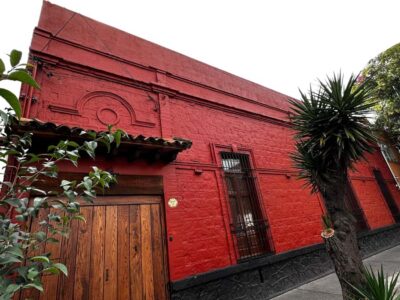
The Museo Frida Kahlo, known as Casa Azul or the Blue House, is central to the subject of this experience. It was Frida’s home and now preserves the colorful domestic setting tied to her work, marriage, health, and public image.
Here, the guide discusses Frida’s life and art, her relationship with Diego Rivera, and people connected to the couple, including Leon Trotsky and Tina Modotti. You pass by and learn about the place, but the entrance ticket is not included.
This distinction deserves your full attention before you pay $95. You are not touring the rooms where Frida lived. You are getting context from outside, then moving on to another studio later in the route.
Casa Azul tickets may require advance planning, and the tour is designed around seeing the museum from outside rather than arranging entry. If the inside of Casa Azul is your main reason for visiting Coyoacán, book that separately and secure a timed ticket before committing to this walk. You can then use this tour for the surrounding streets and the broader story.
For someone who already has a Casa Azul visit planned, the arrangement makes more sense. You get background that can help you understand the museum, while avoiding the pressure of trying to fit a long museum visit into a four-hour walking schedule.
Trotsky’s final Mexico City home
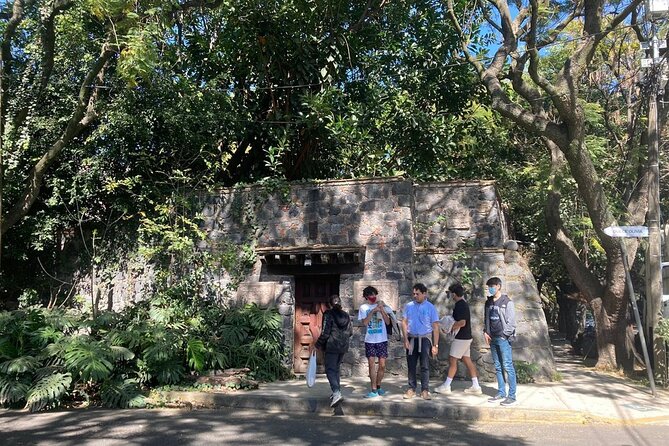
The route also passes the Leon Trotsky House Museum. The house preserves the final residence of the Russian revolutionary, who came to Mexico in the late 1930s and was assassinated there in 1940.
Again, the tour visits from the outside. Admission is not included, and the schedule does not provide an interior museum visit. Your guide explains Trotsky’s exile, his connection to Mexico, and his relationship with Frida and Diego.
This is one of the more useful historical links on the route. It shows that Frida and Diego’s circle was not limited to painters and gallery owners. Their world also included political refugees, international activists, and people caught in the upheavals of the twentieth century.
If political history interests you, you might want to return to the museum independently. On the tour, the stop works as a concise piece of context rather than a full museum experience.
The Diego Rivera and Frida Kahlo Studio House
The final major stop is the Museo Estudio Diego Rivera y Frida Kahlo, designed by architect Juan O’Gorman. Its twin houses are linked by a bridge, reflecting the separate working lives of two artists who were also a famous couple.
This is the one Frida and Diego site where the tour may take you inside, but admission is not included. The visit lasts about 30 minutes, so check the entry cost and timing when planning your budget.
The building itself is the main attraction. Its modernist design feels very different from Casa Azul’s domestic, colorful image. Diego’s studio retains the sense of a working space, with large canvases and murals. The two-house arrangement also makes a clear architectural point: Frida and Diego shared a life, but not one identical artistic personality.
Some people will find this studio fascinating, especially if architecture or the practical side of painting interests you. Others may find it less emotionally powerful than Casa Azul, which contains more personal objects and domestic associations.
That difference matters. If you want relics and intimate details from Frida’s life, the studio may not deliver the same experience. If you want to understand how the couple worked and how modern Mexican architecture framed their lives, it is a strong finish.
What $95 gets you
At $95 per person, this is not a cheap neighborhood stroll. The value rests in the private format, the guide’s interpretation, the included coffee or tea and snacks, and the amount of local ground covered in four hours.
You are paying for a person who can connect a park, a colonial square, a market, a church, a revolutionary’s home, and an architect’s studio into one story. That is more useful than simply finding each place on a map, especially if you want Frida and Diego placed in the wider culture of Mexico City.
The price does not include the Blue House or Trotsky House Museum. It also does not include entry to the Studio House. Add those costs if you plan to go inside the places that allow it.
For the best value, use this experience as a guided neighborhood walk rather than a museum package. It suits you if you want personal stories, local atmosphere, and historical connections. It is a weaker deal if you mainly want guaranteed interior access to Casa Azul.
The tour is recommended by 94 percent of customers and carries a 4.9 rating from 16 reviews. The strongest praise centers on Adriana’s warmth, broad knowledge, and ability to answer questions thoughtfully. One particularly personal touch involved taking extra time to show architecture-related sites by car, but you should treat that as an individual courtesy, not a guaranteed part of the standard route.
Walking conditions and how to prepare
Coyoacán is old, and the cobblestone streets and uneven sidewalks can be tiring. Wear shoes you would happily use for four hours of walking, not the pair that looks best in photographs.
The tour is offered in English and uses a mobile ticket. It begins at 9:00 a.m., ends at the starting point, and operates as a private activity for your group. The meeting point is near public transportation, and most people can participate. Service animals are allowed.
A morning start is helpful. You reach the market and public squares before the day has fully worn you down, and you have more control over the pace. Still, keep the schedule in mind. A four-hour route with several photo stops can become tight, so tell your guide if you prefer fewer pictures and more time at Casa Azul, the market, or the studio.
Free cancellation is available up to 24 hours before the start time. Changes or cancellations within 24 hours are not refunded, so check your plans before that deadline.
Who should book this Coyoacán and San Ángel walk?
I would book this tour if you want a personal introduction to Coyoacán, enjoy walking, and like your art history mixed with food, architecture, religion, and ordinary neighborhood life. It is especially useful for a first visit to Mexico City, when the streets can feel like a puzzle of unrelated sights.
It also suits returning visitors who already know they want more than a standard museum visit. Adriana’s local connection can add texture, and the private format gives you room to ask about architecture, politics, art, or daily life.
I would hesitate if your main goal is to spend time inside Casa Azul. The tour cannot replace that visit. I would also think twice if uneven streets are difficult for you or if your group moves slowly and dislikes a schedule with many stops.
Should you book it?
Book it for the neighborhood story around Frida and Diego, not as a substitute for Casa Azul. You will see Coyoacán at street level, sample its food culture, walk through old public spaces, and learn how artists, exiles, and local residents shared this corner of Mexico City.
The strongest version of the day is to arrange Casa Azul separately, then use this tour for the streets, market, churches, Trotsky connection, and Rivera studio. If that plan fits your interests, $95 can be fair value. If you want one museum-heavy Frida experience with interior access included, choose another arrangement.
FAQ
How long does the tour last?
The experience lasts approximately four hours and starts at 9:00 a.m. It ends back at the Viveros de Coyoacán meeting point.
Where does the tour begin?
Meet at Puerta 5 of Viveros de Coyoacán, G. Pérez Valenzuela 58BIS, Santa Catarina, Coyoacán, Mexico City.
Are tickets to Casa Azul included?
No. The tour discusses and passes by the Museo Frida Kahlo, but its entrance fee is not included.
Can I enter the Leon Trotsky House Museum?
The tour is designed to visit the Leon Trotsky House Museum from outside. Its entrance fee is not included.
Is the Diego Rivera and Frida Kahlo Studio House included?
Admission to the Studio House is not included. The tour allows about 30 minutes for this stop.
What should I wear for the walk?
Wear very comfortable walking shoes. Coyoacán has uneven sidewalks and cobblestone streets, which can make the route tiring in unsuitable footwear.
More Frida Kahlo & Coyoacan Tours in Mexico City


More tours in Mexico City we've reviewed



Frida Kahlo & Coyoacan Tours, compared.
 ★ 4.5Xochimilco, Coyoacan and Frida Kahlo with Optional LunchFrom $349 hours (approx.)
 ★ 4.4CDMX: Xochimilco, Coyoacan, Frida Kahlo Museum & Murals TourFrom $89
 ★ 5.0Frida Kahlo VIP [Museum Tickets Included] Bike, Markets & ChurrosFrom $834 hours (approx.)
 ★ 5.0Frida Kahlo VIP [Museum Tickets Included] Walk, Markets & ChurrosFrom $833 to 4 hours (approx.)
 ★ 5.0EXCLUSIVE TOUR Frida Kahlo Museum – SMALL GROUPSFrom $862 hours (approx.)
 ★ 4.5Mexico City: Frida Kahlo Museum Entry Ticket w/Digital GuideFrom $34
 ★ 5.0Private City Tour in Frida Kahlo, Coyoacan, and XochimilcoFrom $1954 to 6 hours (approx.)
 ★ 5.0PREMIUM Frida Kahlo Museum and Xochimilco (Small Groups)From $806 to 7 hours (approx.)
The lists this tour appears in