
Reviewed · MEXICO CITY
Culinary Secrets of the Centro Histórico
Mexico City’s Centro Histórico reveals itself best one bite at a time. This tour links tacos, sweets, fresh juice, coffee, market food, and mezcal with landmarks such as the House of Tiles, Palacio de Minería, and one of the city’s oldest synagogues.
In This Article
- Key points to know before you book
- Why this food tour works better than a standard sightseeing walk
- Starting at Café La Blanca and Plaza de Santo Domingo
- Visiting the Justo Sierra Synagogue
- Palacio de Minería and the old city’s grand buildings
- The House of Tiles and a memorable food stop
- Camino Real de Tierra Adentro and the story of travel
- What you are likely to eat during the day
- Guide quality and the value of a small group
- Is $140 a fair price?
- Walking, meeting point, and practical planning
- Who should book Culinary Secrets of the Centro Histórico?
- Should you book it?
- FAQ
- How long does Culinary Secrets of the Centro Histórico last?
- How much does the tour cost?
- What language is the tour offered in?
- How many people can join the tour?
- Where does the tour begin?
- Where does the tour end?
- What food and drinks are included?
- Is the tour suitable for vegans?
- What is the cancellation policy?
I like the maximum seven-person group, which gives you room to ask questions and follow your guide into places you might miss alone. I also like the range of stops, from street vendors and traditional cafés to more polished restaurants and a museum setting.
The main consideration is stamina. The walk can last close to six hours and cover roughly 7 kilometers, so this is not a quick snack crawl. You should also note that it is not suitable for a vegan diet, and the $140 price makes the tour a serious splurge.
Key points to know before you book
- A food tour with real variety: Expect breakfast, tacos, sweets, juices, lunch, coffee or tea, alcoholic drinks, and a mezcal tasting.
- Small groups matter here: The tour accepts no more than seven people, making it easier to move through narrow streets and chat with the guide.
- History comes with every stop: Plaza de Santo Domingo, a historic synagogue, colonial buildings, murals, and the Camino Real de Tierra Adentro all add context.
- Guides shape the day: Ana, Liz, Victor, Raul, and Ignacio, also called Nacho, are among the guides associated with the experience.
- Plan for a long walk: The official duration is about five hours, but some outings have taken nearly six hours and covered about 7 kilometers.
- The meeting point is central: Start at Café La Blanca on Avenida 5 de Mayo and finish at Plaza Manuel Tolsá.
Why this food tour works better than a standard sightseeing walk
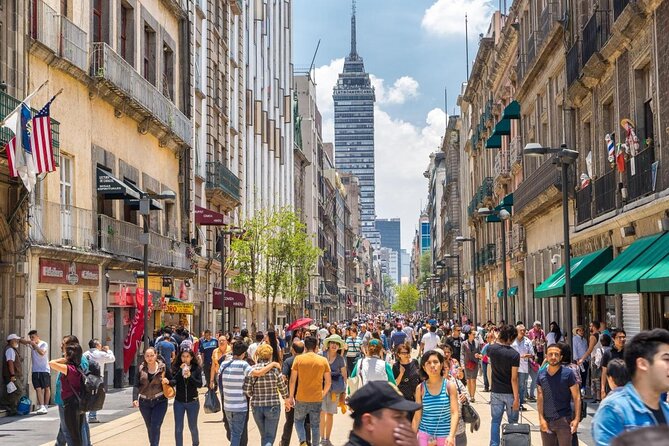
Many Mexico City tours ask you to choose between food and architecture. This one makes the two subjects work together. You may be eating an enchilada, sipping fresh juice, or trying mezcal when your guide turns your attention to a nearby building, mural, market custom, or chapter in the city’s past.
That connection is the tour’s main strength. Food is not treated as a quick reward between monuments. Ingredients, preparation, migration, trade, religion, and politics all become part of the conversation. The stories help explain why a modest food stall can matter just as much to the city as a grand colonial façade.
The small group also changes the feel of the outing. With no more than seven people, you can hear the guide in crowded streets and ask about dishes as they arrive. A guide such as Liz can adjust the conversation for people who already know Mexican food, while Ana, Victor, Raul, and Ignacio have each been praised for combining local food knowledge with stories about Mexico City.
The tour is offered in English. It includes food and drinks, rather than simply pointing you toward places and leaving you to order on your own. That matters in the Centro Histórico, where menus and ordering customs can sometimes slow down a first visit.
If you're still narrowing it down, here are other tours in Mexico City we've reviewed.

Starting at Café La Blanca and Plaza de Santo Domingo
The day begins at Café La Blanca, at Avenida 5 de Mayo No. 40. From there, you head toward Plaza de Santo Domingo, the first major setting for the walk.
The plaza gives you a useful introduction to the Centro Histórico. It is a place where the city’s older architecture, public life, and food culture meet, and it puts you in the right frame of mind for a tour built around connections rather than isolated attractions.
This is also where the eating begins. Breakfast and coffee are part of the included food, and the pacing is designed to spread the meal across the day. You are not expected to sit down for one giant lunch at the start. Instead, you get a series of smaller servings and tastings.
That approach is helpful because it lets you try more kinds of food without feeling overwhelmed too early. Still, bring an appetite. One of the clearest practical lessons from this tour is that you will eat a great deal, and you may not want dinner afterward.
Visiting the Justo Sierra Synagogue
The Justo Sierra Synagogue is one of the most distinctive stops. It is described as one of the oldest synagogues in Mexico City, and its presence adds a cultural layer that most food walks would skip.
This visit gives the day a wider frame. Mexico City’s food traditions did not develop in isolation, and the Centro Histórico has long been shaped by different communities, trades, and religious traditions. Your guide can connect the synagogue to the surrounding streets and explain why this area contains so many overlapping stories.
For many people, this is the moment that separates the tour from a basic eating itinerary. You are not just moving from one plate to another. You are seeing how food, migration, faith, and city life have shared the same blocks.
The synagogue is also a useful pause in the eating schedule. The stops are spread out, so you have time to walk, look around, and let the previous tasting settle before the next one.
Palacio de Minería and the old city’s grand buildings
Palacio de Minería brings colonial-era architecture into the middle of the food route. The building gives you a chance to look up from your plate and see the scale and form of the historic center.
The tour does not treat these landmarks as background scenery. Your guide uses them to explain the changing role of the area and the links between commerce, travel, public institutions, and food. While you continue tasting tacos, sweets, and fresh-squeezed juice, the buildings help place those foods within the city’s long urban story.
This is one reason the tour can feel full without becoming a formal museum visit. You get short, focused stops rather than a long lecture in one location. If you enjoy learning while walking, this format should suit you. If you prefer to spend a full hour inside each landmark, you may find the schedule too quick.
The supplied timing gives each main stop about an hour, though the experience is better understood as a moving route with food breaks. The exact order and length of tastings can vary, so you should come ready for a day that flows rather than follows a rigid museum timetable.
The House of Tiles and a memorable food stop
The House of Tiles, or Casa de los Azulejos, is one of the Centro Histórico’s most recognizable buildings. Its tiled exterior makes it an easy visual highlight, but the tour uses it for more than a photograph.
A food tasting here helps show how famous sights and everyday eating exist side by side in the historic core. You may stop for another bite while your guide explains the building and the surrounding streets.
The 45-minute timing listed for this section is enough to appreciate the setting without turning the day into a long architectural survey. That balance is useful. You get the landmark, a story, and food, then continue before the sightseeing becomes repetitive.
If you are mainly looking for a restaurant meal with long periods at a table, this is not that kind of outing. The pleasure comes from moving through the center and tasting in several settings.



Camino Real de Tierra Adentro and the story of travel
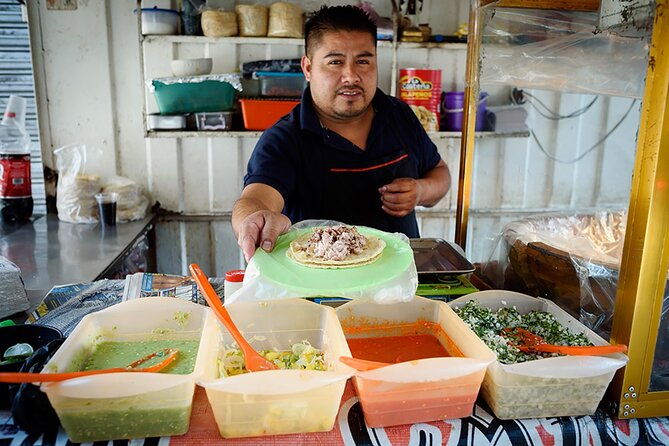
The Camino Real de Tierra Adentro adds a larger regional story to the route. During the colonial period, this corridor served as a staging ground for journeys reaching as far as what is now New Mexico.
That detail gives the food stops a useful sense of place. Mexico City was not simply a local capital with a few neighborhood cafés. It was tied to long routes of movement, trade, administration, and settlement. A short stop here can help you understand why the Centro Histórico became such an important meeting point.
The listed time is about 30 minutes, so expect a concise explanation rather than an extended site visit. I like this kind of stop because it adds historical meaning without taking you away from the main purpose of the day: eating your way through the city.
You may also encounter murals, art, and city artifacts along the route. Guides such as Liz and Nacho have been praised for explaining how these works connect to revolution, food, and public memory. Those details are easy to miss if you walk through the district without someone pointing them out.
What you are likely to eat during the day
The menu is not presented as a fixed list, and that is sensible for a food walk built around local places. The included offerings cover breakfast or brunch, lunch, snacks, coffee or tea, and alcoholic drinks.
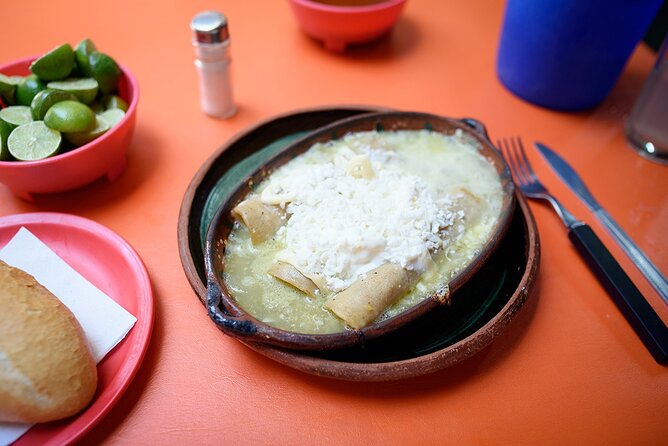
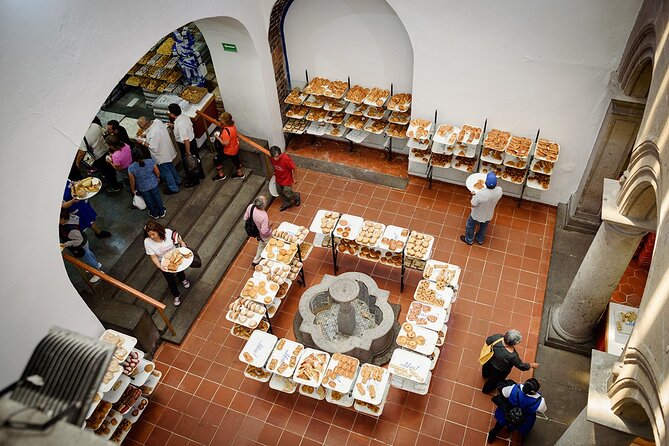
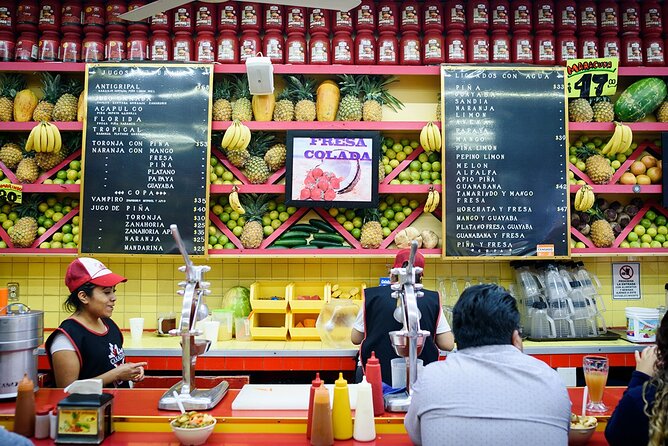
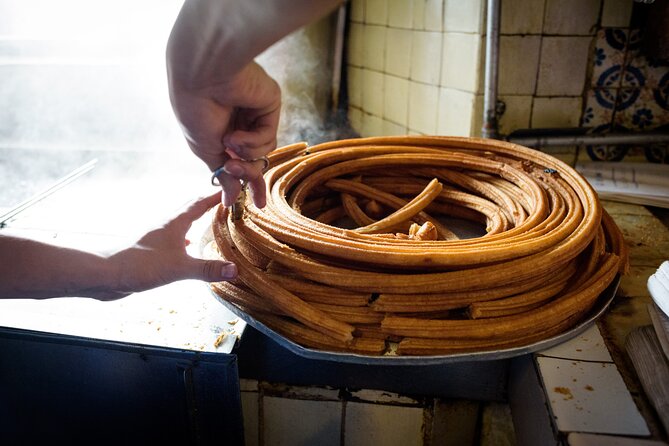
Past descriptions of the experience include tacos, enchiladas, sweets, fresh juice, market food, street food, and a final mezcal tasting. The stops may range from a traditional café to a market stall, a restaurant, and a more unexpected food setting.
The variety is more important than any single dish. You get to compare different forms of Mexican cooking and see how the Centro Histórico feeds itself at different price levels. A street vendor, a long-established restaurant, and a museum-based food stop each offer a different view of the city.
The pacing also deserves credit. The food arrives in stages, with walking between tastings. That makes it possible to sample a lot without feeling uncomfortably full too soon. Even so, do not eat a large breakfast before meeting the group.
Alcoholic beverages are included, and the day may finish with mezcal. If you do not drink, confirm how you would like to handle that with the guide at the start. The tour is not vegan-friendly, so people following a vegan diet should choose another experience.
Guide quality and the value of a small group
The guide is central to the experience. Ana has been associated with strong food and cultural interpretation, while Liz is known for connecting local places with Mexico’s history, murals, and food traditions. Victor has been praised for keeping the food stops well paced, and Raul for an upbeat approach that can include art, history, street food, and mezcal.
Ignacio, often called Nacho, brings attention to ingredients and preparation as well as the surrounding city. His route has included marketplace stops where the details of food, murals, and city artifacts become part of the same story.
These names matter because the experience is not just a self-guided list of places. The guide decides how to explain the food, when to move on, and how to help you navigate unfamiliar flavors. A strong guide can also make the difference between a snack that is merely tasty and one that you remember because you understand its place in the city.
The group limit of seven is a real advantage. Smaller numbers make it easier to enter compact eateries, keep together on busy streets, and have an actual conversation. This is especially helpful if you want to ask about ingredients, ordering habits, or the history of a neighborhood.
Is $140 a fair price?
At $140 per person, this is not a cheap way to grab lunch. You are paying for more than food. The price covers roughly five hours of guiding, multiple tastings, cultural stops, alcoholic drinks, and the convenience of being led to traditional places that are difficult to identify from a guidebook.
The value improves if you want both a meal and an introduction to the Centro Histórico. Several separate restaurant visits, a food market, a synagogue, colonial buildings, and a mezcal tasting would take time and planning to arrange alone. You also avoid spending half the day guessing what to order or walking past places without knowing their importance.
The price may feel high if your main aim is to eat inexpensive street food. In that case, a self-guided food crawl will cost less. But you would give up the small group, the historical narrative, and the carefully spaced route.
I would view this as a worthwhile splurge for a first visit to Mexico City, especially if you value context as much as flavor. It is also a good choice for people who have already eaten Mexican food elsewhere but want to understand how the Centro Histórico’s food culture fits together.
Walking, meeting point, and practical planning
The tour starts at Café La Blanca, Av. 5 de Mayo No. 40, in the Centro Histórico, and ends at Plaza Manuel Tolsá, C. de Tacuba 8. Both points are in central Mexico City, and the area is near public transportation.
The tour is listed at about five hours, but I would keep much of the day free. Some outings have lasted close to six hours and involved around 7 kilometers of walking. Wear comfortable shoes, carry water, and avoid scheduling a demanding activity immediately afterward.
Mobile tickets are accepted, and confirmation normally arrives at booking. If you book within one day of departure, confirmation comes as soon as possible and depends on availability.
Most people can participate, and service animals are allowed. The tour requires good weather and a minimum number of participants. If poor weather or low enrollment causes cancellation, you are offered another date or experience, or a full refund.
Free cancellation is available until 24 hours before the start time. Cancellations or changes inside that 24-hour window are not refunded or accepted, so keep the cutoff in mind when arranging your Mexico City schedule.
Who should book Culinary Secrets of the Centro Histórico?
I would recommend this tour if you want to eat widely, walk steadily, and learn while you go. It suits couples, friends, and families who enjoy trying many small portions instead of spending the whole day in one restaurant.
It is especially useful early in a Mexico City visit. The route can give you a better sense of the Centro Histórico, and the guide may point out places you can return to later. The small group also works well for people who prefer conversation over a large coach tour.
You should think twice if you dislike long walks, need a fully vegan menu, or want a predictable set meal. The tour moves through public streets and varied food settings, so it is more active and less controlled than a restaurant tasting.
Should you book it?
Book this tour if you want a full day of food, city stories, and unusual stops, and if $140 fits your budget. The combination of small-group access, multiple food settings, the Justo Sierra Synagogue, colonial architecture, and mezcal makes it much more than a basic taco crawl.
Skip it if you want a low-cost meal, a short walk, or vegan food. For everyone else, bring an empty stomach, comfortable shoes, and curiosity. The strongest reason to go is simple: you get to taste the Centro Histórico while learning how its people, buildings, and long routes helped shape what ends up on the plate.
FAQ
How long does Culinary Secrets of the Centro Histórico last?
The tour is listed as approximately five hours. Some outings have lasted close to six hours and covered about 7 kilometers of walking.
How much does the tour cost?
The price is $140 per person.
What language is the tour offered in?
The experience is offered in English.
How many people can join the tour?
The maximum group size is seven participants.
Where does the tour begin?
It begins at Café La Blanca, Av. 5 de Mayo No. 40, Centro Histórico de la Ciudad de México.
Where does the tour end?
The tour ends at Plaza Manuel Tolsá, C. de Tacuba 8, Centro Histórico de la Ciudad de México.
What food and drinks are included?
The experience includes snacks, coffee or tea, alcoholic beverages, lunch, brunch, and breakfast. Past food stops have included tacos, enchiladas, sweets, fresh juice, market food, street food, and mezcal.
Is the tour suitable for vegans?
No. The tour is not vegan-friendly.
What is the cancellation policy?
You can cancel up to 24 hours before the start time for a full refund. Changes or cancellations made less than 24 hours before the experience are not accepted or refunded. Poor weather or failure to meet the minimum number of participants may result in another date, another experience, or a full refund.
More tours in Mexico City we've reviewed






Mexico City, compared.
 ★ 5.0Teotihuacan, Guadalupe Shrine & Tlatelolco Day Tour with LunchFrom $399 hours (approx.)
 ★ 4.5Xochimilco, Coyoacan and Frida Kahlo with Optional LunchFrom $349 hours (approx.)
 ★ 5.0Balloon flight + Breakfast in cave + Pyramids + Pick up CDMX.From $1722 to 8 hours (approx.)
 ★ 5.0Teotihuacan pyramids morning or afternoon without tourist trapsFrom $645 hours 30 minutes (approx.)
 ★ 4.5Teotihuacan Early Access Guided Tour with optional LunchFrom $398 hours (approx.)
 ★ 5.0Balloon flight + pick up in CDMX + Breakfast in Cave + PyramidsFrom $1694 to 7 hours (approx.)
 ★ 5.0Balloon Flight + Cave Breakfast + Pick Up from CDMX or We FlyFrom $1663 to 9 hours (approx.)
 ★ 4.6Mexico City: Teotihuacan, Tlatelolco & Guadalupe Shrine TourFrom $49