
Reviewed · 2-HOUR EXPERIENCES
2 Hours of Mexican Muralism with an Art Lover
Mexico City’s mural story comes alive on this compact walk from Palacio de Bellas Artes to the Museo Vivo del Muralismo. You’ll see works by Rivera, Orozco, Siqueiros, Tamayo, and others while connecting art to Mexico’s political and cultural past.
In This Article
- Key points to know before booking
- Why Mexican muralism is worth two and a half hours
- Starting at Palacio de Bellas Artes
- Walking through palaces, churches, and Mexico City’s central plaza
- Antiguo Colegio de San Ildefonso and Orozco’s early work
- Museo Vivo del Muralismo and Diego Rivera’s collection
- The guide makes the difference
- Is $53.74 a fair price?
- Who will enjoy this tour most?
- Practical details before you go
- Should you book 2 Hours of Mexican Muralism with an Art Lover?
- FAQ
- How long does the tour last?
- Where does the tour begin?
- Where does the tour end?
- Is the tour offered in English?
- Is admission to the museums included?
- How many people can join the tour?
- Is the tour close to public transportation?
- Can most people participate?
- What is the cancellation policy?
I like the route’s clear focus and its mix of major museums, historic streets, churches, government buildings, and archaeological remains. I also like the small group limit of 15, which gives José, the guide praised for his wide knowledge and strong passion, room to answer questions. The main catch is that admission to Bellas Artes and San Ildefonso is extra, and two and a half hours can feel brisk.
Key points to know before booking
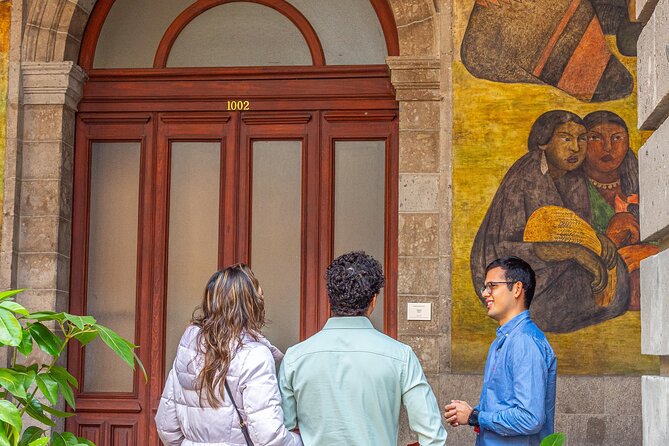
- A focused look at Mexican muralism: Follow the movement from its early 20th-century beginnings to the major works of Diego Rivera and his peers.
- Three museum stops: Visit Palacio de Bellas Artes, Antiguo Colegio de San Ildefonso, and Museo Vivo del Muralismo.
- José may lead your walk: He is praised for connecting art history with Mexican history, anthropology, and politics.
- A route through central Mexico City: The walk includes the grand avenue between museums, the central plaza, churches, palaces, and archaeological windows.
- Budget for extra admissions: Bellas Artes and San Ildefonso are not included, with the listed combined museum charge at MX$150 per person.
- Small-group format: The maximum group size is 15, and the tour is offered in English with a bilingual guide.
Why Mexican muralism is worth two and a half hours
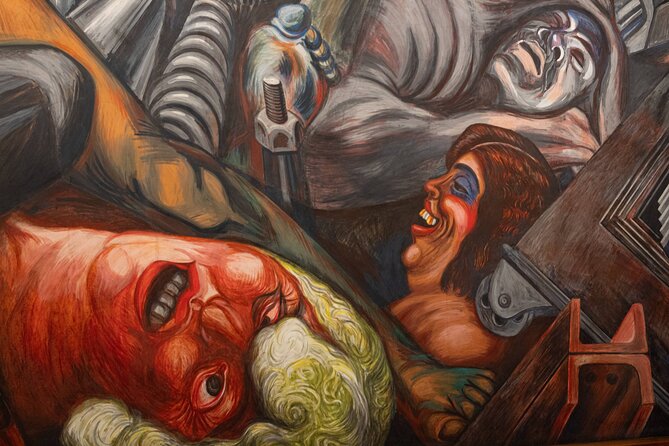
Mexican muralism is not simply a matter of large paintings on large walls. It was a public art movement tied to the rebuilding of Mexico after the Revolution, when artists used walls to tell stories about workers, Indigenous cultures, political power, education, and national identity.
That context matters because the murals can look grand and decorative at first glance. A good guide helps you read who is shown, who is missing, what symbols appear, and why a government building or school became the setting for a particular scene.
This experience gives you a useful chronological path. At Bellas Artes, you begin with several of the movement’s best-known artists. At San Ildefonso, you look closer at José Clemente Orozco and the early development of mural painting. At the final museum, you see a large collection of Diego Rivera’s murals in one place.
I like that the tour does not keep you inside museums for the whole afternoon. The walk between stops adds Mexico City itself to the experience. Palaces, church facades, central squares, and remains of ancient Mexico-Tenochtitlan help explain the setting in which this art was made and displayed.
A few more Mexico City tours and experiences worth a look



Starting at Palacio de Bellas Artes
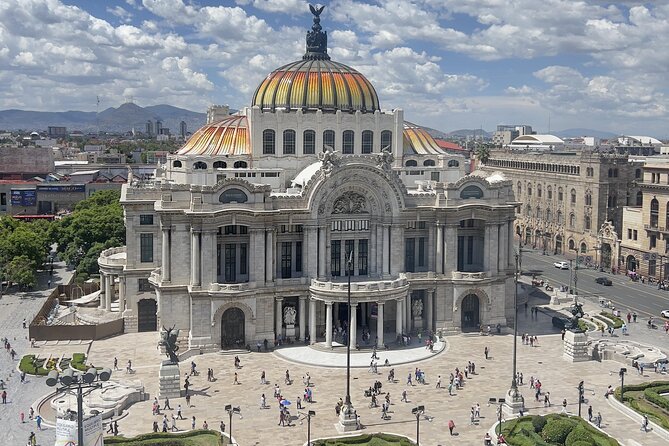
The tour begins at the Museo del Palacio de Bellas Artes on Avenida Juárez, at the corner of Eje Central Lázaro Cárdenas. This is a practical meeting point in Centro Histórico, near public transportation and easy to identify once you are in the area.
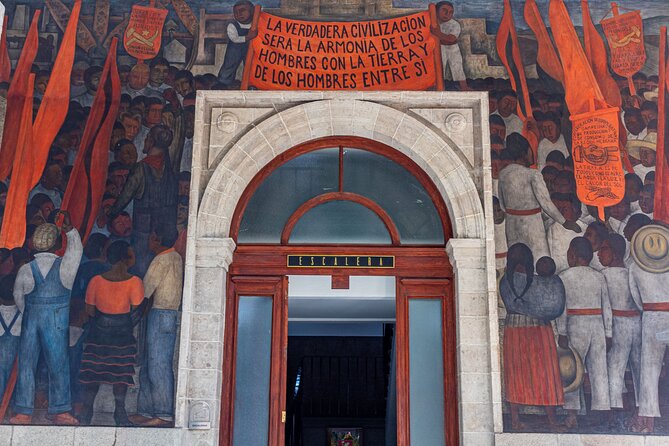
You spend about an hour here discussing Mexican muralism and viewing works by Diego Rivera, David Alfaro Siqueiros, José Clemente Orozco, Roberto Montenegro, Jorge González Camarena, and Rufino Tamayo. The range of artists gives you a strong first look at the movement, including the differences in style and subject between major figures.
Bellas Artes is especially useful as an opening stop because it presents muralism in one of Mexico City’s leading art institutions. You can begin to compare Rivera’s approach with Orozco’s and Siqueiros’s. The guide’s explanations are important here, since the meaning of a mural often depends on political events and artistic debates that are not obvious from a quick look.
Admission is not included, so you need to pay the museum’s entrance fee separately. The tour information lists the fine arts and San Ildefonso admissions together at MX$150 per person. Since the itinerary gives you about an hour inside Bellas Artes, check the day’s museum access details before you arrive if you want to plan your time carefully.
One consideration: this is not a slow museum visit built around every gallery. The focus is muralism, so you should expect the guide to direct attention toward the relevant works rather than cover the entire museum.
Walking through palaces, churches, and Mexico City’s central plaza
Between the museum stops, the route takes you along an impressive central avenue lined with palaces and church facades. This part is more than a transfer from one building to another. It gives you time to see how Spanish colonial architecture, later civic buildings, and modern Mexican cultural institutions sit side by side.
The walk also reaches Mexico City’s central plaza, where you see the government palace, the cathedral, and archaeological windows showing remains of ancient Mexico-Tenochtitlan. These views add useful layers to the mural discussion.
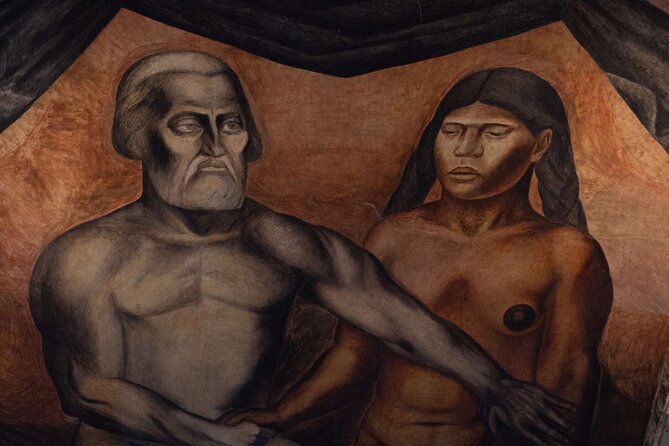
Mexican muralists often looked backward as well as forward. Indigenous cultures, the Spanish conquest, labor, religion, government, and the modern state all appear in the movement’s subject matter. Seeing the cathedral and government buildings in the same route helps you understand why public walls became such an important place for national storytelling.
The supplied information does not give a precise walking distance or specify how long this outdoor portion lasts. You should wear comfortable shoes and allow for normal city walking between the timed museum visits. The activity is near public transportation, but the tour itself is built around walking from one central stop to the next.
Antiguo Colegio de San Ildefonso and Orozco’s early work
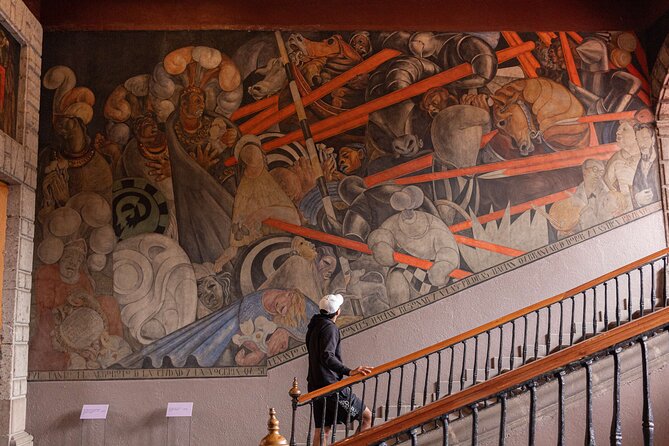
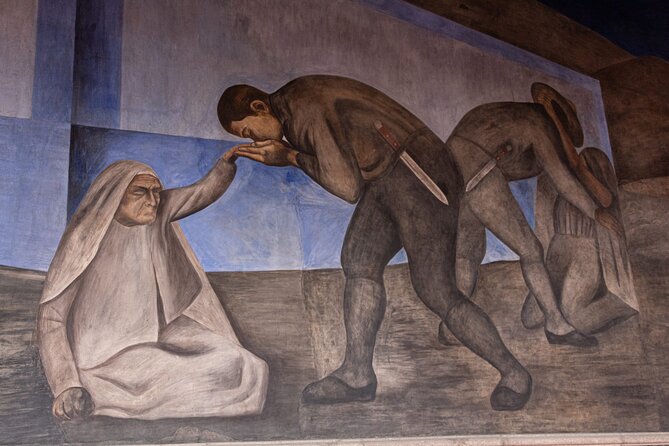
The second named museum stop is the Antiguo Colegio de San Ildefonso, where you spend about 45 minutes. The former school is presented as a key place for understanding the early work of José Clemente Orozco and the birth of the 20th-century mural movement.
This stop changes the pace of the tour. Bellas Artes introduces several major artists and the larger story. San Ildefonso lets you concentrate on a formative period and on Orozco’s work in particular.
Orozco is an important counterpoint to Rivera. His murals are often associated with a darker, more critical view of power and human conflict. The tour description does not promise a full survey of every work in the building, so your guide’s selection and commentary will shape the visit.
San Ildefonso is also one of the places where the connection between art and education becomes clear. The setting helps explain how murals could reach people outside a private gallery. Art was placed in public institutions where students, officials, workers, and local residents could encounter it as part of daily life.
Admission is not included here either. The listed charge for fine arts and San Ildefonso is MX$150 per person, so factor that into the $53.74 tour price. That makes the total cost higher than the headline figure, but you are paying for a focused guide-led visit across three institutions rather than only museum entry.
Museo Vivo del Muralismo and Diego Rivera’s collection
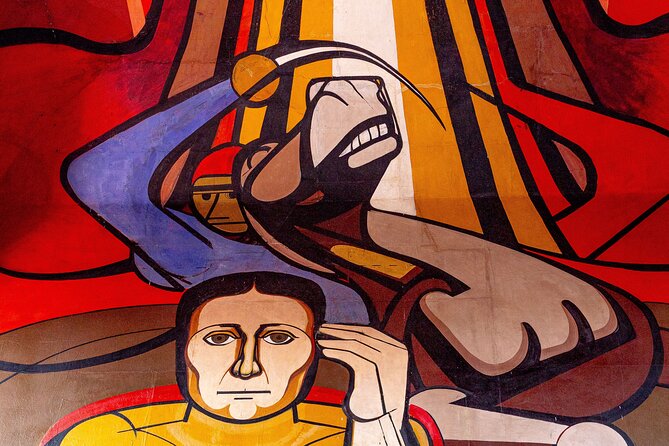
The final stop is the Museo Vivo del Muralismo on República de Argentina. The tour ends at the museum entrance, which is useful if you want to continue exploring this part of Centro Histórico afterward.
You spend about 45 minutes in a three-floor complex with 248 Diego Rivera murals, along with temporary rooms devoted to easel art, mural painting, ceramics, and pre-Hispanic drawings. The museum’s scale gives the tour a strong finish, especially after the earlier introduction to Rivera at Bellas Artes.
The word living in the museum’s name points to an approach that goes beyond preserving murals behind glass. The collection presents muralism alongside other forms of Mexican art, allowing you to consider how wall painting relates to ceramics, drawings, and works made for easels.
The museum admission is free, according to the tour details. That helps balance the paid entry at the first two museums. It also means the final stop can be a useful place to spend extra time after the guided portion ends, though the tour itself includes about 45 minutes.
Because the museum contains three floors and many works, you should not expect to see every mural in detail during the scheduled visit. If Rivera is your main reason for booking, ask the guide which works deserve your closest attention and consider returning on your own if time allows.



The guide makes the difference
The tour includes a bilingual guide and is offered in English. José is the guide most directly praised in the supplied feedback, with particular emphasis on his passion and ability to discuss more than art history.
That wider range is valuable in Mexico City. Muralism touches politics, anthropology, national identity, religion, and the history of Mexico’s public institutions. A guide who can move between those subjects gives you more than names and dates.
José is also praised for welcoming questions and discussing topics that come up along the way. That suggests this tour will work best if you enjoy conversation rather than a silent museum circuit. If you have a particular interest in Rivera, Orozco, the Revolution, Indigenous cultures, or Mexican politics, bring your questions.
The guide’s role is especially important because the tour covers three museums in a short period. Without context, you could spend the day looking at striking images without seeing the links between them. With a strong guide, the route becomes a connected lesson in how Mexico used public art to explain itself.
The experience has a maximum of 15 people. That is not a private tour, but it is small enough to make questions more realistic than on a large coach excursion. Since the guide’s style appears to be one of the experience’s strongest features, the group limit is a meaningful part of the value.
Is $53.74 a fair price?
At $53.74 per person, this is not the cheapest way to see a few murals. You also need to pay the listed MX$150 per person for admission to fine arts and San Ildefonso. The Museo Vivo del Muralismo is free.
The value comes from the structure. You get about two hours and 30 minutes, a bilingual art guide, three museum visits, and a carefully chosen walking route through central Mexico City. If you tried to connect these places without background knowledge, you would need to research the artists, work out the route, and decide which murals matter most.
I think the price is reasonable for someone who wants interpretation rather than simple entry. It is less compelling for a repeat visitor who already knows Rivera and Orozco well, speaks Spanish comfortably, or prefers to set their own museum pace.
The small group cap helps. You are not paying only for transport or a general city walk. You are paying for a person who can explain the art and respond to questions while keeping the group moving.
The average booking window is 14 days in advance. That does not guarantee that every date sells out, but it is a useful sign that you should reserve ahead if your Mexico City schedule is fixed.
Who will enjoy this tour most?
I would recommend it to a first-time Mexico City visitor who wants a strong introduction to Mexican muralism without spending a full day in museums. It also suits anyone who likes history and public art but wants help understanding what they are seeing.
Art students, teachers, photographers, and museum fans should find plenty to discuss. The route brings together Rivera, Orozco, Siqueiros, Camarena, Tamayo, and other artists, while the outdoor walk adds architecture and archaeological remains.
The experience may be less suitable if you need a slow, highly detailed museum visit. Each stop is timed, and the two and a half hour total requires the group to keep moving. It may also disappoint if you expect admission fees to be covered, since the first two museum entries are separate.
Most people can participate, according to the activity details. The tour is near public transportation, uses a mobile ticket, and finishes at the entrance to Museo Vivo del Muralismo rather than returning to the starting point.
You should also remember that the tour is offered in English but includes a bilingual guide. If you prefer a Spanish-only art lecture or a private guide, this may not match your needs.
Practical details before you go
The meeting point is Museo del Palacio de Bellas Artes, Av. Juárez, at Eje Central Lázaro Cárdenas in Centro, Cuauhtémoc. The end point is Museo Vivo del Muralismo at República de Argentina 28 in Centro Histórico.
Plan to arrive at the starting museum with enough time to locate the meeting point. The tour does not include transportation between the museums, and the central route is designed as a walk.
Wear shoes suitable for city streets and museum floors. Since the route includes outdoor sections and several indoor stops, a light layer is sensible, though the supplied details do not specify weather arrangements.
You receive confirmation at booking, and the activity accepts a mobile ticket. Free cancellation is available if you cancel at least 24 hours before the start time. Changes or cancellations within 24 hours are not accepted for a refund.
Should you book 2 Hours of Mexican Muralism with an Art Lover?
Book this experience if you want a guided introduction to Mexican muralism, value a strong art historian, and like linking museum works with the streets and buildings around them. José’s ability to discuss art, history, anthropology, and politics is a major reason to choose this format.
The tour is a good use of a half-day in Centro Histórico, especially early in your Mexico City visit. You will leave with a clearer sense of Rivera, Orozco, Siqueiros, and the public purpose of mural painting.
Skip it if you want to browse at your own speed, avoid extra museum fees, or already have a detailed plan for these institutions. For most first-time visitors with an interest in Mexican art, the focused route, free final museum, and small group make the $53.74 price worthwhile, provided you add the MX$150 admission charge to your budget.
FAQ
How long does the tour last?
The experience lasts approximately two hours and 30 minutes.
Where does the tour begin?
It begins at Museo del Palacio de Bellas Artes on Av. Juárez at Eje Central Lázaro Cárdenas in Centro, Cuauhtémoc, Mexico City.
Where does the tour end?
The tour ends at the entrance of Museo Vivo del Muralismo at República de Argentina 28 in Centro Histórico.
Is the tour offered in English?
Yes. The experience is offered in English and includes a bilingual guide.
Is admission to the museums included?
No. Admission to Bellas Artes and Antiguo Colegio de San Ildefonso is not included. The listed charge is MX$150 per person for fine arts and San Ildefonso. Admission to Museo Vivo del Muralismo is free.
How many people can join the tour?
The maximum group size is 15 travelers.
Is the tour close to public transportation?
Yes. The activity details state that it is near public transportation.
Can most people participate?
Yes. The activity information says most travelers can participate.
What is the cancellation policy?
You can cancel at least 24 hours before the start time for a full refund. Cancellations or changes made less than 24 hours before the start time are not accepted and are not refunded.
More 2-Hour Experiences in Mexico City
More tours in Mexico City we've reviewed


2-Hour Experiences, compared.
 ★ 5.02 Hours and 30 Minutes Salsa Night in México CityFrom $422 hours 30 minutes (approx.)
 ★ 5.02 hours Lucha Libre Show (mexican wrestling) with transportFrom $1283 hours (approx.)
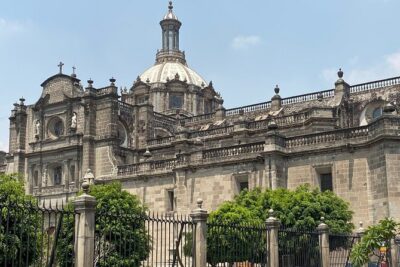 ★ 5.0Express Historic Center the must in two hoursFrom $262 hours (approx.)
 ★ 5.0CDMX Historic Center Walking Tour (2 hours)From $302 hours (approx.)
The lists this tour appears in