
Reviewed · CHAPULTEPEC & MUSEUM TOURS
National Museum of Anthropology Early access with VIP Archaeologist
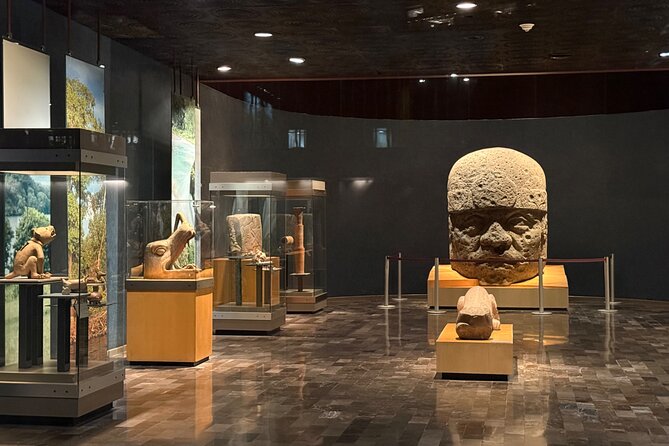
The great strength of this tour is simple: you get help making sense of one of Mexico City’s enormous cultural institutions. The National Museum of Anthropology holds famous objects such as the 24-ton Stone of the Sun, Coatlicue, Olmec colossal heads, and the Tula Atlantean, but a guide gives those pieces a human and historical frame.
In This Article
- Key points to know before booking
- Why this museum deserves a guided visit
- Meeting near Reforma at 8:40 am
- Early entry: useful idea, unclear delivery
- The Umbrella and the museum’s central courtyard
- The Stone of the Sun and Aztec power
- Coatlicue and the difficult side of Aztec belief
- Olmec heads, Tula warriors, and the Maya focus
- What 2.5 hours can realistically cover
- Is $25 a good value?
- Who should choose this museum tour?
- Booking, cancellation, and practical details
- Should you book it?
- FAQ
- Where does the tour begin?
- What time does the tour start?
- How long does the experience last?
- Is museum admission included?
- Is the tour offered in English?
- How large is the group?
- Can I cancel for a full refund?
I like the compact 11-person maximum, which should make it easier to hear and ask questions. I also like the focus on essentials. Raúl Hernández is especially praised for his passion for Maya culture, while Ivan is noted for giving useful historical background.
The main caution is timing. The tour is sold with early-access language, but one account describes a late start and no clear early entry. If your morning schedule is tight, confirm exactly what early access means before booking.
Key points to know before booking
- Meet at 8:40 am near Reforma: The stated meeting point is the Starbucks on Paseo de la Reforma in Chapultepec.
- Admission is included: You do not need to buy a separate museum ticket for this activity.
- The museum’s essentials fit into 2.5 hours: Expect a focused visit rather than a full look at every gallery.
- Small group, up to 11 people: This is a better setup for questions than a large coach-style outing.
- English is offered: The activity is listed in English and uses a mobile ticket.
- Early access needs clarification: The timing and entry arrangement are not perfectly clear from the available information.
Why this museum deserves a guided visit
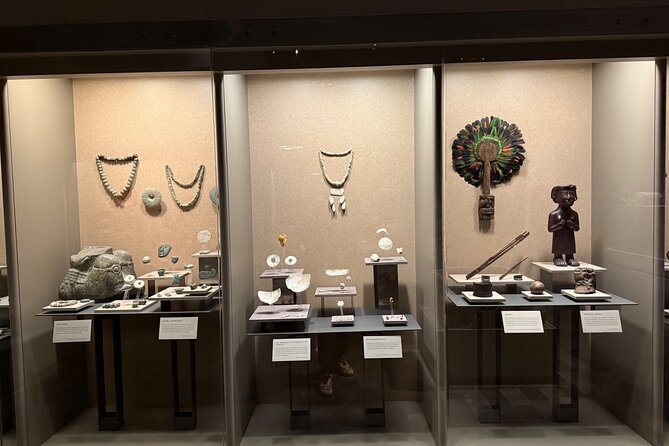
Mexico City’s National Museum of Anthropology is not a quick stop you can casually wander through in half an hour. Opened in 1964 in Chapultepec Forest, it is Mexico’s largest and most visited museum, with galleries devoted to the country’s Indigenous cultures and archaeological past.
That scale is both the attraction and the problem. You can see major works from the Aztec, Maya, Olmec, Zapotec, and Toltec worlds in one place, but without a plan, the museum can feel like a long succession of stone figures, masks, cases, and labels.
I like a guided visit here because the value is not just seeing the objects. It is learning why a particular object matters, how it connects to a culture, and what you should remember after you leave. A strong guide can turn a large museum into a clear story.
The museum itself has a memorable design. Architects Pedro Ramírez Vázquez, Jorge Campuzano, and Rafael Mijares created a building around a central courtyard and pond. Above the courtyard is the famous Umbrella, a broad roof supported by a column that sends water down in a waterfall.
That courtyard is more than a photo stop. It gives you a visual pause between galleries and helps you understand the museum’s grand civic purpose. The building was made to present Mexico’s Indigenous heritage as central to the country’s identity, not as a footnote to colonial history.
In 2025, the museum received the Princess of Asturias de la Concordia Award for its work in conserving, researching, and sharing Indigenous heritage. That recognition adds useful context, but you do not need an award to see why the place matters. Its collections are among the most important cultural holdings in Mexico.
A few more Mexico City tours and experiences worth a look
Meeting near Reforma at 8:40 am
The tour begins at the Starbucks located on Paseo de la Reforma in Chapultepec. The stated start time is 8:40 am, and the activity returns to that same meeting point at the end.
This location is practical, but you should allow time to find the exact meeting spot. One account describes difficulty locating the guide and a start roughly 40 minutes later than scheduled. The provider explained that the group waited for people delayed by Mexico City traffic, followed by the museum’s ticket and luggage procedures.
That explanation may make sense, but it does not remove the planning issue. A late start can reduce the time you have inside a museum that already deserves more than a rushed visit. If you arrive on time, make sure you can identify the guide and group before the stated departure time.
The tour is offered in English and uses a mobile ticket. It is also listed as suitable for most participants, with service animals allowed and public transportation nearby. No special fitness requirement is given in the supplied information.
Early entry: useful idea, unclear delivery
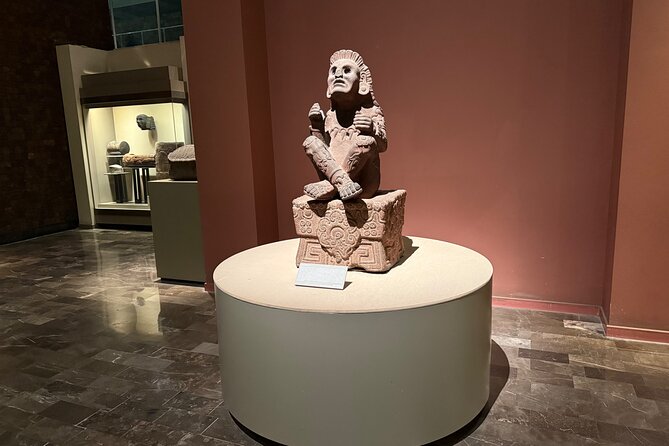
Early access sounds like the main reason to choose this activity over entering on your own. A quieter first look at a famous museum can be valuable, especially around headline objects such as the Stone of the Sun.
Still, you should treat the early-access claim carefully. One account specifically says there was no early access. The group also waited through the normal entry process, including the ticket area and luggage storage.
That does not prove every departure works the same way. Guides, museum procedures, and group timing can vary. But the mismatch is important enough that I would ask the provider a direct question before paying: Does early access mean entry before the general public, priority at the ticket area, or simply an early morning meeting?
If the answer is clear and the arrangement is operating as promised, early entry could be a real advantage. If not, the tour should be judged as a standard guided museum visit with admission included.
The Umbrella and the museum’s central courtyard
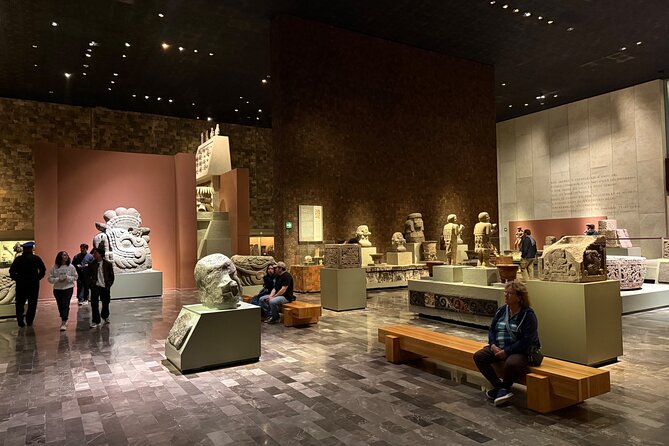
Once inside, the building’s central space gives you an immediate sense of place. The pond and the Umbrella create the museum’s signature view, with water falling from the roof into the courtyard below.
The architecture helps organize your visit. Instead of moving through a confusing maze, you can use the courtyard as a reference point between sections. Your guide may also use it to explain how the museum presents the many cultures of Mexico under one roof.
Do not rush past this area. The Umbrella is one of the museum’s most recognizable symbols, and it shows that the building itself was designed to carry meaning. The experience is not only about ancient objects in glass cases. It is also about how modern Mexico chose to display its Indigenous past.
The Stone of the Sun and Aztec power
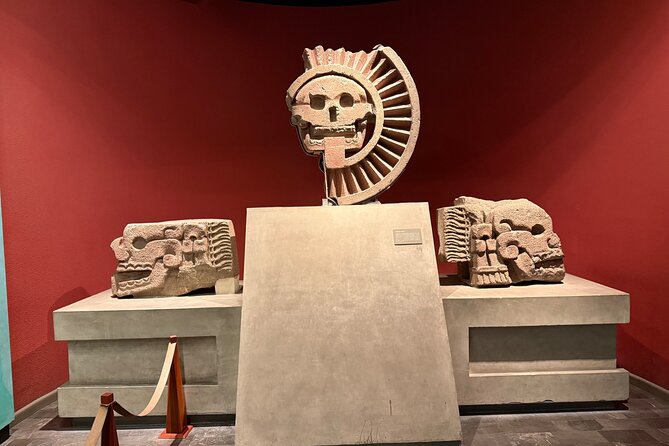
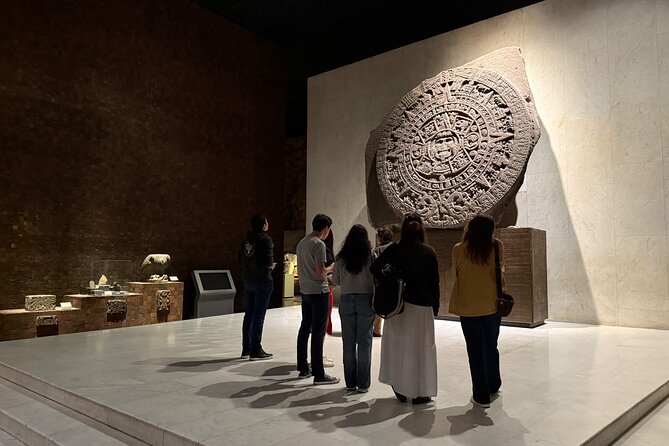
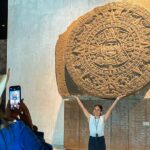
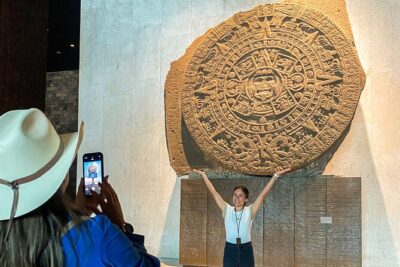
The Stone of the Sun is the object most people expect to see. Often called the Aztec Calendar, it is a 24-ton monolith and one of the museum’s defining pieces.
A guided explanation is particularly useful here because the stone is easy to reduce to a single label. The nickname suggests a simple calendar, but the object carries religious and political meaning tied to the Aztec world. With limited time, your guide can point out the details worth studying instead of leaving you to guess what you are looking at.
This is one place where group size matters. In a group of no more than 11, you have a better chance of hearing the explanation and asking a follow-up question. The museum’s famous pieces can draw attention from many directions, so stay close to the guide when the group reaches the central highlights.
A few more Mexico City tours and experiences worth a look



Coatlicue and the difficult side of Aztec belief
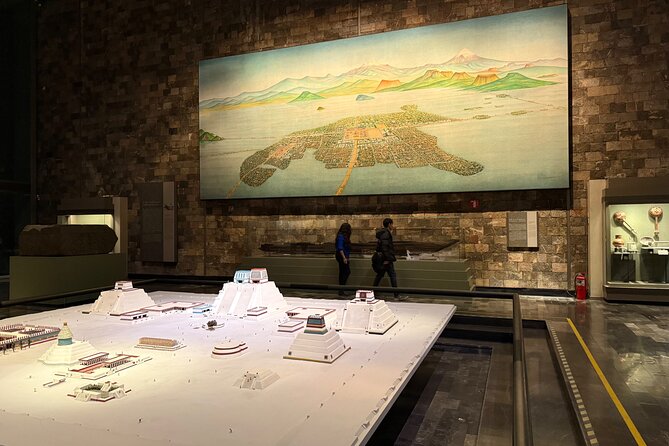
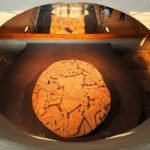
The statue of Coatlicue represents an Aztec goddess connected with life and death. It is one of the museum’s most striking and challenging works.
You may find the image unsettling. That is part of its power. Coatlicue does not present an idealized version of divinity. The sculpture brings together ideas of birth, death, sacrifice, and renewal in a form that demands more than a quick photograph.
This is the kind of object that benefits from a guide who can explain the symbols without flattening them into a simple good-versus-evil story. The tour’s scientific approach is also worth noting. The provider says its guides aim to stay close to museum information and accepted evidence rather than presenting unsupported theories.
That became relevant during one tour when discussion turned toward links between Mexican cultures and aliens. The guide reportedly explained that such claims cannot be confirmed through museum records or science. If you want an evidence-based visit respectful of the cultures on display, that approach should suit you.
Olmec heads, Tula warriors, and the Maya focus
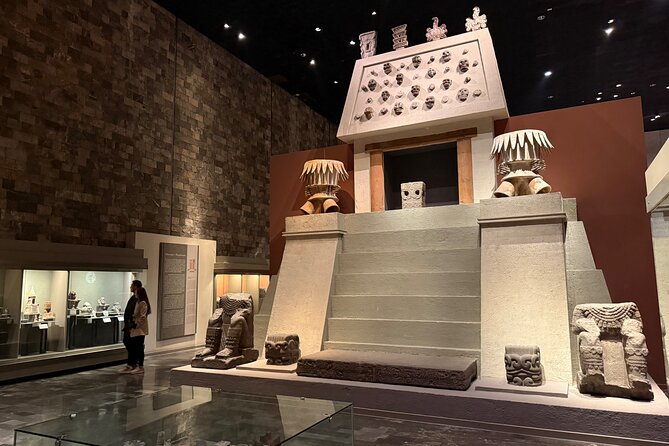
The tour also highlights the Olmec colossal heads, the Tula Atlantean, and the Zapotec Bat God Mask. These pieces help show how varied Mexico’s ancient cultures were.
The Olmec heads are memorable for their scale and carved facial features. They are not interchangeable with Aztec or Maya objects, and a guide can help you keep the cultures separate. That distinction matters in a museum where different centuries and regions can appear close together.
The Tula Atlantean adds another style to the visit. Its warrior form gives you a strong visual contrast with the Olmec heads and the Aztec monolith. The Zapotec Bat God Mask brings yet another set of symbols and beliefs into view.
Raúl Hernández has been singled out for his passion for Maya culture. That detail may matter if the Maya galleries are your main reason for booking. The available information does not promise that Raúl will lead every departure, so ask which guide is scheduled if a particular specialist is important to you.
Ivan is another named guide associated with the experience. His strength is described as giving historical background that makes the visit more meaningful. Rodolfo is identified by the provider as an archaeologist with its highest certifications, though the exact qualification details are not supplied.
What 2.5 hours can realistically cover
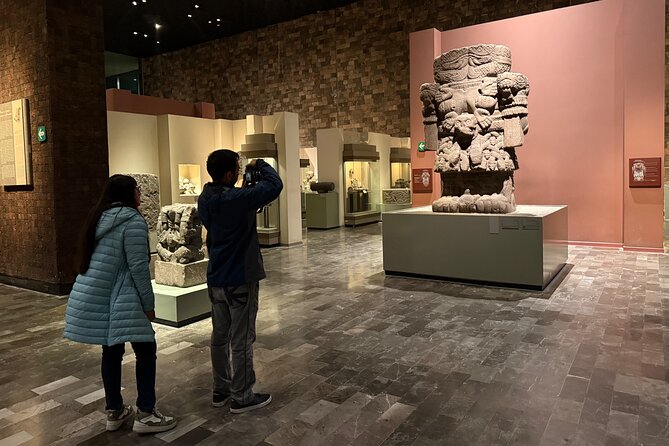
Two and a half hours is a sensible length for a guided introduction, but it is not enough to see the entire museum carefully. The National Museum of Anthropology is too large for that.
I would think of this tour as a highlights route. You will likely get an organized look at the building, several major archaeological objects, and the cultural groups that form the core of the collection. You should not expect long, quiet study in every gallery.
That limited scope is a benefit if you have only one morning in Chapultepec or if a huge museum makes you anxious. It is less suitable if you want to read every label, compare every regional collection, or spend a full day with the Maya material.
A guide also sets the pace. You trade some freedom for structure. I find that worthwhile in a museum of this size, especially on a first visit, but independent museum regulars may prefer to enter alone and stay as long as they like.
Is $25 a good value?
At $25 per person, the price is modest for a 2.5-hour guided visit with museum admission included. The value depends on how much you want interpretation rather than simple entry.
If you visit independently, you keep full control over your time, but you must decide what to see and how to connect the cultures. This tour gives you a route, a guide, and background for the major works. For a first visit, that can save both time and mental effort.
The value becomes weaker if early access is the main reason you are booking and that feature is not actually available. You should also consider the risk of a late start. A delayed group can cut into the promised museum time, even if the cause is understandable.
The small group helps the price make more sense. With a maximum of 11 people, this is not the same as following a large crowd through the galleries. You have a reasonable chance to hear the guide and ask about an object that catches your eye.
Who should choose this museum tour?
I would recommend it most strongly to a first-time visitor to Mexico City who wants an organized introduction to the country’s ancient cultures. It also fits anyone who prefers learning through a guide instead of reading dozens of labels alone.
Families and mixed-interest groups may find the focused route useful. The museum can be tiring when everyone wants to see different things, and a guide can provide a clear start and finish.
It is also a good match for people who want a respectful, science-based presentation. The provider’s stated position against unsupported alien theories makes the approach clear. You can expect the focus to remain on museum evidence and cultural interpretation.
I would be more cautious if you have only a fixed two-hour window after the museum. The advertised start time and one delayed departure make timing less certain than it should be. I would also hesitate if you want early entry above all else and cannot get a firm answer about how it works.
Booking, cancellation, and practical details
The activity costs $25 per person and accepts mobile tickets. It is offered in English, and the group is capped at 11 people.
Free cancellation is available up to 24 hours before the local start time for a full refund. Cancellations or changes made less than 24 hours before the experience are not accepted for a refund.
The meeting point is the Starbucks at Av. Paseo de la Reforma in Chapultepec, and the tour ends back there. Confirmation is provided at booking. Service animals are allowed, public transportation is nearby, and most people can participate according to the supplied details.
I would arrive early, keep your phone available, and confirm the guide’s meeting instructions. That small bit of preparation matters here because one departure had trouble finding the guide.
Should you book it?
Book this tour if you want a short, guided route through Mexico City’s most important anthropology museum, especially if the Stone of the Sun, Aztec culture, Maya culture, and Olmec sculpture are high on your list.
The strongest reasons are the included admission, small group size, and the chance to learn from guides such as Ivan, Raúl Hernández, or Rodolfo, depending on the departure. The main weakness is the unclear early-access promise, along with a reported late start.
My advice is to book after confirming two points: who will lead your tour and what early access actually provides. If you receive a clear answer, $25 is a fair price for a well-focused introduction. If your schedule is rigid or you want to explore every gallery at your own pace, enter independently instead.
FAQ
Where does the tour begin?
It begins at the Starbucks on Av. Paseo de la Reforma in Chapultepec, Mexico City.
What time does the tour start?
The stated start time is 8:40 am.
How long does the experience last?
The tour lasts approximately 2 hours and 30 minutes.
Is museum admission included?
Yes. Admission to the National Museum of Anthropology is included in the $25 price.
Is the tour offered in English?
Yes. The activity is offered in English.
How large is the group?
The activity has a maximum of 11 participants.
Can I cancel for a full refund?
Yes, if you cancel at least 24 hours before the local start time. Cancellations or changes made less than 24 hours in advance are not accepted for a refund.
More Museum Experiences in Mexico City

More VIP Experiences in Mexico City
More Chapultepec & Museum Tours in Mexico City
More tours in Mexico City we've reviewed







Chapultepec & Museum Tours, compared.
 ★ 4.4CDMX: Xochimilco, Coyoacan, Frida Kahlo Museum & Murals TourFrom $89
 ★ 4.5Chapultepec Castle & Anthropology Museum TourFrom $795 hours (approx.)
 ★ 5.0Frida Kahlo VIP [Museum Tickets Included] Bike, Markets & ChurrosFrom $834 hours (approx.)
 ★ 4.5Anthropology Museum Guided TourFrom $392 hours 30 minutes (approx.)
 ★ 5.0Frida Kahlo VIP [Museum Tickets Included] Walk, Markets & ChurrosFrom $833 to 4 hours (approx.)
 ★ 5.0EXCLUSIVE TOUR Frida Kahlo Museum – SMALL GROUPSFrom $862 hours (approx.)
 ★ 4.4Mexico City: Anthropology Museum Guided VisitFrom $672.5 hours
 ★ 4.5Mexico City: Frida Kahlo Museum Entry Ticket w/Digital GuideFrom $34
The lists this tour appears in