
Reviewed · TOURS
Palace of Fine Arts Mural Tour
The striking part of this tour is not simply seeing Mexico City’s grand Palacio de Bellas Artes. It is learning how its murals turn the building into a visual record of revolution, power, faith, science, and national identity. In about 90 minutes, an English-speaking guide explains the architecture and the stories behind works by Diego Rivera, José Clemente Orozco, David Alfaro Siqueiros, Jorge González Camarena, Rufino Tamayo, and others.
In This Article
- Key points at a glance
- Why Bellas Artes works so well as a mural classroom
- Rivera’s controlled universe and the Rockefeller story
- Siqueiros, Orozco, and the politics of large-scale art
- Camarena, Tamayo, and the wider mural collection
- What the 60 to 90 minutes feels like
- The guides and the value of spoken context
- Is $56.75 a fair price?
- Who should book this mural tour?
- Practical booking advice before you go
- Should you book the Palace of Fine Arts Mural Tour?
- FAQ
- Where does the Palace of Fine Arts Mural Tour begin?
- Where does the tour end?
- How long does the mural tour last?
- Is the tour offered in English?
- What murals are covered?
- Is admission included in the price?
- Can I cancel for a full refund?
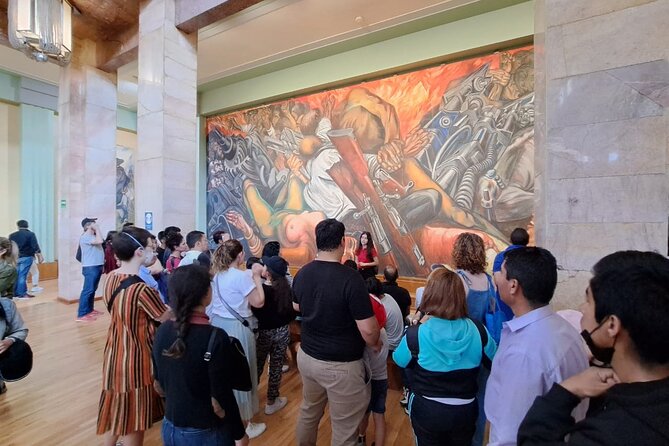
I like the tight focus on Mexican muralism, rather than a broad city tour that gives every subject only a few minutes. I also like the chance to hear the story of Rivera’s mural commissioned for Rockefeller Center, which was destroyed because of its political ideas. Guides such as León and Diego have been singled out for clear English, strong preparation, and lively explanations.
The main consideration is the admission-ticket wording. The details say admission is not included, while another section says entries are included. Confirm this before paying, since the $56.75 price feels much better if your entrance is covered. The group can reach 35 people, so ask where to meet and how the guide will handle a larger group.
Key points at a glance
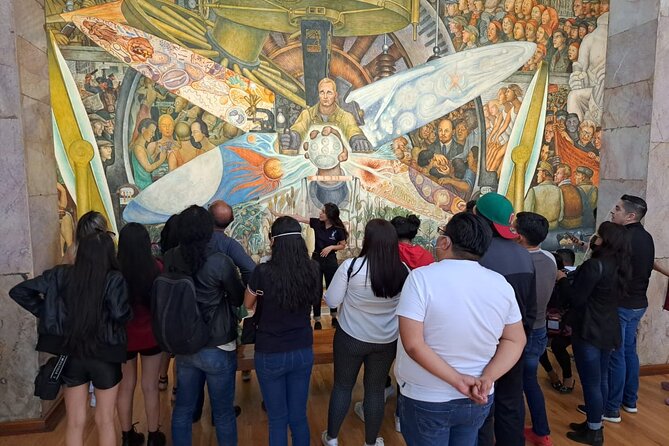
- Rivera’s lost Rockefeller Center mural: Hear how an American commission became a political dispute and ended with the work destroyed.
- Seven major mural subjects: Study Rivera’s Universe Controlled Man and Carnival of Huejotzingo, Siqueiros’s large political works, Orozco’s Katharsis, and more.
- Architecture comes first: The guide explains both the exterior and interior of Palacio de Bellas Artes, not just the paintings.
- English-language guidance: The tour is offered in English, with León praised for detailed cultural and historical explanations.
- A short, focused visit: Plan on one hour to 90 minutes, useful when you want art context without giving up half a day.
- Central meeting point: Start and finish at Palacio de Bellas Artes on Avenida Juárez in Mexico City’s Centro Histórico.
Why Bellas Artes works so well as a mural classroom
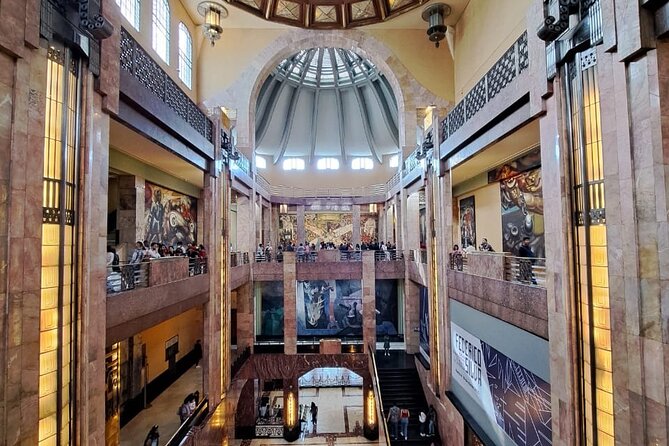
Palacio de Bellas Artes is the most recognizable cultural building in Mexico City’s historic center. It was declared a UNESCO World Heritage Site in 1987, and the tour uses that setting to explain why the building matters before turning to the murals inside.
That order makes sense. If you simply walk in and look up at the paintings, you may notice scale and color but miss the larger argument. The guide connects the building to the era of Porfirio Díaz and explains the purpose behind the project. You get a clearer idea of how architecture, government, art, and national identity meet under one roof.
I appreciate that the experience includes the building’s exterior and interior. The outside gives you a sense of the palace’s public importance, while the interior provides the setting for the mural collection. This is not a tour that treats Bellas Artes as a plain container for paintings.
The setting also helps you read the works as a group. Mexican muralism was designed for public spaces, where large images could speak to people who might never enter a private gallery. The tour’s strength is showing how the murals communicate through history and symbols, not asking you to admire them only as decoration.
If you're still narrowing it down, here are other tours in Mexico City we've reviewed.


Rivera’s controlled universe and the Rockefeller story
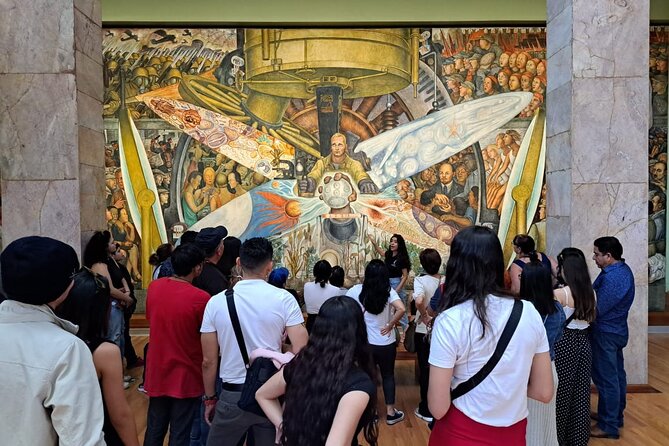
Diego Rivera’s Universe Controlled Man is one of the central works on the route. The subject gives the guide a chance to explain Rivera’s interest in science, industry, society, and the forces shaping modern life. Rather than rushing past it, expect attention to the figures and symbols that make the composition worth studying at close range.
The most memorable Rivera story involves the mural he painted for Rockefeller Center in New York. Rivera included political imagery that clashed with the Rockefeller family’s wishes. The mural was destroyed because of its ideology, and the Bellas Artes tour uses that episode to explain the pressure placed on artists when public commissions meet political beliefs.
That story adds useful context to Rivera’s work in Mexico. You begin to see that his murals were not neutral scenes placed on walls. They made arguments, often about class, labor, power, and the future of society. The guide can point out how those ideas appear in the work rather than leaving you to guess from a distance.
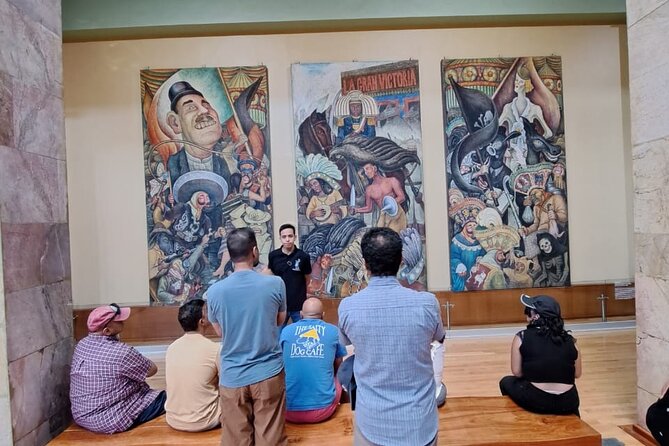
Carnival of Huejotzingo offers a different side of Rivera. The subject brings in a Mexican festival and allows the tour to discuss local tradition, public performance, and the way Rivera used recognizable cultural scenes to build a national visual language. It helps balance the industrial and political concerns of Universe Controlled Man.
Siqueiros, Orozco, and the politics of large-scale art
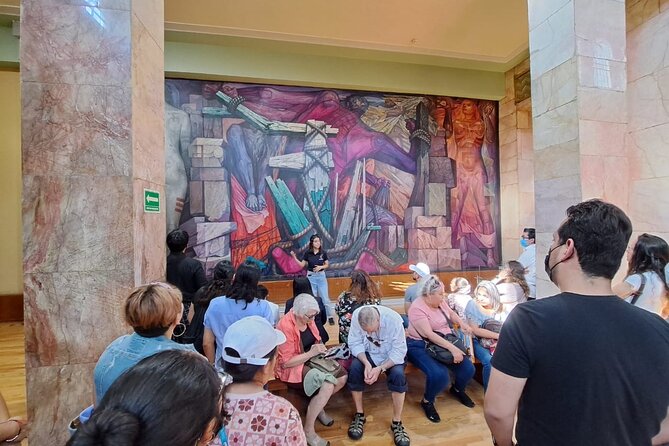
David Alfaro Siqueiros brings a sharper political charge. The tour covers his Diptych Torment and Apotheosis of Cuauhtémoc and his Triptych of the New Democracy. Even the titles signal that these are works to read, not merely glance at.
The Cuauhtémoc diptych links suffering with the elevation of an important Indigenous figure. The guide explains the historical and symbolic background so you can follow the connection between conquest, resistance, and national memory. The work rewards a slow look because its force comes from the way figures and ideas are arranged across the panels.
The Triptych of the New Democracy shifts toward modern political struggle. Here you can expect discussion of democracy, conflict, and the ideals that shaped post-Revolutionary Mexican art. Siqueiros often wanted his paintings to confront the viewer, and the tour’s historical framing helps explain why the scale and drama matter.
José Clemente Orozco’s Katharsis adds another strong contrast. Orozco’s work is known for a darker view of violence and social disorder, and the guide places the mural within its political and cultural setting. You are not left with a simple message that one artist was optimistic and another was bleak. Instead, you see several competing views of Mexico’s past and future.
This is where an expert guide earns the fee. A quick visit might reduce the murals to famous names. A good explanation gives you a way to separate Rivera’s faith in social transformation from Orozco’s harsher warning and Siqueiros’s forceful political energy.
Camarena, Tamayo, and the wider mural collection
Jorge González Camarena’s Liberation expands the tour beyond the three best-known muralists. The title points toward freedom and historical change, while the guide explains the symbols and figures that carry those ideas. This stop matters because it shows that Mexican muralism was not the work of only Rivera, Orozco, and Siqueiros.
Rufino Tamayo adds another artistic voice. Tamayo’s place in the program allows you to compare his approach with the more openly political works nearby. The tour also includes La Piedad by Rodríguez Lozano, giving you another point of comparison in subject, style, and artistic outlook.
The full collection includes 17 murals by major Mexican artists, although the named route highlights a smaller group of works and artists. That distinction is useful. You should expect a guided selection with detailed explanation, not a minute-by-minute account of every image in the building.
I like this balance. Trying to explain all 17 murals in 90 minutes would turn the experience into a list of names. Focusing on major works gives you time to understand symbolism, historical context, and the artists’ different positions. If you want to study every mural at length, plan a separate return visit if your ticket and schedule allow it.
What the 60 to 90 minutes feels like
The advertised duration is about one hour to 90 minutes, with the detailed schedule pointing to 90 minutes. That makes this a practical addition to a day in the Centro Histórico. You can fit it between other central sights without committing your whole afternoon.
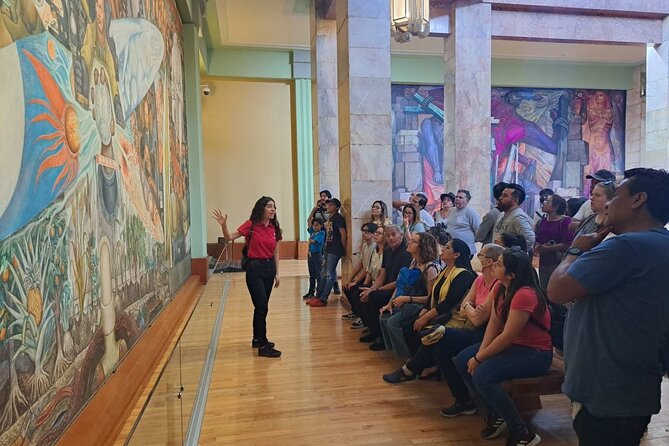
The time is long enough for real explanation but short enough to stay focused. You will spend the visit moving through the palace’s exterior and interior areas, then stopping at major murals. The exact pace may depend on the group size and how many questions people ask.
A group of up to 35 people is permitted. That is not a tiny private visit, so do not assume every stop will feel intimate. A larger group can make it harder to hear or get close to the guide. On the other hand, the tour is still focused enough that you avoid planning your own route through a large collection.
The tour begins and ends at Palacio de Bellas Artes, at Avenida Juárez in the Centro Histórico. That simple arrangement helps with planning, especially if you are using public transportation. The meeting point is near transit, and you do not need to arrange a separate return transfer.
Confirmation is provided when you book, and the activity accepts service animals. The information says most people can participate. The tour is offered in English, an important point for anyone who wants the symbolism explained rather than relying on wall labels.



The guides and the value of spoken context
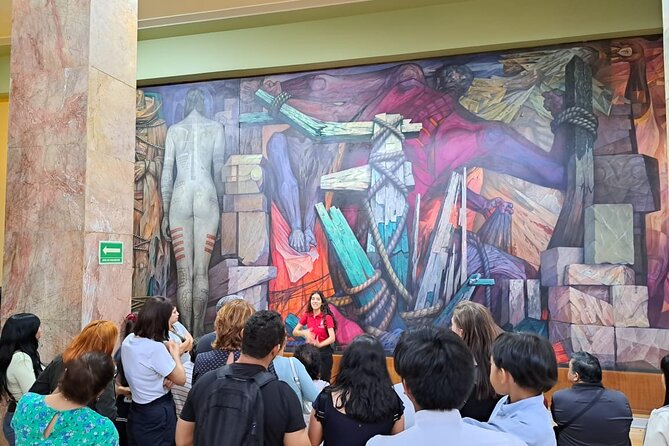
The strongest praise has focused on the guides’ explanations. León has been described as especially good at connecting each mural to its historical and cultural setting, and his English explanations are clear and detailed. Diego has also been praised for telling the mural stories with excitement and care.
Those details matter because mural tours can easily become either too academic or too shallow. The useful middle ground is a guide who can explain what you are seeing, why it was painted, and what it meant in its own time. The comments about León and Diego suggest that the experience can deliver that kind of help, though the guide assigned to your departure may vary.
You should come ready to look closely and ask questions. The program covers symbolism, artist background, and history, so this is not simply a photo stop. If you are curious about why a figure appears in a mural or how a political idea is shown through color and composition, you will get more from the tour by speaking up.
The English service is another practical advantage. Mexican muralism is full of references that can be missed when you are looking without context. A guide can explain the names, historical figures, religious subjects, and political symbols in real time.
Is $56.75 a fair price?
At $56.75 per person, this is not the cheapest way to enter Bellas Artes. The value depends on how much you want interpretation rather than independent viewing.
For a quick look at the building, the price may feel high. You can see some of the murals without paying for a guided experience, depending on the current entrance arrangements. But if you want the story of Rivera’s Rockefeller Center mural, comparisons among Rivera, Orozco, Siqueiros, Camarena, and Tamayo, and a clear explanation of the building itself, the fee can make sense.
The tour is especially useful for first-time visitors who do not already know Mexican muralism. You pay for a structured route and a guide who can turn a collection of large paintings into a connected lesson. That saves you the work of researching each artist while standing in a busy cultural site.
Before booking, settle the admission question. One part of the supplied details says admission is not included, while another says entries are included. Since that changes the real cost, confirm whether the $56.75 covers your entrance to Palacio de Bellas Artes. Lunch, food, and drinks are not included, though the short duration means you can handle those separately before or after.
Who should book this mural tour?
I would choose this experience if you want meaning behind the paintings and prefer an English-speaking guide to independent reading. It suits art lovers, history-minded visitors, and anyone who has seen photos of Bellas Artes but wants to understand what the murals are saying.
It is also a good fit if your Mexico City schedule is tight. The central location and 90-minute maximum make it easier to combine with other Centro Histórico sights. Since the tour returns to its starting point, you can continue your day without figuring out a new meeting place.
You may want to skip it if you prefer a slow, private visit with no fixed pace. A group of up to 35 people will not offer the same quiet attention as a private guide. You might also find the price hard to justify if you already know the major muralists and only want photographs.
The tour is not designed as a general survey of every room in the palace. Its purpose is the architecture and the murals. That focus is a benefit if you want substance, but a limitation if you expect a broad performing-arts or palace tour.
Practical booking advice before you go
Book with the knowledge that the experience is often reserved about six days ahead on average. That does not guarantee a sellout, but it suggests you should not leave it until the last morning if the timing matters to you.
The cancellation terms are reasonable. You can cancel at least 24 hours before the start time for a full refund. Cancellations or changes made within 24 hours are not refunded or accepted, and the cut-off follows Mexico City local time.
Bring your booking confirmation and arrive at the stated Palacio de Bellas Artes meeting point. Since the experience starts and ends there, you can plan nearby activities around the same central location. Check the admission inclusion before finalizing your budget.
Should you book the Palace of Fine Arts Mural Tour?
Book it if the idea of understanding Mexican muralism appeals to you more than simply seeing famous paintings. The strongest feature is the guide-led context, especially the political story behind Rivera’s destroyed Rockefeller Center mural and the comparisons among Rivera, Orozco, Siqueiros, Camarena, Tamayo, and Rodríguez Lozano.
At $56.75, it is best for someone who values clear English explanations and a compact, organized visit. Confirm the ticket inclusion, accept that the group may reach 35 people, and choose this tour when you want Bellas Artes to make sense, not just look beautiful.
FAQ
Where does the Palace of Fine Arts Mural Tour begin?
It begins at Palacio de Bellas Artes, at Av. Juárez S/N in Mexico City’s Centro Histórico, Cuauhtémoc, Mexico City.
Where does the tour end?
The activity ends back at the Palacio de Bellas Artes meeting point.
How long does the mural tour last?
The tour lasts approximately one hour to one hour and 30 minutes. The detailed schedule gives the duration as 90 minutes.
Is the tour offered in English?
Yes. The experience is offered in English.
What murals are covered?
The program covers Universe Controlled Man and Carnival of Huejotzingo by Diego Rivera, Liberation by González Camarena, Katharsis by Orozco, Siqueiros’s Diptych Torment and Apotheosis of Cuauhtémoc and Triptych of the New Democracy, plus Rufino Tamayo and La Piedad by Rodríguez Lozano.
Is admission included in the price?
The supplied details contain conflicting information. One section says admission is not included, while another says entries are included. Confirm this point with the provider before booking.
Can I cancel for a full refund?
Yes, if you cancel at least 24 hours before the experience start time. Cancellations made less than 24 hours before the start time are not refunded, and changes within that period are not accepted.
More tours in Mexico City we've reviewed


Tours, compared.
 ★ 5.0Teotihuacan, Guadalupe Shrine & Tlatelolco Day Tour with LunchFrom $399 hours (approx.)
 ★ 4.5Teotihuacan Early Access Guided Tour with optional LunchFrom $398 hours (approx.)
 ★ 4.6Mexico City: Teotihuacan, Tlatelolco & Guadalupe Shrine TourFrom $49
 ★ 4.4CDMX: Xochimilco, Coyoacan, Frida Kahlo Museum & Murals TourFrom $89
 ★ 5.0Hot Air Balloon Flight with Breakfast Cave and Pyramids TourFrom $1408 hours (approx.)
 ★ 5.0Teotihuacan Private Tour from Mexico CityFrom $1401 to 5 hours (approx.)
 ★ 5.0Balloon flight with breakfast in Cave and Pyramids tour from CDMXFrom $1483 to 9 hours (approx.)
 ★ 4.5Chapultepec Castle & Anthropology Museum TourFrom $795 hours (approx.)