
Reviewed · MEXICO CITY
Arrivals & Survival of Jews in Mexico from 1519
Mexico City’s Jewish story is written into places most visitors pass without noticing: an Inquisition prison, a colonial trading square, a school tied to Diego Rivera and Frida Kahlo, and two early synagogues near Plaza Loreto. This three-and-a-half-hour walk connects those pieces into one long, often difficult story.
In This Article
- Key points at a glance
- Why this Jewish history walk matters
- Beginning at Librería Porrúa above the Templo Mayor
- The Metropolitan Cathedral and the Chapel of the Souls
- Plaza de Santo Domingo and the watched marketplace
- The Palace of the Inquisition and its prison
- San Ildefonso, Rivera, Kahlo, and political Mexico
- Plaza Loreto and Mexico’s first purpose-built synagogues
- Justo Sierra Synagogue, the final stop
- How much walking and how the timing works
- The guide can shape the whole experience
- Is $99 a fair price?
- Who should book this walk?
- Should you book Arrivals & Survival of Jews in Mexico from 1519?
- FAQ
- Where does the tour begin?
- What time does the experience start?
- Where does the tour end?
- How long does the tour last?
- What language is offered?
- How large is the group?
- What synagogues are included?
- Is the tour physically demanding?
- Can I cancel for a full refund?
I like the opening view from Librería Porrúa, where you look across the ruins of the Great Aztec Temple while discussing Mexico’s many religious traditions. I also like the small-group format, capped at 10 people, and the chance to finish inside or at the historic Justo Sierra Synagogue.
The main consideration is scope. This is partly a Jewish history tour and partly a broad history of Mexico, Spain, the Inquisition, art, politics, and religion. One hour-long review described the Jewish content as more limited than expected, so book it for context and connections, not for synagogue visits alone.
Key points at a glance
- Start above the Aztec ruins: Begin at Librería Porrúa with a seated introduction and a striking view over the Templo Mayor site.
- Follow the machinery of the Inquisition: See the Chapel of the Souls, Palace of the Inquisition, administrative offices, living quarters, and former prison.
- Connect Jewish and Mexican art history: Learn about the meeting of Diego Rivera and Frida Kahlo at the Antiguo Colegio de San Ildefonso.
- See Mexico’s first Jewish congregations: Pass Sephardic Mount Sinai and Nidjei Israel near Plaza Loreto, then continue to Justo Sierra Synagogue.
- Expect a personal, discussion-led tour: Carlos is frequently praised for his English, storytelling, and ability to answer detailed questions when he leads the walk.
- Plan for a morning walk: The experience starts at 10 a.m., lasts about 3 hours and 30 minutes, and requires moderate physical fitness.
Why this Jewish history walk matters
Jewish history in Mexico is not confined to one neighborhood or one building. This walk places it inside the larger story of Spanish rule, forced religious conformity, trade, migration, art, political exile, and modern Mexico City.
The experience begins in the historic center, where the Aztec capital once stood beneath the present-day city. From there, your guide builds a timeline reaching back to 1519 and the arrival of the Spanish, then moves through the colonial period and into the Jewish communities that took shape much later.
That broad frame is useful. You will not simply see a synagogue and hear its date of construction. You will hear why Jewish identity had to be hidden or guarded during parts of Mexico’s colonial period, how merchants operated under suspicion, and how later Jewish communities formed along Sephardic and Ashkenazi lines.
The tour also brings in people who are not usually part of a Jewish Mexico City walk. Diego Rivera, Frida Kahlo, Leon Trotsky, Hernán Cortés, the Spanish Empire, and the Mexican anti-Fascist movement all enter the discussion. That makes the experience more ambitious than a narrow religious tour, though it also explains why some of the Jewish material receives less time than the title might suggest.
If you're still narrowing it down, here are other tours in Mexico City we've reviewed.


Beginning at Librería Porrúa above the Templo Mayor
Meet at República de Argentina 15, outside or near Librería Porrúa, at 10 a.m. The opening hour is not a rushed introduction on a street corner. The plan is to sit on a terrace, have an introductory conversation, and look toward the ruins of the Great Aztec Temple.
That setting gives the tour an immediate sense of place. You are looking at the remains of the Mexica capital while discussing the arrival of Europeans, the growth of colonial power, and the way different faiths have occupied the same city over time.
A past participant described beginning with coffee and a snack while the guide explained the history of the United Mexican States. Food and drink are not listed as included benefits, so treat that as a possible part of the setting rather than a promise. The important point is that the tour starts with conversation and orientation before sending you into the streets.
This first section may appeal to you if you prefer a guide who explains the larger setting before pointing out individual buildings. It may feel slow if you want to get straight to a synagogue. The opening takes about an hour, so it is a substantial part of the experience.
The Metropolitan Cathedral and the Chapel of the Souls
From the bookstore, the walk continues toward the Metropolitan Cathedral. You will go behind the cathedral to see the Chapel of the Souls and examine teachings directed against heresy and other religions.
The guide uses this stop to explain the religious control imposed under Spanish rule. From the viewing point, you can also study the cathedral’s colonial design and hear the tour’s argument that the built environment helped keep Jews away from important religious spaces.
This is less about entering a Jewish building and more about understanding the pressure surrounding Jewish life in colonial Mexico. The stop lasts about 20 minutes, enough time for an explanation and a look at the architecture without turning the visit into a full cathedral tour.
Expect interpretation here. The meaning of the images, texts, and architecture is central to the stop, so the experience depends heavily on your guide’s ability to explain historical context. Carlos, when assigned, is often praised for making complicated subjects clear in English and for handling questions rather than simply delivering a memorized speech.
Plaza de Santo Domingo and the watched marketplace
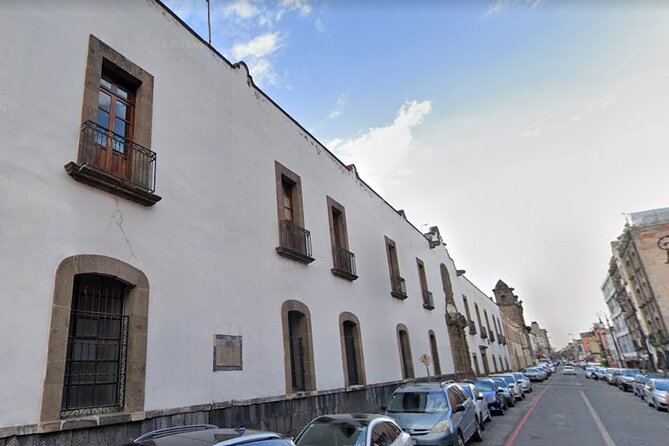
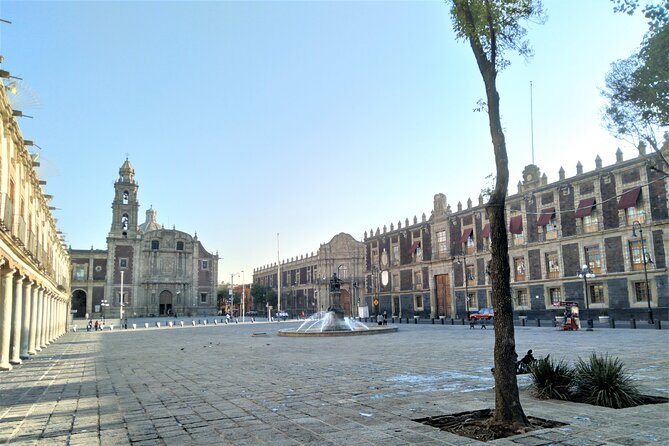
Plaza de Santo Domingo was a major trading marketplace from the 16th through the 19th centuries. The tour presents it as a place where Jews living in hiding had to conduct business while being watched from the Palace of the Inquisition.
That detail gives the square a human scale. Instead of treating the Inquisition as a distant institution, you are asked to picture merchants bringing goods to market while monitoring who might be observing them.
The guide also points out what the tour describes as anti-Semitic messages connected with the Palace of the Inquisition and Santo Domingo Church. You will hear about El Camino Real, presented here as a route used by Jewish traveling traders seeking safety as they moved through colonial territory.
This is a short stop, about 20 minutes, but it carries much of the tour’s central idea: Jewish survival often depended on discretion, trade networks, movement, and careful negotiation with authorities.
The Palace of the Inquisition and its prison
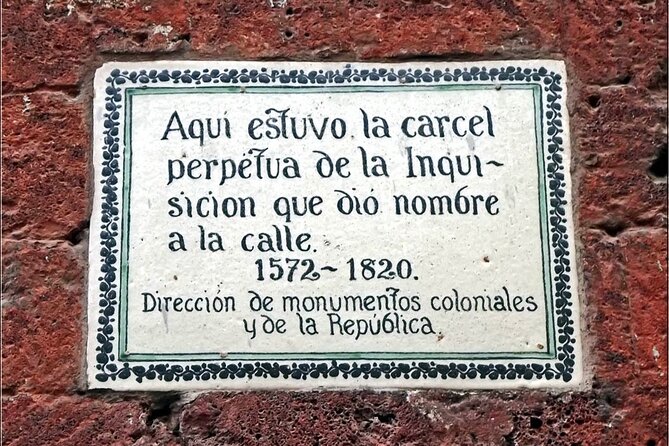
The next stop passes the former administration building of the Inquisition, its living quarters, and the Perpetual Prison. The tour explains how Jews were tortured and sentenced to death in this setting.
You should expect to view these places from outside rather than spend a long period inside a museum. The value comes from seeing how close the offices, residences, and prison were to one another. Authority was not an abstract force here. It operated through nearby rooms, courts, cells, and public spaces.
This portion can be emotionally heavy. The subject is persecution, torture, and execution, so it is not a light sightseeing walk. At the same time, the stop gives necessary weight to the story of Jewish survival in Mexico. The tour is not presenting Jewish settlement as a simple tale of arrival and success.


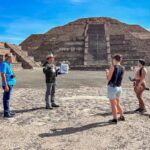

San Ildefonso, Rivera, Kahlo, and political Mexico
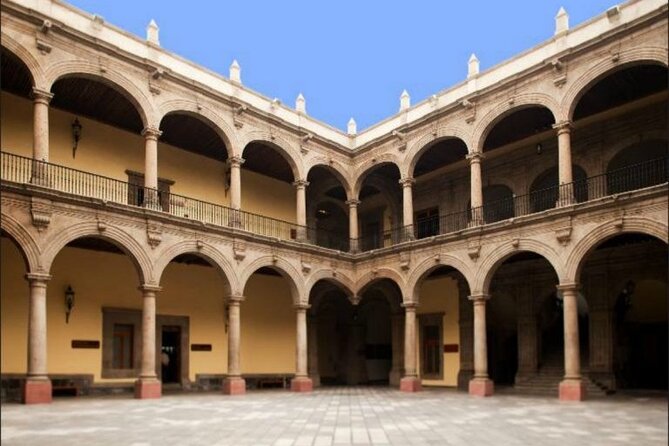
At the Antiguo Colegio de San Ildefonso, you will see the building from the outside and hear about the meeting of Diego Rivera and Frida Kahlo.
The tour identifies Rivera as being of Sephardic origin and Kahlo as being of Ashkenazi origin. Their connection becomes a way to discuss Jewish identity in Mexican art and public life, rather than treating the community as separate from the country around it.
This stop also moves into 20th-century politics. You will hear how Mexican anti-Fascists helped cancel what the tour describes as the first and only anti-Semitic national convention, and how Mexico received Lev Davidovich Bronstein, better known as Leon Trotsky, as a refugee.
It is a lot for a 15-minute stop, especially because the building is viewed from outside. If you want an extended art-history lesson on Rivera or Kahlo, this is not that. If you enjoy links between art, migration, ideology, and Jewish identity, it adds an unusual layer to the walk.
Several families and couples have singled out the guide’s ability to connect Mexican and Jewish history here. High-school-age children may find this section more approachable than a strictly institutional account of religious persecution.
Plaza Loreto and Mexico’s first purpose-built synagogues
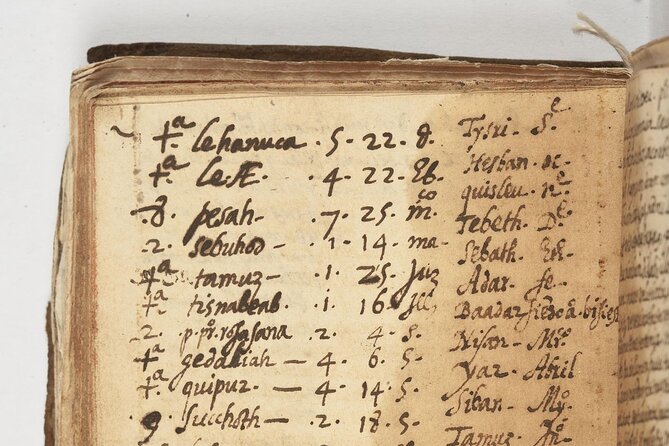
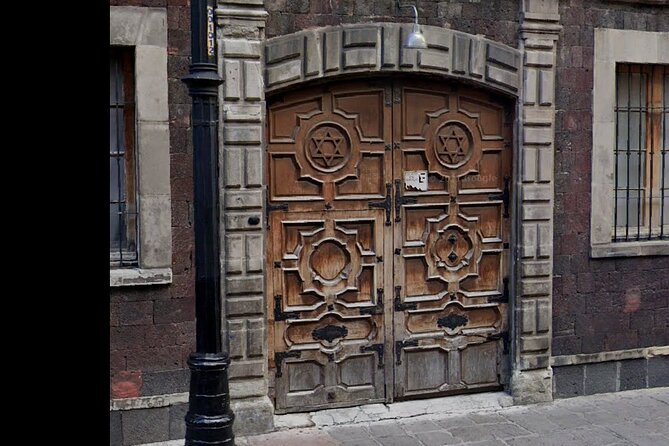
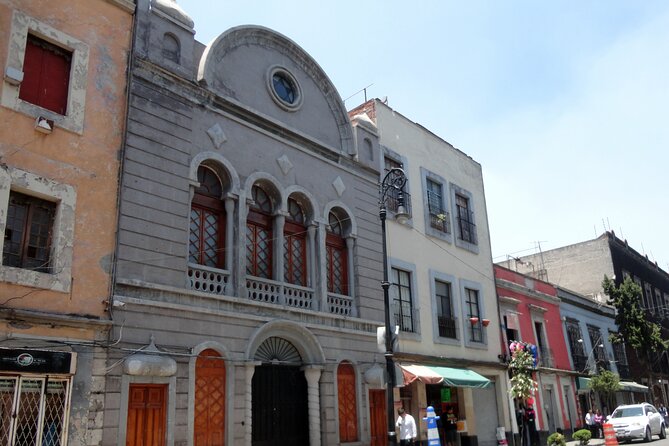
The walk reaches Plaza Loreto, where you pass the first purpose-built Sephardic synagogue in Mexico, Sephardic Mount Sinai, and the neighboring Nidjei Israel, identified as the first Ashkenazi synagogue in Mexico.
This is one of the most important moments for anyone booking the tour specifically for Jewish architecture. The buildings help show that Mexico City’s Jewish community was not a single group with one tradition. Sephardic and Ashkenazi communities created their own institutions, shaped by different backgrounds, languages, customs, and migration patterns.
The stop itself lasts about 15 minutes, so the first look is brief. You should not expect a long service, a religious ceremony, or a full museum presentation. Some public and private access has been arranged for the experience, but the exact level of entry can vary, so the guide’s explanation remains an important part of what you receive.
The location also makes practical sense. You are near the end of the walk, and the tour continues to the Justo Sierra Synagogue rather than ending after a quick exterior view.
Justo Sierra Synagogue, the final stop
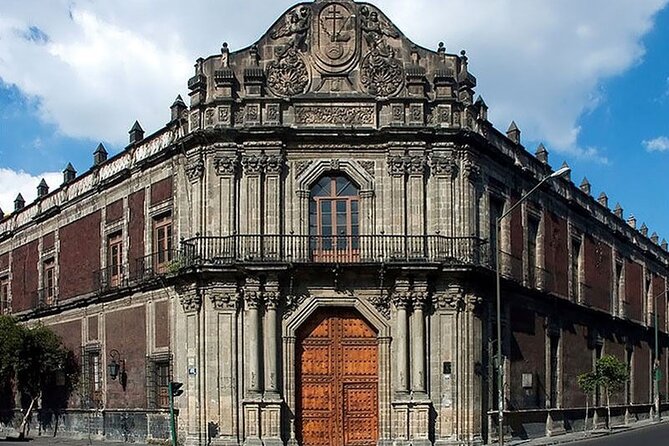
The tour ends at Justo Sierra Synagogue, at Justo Sierra 71, directly in front of Loreto Park on the south side of Justo Sierra Street. The walk’s final 20 minutes focus on this decommissioned building, described as the first Ashkenazi synagogue in Mexico.
This is the payoff for many people. After hearing about Jewish life under colonial pressure and the later separation between Sephardic and Ashkenazi communities, you reach a surviving institutional space tied to the city’s Ashkenazi past.
Because the synagogue is decommissioned, do not approach it as an active house of worship. Its value is historical and architectural. The ending also gives the tour a clear sense of arrival, moving from hidden or threatened Jewish life to purpose-built community institutions.
One review described the final synagogue as a particularly strong ending and a building worth seeing and supporting. You may want to allow extra time afterward to absorb the stop, take in the area around Loreto Park, or continue exploring the Centro Histórico independently.
How much walking and how the timing works
The total duration is about 3 hours and 30 minutes. The listed stops add up to more than three hours, with the opening discussion at Librería Porrúa taking the largest share.
This is a walking tour, but it is not described as a nonstop march. One account specifically noted that the group did not walk for long stretches at a time, with frequent stops for explanation. Still, the physical fitness requirement is moderate, and you should be comfortable walking through the historic center for several hours.
The small maximum of 10 people matters. A group this size makes it easier to ask about family history, Jewish customs, Mexican politics, or confusing details in the guide’s account. It also makes the discussion at the opening terrace more practical than it would be with a large coach group.
The tour is offered in English and uses a mobile ticket. Service animals are allowed, and the meeting point is near public transportation. Wear comfortable shoes and plan around the 10 a.m. start, since the walk ends at a different address from where it begins.
The guide can shape the whole experience
Carlos receives especially strong praise for his storytelling, English, historical range, and willingness to answer questions. When he leads the tour, you can expect a discussion that moves beyond dates and names into the connections between Mexico, Spain, Jewish migration, religion, art, and political exile.
His approach appears personal as well as academic. He has shared modern perspectives on Mexico’s Jewish community and his own background, which can make the subject feel less like a classroom lecture. Some people will appreciate that personal voice. Others may prefer a more tightly documented presentation with a clear list of sources.
One useful caution is that the guide’s style may be more conversational and questioning than strictly scripted. A few comments describe an approach that relies on questions and broad explanations. If you want a highly technical academic tour, you may find parts of it basic or simplified. If you enjoy asking questions and following connections, the format should work better.
Guide assignment is not guaranteed in the information provided, so book for the experience rather than assuming Carlos will lead your specific departure.
Is $99 a fair price?
At $99 per person, this is not the cheapest way to walk around Centro Histórico. You are paying for about three and a half hours with a local guide, a small group, historical interpretation, and arranged access to some public and private places.
The value is strongest if you would otherwise book a general historic-center walk and want a focused Jewish angle instead. You will still receive a broad account of Mexico City, but the selected buildings and stories give ordinary streets a different meaning.
The value is weaker if you mainly want extended synagogue access. Two synagogue sites are viewed near Plaza Loreto, and the final stop focuses on the decommissioned Justo Sierra Synagogue. Much of the experience takes place outdoors or around historic buildings rather than inside active religious spaces.
The tour has a 4.6 rating from 87 reviews, with 90 percent recommending it. Most of the strongest feedback centers on the guide’s storytelling, depth, friendliness, and personal attention. There are also several serious cancellation complaints, including last-minute cancellations connected to health or security concerns and delays involving refunds. The operator explains that safety consultations can lead to cancellation, particularly for a Jewish tour during large public events or heightened tension.
That does not make the tour poor value, but it does mean I would avoid placing it on the only morning before a flight or a fixed-ticket activity. The stated policy allows free cancellation up to 24 hours before the start, while changes or cancellations within 24 hours are not refundable under the posted terms.
Who should book this walk?
I would recommend it to you if you want Jewish history placed inside Mexico’s wider political and religious story. It suits visitors who enjoy architecture, urban history, art, migration, and long conversations rather than a simple checklist of Jewish sites.
It is also a good choice for families with older children or teenagers who can follow connections between the Inquisition, Rivera and Kahlo, anti-Fascism, Trotsky, and modern Jewish life. The small group can make it easier to keep younger participants involved.
You may want another option if you are seeking a primarily religious experience, a service, a kosher food tour, or a full visit to active synagogues. You may also find the tour too broad if your only goal is the history of Jewish immigration after the colonial period.
Should you book Arrivals & Survival of Jews in Mexico from 1519?
Book it if you want Mexico City to explain itself through Jewish history, not if you want a short synagogue-hopping tour. The strongest parts are the careful route through the Inquisition sites, the unusual Rivera and Kahlo connection, the first Sephardic and Ashkenazi synagogue locations, and the final visit to Justo Sierra Synagogue.
I would choose it early in your Mexico City stay, when the historic center is still new to you and the larger context can improve later sightseeing. Keep your schedule flexible around the morning departure, confirm communication details before the date, and go prepared to ask questions. That is where the tour’s best value lies.
FAQ
Where does the tour begin?
The tour begins at República de Argentina 15 in Mexico City’s Centro Histórico, at or near Librería Porrúa.
What time does the experience start?
The start time is 10 a.m.
Where does the tour end?
It ends at Justo Sierra 71, directly in front of Loreto Park on the south side of Justo Sierra Street.
How long does the tour last?
The experience lasts approximately 3 hours and 30 minutes.
What language is offered?
The tour is offered in English.
How large is the group?
The maximum group size is 10 people.
What synagogues are included?
The route passes Sephardic Mount Sinai and Nidjei Israel near Plaza Loreto, then visits the decommissioned Justo Sierra Synagogue, described as the first Ashkenazi synagogue in Mexico.
Is the tour physically demanding?
A moderate level of physical fitness is recommended. The experience involves walking through the historic center and making several stops.
Can I cancel for a full refund?
Yes. You can cancel at least 24 hours before the local start time for a full refund. Cancellations or changes made less than 24 hours before the start are not accepted for a refund under the stated policy.
More tours in Mexico City we've reviewed


Mexico City, compared.
 ★ 5.0Teotihuacan, Guadalupe Shrine & Tlatelolco Day Tour with LunchFrom $399 hours (approx.)
 ★ 4.5Xochimilco, Coyoacan and Frida Kahlo with Optional LunchFrom $349 hours (approx.)
 ★ 5.0Balloon flight + Breakfast in cave + Pyramids + Pick up CDMX.From $1722 to 8 hours (approx.)
 ★ 5.0Teotihuacan pyramids morning or afternoon without tourist trapsFrom $645 hours 30 minutes (approx.)
 ★ 4.5Teotihuacan Early Access Guided Tour with optional LunchFrom $398 hours (approx.)
 ★ 5.0Balloon flight + pick up in CDMX + Breakfast in Cave + PyramidsFrom $1694 to 7 hours (approx.)
 ★ 5.0Balloon Flight + Cave Breakfast + Pick Up from CDMX or We FlyFrom $1663 to 9 hours (approx.)
 ★ 4.6Mexico City: Teotihuacan, Tlatelolco & Guadalupe Shrine TourFrom $49