
Reviewed · HISTORIC CENTER WALKS
Private Walking Tour Gems of the Historic Center of Mexico City
Mexico City’s historic center packs Aztec ruins, Spanish churches, grand public squares, and 20th-century murals into one walkable stretch. This private four-hour tour gives you the story that ties those places together, finishing inside Palacio de Bellas Artes with works by Diego Rivera, David Alfaro Siqueiros, and Rufino Tamayo.
In This Article
- Key points to know before you book
- Why this four-hour walk works as a first look at Mexico City
- Templo Mayor: begin where Tenochtitlan began
- The Zócalo and National Palace: Mexico’s central stage
- Metropolitan Cathedral: centuries of styles in one building
- Madero Street: a historic walk with room to slow down
- Iturbide Palace and La Profesa: Baroque Mexico up close
- Casa de los Azulejos and San Francisco
- Plaza Tolsá and the Postal Palace
- Bellas Artes: the strongest finish
- What the $156 price buys you
- Timing, walking, and practical concerns
- Who should book this private Mexico City tour?
- Should you book it?
- FAQ
- How long is the private walking tour?
- What language is the tour offered in?
- Is the tour private?
- Is admission to the Templo Mayor Museum included?
- Can you enter the National Palace?
- Is admission to Palacio de Bellas Artes included?
- Is coffee included?
- Where does the tour start and finish?
I like the private format because your guide can shape the pace around your interests. I also like the strong art focus, especially the time spent at Bellas Artes and the chance to ask about architecture, Mexican history, or daily life without keeping up with a large group.
The main catch is that several places are viewed only from outside, including Templo Mayor and the National Palace. At about $156 per person, the price is high for a walking tour, so the value depends on whether you want context, flexible pacing, and a personal guide rather than a quick orientation.
Key points to know before you book
- Aztec, colonial, and modern Mexico in four hours: The route links Templo Mayor, the Zócalo, Madero Street, and Bellas Artes in one clear historical arc.
- Private attention: Only your group takes part, so the guide can adjust the pace, answer questions, and pause for shade or rest.
- Bellas Artes entry included: You go inside the lobby and upper floors to see important Mexican murals.
- A strong choice for art lovers: The final stop gives the tour a clear focus on Rivera, Siqueiros, Tamayo, and Mexico’s mural tradition.
- Coffee break included: Your guide provides a complimentary coffee or tea during the walk.
- Check event conditions: Political marches, barricades, weather, or temporary closures can affect access to the historic center.
Why this four-hour walk works as a first look at Mexico City
The route is short enough to fit into a busy trip, yet broad enough to explain how Mexico City grew from Tenochtitlan into the capital you see today. You begin near the Zócalo Central Hotel on Avenida 5 de Mayo and finish at Bellas Artes on Avenida Juárez.
The order makes sense. You first look toward the remains of the Aztec ceremonial center, then cross the great plaza shaped by colonial rule and national politics. From there, the walk moves through churches and former palaces before arriving at the art and architecture of the early 20th century.
I would choose this tour early in a Mexico City visit. A good guide can give you useful bearings for later visits, point out buildings you might otherwise pass, and explain why the murals matter beyond their size and color.
The private setup is especially useful here. The historic center can feel like a lot of information at once. Guides such as Alejo, Hermes, Isaias, Hilary, Silvia, Alicia, Julio, Hector, Fabio, Carla, Francisco, and Ari have been praised for adjusting explanations to individual interests, helping families stay engaged, and offering ideas for food and further sightseeing.
A few more Mexico City tours and experiences worth a look



Templo Mayor: begin where Tenochtitlan began
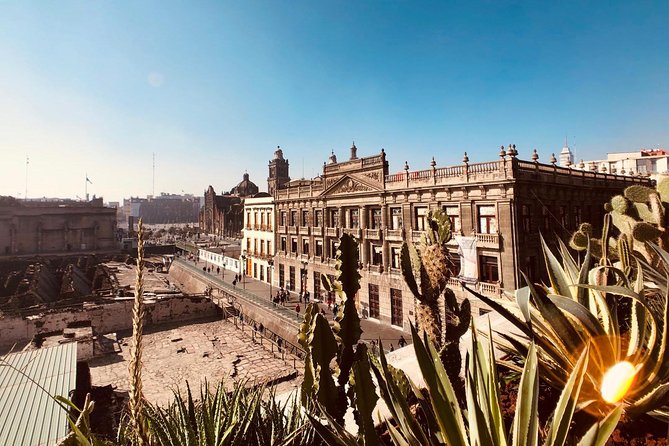
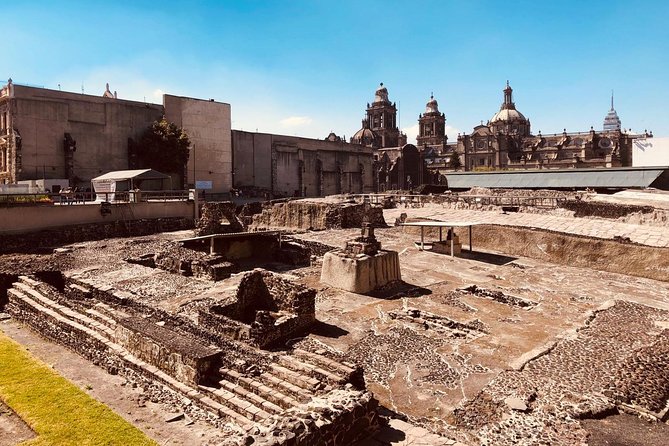
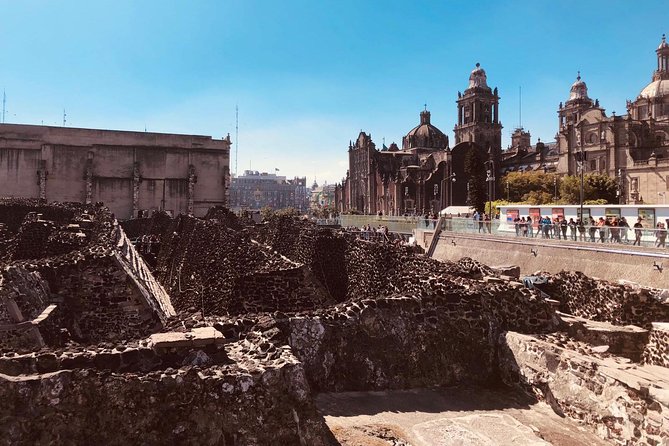
The first stop is the archaeological site of Museo del Templo Mayor, viewed from a panoramic point outside. You see the exposed ruins of the ceremonial heart of Mexico-Tenochtitlan and hear how the Aztec capital became a powerful city in roughly three centuries.
This is a valuable opening because Mexico City’s colonial buildings can otherwise make the city seem entirely Spanish. Templo Mayor corrects that impression at once. The modern capital sits directly over an older city, and the ruins make that fact physical rather than abstract.
Plan on about 20 minutes here. Admission to the archaeological site and its museum is not included, and the guided visit focuses on the exterior. If you want the museum galleries, you will need to arrange that separately and allow extra time.
That limitation matters. You will get orientation and historical explanation, not a full archaeological visit. Still, the outside view gives your guide a good place to explain the sacred center of the Aztec world before the walk shifts to colonial Mexico.
The Zócalo and National Palace: Mexico’s central stage
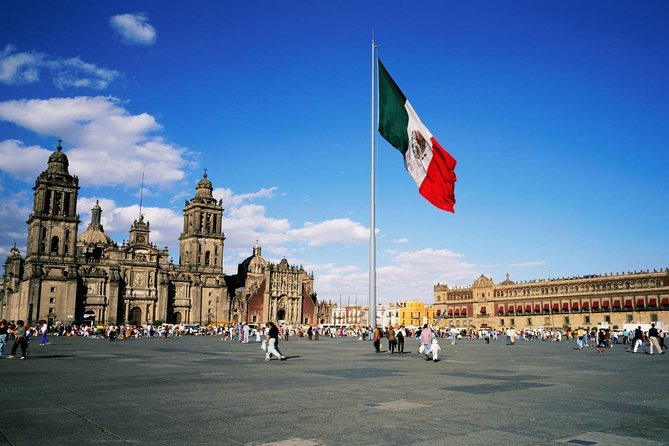
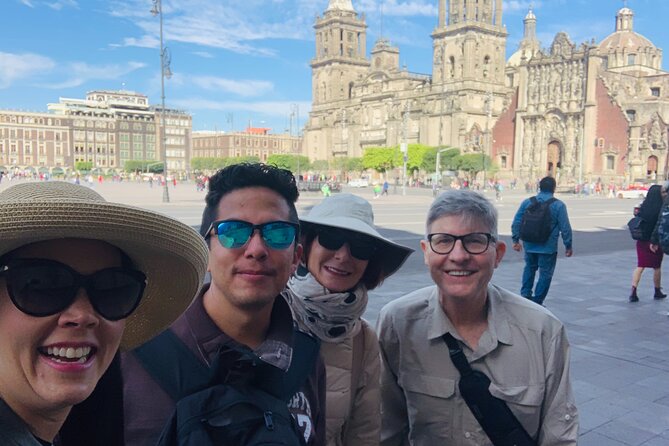
The Plaza de la Constitución, usually called the Zócalo, is the city’s great public square. Your guide explains how it has served religious, political, and civic purposes, from colonial ceremonies and independence-era conflict to present-day gatherings and celebrations.
The square is huge, and its scale helps you understand the plan of the historic center. The Metropolitan Cathedral occupies one side, while the National Palace fills another. The Zócalo is not just a place to take a photo. It is the point where Mexico’s major layers of power meet.
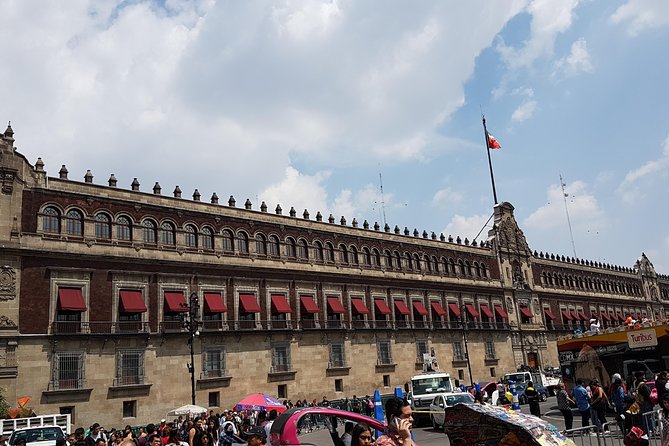
You get a panoramic view of the National Palace from the square, but you do not go inside. The palace occupies ground associated with Moctezuma’s former residence and later became a seat of political power. Since interior access is not allowed on this tour, your guide’s explanation carries much of the stop.
If seeing the palace murals is a priority, note this carefully. The tour does not include that interior visit. Bellas Artes supplies the major mural experience instead.
Metropolitan Cathedral: centuries of styles in one building
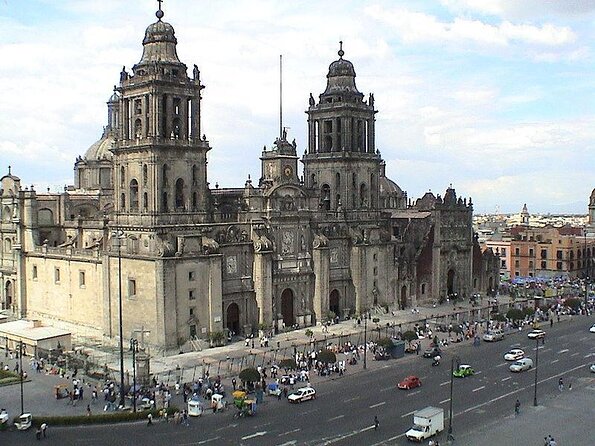
The Metropolitan Cathedral gives you a close look at Mexico’s long Catholic and architectural tradition. Its exterior combines Gothic, Herrerian, Mexican Baroque, and Neoclassical elements, while the interior contains chapels filled with religious art and historic detail.
You spend about 20 minutes here, with free admission. Depending on timing and access, the guide may take you to the sacristy, sometimes called the Mexican Sistine Chapel, or show you the impressive church organ up close. Neither special access is guaranteed, so treat it as a possible bonus rather than a promised feature.
The cathedral is one of the places where a private guide earns their keep. You can easily walk through, take in the gilded details, and leave without understanding what you saw. A guide can point out changes made over different periods and explain why several architectural styles ended up sharing one building.
Madero Street: a historic walk with room to slow down
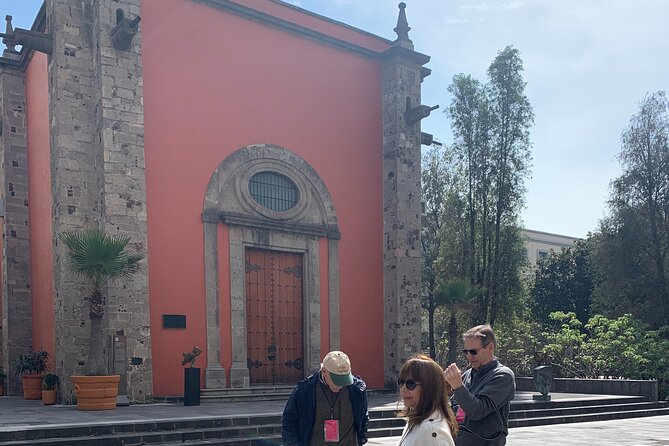
From the Zócalo, the route follows Francisco I. Madero Avenue, a pedestrian street lined with churches, former residences, shops, and grand colonial structures. The walk lasts about an hour, making it the longest part of the experience.
This is where the tour becomes less about isolated monuments and more about the city as a whole. Your guide connects the buildings to people and events, while you move through a street still used as part of everyday downtown life.
The pace is flexible. Guides can pause for a rest, find shade, or adjust the route around your interests. A complimentary coffee or tea break is included, which is a welcome touch during a four-hour walk. Several accounts describe guides stopping for drinks or snacks and making the day feel relaxed without losing momentum.
Madero Street can also be the busiest stretch of the route. You are walking through an active public corridor, not a quiet museum. That brings useful contact with city life, but it can make listening and moving together a little harder at peak times.
Other walking tours we've reviewed in Mexico City


Iturbide Palace and La Profesa: Baroque Mexico up close
The Museo Antiguo Palacio de Iturbide is a brief exterior stop. Your guide points out its Mexican Baroque details and explains the role of Agustín de Iturbide, the first emperor of independent Mexico.
You do not enter the palace on this tour. Even so, the stop helps put the grand façades along Madero Street into political context. This was not simply an elegant address. The building is tied to the complicated transition from Spanish rule to an independent Mexican state.
Nearby, the Temple of San Felipe Neri, known as La Profesa, offers another short stop. Its Baroque altarpiece and collection of sacred art reflect the influence of religious orders in Mexico’s colonial society.
These visits are concise, about 10 minutes each. If you want long interior time at every church, this tour may feel too brisk. If you want a well-paced introduction with many different examples, the variety works well.
Casa de los Azulejos and San Francisco
Casa de los Azulejos, or the House of Tiles, is one of the most memorable façades on Madero Street. Blue and white tiles cover the exterior, and the interior includes murals and architectural details worth seeing.
The stop lasts about 10 minutes and has free admission. The tour gives you time to appreciate the design and hear its history, but it is not a long museum visit. You will want to keep your eyes up as you approach, since the building’s appeal begins before you step inside.
Across the street, you can see the Chapel of Aranzazú and surviving sections of the former Church and Convent of San Francisco. This is a smaller stop, but it shows how much of the old religious complex has been altered or absorbed into the modern city.
Together, these places make Madero Street rewarding for architecture fans. You get a quick succession of façades, interiors, churches, and stories without spending the whole morning in one building.
Plaza Tolsá and the Postal Palace
At Plaza Tolsá, the guide pauses near the exterior of the Mining Palace, a landmark connected with Mexico City’s grand civic architecture. It is a brief stop before the final buildings.
The Postal Palace is more than a place to admire from the sidewalk. Entry to its interior courtyard is included, and the stained glass gives the visit a clear visual payoff. The stop lasts about 10 minutes, so you will see the principal interior rather than tour every corner.
This section of the route is useful because it broadens the picture of Mexico City. The walk has moved from Aztec foundations to churches and palaces, and now to public buildings shaped by a modernizing capital. The buildings are close together, but their purposes and styles differ sharply.
Bellas Artes: the strongest finish
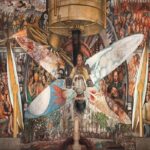
The tour ends at Palacio de Bellas Artes, with admission included. You enter the lobby, see its ornate decoration, and go to the second and third floors for murals by major Mexican artists, including Diego Rivera, David Alfaro Siqueiros, and Rufino Tamayo.
For many people, this is the tour’s best stop. The murals are not merely decorative. They address Mexico’s past, political struggles, social change, and national identity. A guide can help you read the scenes, identify the artists, and understand why mural painting became such an important public art form.
The Bellas Artes visit lasts about 50 minutes, giving it more time than most earlier stops. That balance is sensible. You receive a quick look at many historic buildings, then a longer visit where art and history come together.
Past guides have been especially praised for their mural explanations. Alicia, Hilary, Julio, and others have helped people focus on details they might miss alone, including Rivera’s treatment of Mexican history. If you care about art, tell your guide early. The private format makes it easier to give the murals the attention they deserve.
The tour ends here rather than returning to the starting point. That is convenient if you plan to continue toward Alameda Central or other central sights, but you should remember that your own transportation after the tour is not included.
What the $156 price buys you
At $156 per person, this is not a budget walk. You are paying for a private certified bilingual guide, a four-hour route, coffee or tea, entry to the Postal Palace courtyard, and admission to Bellas Artes.
The price makes the most sense for couples, families, or small groups who want a personal pace and a guide who can respond to questions. It is also easier to justify if you value art and history, since the final Bellas Artes visit can be much more rewarding with explanation.
The value drops if you mainly want a list of photo stops. Many façades and plazas are free to see on your own, and several interiors are not included. Group discounts may help, but the exact savings depend on the booking arrangement.
The high rating of 4.9 from 87 ratings and recommendation by 99 percent of participants suggest a consistently strong experience, particularly with the guides. The praise centers on clear historical storytelling, flexibility, patience with children, and useful suggestions for the rest of a Mexico City visit.
Timing, walking, and practical concerns
Expect about four hours on foot. One account estimated close to 10,000 steps, or roughly four miles, though the route can be shortened for someone with mobility limits. Wear comfortable shoes and bring water beyond the included coffee break.
The tour is offered in English and uses a mobile ticket. It begins at Zócalo Central Hotel, Av. 5 de Mayo 61, and ends at Bellas Artes, Av. Juárez. Public transportation is nearby, and private transportation is not part of the experience.
Most people can take part, but the distance and downtown crowds are worth considering. The flexible format helps, yet this is still a walking tour through a major city center.
Conditions in the historic center can change quickly. A political march once blocked access to several landmarks and made one tour unsafe enough to stop early. If a major event is announced for your date, contact the operator about changing the day instead of assuming every site will be reachable.
Free cancellation is available up to 24 hours before the start time. Poor weather can also lead to a different date or a full refund. Confirmation arrives within 48 hours, subject to availability.
Who should book this private Mexico City tour?
I would choose this for a first visit, especially if you want the historic center explained rather than simply photographed. It suits couples, families with older children, solo visitors, and anyone interested in murals, architecture, or the Aztec and colonial periods.
Families may appreciate the private pace. Guides have adapted explanations for children as young as 11 and 14, and they can build in rest stops. Art lovers should make Bellas Artes the focus of their questions.
I would skip it if you want long museum visits, a dedicated Templo Mayor archaeological tour, or an inexpensive group walk. The experience samples many places, but only Bellas Artes receives substantial interior time.
Should you book it?
Book this tour if you want a well-connected introduction to central Mexico City, a private English-speaking guide, and a strong finish with the country’s major muralists. The best value comes from asking questions and using the flexible format, not from rushing through every stop.
Before booking, confirm your priorities with the operator. Ask for extra attention to murals, Aztec history, architecture, or family pacing. At $156 per person, that personal service needs to be the point. If that sounds useful, this is a smart first half-day in the city.
FAQ
How long is the private walking tour?
The experience lasts approximately four hours.
What language is the tour offered in?
The tour is offered in English with a certified bilingual guide.
Is the tour private?
Yes. Only your group participates in the activity.
Is admission to the Templo Mayor Museum included?
No. The Templo Mayor stop focuses on the exterior archaeological site, and admission to the museum is not included.
Can you enter the National Palace?
No. The tour provides a panoramic view of the National Palace from the Zócalo, but the interior is not accessible on this experience.
Is admission to Palacio de Bellas Artes included?
Yes. Admission is included, including access to the lobby and the second and third floors where major murals are displayed.
Is coffee included?
Yes. A complimentary coffee or tea break is included.
Where does the tour start and finish?
It starts at Zócalo Central Hotel, Av. 5 de Mayo 61, and ends at Palacio de Bellas Artes on Avenida Juárez.
More City Tours in Mexico City




More Walking Tours in Mexico City
More Historic Center Walks in Mexico City

More tours in Mexico City we've reviewed





Historic Center Walks, compared.
 ★ 5.0Historic Downtown Walking TourFrom $263 hours (approx.)
 ★ 5.0Historic Center Food Tour in Mexico CityFrom $1155 hours (approx.)
 ★ 4.8Mexico City: Historic Downtown Walking TourFrom $263 hours
 ★ 5.0Walking Tour of the Historic Center of Mexico City3 hours (approx.)
 ★ 5.0Mexico City Historical Centre Food Tour with 7 Authentic TastingsFrom $653 hours (approx.)
 ★ 5.010 wonders of the Historic Center of Mexico City food and musicFrom $493 hours (approx.)
 ★ 5.0Walking Tour in Historic Center CDMXFrom $832 hours 30 minutes to 3 hours 10 minutes (approx.)
 ★ 5.0The best and most complete PRIVATE CITY TOUR through the Historic CenterFrom $683 hours (approx.)
The lists this tour appears in