
Reviewed · CITY TOURS
Azcapotzalco: Mexico City’s Culinary Kaleidoscope
Azcapotzalco gives you a side of Mexico City that most visitors miss. Over roughly six hours, you move from a historic meeting point to a family restaurant, taco stand, tortilleria, and an Italian-founded cantina, eating your way through several eras of the city.
In This Article
- Key points at a glance
- Why Azcapotzalco makes such a good food tour setting
- Starting at the Arbol de la Noche Triste
- The first breakfast: cafe de olla and sweet bread
- The backstreet restaurant and its second breakfast
- Offal tacos and the story of former slaughterhouses
- Handmade tortillas at an artisanal tortilleria
- Ancient roots in a third-generation drink stand
- Finishing in a century-old Italian-founded cantina
- What the guide adds to the food
- Walking, timing, and physical demands
- Food safety and managing a sensitive stomach
- Is $140 a fair price?
- Who should book this Azcapotzalco food walk?
- Booking details that matter
- Should you book it?
- FAQ
- Where does the Azcapotzalco food tour begin?
- What time does the tour start?
- Where does the tour end?
- How many people can join the tour?
- Is the tour offered in English?
- What is the cancellation policy?
I like the small maximum of seven people, which keeps the walk personal and makes it easier to hear the guide and ask questions. I also like the unusual range of food, from cafe de olla and sweet bread to offal tacos, huevos encamisados, ancient-style drinks, and a house cocktail.
The main caution is simple: this is a lot of food in one morning and afternoon. One participant became ill after the tour despite spending nearly a week in Mexico City without trouble, so use small bites and sips if your stomach is sensitive, and place this tour carefully in your schedule.
Key points at a glance
- Azcapotzalco beyond the usual route: Explore a Mexico City district with a strong local identity and fewer standard sightseeing stops.
- A serious amount of food: Expect breakfast dishes, tacos, drinks, tortilla-making, small cantina plates, and a cocktail.
- Guide Liz adds historical context: The experience connects what you eat with the neighborhood’s former slaughterhouses, family businesses, and older traditions.
- Small group size: No more than seven people makes conversation and pacing easier.
- Long walking day: Wear comfortable shoes and leave room in your appetite.
- Useful booking terms: The price is $140 per person, with free cancellation up to 24 hours before the 10 a.m. start.
Why Azcapotzalco makes such a good food tour setting
Mexico City food tours often focus on neighborhoods already familiar to visitors. Azcapotzalco offers a different kind of day. Here, food is not treated as a short list of famous dishes. It is used to explain how the area worked, who lived there, and how old customs still show up at a modern table.
That makes the tour appealing if you want more than restaurant recommendations. You are given a sequence of tastes that moves from a morning coffee to substantial meals, street food, handmade tortillas, traditional drinks, and a cantina founded by an Italian family about 110 years ago.
The format also gives the neighborhood a clear shape. You begin at the Plaza de el Arbol de la Noche Triste, near Popotla, at 10 a.m., then spend the central part of the day in Azcapotzalco. The walk ends back at the meeting point. The exact route and timing can vary, but you should plan for about six hours overall, since the published stop descriptions add up to roughly five hours and the tour is advertised as approximately six.
Other city tours we've reviewed in Mexico City

Starting at the Arbol de la Noche Triste
The meeting point is Plaza de el Arbol de la Noche Triste, at Popotla, 11400 Ciudad de México. This is more than a place to gather the group. It frames the day with a reminder that Mexico City is built from overlapping periods, not a single neat story.
The first stop is listed as about an hour, with no admission fee. Expect the opening portion to set the scene before the eating begins in earnest. The point is not to spend the day inside formal museums. Instead, the guide uses places, streets, food businesses, and neighborhood details to show how the past remains part of daily life.
That approach suits me because it avoids separating food from the city around it. You are not simply told that a dish is traditional. You get a sense of why it belongs in this district and how local customs, businesses, and migration shaped what people eat.
The first breakfast: cafe de olla and sweet bread
The tour begins as many mornings in the neighborhood do, with cafe de olla and a piece of sweet bread. Cafe de olla is coffee prepared with spices, so it offers a different start from a standard café americano. The drink is warm, fragrant, and tied to home-style Mexican cooking.
This first taste is modest, but it matters. It gives you a gentle introduction before the larger meal. If you have just arrived from a heavy hotel breakfast, you may find the day challenging from the first stop, so keep your morning meal light.
The coffee and bread also create an easy opening for the guide to explain everyday food customs. With a group of no more than seven, this is a good time to ask questions about ingredients, preparation, or the businesses you pass. The small group is one of the tour’s strongest practical features because food tours work best when conversation can move naturally.
The backstreet restaurant and its second breakfast
The next meal is far more substantial. At a family-run restaurant in the backstreets, you may eat huevos encamisados, enchiladas, freshly made juices, and other dishes. The restaurant is described as one of Mexico City’s best, but the more important point for you is its setting: this is a local family business rather than a polished dining room selected only for visitors.
Huevos encamisados are the sort of dish that makes this tour different from a standard taco crawl. You get a chance to try a regional preparation in a restaurant tied to the neighborhood, then compare it with the enchiladas and fresh juices served alongside it.
This is also where the food load begins to rise quickly. You have already had coffee and sweet bread, and now you are moving into a full breakfast. If you want to enjoy the whole day, do not feel obliged to finish every serving. Small portions and thoughtful pacing will help you save appetite for the stops ahead.
The restaurant is a major reason the $140 price can make sense. You are paying for a guided progression through several types of food, not simply a plate at one location. The value depends on how much you care about context, access to small local businesses, and having someone explain what you are tasting.
Offal tacos and the story of former slaughterhouses
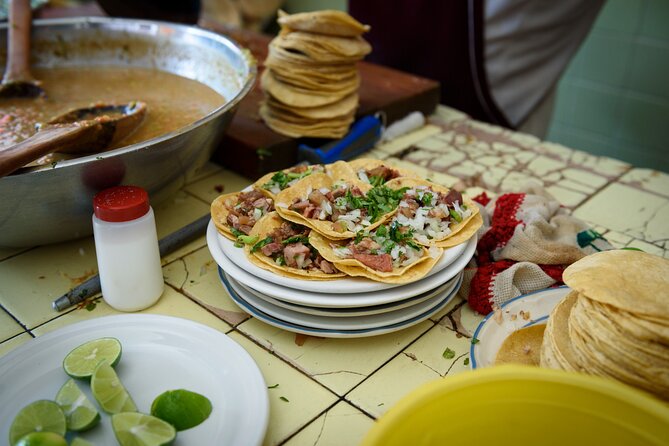
Later, the food turns more direct and more adventurous with succulent offal tacos. This is not an optional garnish to the tour’s main theme. The tacos connect to slaughterhouses that were once located in the area, giving a physical and culinary reason for this particular food tradition.
Offal can be a sticking point for some people. If you are curious but cautious, try a small bite first. You can still take part in the conversation and understand the dish without forcing yourself to eat a large serving.
For people who already enjoy tacos and want to move beyond the most familiar fillings, this stop is a real strength. It shows how working neighborhoods shape food in practical ways. The dish is not presented as a novelty for its own sake. It reflects the area’s former economy and the way cooks make use of available ingredients.
The route includes bathroom stops, which is useful on a day with frequent tastings and drinks. Still, you should think about the tour as a food-heavy outing, not a light walk with occasional samples.


Handmade tortillas at an artisanal tortilleria
The stop at an artisanal tortilleria adds another useful layer. Tortillas are easy to treat as background, but they are central to Mexican meals. Seeing a dedicated tortilla business helps you pay attention to something you might otherwise take for granted.
The supplied details do not specify the exact tortilla-making process or how much you will taste there, so you should not expect a formal cooking class. Think of it as a chance to see a craft business within the neighborhood’s daily rhythm and to understand why fresh tortillas matter to the dishes served earlier and later.
This stop also breaks up the meals. A walk through a working food shop gives the day some balance after the restaurant breakfast and tacos. It is one of the places where the tour’s wider idea becomes clear: Azcapotzalco is being explained through the businesses that feed it.
Ancient roots in a third-generation drink stand
At a third-generation street stand, you sample drinks whose roots reach back to Aztec times. The details do not name the beverages, so the exact flavors remain part of the day’s discovery. What you can expect is a direct link between an old tradition and a family business that has continued serving it across generations.
This is an especially useful stop if you want to understand Mexican food as more than restaurant cooking. Drinks can carry old ingredients, techniques, and customs just as clearly as solid dishes. A street stand also changes the feel of the day after the more substantial restaurant meals.
You should pace yourself here. Between coffee, juice, taco accompaniments, and traditional drinks, the liquid intake can add up. Small sips are sensible if you are not used to the ingredients or if you have a sensitive stomach.
Finishing in a century-old Italian-founded cantina
The final food stop is a cantina opened about 110 years ago by a family from Italy. That detail gives the tour a satisfying finish because it shows Mexico City food as a meeting place for different traditions.
You try the house cocktail and small dishes that combine classic Mexican customs with elements connected to the founders’ European roots. The exact cocktail and dishes are not specified, so you should expect the guide to introduce them on the day rather than plan around a named menu item.
The cantina is also a good final stop for the tour’s larger message. Mexican cooking is not frozen in one period or limited to one origin. Family businesses, migration, local ingredients, street food, and older traditions all sit beside one another.
Because the day begins at 10 a.m. and ends back at the starting point, the cantina stop may come after several hours of walking and eating. You may be ready for the slower pace. If you are planning an evening meal, keep it flexible. You could be comfortably full by the end.
What the guide adds to the food
The best part of this experience is the connection between dishes and place. A guide can turn a coffee into an explanation of morning habits, an offal taco into a clue about former slaughterhouses, and an old cantina into a lesson about migration and family enterprise.
Guide Liz received specific praise for explaining both the area and its food. That combination matters. A guide who only names ingredients gives you a tasting session. A guide who only recites history gives you a walking lecture. This tour aims for both, and Liz’s role appears especially important to making the two parts work together.
The group cap of seven supports that style. You should have more room to ask why a dish is prepared a certain way, how a business fits into the area, or what to look for in the next stop. A larger group would make those exchanges harder.
Walking, timing, and physical demands
This is a walking tour with a lot of food added to it. The published timing includes about one hour at the first stop, four hours in Azcapotzalco, and a final hour associated with Mexico City and the return. The tour is described elsewhere as about five hours, while the main duration is approximately six, so allow the longer window.
The meeting point is near public transportation, and the tour ends where it starts. That makes it easier to plan your day than a route that leaves you on the far side of the city. You should still avoid booking a tight appointment immediately afterward because meals, conversation, walking pace, and weather can affect the finish.
Most people can participate, and service animals are allowed. No special fitness requirement is listed, but the amount of walking and eating still matters. Comfortable shoes are sensible, and you should arrive ready to spend much of the day on your feet.
Food safety and managing a sensitive stomach
The food businesses are selected with attention to hygiene, but no food tour can remove every personal risk. One participant reported stomach trouble that lasted for several days, even after nearly a week in Mexico City without problems.
That experience does not prove that the tour is unsafe, but it is a useful warning about quantity, unfamiliar ingredients, and personal sensitivity. You may be eating quickly because the group is moving from one stop to the next. Take small bites, take small sips, and stop when you are full.
There are several bathroom stops along the way, which helps. I would also avoid placing this tour on the day before an important excursion, long bus ride, or flight. Give yourself recovery time, especially if you know you react badly to rich food, offal, unfamiliar drinks, or alcohol.
Is $140 a fair price?
At $140 per person, this is not a bargain food crawl. The price makes more sense if you value a small group, an English-speaking guide, a long route, several substantial tastings, and historical explanation along the way.
You are paying for more than the food itself. The tour links family-run cooking, street tacos, a tortilla business, old-style drinks, and a century-old cantina. It also saves you from having to find these places and work out the order on your own.
If you only want a few tacos at the lowest possible cost, you can spend far less by eating independently. If you want an organized day that introduces an unfamiliar district and explains why the food belongs there, the price is easier to justify.
The high 4.8 rating from 33 reviews and 97 percent recommendation rate point to a strong overall experience, but I would not ignore the stomach warning. The value is best for an adventurous eater who wants a full day rather than a quick tasting.
Who should book this Azcapotzalco food walk?
I would choose this tour if you have already seen the main Mexico City sights and want a neighborhood-focused day. It also works early in a longer visit because it gives you useful food context for the rest of your time in the city.
You are a good match if you enjoy:
- Street food and family-run restaurants
- Historic context tied directly to what you eat
- Offal and less familiar dishes
- Traditional Mexican drinks
- Long, social walking tours
- Small groups and questions for the guide
I would hesitate if you need a short activity, dislike eating several times in one day, or have a very sensitive stomach. The tour is also not ideal if you want to choose every dish yourself, since the appeal comes from following the planned sequence.
Booking details that matter
The tour is offered in English and uses a mobile ticket. Confirmation normally arrives when you book, though bookings made within one day of departure are confirmed as soon as possible and depend on availability.
The group has a maximum of seven people, and the start time is 10 a.m. Free cancellation is available up to 24 hours before the local start time for a full refund. Inside that 24-hour window, changes are not accepted and the payment is not refunded.
The experience requires good weather and a minimum number of participants. If poor weather or insufficient bookings cancel the tour, you are offered another date or experience, or a full refund.
Should you book it?
Book this Azcapotzalco tour if you want Mexico City food with a strong sense of place. The most appealing features are the small group, Liz’s food and neighborhood explanations, the offal tacos linked to former slaughterhouses, the old-style drinks, and the Italian-founded cantina at the end.
Skip it if you are looking for a cheap snack tour or a gentle outing. This is a long, food-heavy day with plenty of walking and some dishes that may push your comfort zone. Arrive hungry but not over-hungry, pace yourself, and leave your evening open. For the right eater, it offers an unusually clear look at how one Mexico City neighborhood tells its story through food.
FAQ
Where does the Azcapotzalco food tour begin?
The tour begins at Plaza de el Arbol de la Noche Triste in Popotla, at 11400 Ciudad de México, CDMX, Mexico.
What time does the tour start?
The start time is 10 a.m.
Where does the tour end?
The activity ends back at the meeting point.
How many people can join the tour?
The tour has a maximum of seven participants.
Is the tour offered in English?
Yes. The experience is offered in English and provides a mobile ticket.
What is the cancellation policy?
You can cancel at least 24 hours before the start time for a full refund. Cancellations or changes made within 24 hours are not accepted and are not refunded. If poor weather or an unmet minimum number of participants cancels the experience, you are offered another date or experience, or a full refund.
More City Tours in Mexico City


More tours in Mexico City we've reviewed





City Tours, compared.
 ★ 4.6Mexico City: Teotihuacan, Tlatelolco & Guadalupe Shrine TourFrom $49
 ★ 5.0Teotihuacan Hot Air Balloon Flight from Mexico City / VolareFrom $1553 to 9 hours (approx.)
 ★ 5.0Teotihuacan Private Tour from Mexico CityFrom $1401 to 5 hours (approx.)
 ★ 5.0Historic Center Food Tour in Mexico CityFrom $1155 hours (approx.)
 ★ 5.0The best tour to Teotihuacán from Mexico CityFrom $506 to 7 hours (approx.)
 ★ 4.3From Mexico City: Puebla, Cholula and Tonantzintla Day TripFrom $89
 ★ 4.0Mexico City: Hop-on Hop-off Bus TourFrom $211 - 2 days
 ★ 4.8Mexico City: Historic Downtown Walking TourFrom $263 hours