
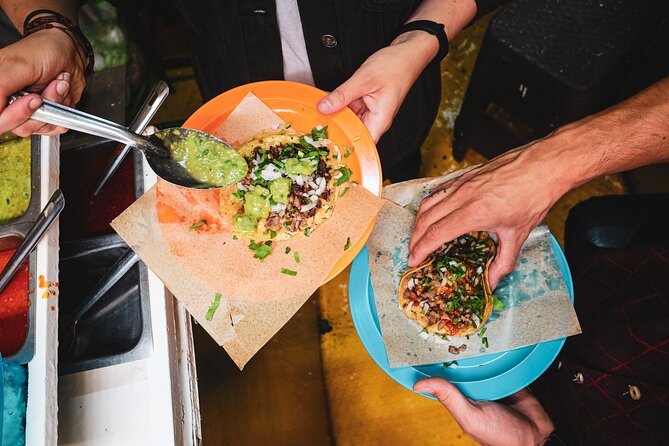
Reviewed · CITY TOURS
Mexico City deep tour through La Merced and iconic markets
Mexico City’s La Merced district is not a polished sightseeing zone. It is loud, crowded, colorful, and packed with everyday trade. This four-hour walk takes you through Mercado Sonora and Mercado Merced, then adds tacos, mole, drinks, pre-Hispanic snacks, and a look at public art most visitors miss.
In This Article
- Key points at a glance
- Why this market walk feels different
- Mercado Sonora and its stranger side
- La Merced, the main event
- Tacos, mole, and pre-Hispanic bites
- Abelardo L. Rodriguez murals
- A one-minute church stop with real visual impact
- Walking, crowds, and the right pace
- Guides and the benefit of a small group
- Is $115 a fair price?
- Who should book this experience?
- Should you book the La Merced market tour?
- FAQ
- How long is the tour?
- What time does the tour begin?
- Where does the tour start?
- Where does the tour end?
- Is hotel pickup included?
- How many people can join?
- Is the tour offered in English?
- What food is included?
- What drinks are included?
- What happens if I cancel?
I like two things right away: the group is limited to six, and the food is woven into the route rather than treated as a separate meal. I also like the chance to see Mexico City with guides such as Pablo, Cesar, Cristobal, Jorge, Ricardo, Elissa, and Jose Miguel, who can explain what you are seeing as the streets change around you.
The main caution is physical and sensory. You will walk through tight market aisles and heavy crowds, and the route can feel rushed if you want long stops at individual stalls. This is best for a confident walker who wants an active, local-feeling morning, not a quiet museum tour.
Key points at a glance
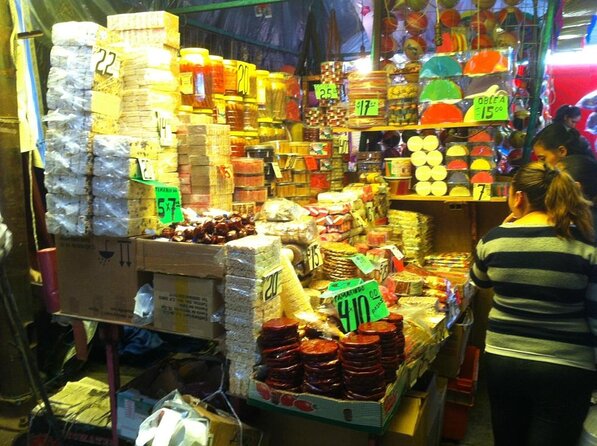
- Mercado Sonora brings a different side of Mexico City: Expect a market known for sorcery-related goods and live animals, an unusual stop that can be confronting for some people.
- La Merced is the food heart of the walk: This is the oldest market in town, with fruit, prepared food, ingredients, and countless corners to explore.
- Food and drinks are included: You receive three top street tacos, fresh fruit juice, pre-Hispanic snacks, mole, a michelada, a beer, and a cocktail or coffee.
- The group stays small: A maximum of six people makes it easier to ask questions and keep up in crowded passages.
- The route includes art and architecture: The Abelardo L. Rodriguez murals and the Templo de Nuestra Señora de Loreto add cultural depth beyond food.
- The ending requires planning: The walk begins near Centro Histórico and ends at Itacate del Mar in Bosques de las Lomas, so confirm the final meeting details before setting out.
Why this market walk feels different
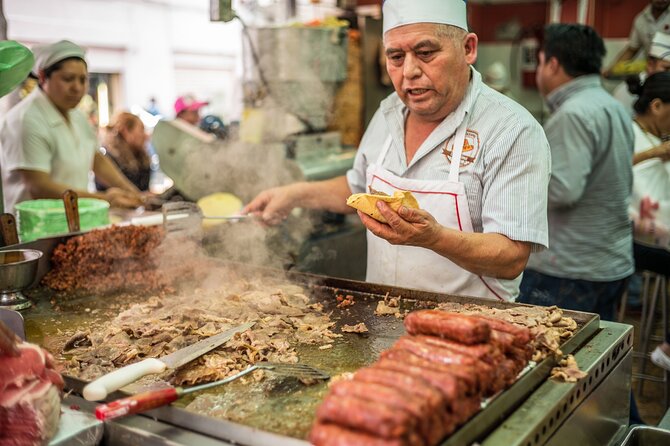
Many Mexico City food tours stay in familiar Roma, Condesa, or Centro Histórico neighborhoods. This one points you toward La Merced, where the city’s daily commerce takes center stage. You will see vendors, shoppers, narrow passages, food stalls, unusual merchandise, and the constant movement that makes the district feel more like a working city than a sightseeing set.
The experience starts at 11:30 a.m. at Hotel CastropolAV on José María Pino Suárez in Centro. From there, your bilingual guide leads you into the market district. The format matters. With no more than six people, the guide can usually keep the group together through crowded areas and adjust the stops to your interests.
That small size does not turn the area into an easy stroll. The route involves plenty of walking and repeated turns through market corridors. I would wear comfortable shoes, keep your hands free, and avoid carrying valuables. The requested dress code is smart casual and discreet, which is sensible for a local market setting.
Other city tours we've reviewed in Mexico City

Mercado Sonora and its stranger side
The first stop is Mercado Sonora, with about 40 minutes set aside for the visit. It is known for goods connected with sorcery and folk practices, along with live animals. That combination gives the market a character unlike the standard produce-and-tacos hall.
Your guide is especially useful here. Without context, shelves of unfamiliar objects and the market’s animal areas can seem confusing or unsettling. A guide can explain the role of the products and help you move through the market without getting lost.
This is also the point where you should consider your comfort level. One person described the caged animals as difficult and felt that the route spent too much time zigzagging through the market. That response is worth taking seriously. If you are sensitive to live-animal markets, ask your guide early how much time the group will spend in those areas.
For the right person, Sonora is a memorable introduction to Mexico City’s less familiar traditions. It is not a tidy cultural display. It is a working market with a strong local purpose, and that is precisely what makes it unusual.
La Merced, the main event
After Sonora, the walk continues to La Merced for about an hour. This is the core of the experience and the place where the food side of the tour makes the most sense.
La Merced is described as Mexico City’s oldest market, and the scale is part of the story. You are not simply visiting one attractive hall with a few photo stops. You are moving through a network of stalls and passages where ingredients, prepared foods, produce, and everyday goods fill the space.
The market can be challenging to navigate alone. The guide’s job is not only to name dishes but also to steer you through the maze and point out details you would probably miss. Pablo, Cesar, Cristobal, Jorge, Ricardo, Elissa, and Jose Miguel have each been praised for making the market easier to understand and for showing things that are not obvious on a normal city walk.
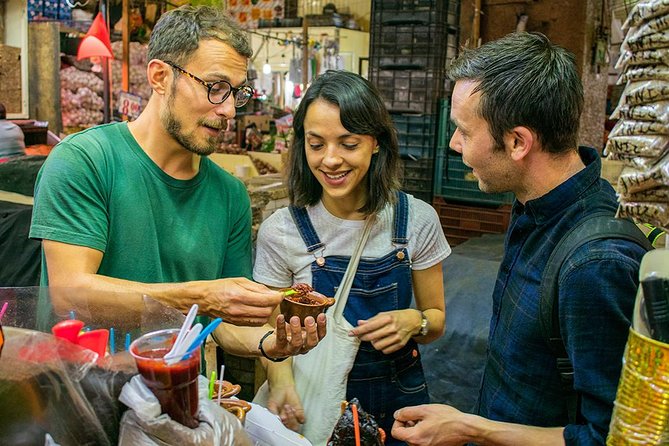
Food is served in stages. You receive fresh fruit juice, pre-Hispanic snacks, and three street tacos, along with the other tastings included in the price. The exact taco stops can be adapted, but the pace may be brisk. If you want time to sit, watch one vendor work, or study a particular aisle, say so at the beginning.
That point is important. Some people want a food crawl with one carefully chosen stop at a time. This tour is more of a moving survey of the district, with bites and drinks along the way. You will see more, but you may not linger as long.
Tacos, mole, and pre-Hispanic bites
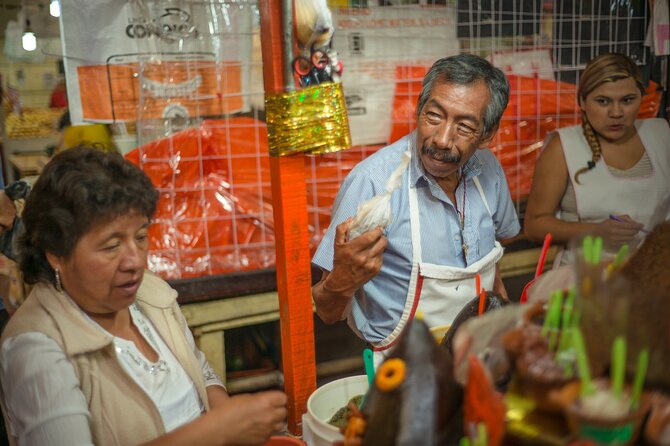
The included food gives the tour good value, especially if you are curious about more than standard restaurant dishes. Three street tacos form the main meal, while fresh juice and pre-Hispanic snacks broaden the range.
The pre-Hispanic tasting may be the most challenging part for cautious eaters. The point is not simply to provide familiar Mexican food in small portions. You are asked to try flavors and ingredients that may be new to you. Keep an open mind, but do not feel that you need to pretend every bite is your favorite.
Mole is also included as a tasting, listed alongside breakfast. The information does not specify the exact mole style or venue, so consider it an introduction rather than a full sit-down mole meal. Your guide can provide the useful context: how the sauce is used, what you are tasting, and why it belongs in the city’s food culture.
Drinks keep the route lively. The package includes one michelada, one beer, soft drinks if preferred, and a cocktail or coffee. Alcohol is not required, and the soft-drink option makes the tour workable for people who want the food and market experience without drinking.
The value here depends on how you eat. If you would normally pay separately for tacos, snacks, juice, mole, and drinks, $115 per person may feel reasonable, particularly with a bilingual guide and a six-person cap. If you are mainly looking for one large meal, the price may seem high. You are paying for access, navigation, explanations, and a broad tasting route, not just lunch.
Abelardo L. Rodriguez murals

The 40-minute stop at the Abelardo L. Rodriguez murals shifts the mood from market commerce to public art. The site is presented as an art market and one of the area’s lesser-known cultural stops.
This is a useful change of pace. After the crowded aisles of Sonora and La Merced, the murals give you a chance to look upward and pay attention to the buildings and artwork around you. The route is stronger because it does not reduce the district to food alone.
The stop also gives your guide room to connect art, architecture, and the Centro Histórico. The most rewarding guides on this experience, including Cristobal and Jorge, are described as good at explaining the setting in an engaging way rather than simply pointing at a wall and moving on.
Do not expect a major museum visit or a long art lecture. The stop lasts around 40 minutes, and the tour keeps moving. Think of it as a compact cultural pause that adds meaning to the streets you have just walked.


A one-minute church stop with real visual impact
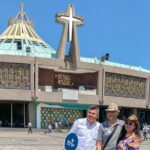
The Templo de Nuestra Señora de Loreto is listed as a one-minute stop, so this is a quick exterior look rather than a full church visit. Its appeal is visual: the church is described as surreal, an unexpected sight along the route.
The short timing tells you how to treat it. You may stop for a photograph and a brief explanation, but it is not a chance to explore the interior at length. That is not a flaw if you enjoy seeing small architectural surprises between larger stops. It may disappoint you if religious buildings are a main reason you booked the tour.
Walking, crowds, and the right pace
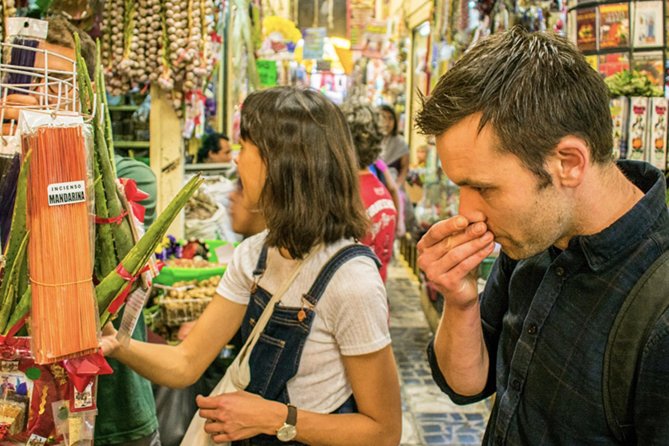
You need moderate physical fitness for this experience. The challenge is not a steep hike. It is the combination of distance, hard walking surfaces, crowded aisles, sudden turns, and the need to stay close to your guide.
Some people have described the route as an adventure that would be difficult to manage alone. Others found the repeated zigzagging tiring and wanted more time in La Merced. Both reactions make sense. The route aims to show several markets and cultural sites in four hours, so movement is built into the design.
Wear walking shoes and bring only what you need. Avoid valuables, keep your phone secure, and arrive early. The maximum waiting time is 15 minutes, and missing the start can mean losing the tour.
There is one practical detail I would confirm before booking: the end point. The tour starts near Centro Histórico at Hotel CastropolAV and ends at Itacate del Mar, P.º de los Tamarindos 90, in Bosques de las Lomas. That is a substantial change of area, and the published information has caused confusion about the ending location and tour length. Contacting the guide the day before is a smart move.
Guides and the benefit of a small group
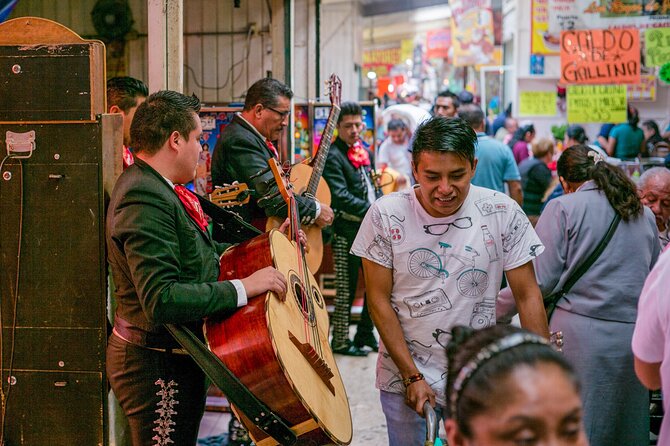
The guide can make or break this kind of outing. In a market this large, a good guide keeps you moving, explains what you are eating, and adds context without turning every stop into a lecture.
Pablo has been singled out for navigating both Sonora and La Merced, while Cesar is praised for food knowledge and a lively manner. Cristobal is noted for his passion for Mexico City and its culture. Elissa is associated with local food knowledge, ingredients, and history, and Jorge is described as engaging when explaining the city’s less familiar places.
The named guides are not a guarantee of who will lead your departure, but they show the sort of guide this experience aims to provide. Because the maximum group size is six, you should have a better chance to ask for clarification or request a small adjustment than you would on a large coach tour.
Do not expect a rigid script to suit every interest. The best use of the small group is to tell your guide what you care about. If you want more food detail, more architecture, or extra time at La Merced, mention it early. One guide has adjusted stops for the group, but the four-hour limit still applies.
Is $115 a fair price?
At $115 per person, this is not a bargain-basement street food walk. The price includes a bilingual guide, three tacos, fresh juice, pre-Hispanic snacks, a michelada, a beer or soft drink, a cocktail or coffee, and mole tasting.
The strongest value comes from the combination. You are paying to enter a part of Mexico City that can be confusing to navigate, while also sampling several foods and drinks. The small group is another meaningful benefit.
The price is less attractive if your priority is a long, relaxed meal or a single market. One person felt that the route covered too much ground and that the group had too little time to enjoy La Merced. If that sounds like your ideal day, a focused market visit with your own food budget may suit you better.
Free cancellation is available up to 24 hours before the start time. Changes or cancellations within 24 hours are not refunded, so keep that cutoff in mind when arranging your Mexico City schedule.
Who should book this experience?
You should book this if you want to see an everyday side of Mexico City, enjoy trying unfamiliar foods, and are comfortable walking through dense markets. It suits curious eaters, repeat visitors, confident first-time visitors, and anyone who wants a guide in places that can be hard to read on your own.
It is less suitable if you dislike crowds, live-animal markets, fast-paced walking, or food tastings with unfamiliar ingredients. It is also not the best choice if you want a quiet historical tour with long explanations at each monument.
Should you book the La Merced market tour?
Book it if your idea of a good Mexico City morning includes street tacos, a michelada, market noise, folk traditions, public murals, and the chance to see places outside the usual sightseeing circuit. The 4.9 rating from 93 ratings and 98 percent recommendation figure fit the tour’s strongest qualities: local access, strong food stops, and guides who can lead you through spaces you might not tackle alone.
Go in with realistic expectations. This is an active four-hour route, not a slow afternoon in one market. Confirm the end point, arrive before 11:30 a.m., wear good shoes, and tell the guide whether you want more food detail or more time to look around. If you do that, the tour offers a lively and unusual look at Mexico City’s market culture.
FAQ
How long is the tour?
The experience lasts approximately four hours.
What time does the tour begin?
It begins at 11:30 a.m.
Where does the tour start?
The starting point is Hotel CastropolAV, José María Pino Suárez 58, Centro Histórico, Mexico City.
Where does the tour end?
It ends at Itacate del Mar, P.º de los Tamarindos 90, Bosques de las Lomas, Mexico City.
Is hotel pickup included?
No. Hotel pickup and drop-off are not included, though they are available to purchase.
How many people can join?
The maximum is six people per booking and six people on the activity.
Is the tour offered in English?
Yes. A bilingual guide leads the experience, and it is offered in English.
What food is included?
You receive three street tacos, fresh fruit juice, pre-Hispanic snacks, and a mole tasting.
What drinks are included?
The experience includes one michelada, one beer, and a cocktail or coffee. Soft drinks are available instead of alcoholic drinks.
What happens if I cancel?
You receive a full refund if you cancel at least 24 hours before the start time. Cancellations or changes made less than 24 hours before the start are not refunded.
More City Tours in Mexico City

More tours in Mexico City we've reviewed




City Tours, compared.
 ★ 4.6Mexico City: Teotihuacan, Tlatelolco & Guadalupe Shrine TourFrom $49
 ★ 5.0Teotihuacan Hot Air Balloon Flight from Mexico City / VolareFrom $1553 to 9 hours (approx.)
 ★ 5.0Teotihuacan Private Tour from Mexico CityFrom $1401 to 5 hours (approx.)
 ★ 5.0Historic Center Food Tour in Mexico CityFrom $1155 hours (approx.)
 ★ 5.0The best tour to Teotihuacán from Mexico CityFrom $506 to 7 hours (approx.)
 ★ 4.3From Mexico City: Puebla, Cholula and Tonantzintla Day TripFrom $89
 ★ 4.0Mexico City: Hop-on Hop-off Bus TourFrom $211 - 2 days
 ★ 4.8Mexico City: Historic Downtown Walking TourFrom $263 hours