

Reviewed · CITY TOURS
México City: Explore neighborhood of Tepito with local
Tepito is Mexico City without the polished tourist wrapper. This three-hour walk takes you into the Barrio Bravo with a local guide, through its huge street market, past El Maracaná and San Francisco de Asís, and finally to a famous La Santa Muerte altar. The local viewpoint is the point.
In This Article
- Key points about walking Tepito
- Why Tepito makes a different Mexico City stop
- Meeting at Letras de Tepito
- Entering the market with 12,000 stalls
- El Maracaná and Tepito’s sporting identity
- San Francisco de Asís in the heart of the barrio
- Residential streets known to Tepiteños
- Local tastings and the Tepiteña michelada
- La Santa Muerte altar
- Safety, comfort, and respectful behavior
- Is $81 a fair price?
- Who should book this walk?
- Should you book the Tepito experience?
- FAQ
- Where does the Tepito tour meet?
- How long does the tour last?
- What languages are available?
- How large is the group?
- What food and drinks are included?
- Can I bring a professional camera or valuables?
- Who should not take this tour?
I like the tiny group, limited to six, and the guides who come from Tepito itself. I also like the mix of food, neighborhood history, architecture, and daily life. You get a drink and local tastings, not just a lecture while walking past closed doors.
The main drawback is that this is a physically demanding urban walk. Narrow streets, crowded market passages, and residential areas can be hard for anyone with mobility limits, claustrophobia, a recent surgery, or hearing impairment. Leave professional cameras and valuables behind.
Key points about walking Tepito

- A local Tepiteño guide: Guides such as Gabi, also written as Gaby, Lili, and Nelly bring personal knowledge of the neighborhood and its people.
- A 12,000-stall street market: The market is one of Latin America’s largest and most maze-like traveling markets.
- A small group of six: You get a closer connection with the guide and less chance of being separated in crowded streets.
- Food and drink included: Try local cuisine tastings and one Tepiteña michelada, or choose water or fruit juice.
- More than the market: The route includes El Maracaná sports center, San Francisco de Asís church, residential streets, and a La Santa Muerte altar.
- A careful approach to safety: Guides and security are included, but you still need to follow instructions and carry as little as possible.
Why Tepito makes a different Mexico City stop
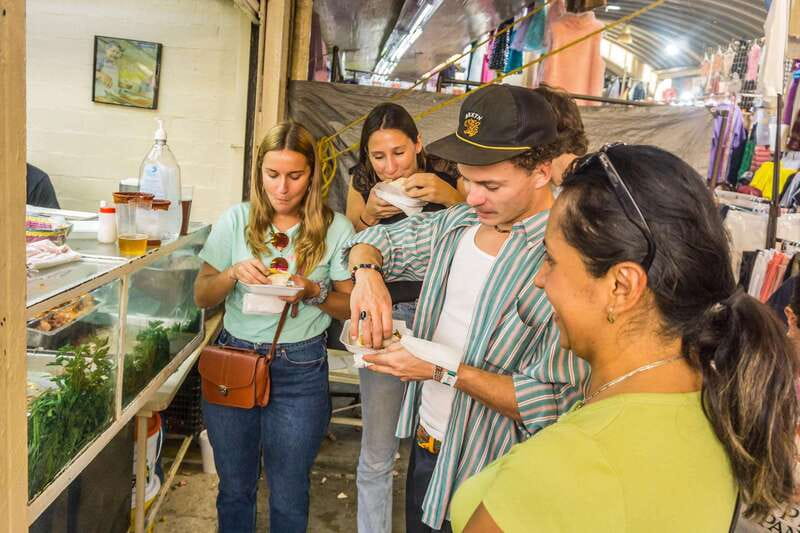
Many first visits to Mexico City focus on grand museums, historic plazas, fashionable neighborhoods, and celebrated food halls. Tepito offers a very different picture. It is a working neighborhood known as Barrio Bravo, where commerce, sport, faith, family life, and street culture meet in a tight urban setting.
I like the honesty of that contrast. This is not a tour that tries to make Tepito look like somewhere else. You are shown the market, the public places, the churches, the side streets, and the religious traditions that shape local life.
That difference is also why you should think carefully before booking. Tepito can feel intense, especially when you move from the main street into a maze of stalls and smaller residential lanes. The provider includes guides and security, and the group is kept small, but you should still treat the neighborhood with respect and keep your attention on the guide.
The strongest part of the experience is the local connection. Gabi, also called Gaby in the tour information, is from Tepito and has been praised for knowing the area and its people closely. Lili and Nelly are also named as guides who bring a personal, community-based perspective. Guide assignments can vary, so you should not assume one particular person will lead your departure.
Other city tours we've reviewed in Mexico City


Meeting at Letras de Tepito
The meeting point is Letras de Tepito. These large neighborhood letters provide a clear visual landmark, but hotel pickup and drop-off are not included, so you need to arrange your own way to and from the starting point.
The tour lasts three hours. That is enough time for a real walk without turning the outing into an all-day commitment. It also means the pace matters. You will be moving through a busy market and narrow streets, so comfortable shoes are a practical choice.
The language options are English and Spanish. A small group of no more than six people should make it easier to hear the guide and ask questions, though street noise may still be part of the experience. If you have a hearing impairment, the provider lists this activity as unsuitable, so choose another Mexico City outing.
Entering the market with 12,000 stalls

The first major part of the walk leads toward one of Tepito’s main streets and into its traveling street market. The market has more than 12,000 stalls and is described as one of the largest and most labyrinthine in Latin America.
That number matters because this is not a short row of souvenir tables. It is a dense commercial world with many routes, sounds, products, and people moving at once. The guide helps you read the place rather than simply pass through it. You can ask how the market works, what makes it important to Tepito, and how it fits into the neighborhood’s daily rhythm.
I like that the market is treated as a central part of local life, not as scenery. You are not being led to a staged performance. You are walking through an active part of the community, so stay close and follow instructions.
There is a tradeoff. A market this large can feel crowded and disorienting, particularly if you dislike tight spaces. It is also not the right setting for professional photography. The rules specifically prohibit professional cameras, and you are advised not to bring valuables.
The best approach is simple: carry only what you need, dress plainly, and avoid turning the walk into a photo expedition. Listen first. You will get more from the market if you pay attention to the guide’s explanation and the activity around you.
El Maracaná and Tepito’s sporting identity
The route continues to El Maracaná, described as a famous and beautiful sports center. Its inclusion gives the tour another layer. Tepito is not presented only as a market or as a neighborhood with a reputation. Sport is part of its public identity too.
A sports center can tell you a great deal about how a neighborhood gathers and sees itself. Here, the stop helps move the tour beyond shopping stalls and into community life. Your guide can place the building within Tepito’s local story and explain why it matters to residents.
The supplied information does not promise a match, a training session, or entry into every part of the facility. Think of El Maracaná as a guided stop and a chance to understand the area, not as a sporting event.
That distinction helps keep expectations in line. If you want a stadium tour or a scheduled game, this is not advertised as one. If you want to see how sport fits into Tepito’s identity, it earns its place on the route.
San Francisco de Asís in the heart of the barrio

The next stop is the main church, San Francisco de Asís, located in the heart of Tepito. A church visit adds a quieter and more reflective note after the energy of the market and sports center.
The value here is context. Neighborhoods are shaped by commerce and public activity, but also by places of worship and shared tradition. Your guide can connect the church to Tepito’s religious life and show how it fits into the surrounding streets.
This is also one reason the tour works better than a simple market walk. You are moving through several parts of the neighborhood’s identity: trade, sport, faith, food, and home life. I appreciate that range because it prevents Tepito from being reduced to a single stereotype.
As with the sports center, the supplied details do not promise a service or special access inside the church. Be ready to follow any instructions from your guide about entering, taking photographs, or keeping quiet.



Residential streets known to Tepiteños

After the major public sites, the route turns toward streets that the local guides know well. The goal is to show you residential areas and offer a view of Tepito beyond its best-known market.
This may be the most valuable section for you if you want to understand daily life. A market can be fascinating, but it can also make a neighborhood seem like one giant place of business. The residential streets add a human scale. You begin to see Tepito as a place where people live, not just where people shop.
The route is described as an exclusive perspective because the guides are Tepiteños. That does not mean you should wander independently or treat private streets as a photo set. It means you are accompanied by someone who can explain the area and guide you through it appropriately.
The small group helps here. Six people are easier to keep together than a large tour party, and you have more room to ask about architecture, local customs, and the differences between the market streets and residential sections.
Still, this is where the physical demands may become more noticeable. You may be walking over uneven urban surfaces, passing through narrow lanes, and adjusting to a crowded environment. The tour is not suitable for wheelchair users or people with mobility impairments.
Local tastings and the Tepiteña michelada

Food is part of the experience, not an afterthought. Local cuisine tastings are included, giving you a chance to sample flavors tied to the neighborhood rather than stopping at a generic restaurant.
The exact snacks are not specified, so you should not book this expecting a fixed tasting menu. The useful promise is variety and local context. Your guide can connect what you taste with the neighborhood’s food culture and explain what you are trying as you go.
Each participant also receives one Tepiteña michelada, described as a famous local drink. If you do not want alcohol, you can choose a bottle of water or a fruit juice instead.
That choice makes the tour easier to recommend to mixed groups. You can enjoy the food portion without drinking alcohol, and the included refreshment gives you a brief pause during a three-hour walk. If you have dietary restrictions, the supplied information does not explain whether substitutions are available, so ask the provider before booking.
La Santa Muerte altar

The final major stop is one of Mexico’s most famous altars to La Santa Muerte. This is a serious religious and cultural site, and it deserves a respectful attitude.
La Santa Muerte devotion is an important part of the wider story the tour is trying to tell about Tepito. Ending here shifts the focus from commerce and public streets to belief, protection, and personal devotion.
The guide’s role matters especially at this stop. A local explanation can help you understand what you are seeing without treating the altar as a strange spectacle. Listen carefully, avoid careless jokes, and follow directions about photographs and behavior.
The information provided does not promise a ceremony, private meeting, or special access. You are visiting the altar as part of a guided neighborhood walk. The value is in learning how this place fits into Tepito, not in collecting a dramatic photograph.
Safety, comfort, and respectful behavior

The tour is presented as a safe and comfortable way to visit Tepito, with guides and security included. Several named guides have been praised for making people feel at home, and one account specifically describes never feeling insecure during the walk.
That is useful reassurance, but it is not a reason to ignore common sense. Tepito is a working neighborhood, not a theme park built for visitors. Keep your valuables at home, do not bring a professional camera, stay with the group, and let the guide set the tone.
The restrictions are clear. The activity is not suitable for wheelchair users, people with mobility impairments, people with claustrophobia, people with recent surgeries, or people with hearing impairments. Those limits are easy to understand given the market passages and walking conditions.
You should also consider your own comfort with attention and uncertainty. If you need a quiet, highly controlled tour with wide paths and predictable stops, this will probably feel demanding. If you are open to a busy urban environment and willing to listen, the same qualities make it memorable.
Is $81 a fair price?
At $81 per person, this is not the cheapest way to spend three hours in Mexico City. The price needs to be judged against what is included: a local guide, security, a small group capped at six, local food tastings, and one michelada or nonalcoholic drink.
You are paying for access and interpretation, not transportation or a large attraction ticket. Hotel pickup and drop-off are not included, so add your own transport costs when planning the outing.
For me, the small group is a major part of the value. In a market with thousands of stalls, a large party would make it harder to hear, ask questions, or stay together. A local guide who knows Tepito personally also offers something you cannot get from walking in alone with a map.
The price makes the most sense if you want a focused, personal introduction to a neighborhood you would not feel comfortable exploring independently. It makes less sense if your main goal is bargain shopping, a food tour with many dishes, or a formal museum-style history lesson.
Free cancellation up to 24 hours before the start gives you some flexibility, and you can reserve now and pay later. Starting times vary, so check availability when choosing your date.
Who should book this walk?
I would recommend it to curious adults who want Mexico City beyond the usual visitor route. It suits you if you care about local stories, neighborhood architecture, food, public spaces, religion, and the way people use their own streets.
It is especially useful for first-time visitors who want a guided introduction to Tepito rather than an unsupervised wander. It can also work well for repeat visitors who have already seen the historic center and want a more grounded view of the city.
Spanish speakers may find it especially easy to connect, but English tours are available. The guide names associated with the experience include Gabi or Gaby, Lili, and Nelly, though the person leading your tour may differ.
I would not choose it for young children who tire quickly, anyone with the listed physical limitations, or visitors who want a relaxed sightseeing stroll. The route has a strong street-level character, and you should be ready for close quarters and a changing pace.
Should you book the Tepito experience?
Book this tour if you want to see Mexico City’s B side with a local who can explain more than the postcard version. The market, El Maracaná, San Francisco de Asís, residential streets, local tastings, and La Santa Muerte altar create a broad look at Tepito in just three hours.
Skip it if crowds and narrow spaces make you uneasy, or if you want to carry expensive equipment. For the right visitor, $81 buys a rare kind of access: not a performance, but a guided walk through a neighborhood that most tourists never see. Go light, listen closely, and let Tepito be itself.
FAQ
Where does the Tepito tour meet?
The meeting point is Letras de Tepito. Hotel pickup and drop-off are not included.
How long does the tour last?
The tour lasts three hours. Starting times vary, so you need to check availability for your chosen date.
What languages are available?
The tour is offered in English and Spanish.
How large is the group?
This is a small-group experience limited to six participants.
What food and drinks are included?
Local cuisine tastings are included. Each participant receives one Tepiteña michelada, or can choose a bottle of water or fruit juice instead.
Can I bring a professional camera or valuables?
Professional cameras are not allowed, and you are advised not to bring valuables.
Who should not take this tour?
The activity is not suitable for people with mobility impairments, wheelchair users, people with claustrophobia, people with recent surgeries, or people with hearing impairments.
More City Tours in Mexico City


More tours in Mexico City we've reviewed








City Tours, compared.
 ★ 4.6Mexico City: Teotihuacan, Tlatelolco & Guadalupe Shrine TourFrom $49
 ★ 5.0Teotihuacan Hot Air Balloon Flight from Mexico City / VolareFrom $1553 to 9 hours (approx.)
 ★ 5.0Teotihuacan Private Tour from Mexico CityFrom $1401 to 5 hours (approx.)
 ★ 5.0Historic Center Food Tour in Mexico CityFrom $1155 hours (approx.)
 ★ 5.0The best tour to Teotihuacán from Mexico CityFrom $506 to 7 hours (approx.)
 ★ 4.3From Mexico City: Puebla, Cholula and Tonantzintla Day TripFrom $89
 ★ 4.0Mexico City: Hop-on Hop-off Bus TourFrom $211 - 2 days
 ★ 4.8Mexico City: Historic Downtown Walking TourFrom $263 hours