
Reviewed · BUS TOURS & PASSES
Turibus Hop On Hop Off Mexico City Tour
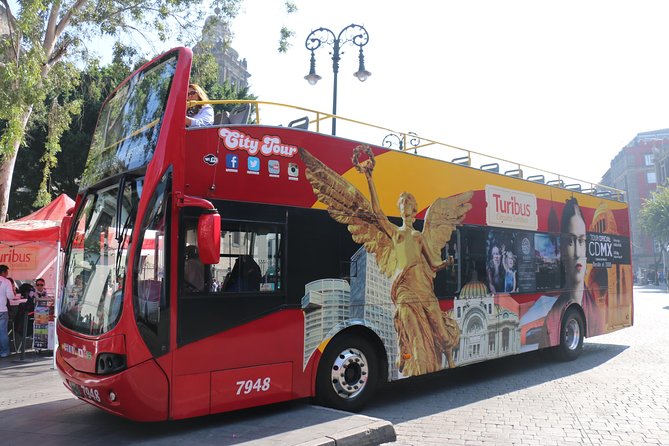
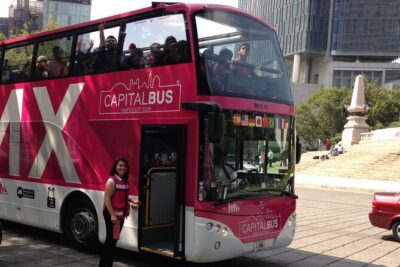
Mexico City is too large for a quick checklist, and the Turibus gives you a useful first look from the top of a sightseeing bus. Four routes cover the historic center, Polanco, the southern districts, and the Basilica area, so you can shape the day around what interests you most.
In This Article
- Key points to know before you board
- Four routes, four different Mexico City experiences
- Riding the Historical Center route from Auditorio to the Zócalo
- Polanco route for museums, shopping, and family stops
- The South route to Coyoacán and Frida Kahlo
- The Basilica route and its northern sights
- How to use the bus without wasting your day
- What the included coupon booklet is really worth
- Where the tour can lose value
- Who will get the most from this ticket
- Should you book the Turibus Mexico City tour?
- FAQ
- How long does the Turibus Mexico City tour last?
- Which routes are included?
- Is commentary available in English?
- Can I ride on the open top or inside?
- Does the ticket include food or museum admission?
- What happens if the Basilica route cannot reach the Basilica?
I like the freedom to hop off at places such as the Zócalo, Museo Nacional de Antropología, Frida Kahlo Museum, or Museo Soumaya. I also like having both an open-top deck and a lower air-conditioned level, plus audio commentary in English and a coupon booklet for extra savings.
The main drawback is reliability. Traffic, demonstrations, public events, Sunday cycling closures, and route changes can affect the service. The current operating note also says that only the Historical Center route runs from 9 a.m. to 7 p.m. until further notice, so you should confirm the routes before building your day around them.
Key points to know before you board
- Four different routes: Choose among the Historical Center, Polanco, South, and Basilica circuits, each with a different feel and set of sights.
- One ticket connects the routes: The ticket includes transportation between the listed stops, though route availability and frequency can change.
- Best for a first orientation: The bus helps you understand the shape of Mexico City before returning to favorite areas on foot.
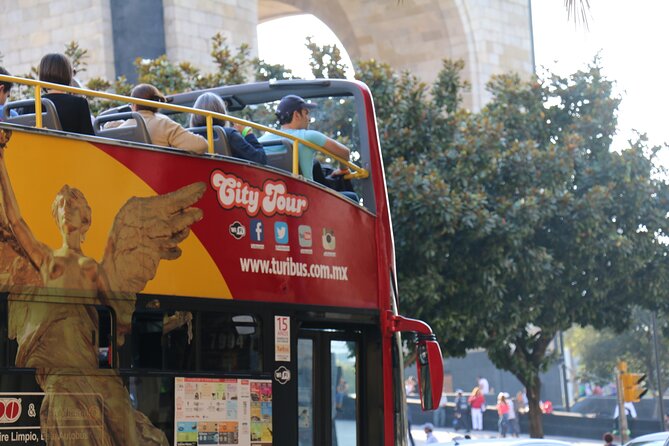
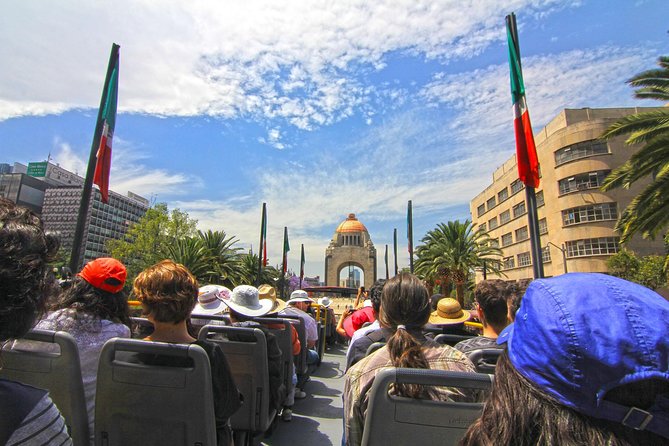
- Open air or air conditioning: Sit upstairs for broad city views or downstairs for a cooler, more sheltered ride.
- English audio included: Pick up the provided headphones at the ticket office and follow the digital commentary as you ride.
- Sunday mornings need extra planning: From 8 a.m. to 2 p.m., the Ciclotón can close streets and force route changes.
Four routes, four different Mexico City experiences
The value of this tour comes from its range. You are not getting one short loop around the center. You can use the same ticket to reach museums, parks, shopping areas, university buildings, neighborhoods, and major religious sites.
The routes also differ in character. The Historical Center is the most useful for first-time orientation. Polanco is polished and museum-heavy. The South route takes you toward Coyoacán and the UNAM area. The Basilica route is shorter and focused on northern Mexico City sights.
The listed duration is about three hours if you stay on the bus. That is enough for a broad overview, but not enough to explore more than a few stops properly. If you hop off often, plan on spending much longer than three hours, since you will need to wait for the next bus and account for city traffic.
A few more Mexico City tours and experiences worth a look


Riding the Historical Center route from Auditorio to the Zócalo
The main route begins at Auditorio Nacional, near some of Mexico City’s best-known cultural institutions. From there, it moves through the area around the Museo de Arte Moderno and La Condesa before joining major Reforma stops.
At Museo de Arte Moderno, you are near one of the city’s key art museums. La Condesa gives you a chance to leave the bus and walk through one of the city’s most appealing central neighborhoods. The Fuente de Cibeles stop is useful for reaching that district and Mercado Roma, although the exact route connection can depend on current operations.
Casa Lamm is another stop in the Condesa and Roma area. It gives you access to a cultural center in a part of town known for cafés, galleries, and attractive streets. The bus will not replace a proper neighborhood walk, but it can save you a long taxi ride between districts.
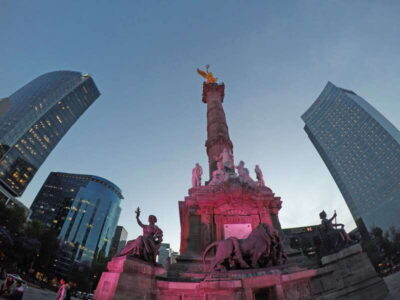
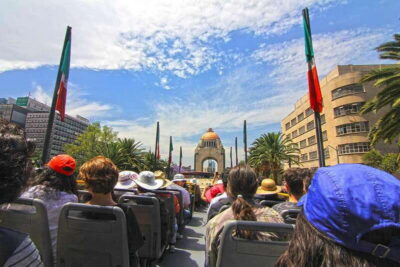
The Angel of Independence is one of the clearest orientation points on Paseo de la Reforma. From the upper deck, you get a good sense of the avenue’s scale. The stops at Reforma 222, Museo de Cera, and the Monument to Cuauhtémoc continue along this major urban corridor.
The route then heads toward the historic center. Av. Juárez 50 is a practical stop for reaching central sights, followed by the Zócalo, Plaza Manuel Tolsá, and Museo Franz Mayer. The Zócalo is the essential hop-off point. You can walk around the enormous main square, visit the cathedral area, and explore streets leading into the oldest part of the city.
Plaza Manuel Tolsá and Museo Franz Mayer are better choices if you prefer smaller-scale cultural stops. Plaza de la República, near the Monument to the Revolution, adds another major civic landmark. Museo San Carlos gives art-minded visitors another reason to leave the bus.
The listed route includes Reforma L1, the Angel of Independence again, Paseo de la Reforma near Río de la Plata, and the Museo Nacional de Antropología. That museum is one of the biggest reasons to use this route, but allow several hours if you want more than a quick look. A short hop-off visit will give you only a taste.
Polanco route for museums, shopping, and family stops
The Polanco circuit begins around Auditorio and Bicigratis, then travels through Calle Arquímedes and Avenida Presidente Masaryk. This is the route for polished streets, major museums, high-end shopping, and family attractions.
Avenida Presidente Masaryk is useful if you want to see one of Mexico City’s best-known shopping avenues. Antara continues that theme with a large commercial complex. The route is convenient for moving through Polanco without relying on taxis, though you should not confuse a sightseeing ride with a fast point-to-point transfer. Traffic can slow the bus.
Museo Soumaya is the star stop on this circuit. Its unusual building is easy to recognize, and the museum gives the route a strong cultural focus. You can also use the stop to reach nearby attractions in the Polanco area.
Hipódromo de las Américas and Papalote Museo del Niño broaden the appeal for families. Papalote is the natural hop-off choice if you are traveling with children and want a hands-on museum stop. The circuit is also useful if you prefer modern Mexico City over colonial monuments and central plazas.
Polanco works best as a separate half-day plan. Ride the route for orientation, get off at one or two stops, and leave enough time to visit the museum or explore on foot. Trying to combine every Polanco stop with the full Historical Center route in one day may leave you spending too much time waiting and not enough time seeing.
The South route to Coyoacán and Frida Kahlo
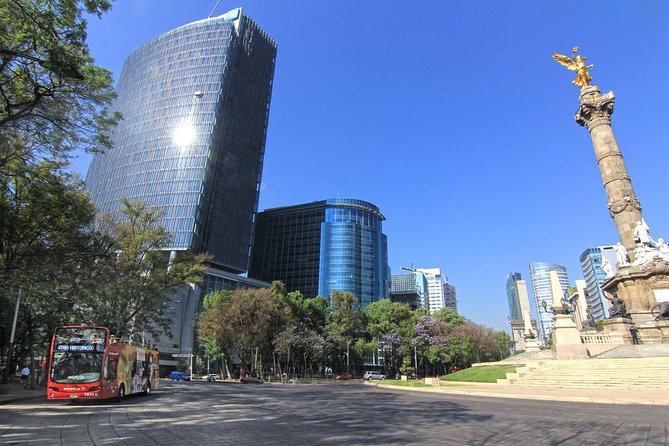
The South route begins at Fuente de Cibeles and runs through Mercado Roma, the World Trade Center, and the Monumental Plaza de Toros México. It then heads toward the university district and Coyoacán.
Mercado Roma is a practical food stop, though lunch is not included. You pay separately for any food or drinks, so treat the market as an optional break rather than part of the ticket.
The World Trade Center and Plaza de Toros show a different side of the city from the colonial center. Avenida de la Paz and the stops near Estadio Olímpico Universitario lead you into the southern part of Mexico City, where the setting and attractions feel less like the central tourist zone.
Perisur and Avenida Centro Comercial are commercial stops. Mercado de flores San Ángel is more distinctive, especially if you want a local market atmosphere and a change from museums and major monuments. The route then continues toward Universum, University City, Rectoría de la UNAM, and the Alfredo Guati Rojo National Watercolor Museum.
University City is an important stop for architecture and campus life. The route lists several university-area stops, including Rectoría de la UNAM, so check the map and current operating pattern before getting off. A route map is included with the ticket, which is helpful here because the southern circuit covers a wide area.
Coyoacán and the Frida Kahlo Museum are the strongest reasons to choose this route. Coyoacán rewards a slower visit, with plazas, markets, and streets that are better explored on foot. The Frida Kahlo Museum is a major draw, but the bus ticket only covers transportation. Admission and any other services are not included.
The stops at Aguayo and the museum area give you flexibility, but do not assume buses will arrive every few minutes. Traffic and route changes may lengthen the wait. If Frida Kahlo is your main goal, plan that stop carefully and avoid packing the entire South route into a tight schedule.
The Basilica route and its northern sights
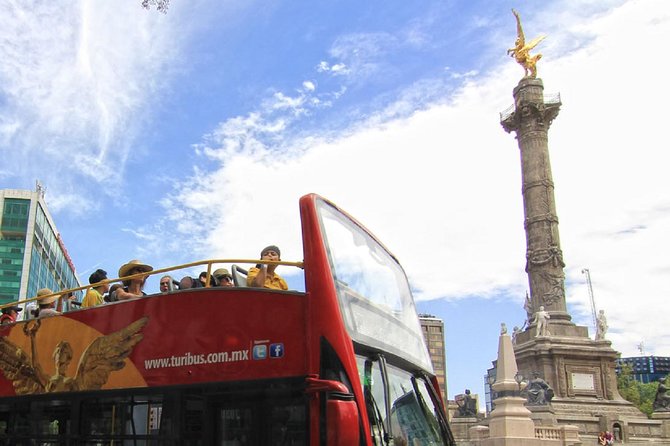
The Basilica circuit starts at the Zócalo and goes to Garibaldi Plaza, Tlatelolco, and the Basilica. It is the shortest listed route, but it reaches places that are not covered as directly by the other circuits.
Garibaldi Plaza is known for mariachi culture and gives the route a strong musical identity. Tlatelolco adds an important historical and archaeological stop in the northern part of the city. These are worthwhile places to see if you want more than the standard Reforma and museum circuit.
The Basilica is the main destination. If the bus cannot reach it for reasons outside the operator’s control, the route may go instead to Plaza de las Tres Culturas. That alternative is not a minor detail, so confirm the route on the day if the Basilica is your priority.
The final listed stop is the Turibus stop near the Palace of the Counts of Miravalle. As with all four circuits, route patterns can change because of road closures, public celebrations, demonstrations, traffic, or safety measures.
Other city tours we've reviewed in Mexico City



How to use the bus without wasting your day
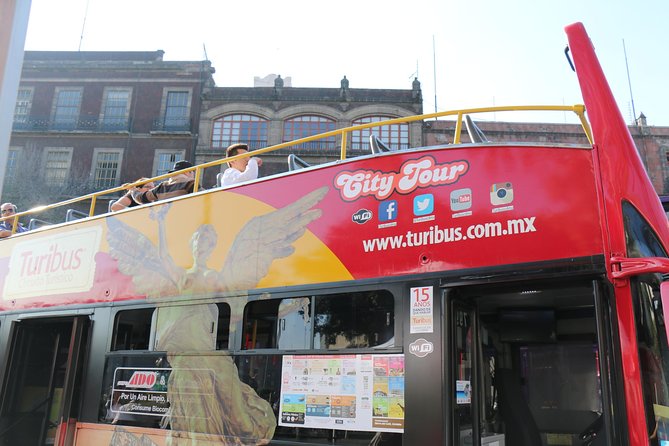
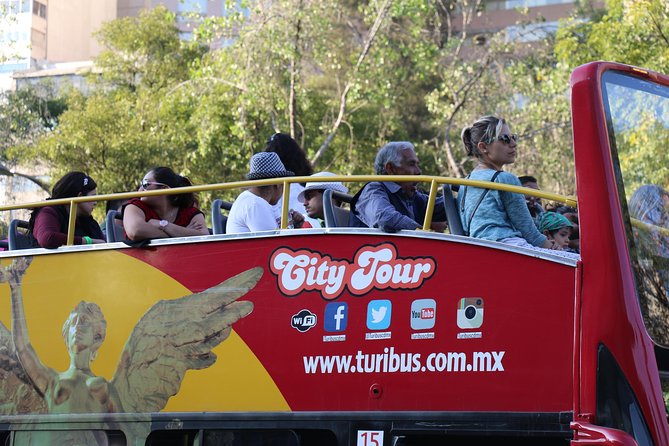
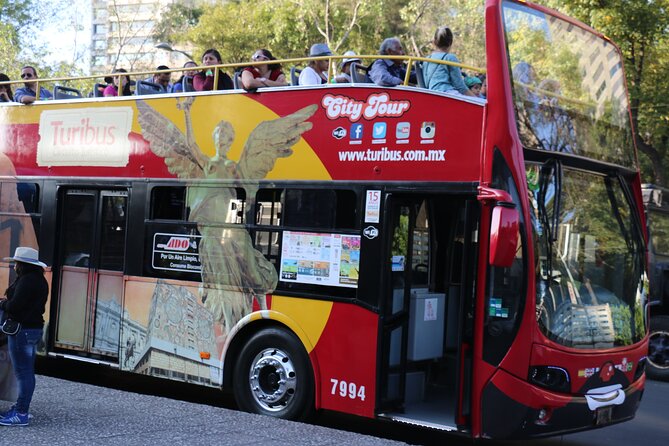
I would begin with a full loop if you are new to Mexico City. Sit upstairs when the weather is comfortable and use the ride to mark places you want to revisit. The open top gives you wider views, but the lower air-conditioned level is the sensible choice in heat, rain, or heavy traffic.
You show your voucher to board at the designated stops. Headphones are provided at the ticket office, and the multilingual digital audio system supplies commentary in English. The commentary is useful for orientation, but it cannot replace time on the ground. Use it to decide where to get off, not as a reason to stay seated all day.
A practical plan is to choose one main route and one short section of another. For example, you might ride the Historical Center circuit in the morning, get off at the Zócalo, and later take part of the Polanco route to Museo Soumaya. Another day, if your ticket option allows two operating days, you could focus on Coyoacán and the South route.
The booking information says options may be available for one or two days, while the operating notes also say tickets are valid for one operating day. Because those statements do not fully match, check the exact validity printed on your voucher before booking around a second day.
The current service note says only the Historical Center route operates from 9 a.m. to 7 p.m. until further notice. This may be a temporary restriction, but it matters. If you specifically want Polanco, South, or Basilica, verify that those circuits are running before you pay for plans built around them.
What the included coupon booklet is really worth
The coupon booklet adds value, but it should not be the main reason you book. It offers discounts on local experiences, which can help if one of the listed offers matches your plans. You do not know the real savings until you see which discounts apply to places you already intend to visit.
The useful inclusions are the transportation on all listed routes, the digital audio system, and the Mexico City Tour Stops guide. Together, they reduce the need to arrange separate taxis between distant areas. The savings are greatest when you use several routes and hop off at more than one stop.
Lunch, drinks, museum admission, and other services are not included. Keep that in mind at the Zócalo, Museo Soumaya, Frida Kahlo Museum, Museo Nacional de Antropología, and other major stops. The ticket is a transport and orientation product, not an all-inclusive sightseeing pass.
Where the tour can lose value
A three-hour ride sounds efficient, but Mexico City traffic can change the math. If buses are delayed or running less often, you may spend a sizable part of your day waiting. Route variations can also make a carefully planned sequence less predictable.
Sunday morning is a special case. From 8 a.m. to 2 p.m., the Ciclotón closes some streets, and the buses use alternative roads on some routes. That can be pleasant for people who enjoy the city’s cycling program, but it may mean that your chosen stop is skipped or reached by a different path.
The tour is near public transportation, which gives you a useful backup. If a route is delayed, you are not completely dependent on the bus. Still, the service is most valuable when you remain flexible and avoid scheduling a timed museum visit immediately after a long cross-city ride.
The overall rating of 3 out of 5 suggests a mixed experience rather than a sure bet. That fits the practical picture: the route coverage is impressive, but changing operations and traffic can reduce the convenience that makes a hop-on-hop-off tour appealing.
Who will get the most from this ticket
I would consider this tour for a first visit, especially if you want to see how far apart Mexico City’s main districts are before choosing where to spend more time. It also suits families, older visitors, and anyone who would rather avoid handling public transit and taxis between several neighborhoods.
It is a good fit if you enjoy seeing a lot from a moving seat and are happy to make your own plan. The bus lets you combine Reforma, the historic center, Polanco, Coyoacán, and the Basilica area without arranging separate transportation for every section.
I would be more cautious if you have only a few hours and one fixed destination. In that case, a direct taxi or public transit trip may be faster. I would also hesitate if your entire plan depends on a route other than the Historical Center, since the current operating note limits service until further notice.
You can cancel for a full refund if you do so at least 24 hours before the experience start time. Cancellations or changes inside that window are not refunded or accepted.
Should you book the Turibus Mexico City tour?
Book it if you want a broad first look, prefer simple transport between districts, and can keep your schedule loose. The Historical Center route is the safest starting point because it connects the Zócalo, Reforma, museums, and major central sights.
Book only after checking current route operations if your priorities are Frida Kahlo Museum, Museo Soumaya, or the Basilica. The tour can be a good value when several routes are running and you use the included transportation well, but delays and route changes make it a poor choice for a tightly timed itinerary.
FAQ
How long does the Turibus Mexico City tour last?
The sightseeing ride lasts approximately three hours if you remain on the bus. Hop-on-hop-off use can take longer because you may get off at stops and wait for another bus.
Which routes are included?
The ticket includes the Historical Center, Polanco, South, and Basilica routes, with transportation between stops listed for those circuits.
Is commentary available in English?
Yes. The tour includes a multilingual digital audio system, and English is offered. Headphones are provided at the ticket office.
Can I ride on the open top or inside?
Yes. You can choose the open-top level or the lower air-conditioned level.
Does the ticket include food or museum admission?
No. Lunch, beverages, museum admission, and services not specifically listed are excluded.
What happens if the Basilica route cannot reach the Basilica?
If the route cannot go to the Basilica for reasons beyond the operator’s control, it may take you to Plaza de las Tres Culturas instead.
More City Tours in Mexico City
More Bus Tours & Passes in Mexico City

More tours in Mexico City we've reviewed






Bus Tours & Passes, compared.
 ★ 4.0Mexico City: Hop-on Hop-off Bus TourFrom $211 - 2 days
 ★ 4.1Mexico City: Hop-on Hop-off City Tour by Turibus 1-Day PassFrom $2010 hours
 ★ 3.9Mexico City: Hop-On Hop-Off Bus City TourFrom $201 day
 ★ 3.0Hop-on Hop-off or Night Tour Tourist Bus in Mexico City1 to 11 hours (approx.)
 ★ 3.4Mexico City: Night Bus TourFrom $11
 ★ 3.9Mexico City: Hop-on Hop-off City Tour with AttractionsFrom $231 day
 ★ 2.5Tourist Bus in Mexico City Night Tour or Hop-On Hop-Off Service1 hour 15 minutes (approx.)
 ★ 4.0Mexico City: Hop-on Hop-off City Tour by Turibus 2-Day PassFrom $25
The lists this tour appears in