
Reviewed · WALKING TOURS
Guided Walking Tour to the Archaeological Zone of Teotihuacán
The most memorable part of this Teotihuacán walk is the way it connects the great monuments with smaller details. You follow the Avenue of the Dead from the Citadel past sunken patios, former apartments, palaces, and the two famous pyramids, while your guide points out acoustics, symmetry, obsidian, and the site’s natural setting. Guide Joel is especially praised for his warm manner and for showing the best spots.
In This Article
- Key things to know before you book
- Starting at Gate 1 and getting your bearings
- The Citadel and the Temple of Quetzalcóatl
- Walking the Avenue of the Dead
- The Sun Pyramid and the scale of Teotihuacán
- Palaces, apartments, and the everyday side of the site
- The Moon Pyramid and the final stretch
- Is $73 a fair price?
- Who will enjoy this walk most?
- Should you book the Teotihuacán walking tour?
- FAQ
- Where does the tour begin?
- Where does the tour end?
- How long does the experience last?
- Is admission included?
- Is bottled water included?
- What language is the tour offered in?
- How large can the group be?
- What level of fitness is required?
- Can I cancel or change the booking?
I like the clear route from Gate 1 to Gate 3, which gives you a broad look at the archaeological zone instead of keeping you in one small area. I also like the chance to hear the quetzal song and try the clapping sound near the temple associated with the Moon Pyramid, a small but memorable touch that makes the stonework feel less distant.
The main drawback is the pace. Three hours is enough for a strong overview, but the road is long and the walk requires moderate physical fitness. Bring your own water, since bottled water is not included, and remember that the booking is non-refundable.
Key things to know before you book
- Joel brings the site to life: His friendly, attentive guiding is one of the tour’s strongest features.
- The walk covers the main ceremonial route: You visit the Citadel, Avenue of the Dead, Sun Pyramid, palaces, and Moon Pyramid.
- The tour crosses the archaeological zone: You start at Gate 1 and finish at Gate 3, near a restaurant, bus stop, bathrooms, and Uber service.
- Acoustics are part of the experience: You may hear the quetzal song and learn about the clapping sound connected with the temple area.
- Plan for a long walk: The outing lasts about three hours and calls for a moderate level of fitness.
- The $73 price includes admission fees: Water is extra, and the tour can include up to 40 people.
Starting at Gate 1 and getting your bearings
You meet at the parking area for Gate 1 of the Zona Arqueológica de Teotihuacán. The opening routine is practical rather than fancy: use the bathroom, buy your entrance ticket if needed, and pick up water before setting off. Admission fees and taxes are included in the tour price, but bottled water is not.
That small preparation matters here. The route is long, and once you leave the entrance area, you want to focus on the monuments rather than wonder where your next drink will come from. I would arrive ready to walk, with comfortable shoes and enough water for the full outing.
The tour is offered in English and lasts about three hours. Its listed hours are Monday through Sunday from 8:30 a.m. to 11:30 a.m., so the experience fits a morning visit. The group may contain as many as 40 people. That is a fairly large maximum for an archaeological walk, and it can affect how easily you hear every explanation, especially in open areas with other groups nearby.
Still, the route itself gives the tour a useful shape. You begin near Gate 1 and end at Gate 3, rather than retracing every step. That makes the visit feel like a crossing of the site, not a quick look at one pyramid followed by a return to the entrance.
Other walking tours we've reviewed in Mexico City



The Citadel and the Temple of Quetzalcóatl
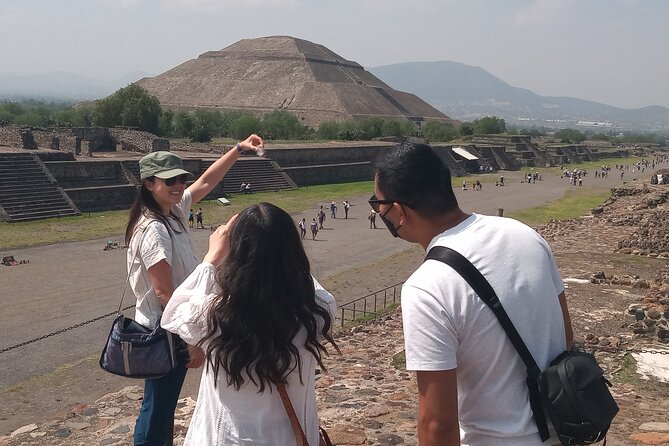
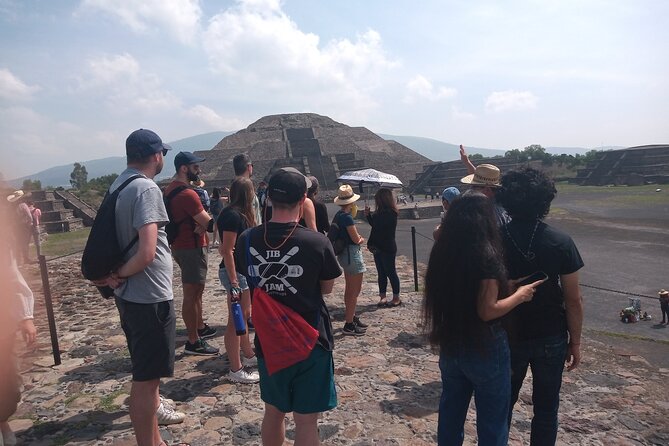
The first major stop is the Citadel, including the temple area associated with Quetzalcóatl. From the parking area, the tour first visits a viewpoint of the archaeological zone before continuing on foot toward this part of the complex.
The viewpoint helps you understand the size of Teotihuacán before you get pulled into the details. The monuments are not arranged as isolated photo stops. They are linked by broad avenues, plazas, patios, and residential spaces, and the first view gives you a better sense of that larger plan.
At the Citadel, your guide explains the site and the Temple of Quetzalcóatl. The tour also uses this early section to introduce the making of the pyramids, the role of architecture, and the way natural resources such as obsidian fit into the story of the place.
I like beginning here because the Citadel provides context before the route reaches the largest pyramids. You are not simply told to admire a giant staircase. You start to see how ceremonial spaces, open plazas, and buildings fit together.
The acoustics are another unusual feature. The guide may demonstrate how sound behaves in the temple area, including the quetzal-like sound produced by clapping. One particularly memorable detail from the experience is a bird sound made by clapping in front of the temple area connected with where the Moon rises during a full moon. The exact timing and demonstration can vary, but this is the kind of local detail that gives the visit character.
Walking the Avenue of the Dead
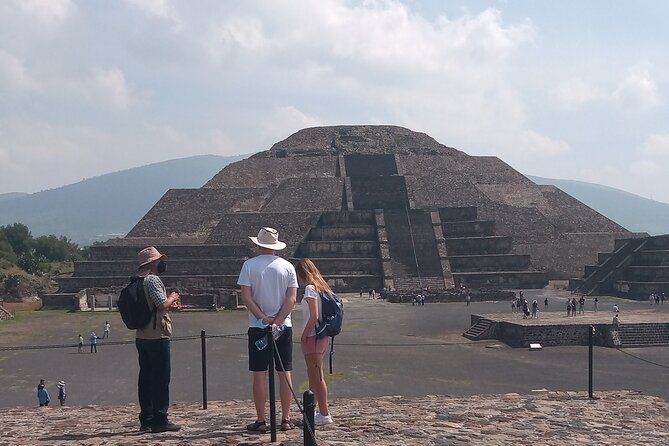
From the Citadel, you continue along what is commonly called the Avenue of the Dead. This is the central walking section of the tour, and it is also where the physical demand becomes clear.
The road is long, so you should not expect a short stroll between monuments. Along the way, the guide points out sunken patios, the West Plaza, and apartment areas where Teotihuacán residents lived. These smaller features are important because they shift your attention away from the pyramids alone.
The apartment areas help you picture daily life within the city. The tour does not treat Teotihuacán as a collection of empty ceremonial stones. You also see spaces connected with housing and community life, along with plazas and patios that made the built environment more varied than the grand avenue suggests from a distance.
Sunken patios and the West Plaza add another layer to the walk. They show how the city used enclosed and open spaces in different ways. I find these stops valuable for travelers who want more than a pyramid photograph, although anyone hoping to climb or spend a long time at every monument may find three hours too brief.
The avenue also gives Joel room to explain symmetry and the way the builders worked with natural resources. Those ideas can sound abstract in a museum label, but they become easier to grasp when you are walking through aligned plazas and looking across the broad ceremonial route.
The Sun Pyramid and the scale of Teotihuacán
The Sun Pyramid is one of the tour’s central landmarks. You pass through the ceremonial route toward it, with the Avenue of the Dead helping you appreciate its scale in relation to the rest of the complex.
The value of seeing it with a guide is not only the monument itself. Joel explains how the pyramids were made and places the Sun Pyramid within the wider design of Teotihuacán. That helps prevent the usual problem at major archaeological sites, where the largest structure gets all the attention and everything else becomes background scenery.
The tour information does not promise climbing the pyramid, so you should book this experience as a guided walking visit rather than a climb-focused outing. The emphasis is on seeing, understanding, and moving through the site.
Take your time with the views when the group pauses. The broad setting makes the scale easier to read, while the nearby avenue helps you see the relationship between the pyramid and the ceremonial center. If you want quiet, unhurried time for photographs, the group size and three-hour limit may require some compromise.
That is the tradeoff with a guided overview. You get a planned route and explanations from Joel, but you do not control every pause. For a first visit to Teotihuacán, I think the structure is useful. For a return visit focused on photography or close study, you might prefer more independent time.
Palaces, apartments, and the everyday side of the site
After the major pyramid area, the route continues past palaces and other architectural remains. These stops balance the grand scale of the Sun Pyramid with more detailed spaces.
The palaces matter because they make you look at walls, rooms, patios, and patterns rather than only at height. The tour’s attention to architecture and symmetry is especially useful here. You can compare the formal ceremonial spaces with the more enclosed areas that formed part of the city’s built fabric.
The apartment remains offer another useful contrast. Teotihuacán was not only a place for monuments and rituals. People lived here, organized homes, and used shared spaces. Even without adding unsupported claims about dates or daily customs, the physical remains let you see that the city had a practical side as well as an impressive ceremonial one.
This is where a guide’s local knowledge earns its keep. Joel is praised for being hospitable and for taking people to strong viewing spots. That suggests a guide who pays attention to how the site feels on foot, not just one who recites names. His warmth may be especially welcome in a large group, where a friendly guide can make a long walk feel less formal.
Other guided tours in Mexico City

The Moon Pyramid and the final stretch
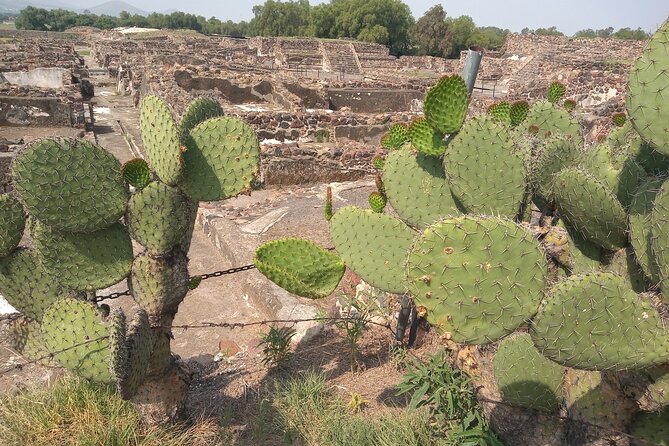
The route finishes at the Moon Pyramid, one of the best-known points in Teotihuacán. By the time you reach it, you have crossed much of the main route and seen the site from several angles.
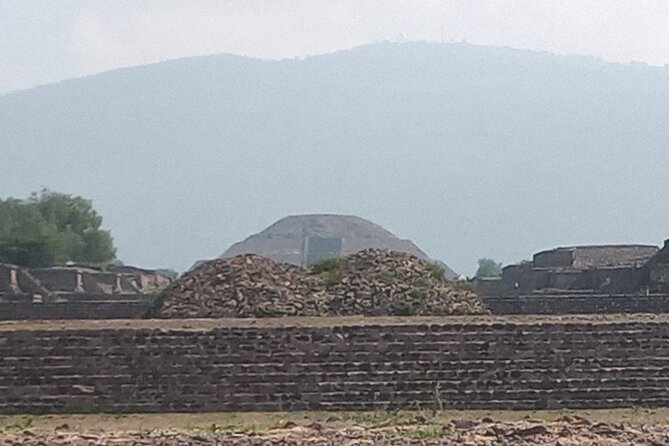
The Moon Pyramid is a fitting final stop because it lets you look back along the Avenue of the Dead and connect the individual places you have visited. The earlier explanations about symmetry, acoustics, and the site’s natural resources come together here as part of a larger picture.
The full-moon reference adds a distinctive detail. The temple area is connected with the direction where the Moon rises on a full-moon day, and the clapping sound demonstration is meant to echo a bird call. You should treat this as a guided interpretation and sound experience, not as a guarantee that you will attend during a full moon.
After the final stop, you end at Gate 3. This is convenient because the exit area has bathroom services, Uber service, a bus stop for Mexico City, and a restaurant nearby. The end point is not the same as the starting gate, so keep that in mind if someone is meeting you or if you are arranging onward transport.
Is $73 a fair price?
The price is $73 per person, with all fees and taxes included. Water is not included, and you should budget for that separately.
The value depends on how much help you want at the site. You are paying for an English-speaking guide, a planned three-hour route, admission-related costs, and explanations that connect major monuments with smaller features such as patios, apartments, acoustics, and obsidian.
For someone visiting Teotihuacán for the first time, that package can make sense. The archaeological zone is large, the road is long, and a guide helps you use limited time well. You also finish at a practical exit with transport and food options close by.
The value is less clear if you already know the site well or prefer to walk alone at your own pace. A group of up to 40 people may mean less personal attention, and the fixed schedule leaves less room to linger. I would compare the price with the cost and effort of arranging entrance, transport, and an independent visit, but the strongest reason to book is the guiding, not luxury or a small-group feel.
The experience is booked, on average, 41 days ahead. That does not guarantee that every date sells out, but it is a useful sign to plan early if the morning schedule fits your Mexico City plans.
Who will enjoy this walk most?
I would recommend this tour to a first-time visitor who wants the main sights explained in English and prefers a clear route through the archaeological zone. It also suits anyone who enjoys unusual site details, especially acoustics and the clapping sound near the temple area.
You should be comfortable walking for about three hours and managing a long route under outdoor conditions. The stated fitness requirement is moderate, so this is not the best choice if you need a short, low-effort visit.
Families and mixed-interest groups may appreciate the variety. The pyramids provide the big visual moments, while the patios, apartments, palaces, architecture, and sound demonstrations keep the visit from becoming one long walk between giant structures.
I would be more cautious about booking if you want a private experience, extensive photography time, or a slow archaeological study. The group maximum is 40, and the tour has a fixed morning window. You also cannot cancel for a refund or amend the booking, so confirm your date and plans before paying.
Should you book the Teotihuacán walking tour?
Book it if you want a straightforward English-language introduction to the main archaeological zone, with a friendly guide and a route that covers both the famous pyramids and less obvious remains. Joel’s personal style, the sound demonstrations, and the Gate 1 to Gate 3 route give the visit more shape than a simple walk around the site.
Skip it if you need a private guide, dislike long walks, or want complete control over your time. The $73 cost is reasonable when you value included admission and clear explanations, but it is not a bargain for an independent-minded visitor who already knows Teotihuacán.
For the right person, this is a practical way to see a large and complex site in one morning. Bring water, wear comfortable shoes, arrive ready for distance, and let the guide fill in the details between the big monuments.
FAQ
Where does the tour begin?
The tour begins at Zona Arqueológica de Teotihuacán Estacionamiento Puerta 1, in the Gate 1 parking area.
Where does the tour end?
The tour ends at Gate 3, at Estacionamiento Puerta 3, Acceso por Puerta 3.
How long does the experience last?
The walking tour lasts approximately three hours.
Is admission included?
Yes. All fees and taxes are included in the tour price.
Is bottled water included?
No. Bottled water is not included, but water can be purchased near the starting area.
What language is the tour offered in?
The tour is offered in English.
How large can the group be?
The maximum group size is 40 travelers.
What level of fitness is required?
A moderate level of physical fitness is recommended because the route is long and involves substantial walking.
Can I cancel or change the booking?
No. The experience is non-refundable and cannot be changed for any reason.
More Guided Tours in Mexico City
More Walking Tours in Mexico City

More tours in Mexico City we've reviewed


Walking Tours, compared.
 ★ 5.0Historic Downtown Walking TourFrom $263 hours (approx.)
 ★ 4.8Mexico City: Historic Downtown Walking TourFrom $263 hours
 ★ 5.0Frida Kahlo VIP [Museum Tickets Included] Walk, Markets & ChurrosFrom $833 to 4 hours (approx.)
 ★ 5.0Walking Tour of the Historic Center of Mexico City3 hours (approx.)
 ★ 5.0Anthropology Museum Private Experience Walking TourFrom $783 hours (approx.)
 ★ 5.0Walking Tour in Mexico City for Exploring their Cultural HeritageFrom $252 to 3 hours (approx.)
 ★ 5.0Walking Tour – Impressive murals in Historical Center of Mexico CityFrom $511 to 3 hours (approx.)
 ★ 5.0Muralist Art Semi Private Walking Tour in Mexico City DowntownFrom $583 hours 30 minutes (approx.)
The lists this tour appears in