
Reviewed · HISTORIC CENTER WALKS
Historic center walking tour through time and space
Mexico City’s center packs centuries into a few walkable blocks. This private tour begins at the ruins of Tenochtitlan and moves through the Cathedral, Zócalo, ornate palaces, Bellas Artes, and Alameda Central, giving you a useful timeline instead of a string of disconnected photo stops. I like the way Aztec, colonial, and modern Mexico are placed side by side. I also like that the tour uses a historian guide, with Ricardo and Joss named among the guides who have led it. The main drawback is pace: three hours and 11 stops leave little time for long visits inside museums or buildings.
In This Article
- Key points at a glance
- A three-hour walk through Mexico City’s changing identity
- Templo Mayor: beginning with Tenochtitlan
- Cathedral and Zócalo: the city’s main stage
- San Francisco and the House of Tiles
- National Art, Mining, and the Postal Palace
- Palacio de Bellas Artes and Alameda Central
- Finishing at Museo de Arte Popular
- What the $39.45 price delivers
- Who will enjoy this walk most
- Timing, booking, and cancellation
- Should you book this Mexico City walking tour?
- FAQ
- How long does the walking tour last?
- Where does the tour begin?
- Where does the tour end?
- Is the tour offered in English?
- Is this a private tour?
- Are museum admission fees included?
- Is anything provided during the tour?
- Are tips included?
- Can I cancel for a full refund?
I especially like the private format, since your group can focus on questions and move at a sensible rhythm. The $39.45 price is fair if you want a broad introduction to the center without paying separate admission fees along the route. Keep in mind that tips are not included, and the Popular Art Museum itself costs extra if you choose to go in.
Key points at a glance
- Start at Templo Mayor: See the remains of Tenochtitlan before following the city’s later Spanish and modern chapters.
- Private English-language tour: Only your group participates, with a historian guide explaining architecture, culture, and change over time.
- Eleven central stops: The route covers the Cathedral, Zócalo, House of Tiles, Postal Palace, Bellas Artes, Alameda Central, and more.
- Mostly exterior viewing: Several stops focus on façades, atriums, lobbies, or brief looks inside rather than full museum visits.
- Useful three-hour overview: The tour gives you a strong first orientation to the Centro Histórico without requiring a full day.
- Ends near Museo de Arte Popular: You can finish at the museum entrance and decide if you want to pay for admission and continue inside.
A three-hour walk through Mexico City’s changing identity
I see this tour as an introduction to Mexico City rather than a museum-heavy study day. Its strength is the sequence. You begin with the city that existed before Spanish rule, then watch the center change through religious construction, colonial wealth, civic ambition, art, and public space.
That order matters. Without a guide, the center can feel like a grand collection of buildings with no clear connection. Here, the explanations help link the ruins beneath your feet to the streets and monuments around them.
The walk is private and offered in English. That gives you a better chance to ask about details that catch your eye, such as building damage, decoration, or the layers of construction around the Zócalo. The guides Ricardo and Joss are specifically associated with detailed explanations of Mexican history, culture, architecture, and the city center.
You should still set your expectations correctly. This is a brisk route. The listed stop times range from five to 25 minutes, and many locations are viewed from outside. If you want to read every museum label or spend an hour inside Bellas Artes, you will need to return on your own.
A few more Mexico City tours and experiences worth a look



Templo Mayor: beginning with Tenochtitlan
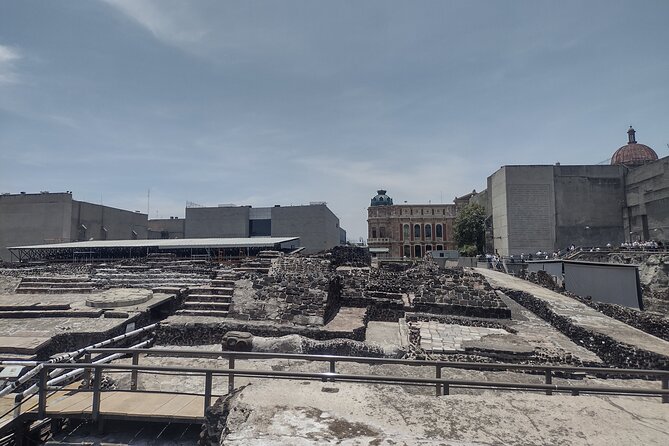
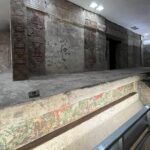
The tour opens at Museo del Templo Mayor, where the ruins offer a direct introduction to the 14th-century city of Tenochtitlan. The scheduled look lasts about 15 minutes, and admission for this stop is listed as free.
This is the right place to begin because it shifts your view of Mexico City. The center is not simply a colonial district built from scratch. It occupies the site of an earlier capital, and the exposed remains make that fact hard to ignore.
Your guide sets the first chapter of the story here, before the route moves toward the Spanish cathedral and the great central square. I value that opening because it gives the rest of the walk a clear point of reference.
The limitation is time. Fifteen minutes is enough for an explanation and an initial look, but not for a full museum visit. If Templo Mayor is a priority for you, plan a separate visit later rather than treating this stop as a complete tour of the archaeological museum.
Cathedral and Zócalo: the city’s main stage
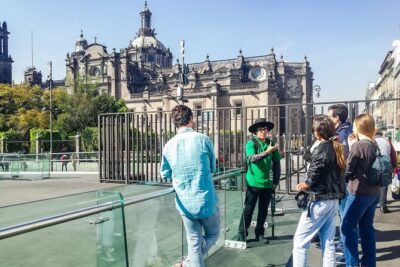
Next comes Catedral Metropolitana de la Ciudad de México, the largest ecclesiastical building in Mexico City. The stop lasts about 10 minutes and focuses on its architecture and the damage it has suffered over time.
That mention of damage is useful. Mexico City’s ground conditions have affected major structures, and the cathedral gives you a chance to notice that history in the building itself. You will not have time for a full architectural study, but a guide can point out why the cathedral matters and how time has marked it.
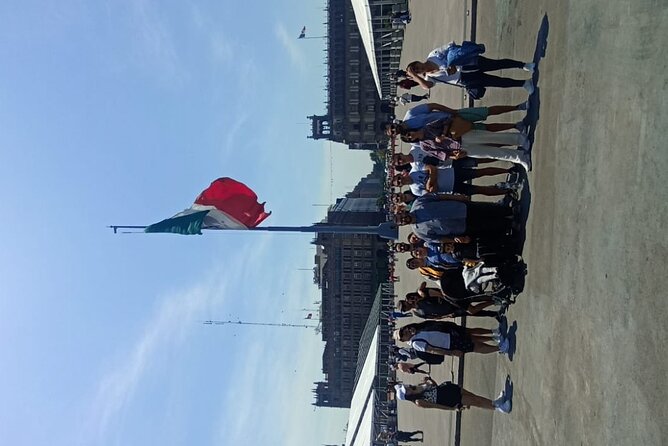
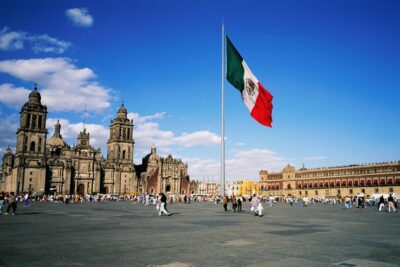
The route then reaches the Zócalo, Mexico City’s most important square. The scheduled stop is only five minutes, so think of this as a fast orientation rather than a long pause. The square is the civic heart of the center, and it helps you understand the scale of the institutions clustered around it.
I would not plan a leisurely coffee break here during the tour. The value comes from the guide’s explanation and from seeing how the cathedral, square, and surrounding historic buildings relate to one another.
San Francisco and the House of Tiles
At the atrium of the Templo de San Francisco, you spend about 15 minutes visiting what the tour describes as the first church in Mexico City. The stop adds another layer to the city’s religious past, but it also gives the walk some variety. You are no longer looking only at the biggest monuments.
The word atrium matters here. This is not presented as an extended interior church visit. You will see the entrance area and learn about its place in the city’s story.
The House of Tiles receives about 20 minutes. This 16th-century palace is famous for its Moorish decoration, making it one of the route’s most immediately striking façades. It is an ideal stop for anyone who enjoys architecture because the design gives the guide a clear subject to explain.
You will want your phone ready at this point. The tour includes a mobile ticket, and the route has several highly photogenic buildings, but the point is not only to collect pictures. The guide’s account of how the buildings fit into Mexico City’s development is what turns a pretty façade into a meaningful stop.
National Art, Mining, and the Postal Palace

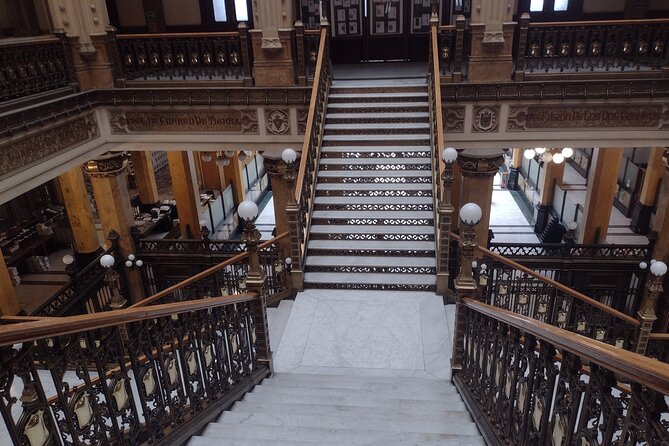
The Museo Nacional de Arte is visited for about 15 minutes. You will see one of the city’s most beautiful 20th-century buildings, look at its lobby, and hear about its past.
This is a good example of the tour’s approach. You get a taste of the building rather than a full museum session. The lobby gives you a chance to appreciate the design in person, while the guide supplies the background you would otherwise miss if you simply walked past.
The next stop is Palacio de Minería, viewed from the exterior for roughly 10 minutes. You learn about the Old Mining Palace and its place in the city’s history. Since the stop stays outside, it is best for you if you want context about the building and its role, not a complete look at its interior.
Palacio Postal follows, with about 15 minutes devoted to the Fifth House of the Post Office. The building is known for its ornate design and is one of the tour’s strongest photo stops. I like that the route does not treat the center as only a story of churches and government buildings. Postal architecture shows another side of urban life, tied to communication and public services.
The sequence also gives you a useful lesson in Mexico City’s changing ambitions. Religious power, mining, art, and civic infrastructure all appear within a short walk.
Other walking tours we've reviewed in Mexico City





Palacio de Bellas Artes and Alameda Central

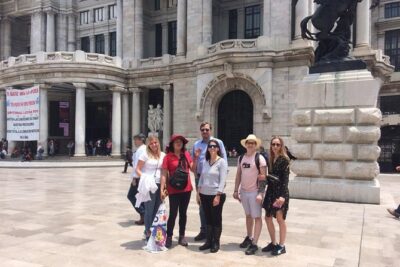
Palacio de Bellas Artes receives the longest stop, about 25 minutes. Your historian guide explains the palace’s history, you view it from outside, and you look into the lobby.
That extra time makes sense. Bellas Artes is one of the center’s defining landmarks, and its exterior alone gives you plenty to study. The lobby visit adds another layer without turning the tour into a full performance or museum program.
You should note that the experience does not include a full visit to the museum spaces inside Bellas Artes. If you want to see the galleries or spend more time with the building, return separately. The tour gives you a strong first look and the historical frame needed to appreciate it.
From there, the route passes through Alameda Central, the largest park in the city center. The walk lasts about 15 minutes and includes history and legends connected with the park.
This is a pleasant change of pace after so many formal buildings. Alameda Central lets you see the center as a public gathering place, not just a row of monuments. The guide’s stories give the park a sense of character, while the walking itself offers a short breather before the final stop.
Finishing at Museo de Arte Popular
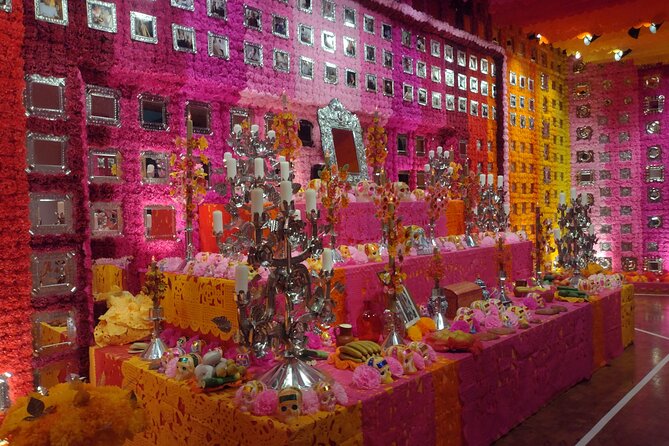
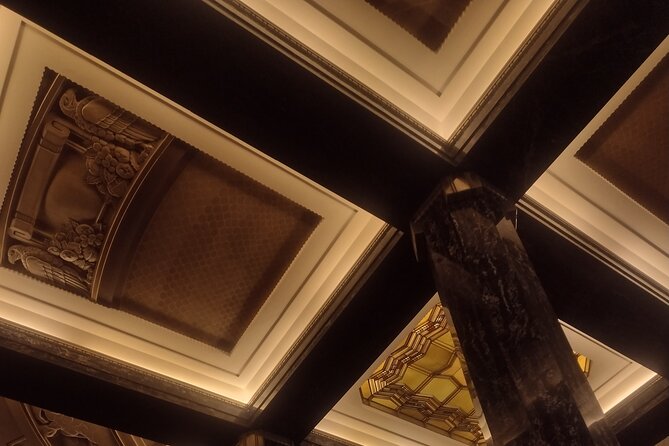
The tour ends at Museo de Arte Popular after about 15 minutes at the entrance. You will see the building’s art deco architecture and some important expressions of the city’s popular art.
This ending is practical. It leaves you near a museum that fits the cultural theme of the walk, and you can decide for yourself if you want to continue inside. Admission is not included, so treat the museum visit as an optional extension rather than part of the paid tour.
I like this arrangement because it gives you flexibility. If three hours of walking is enough, you can finish there. If you still have energy and want a closer look at Mexican popular art, you can pay for entry and continue independently.
The endpoint is on Revillagigedo, in the Centro district, while the meeting point is at Seminario 8 beside Museo del Templo Mayor. Both locations are near public transportation, which helps if you are building this walk into a larger day in the historic center.
What the $39.45 price delivers
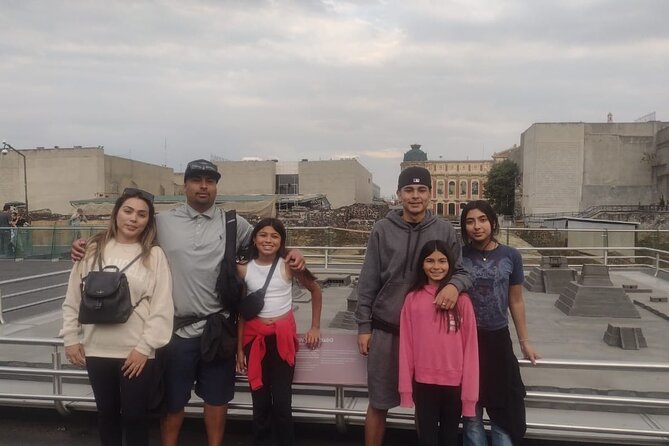
At $39.45 per person, the tour offers a fairly priced orientation to a large part of central Mexico City. You are paying for about three hours of guiding, an English-language historian, a private group experience, and a route that ties together 11 significant locations.
The value is strongest if you are visiting the center for the first time. A good guide can save you from treating each building as an isolated stop, and the private format means you are not sharing the walk with a large unknown group.
The price is less compelling if you already know the Centro Histórico well or mainly want interior access. Admission is listed as free at the main stops, but the schedule usually offers only a brief look at each place. Museo de Arte Popular costs extra, and tips are not included.
A water bottle or soda is included. It is a small touch, but useful during a three-hour walk. I would still wear comfortable shoes and plan around the pace, since the experience is built around moving from one site to the next.
Who will enjoy this walk most
I would recommend this tour to first-time visitors who want a clear introduction to Mexico City’s center. It also suits anyone who likes architecture and wants a guide to explain why the buildings look as they do, rather than simply pointing them out.
The private setup works well for couples, families, or small groups with different interests. You can ask Ricardo, Joss, or your assigned guide to spend more time on history, architecture, culture, or legends when the schedule allows.
This is less suitable for you if you need a slow, accessible museum day or want to photograph every stop without interruption. The route is designed to cover a lot. The five-minute Zócalo stop and the short exterior visits make that clear.
Most people can participate, and service animals are allowed. The tour is near public transportation, but no special transport is provided as part of the experience.
Timing, booking, and cancellation
The tour lasts approximately three hours and is offered daily from Monday through Sunday. The operating dates provided run from April 1, 2024, through January 23, 2027, with hours shown as 10:00 a.m. to 8:00 p.m.
It is commonly reserved about 10 days ahead, so I would book before your trip if you want a particular date. Confirmation arrives at booking, and the ticket is mobile, which keeps the meeting process simple.
You can cancel for a full refund if you do so at least 24 hours before the start time. Cancellations or changes made inside that 24-hour window are not accepted for a refund, and the cut-off follows local Mexico City time.
Should you book this Mexico City walking tour?
Book it if you want a smart first look at the historic center, especially if you value a private English-speaking guide and clear explanations of architecture and history. The route covers an impressive range, from Tenochtitlan ruins to Bellas Artes, without asking you to spend a full day on the subject.
Skip it if you want long interior visits, extensive museum time, or a very slow photo walk. In that case, use this as an orientation and return to Templo Mayor, Bellas Artes, or Museo de Arte Popular on your own.
For the right visitor, the best reason to book is the route’s structure. You see how one city has been reshaped across centuries, then finish with the option to explore popular art on your own. That is a useful way to get your bearings before tackling the rest of Mexico City.
FAQ
How long does the walking tour last?
The tour lasts approximately three hours.
Where does the tour begin?
It begins at Museo del Templo Mayor, Seminario 8, Centro Histórico, Mexico City.
Where does the tour end?
The tour ends at Museo de Arte Popular, Revillagigedo 11, Colonia Centro, Mexico City.
Is the tour offered in English?
Yes. The tour is offered in English.
Is this a private tour?
Yes. Only your group participates in the private activity.
Are museum admission fees included?
Admission is listed as free for the scheduled stops. Admission to Museo de Arte Popular is not included if you choose to visit the museum.
Is anything provided during the tour?
A soda or bottled water is included.
Are tips included?
No. Tips are not included in the tour price.
Can I cancel for a full refund?
Yes. You can receive a full refund if you cancel at least 24 hours before the experience start time. Changes or cancellations made less than 24 hours ahead are not accepted for a refund.
More Historical Tours in Mexico City
More Walking Tours in Mexico City
More Historic Center Walks in Mexico City

More tours in Mexico City we've reviewed







Historic Center Walks, compared.
 ★ 5.0Historic Downtown Walking TourFrom $263 hours (approx.)
 ★ 5.0Historic Center Food Tour in Mexico CityFrom $1155 hours (approx.)
 ★ 4.8Mexico City: Historic Downtown Walking TourFrom $263 hours
 ★ 5.0Walking Tour of the Historic Center of Mexico City3 hours (approx.)
 ★ 5.0Mexico City Historical Centre Food Tour with 7 Authentic TastingsFrom $653 hours (approx.)
 ★ 5.0Private Walking Tour Gems of the Historic Center of Mexico CityFrom $1564 hours (approx.)
 ★ 5.010 wonders of the Historic Center of Mexico City food and musicFrom $493 hours (approx.)
 ★ 5.0Walking Tour in Historic Center CDMXFrom $832 hours 30 minutes to 3 hours 10 minutes (approx.)
The lists this tour appears in